7-minute read | Last updated March 2026 | Reviewed for accuracy
By King James Adjei | GoldenDoodleReport.com
Researcher, Goldendoodle enthusiast, and founder of GoldenDoodleReport. Every guide on this site is written to give owners reliable, clearly organised information — researched carefully and updated regularly.
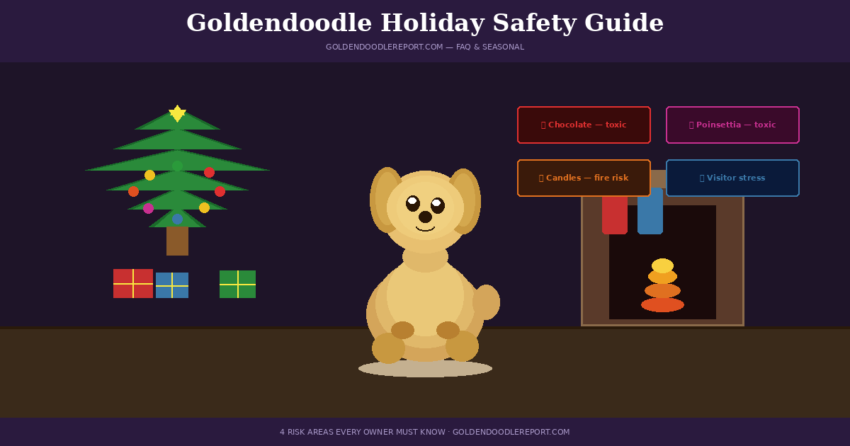
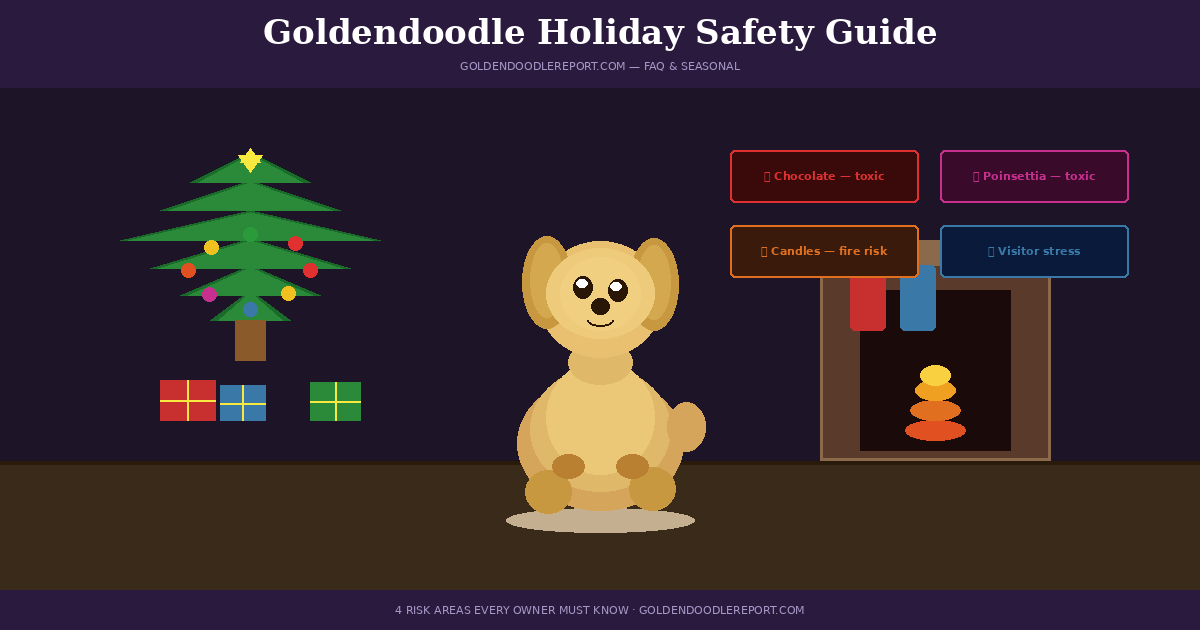
Goldendoodle holiday safety covers more ground than most owners realise — the festive season introduces four completely different risk categories simultaneously, each requiring its own specific management approach. Get these right and the holidays become one of the most enjoyable times of year for your dog. Miss them and the season that is supposed to be joyful becomes a stressful or even dangerous one.
Who This Guide Is For
This article is most useful if you:
- Are heading into the festive season and want to know the specific hazards to prepare for
- Have a Goldendoodle that becomes anxious, destructive, or unsettled when visitors arrive
- Are planning to travel with your dog over the holidays and want a safety checklist
- Want to know which holiday foods and decorations are genuinely dangerous versus mildly risky
For year-round health hazard guidance, see the Goldendoodle Health Guide.
Quick Summary
The holiday season introduces four specific risk categories for Goldendoodles that do not exist at other times of year: food hazards from festive meals and treats, toxic plants and decoration hazards from seasonal decor, visitor and routine disruption stress, and travel safety. Each category requires different management. A Goldendoodle with a prepared owner navigates the holidays safely and comfortably — the risks are real but every single one is preventable.
Quick Answer
The main Goldendoodle holiday safety risks are chocolate and xylitol ingestion (both emergencies), toxic seasonal plants including holly, mistletoe, and poinsettia, tinsel and ornament ingestion, visitor-induced stress from disrupted routine, and travel anxiety. Most holiday incidents involving dogs are preventable with awareness and a few specific household management steps applied before the season begins.
The holidays are when veterinary emergency clinics see their busiest period of the year for dogs. Not because owners do not care — they do — but because the season changes the home environment in a dozen ways simultaneously, and the specific hazards it introduces are not the ones owners are thinking about when they are focused on guests, cooking, and travel. This guide covers every category so you are thinking about them before they matter.
This guide covers:
- Food hazards — which are emergencies and which are just risks
- Toxic plants and decoration hazards specific to the festive season
- Managing the Christmas tree — the most consistent holiday challenge
- Visitor and routine disruption stress — why Goldendoodles are specifically vulnerable
- Travel safety — preparation, in-transit, and at-destination protocols
- The holiday hazard complete reference guide
Goldendoodle Holiday Safety — Food Hazards
Holiday meals and treats introduce more genuinely toxic foods into the home than any other season. The festive period involves chocolate everywhere, fruit cakes containing raisins, sugar-free products with xylitol, and alcohol in accessible locations — all of which are dangerous to dogs, some acutely so.
Emergency-level foods — call the vet immediately if ingested
Chocolate. Theobromine and caffeine in chocolate are toxic to dogs. The severity depends on the type of chocolate and the amount relative to body weight — dark chocolate and baking chocolate are significantly more toxic than milk chocolate, but no chocolate is safe. A Goldendoodle that has ingested any amount of dark chocolate requires immediate veterinary contact. Symptoms include vomiting, diarrhoea, restlessness, excessive urination, muscle tremors, and in severe cases, seizures.
Xylitol. This artificial sweetener appears in sugar-free sweets, chewing gum, some peanut butters, and an increasing number of baked goods. It causes rapid insulin release in dogs, leading to hypoglycaemia (dangerously low blood sugar) and potentially liver failure. Xylitol toxicity is fast-acting and fatal without treatment — it is a veterinary emergency regardless of the amount ingested. Check ingredient labels on any sugar-free product before bringing it into a home with a dog.
Grapes and raisins. Found in fruit cake, mince pies, Christmas pudding, and various holiday baked goods. The toxic mechanism is not fully understood, but even small amounts can cause acute kidney failure in some dogs. There is no established safe dose — any ingestion warrants immediate veterinary contact.
Alcohol. Appears in mulled wine, punch bowls, alcohol-containing desserts (Christmas pudding, rum balls, trifle), and cocktails left on accessible surfaces. Alcohol causes rapid central nervous system depression in dogs — even small amounts relative to body weight can cause vomiting, disorientation, breathing difficulty, and coma.
High-risk foods requiring monitoring
Cooked bones. Turkey and chicken bones cooked at high temperature become brittle and splinter when chewed, creating sharp fragments that can lacerate the mouth, throat, oesophagus, and intestinal tract. Raw bones are different — cooked bones specifically are the hazard. Never give cooked poultry bones and ensure they are disposed of in a sealed bin the dog cannot access.
Onions and garlic. Found in stuffing, gravies, and many savoury holiday dishes. Compounds in alliums damage red blood cells over time, causing anaemia. The effect is cumulative — a dog that repeatedly gets small amounts of gravy containing onion powder can develop significant anaemia over the holiday period.
Macadamia nuts. Cause weakness, vomiting, tremors, and hyperthermia within 12 hours of ingestion. Not life-threatening in most cases but require veterinary assessment.
Nutmeg. Found in eggnog and some spiced holiday baked goods in larger amounts than many owners realise. Can cause tremors, seizures, and central nervous system issues in significant quantities.
Fatty foods — turkey skin, rich gravy, buttery sides. Not acutely toxic but can trigger pancreatitis — a painful and potentially serious inflammation of the pancreas — particularly in dogs that do not normally eat high-fat food. Pancreatitis symptoms appear 24–48 hours after ingestion: vomiting, abdominal pain, hunched posture, and lethargy.
The most effective prevention: Inform every person in the house and every visitor before they arrive — no feeding the dog from the table or from plates, no giving treats from the food that is being prepared. One uninformed guest who thinks a small piece of Christmas cake is a nice treat can create a veterinary emergency. The conversation takes 30 seconds and prevents the most common holiday food incidents.
Toxic Plants and Decoration Hazards
The festive season introduces several plants into the home that are not present year-round — and several of them are toxic to dogs.
Holly. Holly berries and leaves contain saponins and other compounds that cause vomiting, diarrhoea, lethargy, and loss of balance. Veterinary assessment is recommended after any ingestion.
Mistletoe. More toxic than commonly believed. American mistletoe causes gastrointestinal distress; European mistletoe can cause cardiovascular effects alongside digestive symptoms. Keep mistletoe completely out of reach and ideally use artificial versions in homes with dogs.
Poinsettia. Less toxic than its reputation suggests — the milky sap causes mild oral irritation and vomiting but is rarely severe. However any ingestion that causes symptoms warrants a veterinary call.
Amaryllis. Commonly given as a Christmas gift. Contains lycorine and other alkaloids that cause vomiting, diarrhoea, abdominal pain, excessive salivation, and tremors. The bulb is the most toxic part.
Christmas tree water. Standing water in the tree base can contain fertilisers, preservatives, or bacteria from the decomposing wood. Dogs that drink from the tree base can develop gastrointestinal illness. Cover or block access to the tree water reservoir.
Decoration hazards
Tinsel. Visually appealing and physically dangerous. Dogs that ingest tinsel can develop linear foreign body obstruction — a serious surgical emergency where the tinsel anchors in the intestinal tract and causes the intestine to bunch and lacerate. If you have a dog that investigates the tree closely, tinsel is the decoration most worth avoiding entirely.
Glass ornaments. Broken glass ornaments create sharp fragments on the floor that can lacerate paws. Place glass ornaments on higher branches out of tail-wagging range and check the floor under the tree daily.
Electrical cords and lights. A Goldendoodle puppy or a bored adult dog that chews electrical cords risks electrocution. Secure cords behind furniture or use cord covers where they run along the floor.
Managing the Christmas tree. The Christmas tree is the holiday decoration that generates the most consistent owner complaints — the dog that investigates it repeatedly, knocks ornaments off, drinks the water, or in some cases attempts to eat the branches. Management options in ascending order of restriction: place lower ornaments as unbreakable ones only; use a deterrent spray on lower branches; baby-gate the tree; or set up the tree in a room the dog does not have unsupervised access to. The last option is the only one that fully eliminates risk for a highly motivated dog.
Visitor and Routine Disruption Stress
Goldendoodles are specifically vulnerable to holiday stress for two breed-specific reasons. They are strongly handler-bonded — which means changes in the owner’s behaviour, availability, and emotional state during a busy holiday period register directly. And they are routine-dependent — the disruption to walk times, meal times, and quiet periods that holiday gatherings create removes the predictable structure that keeps a Goldendoodle settled.
The result is a dog that looks like it has suddenly developed behaviour problems: excessive barking at visitors, destructive behaviour, house-soiling, or conversely, hiding and refusing to engage. Neither is a behaviour problem. Both are a stress response to an environment that has changed significantly and unpredictably.
Before visitors arrive
Exercise the dog thoroughly before guests arrive. A Goldendoodle that has had a good walk and a mental stimulation session before a gathering starts is significantly calmer than one that has been in the house all day anticipating the disruption.
Set up a dedicated retreat space — a quiet room or a crate in a low-traffic area — with the dog’s bed, a bowl of water, and a familiar high-value chew. This gives the dog somewhere to go voluntarily when the stimulation level gets too high. A dog that can self-regulate by retreating is a dog that stays below the stress threshold.
Brief every visitor on two things before they arrive: no feeding the dog from plates or tables, and do not force interaction if the dog comes to investigate on its own terms but then moves away. Unwanted attention from enthusiastic visitors is a significant stress driver in socially anxious dogs.
During gatherings
Maintain the feeding and walk schedule as closely as possible. Even 30 minutes of deviation from the normal walk time is noticeable to a routine-dependent dog. If the schedule must shift, shift it gradually rather than suddenly.
Watch for early stress signals rather than waiting for the behaviour to escalate. A dog that is yawning repeatedly, licking its lips, panting in a cool room, or showing whale eye (whites of eyes visible) around visitors is communicating discomfort. Moving the dog to its retreat space at this point prevents the escalation to vocalising or destructive behaviour.
For dogs with known visitor anxiety, the festive season is worth discussing with a veterinarian in advance. Short-term anxiety management options — whether through behaviour strategies, supplements, or where clinically appropriate, medication — are most effective when planned before the stressful event rather than administered reactively during it.
Holiday Hazard Complete Reference
Use this reference guide to cover all four holiday risk categories at a glance.
Goldendoodle Holiday Safety — Complete Hazard Reference
| 🍽 Food Hazards | 🌿 Plants & Decor | 👥 Visitor Stress | 🚗 Travel Safety |
|---|---|---|---|
| Toxic — avoid entirely: Chocolate (all types) Xylitol / sugar-free items Grapes and raisins Onions and garlic Macadamia nuts Alcohol (all forms) Cooked bones NutmegLimit / caution: Turkey skin (fatty) Stuffing ingredients Rich gravies and sauces Dairy in large amounts |
Toxic plants: Poinsettia (mild-moderate) Holly (berries toxic) Mistletoe (toxic) Christmas rose Amaryllis (toxic) Christmas tree waterDecoration risks: Tinsel (intestinal blockage) Baubles (sharp when broken) Candles (burn & fire risk) Fairy lights (chewing risk) Wrapping ribbon (ingestion) |
Before visitors arrive: Set up a retreat space Secure all food and bins Brief visitors on rulesDuring gatherings: Maintain walk schedule Watch for stress signals Allow voluntary retreat No forced interactionsStress signals to watch: Repeated yawning Lip licking Whale eye (whites showing) Panting in cool room |
Travelling with dog: Update ID tag + microchip Safety restraint in car Water stops every 2 hours Puppy-proof destination Maintain routineDog staying home: Familiar pet sitter Written routine for sitter Familiar bedding in place Emergency vet contact left Do not rearrange home |
Travel Safety — With and Without Your Goldendoodle
Holiday travel with a Goldendoodle is manageable with preparation. Without it, it is one of the more stressful experiences both dog and owner can have.
If you are travelling with your dog
Update identification before you leave. Check that the ID tag is current and legible and that the microchip registration has your current contact details. A Goldendoodle that slips out of an unfamiliar house or garden over the holidays needs to be identifiable and traceable. This takes five minutes and is the most important single preparation step.
Safety restraint in the vehicle. A dog travelling loose in a moving vehicle is a safety hazard — for the dog and for the occupants. In a collision, an unrestrained dog becomes a projectile. Use a crash-tested harness attached to the seatbelt, a properly secured crate, or a boot barrier. This is not optional.
Water and exercise stops every 2 hours. Long car journeys require regular stops for water and the opportunity to urinate and stretch. A Goldendoodle confined in a car for more than 2 hours without a break will become distressed and may develop car anxiety that persists beyond the trip.
Dog-proof the destination before letting the dog explore. An unfamiliar house may have toxic plants, unsecured food, accessible bins, or other hazards that do not exist in your home. Do a brief walk-through before letting the dog loose in the new environment.
Maintain the routine as closely as possible. Feed at the same times. Walk at similar times. Keep the same commands and the same expectations. The routine is the dog’s anchor in an unfamiliar place — the more it is maintained, the faster the dog settles.
For additional guidance on travelling safely with dogs, the American Kennel Club’s dog travel safety guide covers car travel, accommodation, and destination preparation in detail.
If your dog is staying home
A familiar pet sitter who maintains the dog’s established routine is significantly less stressful for a Goldendoodle than travelling to an unfamiliar environment. If you are leaving your dog at home, provide the sitter with the full routine in writing — walk times, feeding times, feeding amounts, commands the dog knows, and the location of the nearest emergency vet. Leave familiar bedding and toys in place. Do not rearrange the home before leaving.
⚠️ Watch Out
The post-holiday period — when guests have left, travel is over, and the house returns to normal — can trigger a secondary stress response in Goldendoodles that went through significant routine disruption. A dog that was manageable through the holidays sometimes shows the stress after the fact: increased clinginess, appetite changes, or unsettled sleep. This is normal and resolves as routine re-establishes — but if symptoms persist beyond a week of normal routine, a veterinary check is appropriate.
When to Call the Vet Immediately
- Any suspected ingestion of chocolate, xylitol, grapes, raisins, or alcohol — do not wait for symptoms
- The dog has ingested tinsel, ribbon, or any string-like material — linear foreign body obstruction is a surgical emergency
- Vomiting or diarrhoea that begins 24–48 hours after a holiday meal — possible pancreatitis
- The dog appears disoriented, is having muscle tremors, or has collapsed after potential toxic ingestion
- Signs of severe stress that do not resolve with rest and familiar environment — panting, inability to settle, excessive vocalisation over several hours
Key Takeaways
- Goldendoodle holiday safety covers four distinct risk categories — food hazards, toxic plants and decorations, visitor stress, and travel — each requiring different management
- Chocolate, xylitol, grapes, raisins, and alcohol are veterinary emergencies — call immediately if any are ingested, do not wait for symptoms
- Tinsel is the single most dangerous decoration in a home with a dog — if your dog investigates the tree, remove tinsel entirely
- Goldendoodles are specifically vulnerable to holiday stress because of their handler-bonding and routine-dependence — a retreat space and maintained routine prevent most stress-related behaviour problems
- Inform every visitor before arrival — no feeding from plates or tables. One uninformed guest causes more holiday incidents than any decoration hazard
- The holiday season does not need to be stressful for a Goldendoodle — every risk listed in this guide is preventable with awareness and a few specific preparations made in advance
Related Goldendoodle Guides
- Goldendoodle Health Guide — Complete guide to Goldendoodle health conditions, prevention, and when to see a vet
- Goldendoodle Winter Care Guide — Cold weather care including road salt, ice, and coat management
- Why Is My Goldendoodle Whining? — Understanding holiday stress vocalisation
- Why Does My Goldendoodle Follow Me Everywhere? — Handler-bonding behaviour that intensifies during holiday disruption
- Why Is My Goldendoodle So Hyper? — Managing elevated energy and arousal during the busy holiday period
Part of our Goldendoodle FAQ & Seasonal resource hub:
→ Goldendoodle FAQ & Seasonal — Browse all FAQ and seasonal guides
Frequently Asked Questions
What foods are dangerous for Goldendoodles at Christmas?
The most dangerous foods are chocolate, xylitol (in sugar-free products), grapes and raisins (in fruit cake and mince pies), alcohol (including alcohol-containing desserts), cooked bones, onions and garlic (in stuffing and gravy), and macadamia nuts. Chocolate, xylitol, grapes, raisins, and alcohol are veterinary emergencies requiring immediate contact — do not wait for symptoms to appear.
Are Christmas trees dangerous for Goldendoodles?
Several aspects of Christmas trees pose risks: the water reservoir (which can contain bacteria and additives), tinsel (which causes intestinal obstruction if ingested), glass ornaments (which break into sharp fragments), and electrical cords from lights. Covering the water, placing fragile ornaments high, removing tinsel entirely, and securing electrical cords addresses all of these. For a dog that cannot be deterred from investigating the tree, gating it off is the most reliable solution.
Why does my Goldendoodle get anxious at Christmas?
Goldendoodles are strongly handler-bonded and routine-dependent. The holidays disrupt both — the owner’s behaviour and schedule changes, visitors alter the home environment and energy level, and the established routine of walks and meals shifts. The result is a dog reading its environment as unpredictable, which produces anxiety. A maintained routine, pre-visitor exercise, and a designated retreat space prevent the majority of holiday anxiety in this breed.
Is it better to travel with my Goldendoodle or leave them at home for the holidays?
For most Goldendoodles, a trusted pet sitter who maintains the home routine is less stressful than travelling to an unfamiliar environment. If travel is necessary, preparation — updated ID, safety restraint, water stops, dog-proofing the destination — makes it manageable. The key factor is routine maintenance: a dog whose routine is preserved closely, whether at home or travelling, adjusts significantly better than one whose routine is disrupted.
What should I do if my Goldendoodle eats something toxic at Christmas?
Call your veterinarian or an emergency animal poison control line immediately — do not wait for symptoms. For chocolate, xylitol, grapes, raisins, and alcohol, the treatment window is short and outcomes are significantly better with early intervention. Have the product packaging ready so you can tell the vet exactly what was ingested and in what approximate quantity. Do not attempt to induce vomiting without veterinary guidance.
The information in this article is provided for general educational purposes only. King James Adjei is a researcher and enthusiast, not a veterinarian. For toxic ingestion, suspected poisoning, or any holiday health emergency, always contact a qualified veterinarian immediately. In the UK, the Animal Poison Line is available at 01202 509000. In the US. the ASPCA Animal Poison Control Center is available at 888-426-4435.