7-minute read | Last updated March 2026 | Reviewed for accuracy
By King James Adjei | GoldendoodleReport.com
Researcher, Goldendoodle enthusiast, and founder of GoldendoodleReport. Every guide on this site is written to give owners reliable, clearly organised information — researched carefully and updated regularly.
Goldendoodle exercise needs by age change significantly across the lifespan — from the carefully restricted amounts required during puppyhood to protect developing joints, through the substantial adult exercise requirements, to the adjusted routines that keep senior Goldendoodles healthy without causing pain. This guide covers every life stage with specific numbers, the reasoning behind them, and the signs that tell you when you are getting it wrong in either direction.
Who This Guide Is For
This article is most useful if you:
- Have a Goldendoodle puppy and want to know exactly how much exercise is safe at each age
- Are concerned your puppy is getting too much or too little exercise
- Have an adult Goldendoodle and want to know whether their current routine is adequate
- Have a senior Goldendoodle and want to understand how exercise needs change with age
👉 Start here: Goldendoodle FAQ & Seasonal — Complete Owner Guide
Quick Summary
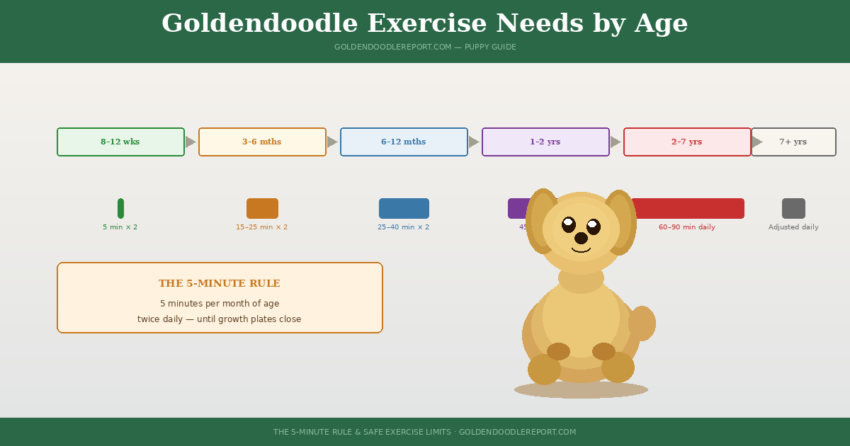
Goldendoodle exercise needs by age follow a clear progression: restricted to 5 minutes per month of age twice daily during puppyhood to protect growth plates, increasing to 45–90 minutes daily through adulthood based on size and energy level, then tapering as joint health and energy capacity change in the senior years. The most critical period is 8 weeks to 18 months — this is when over-exercise causes the joint damage that produces hip dysplasia, elbow problems, and early-onset arthritis. Under-exercise in this same period produces a hyper, destructive dog with no outlet for its energy. The correct amount changes every few weeks in the first year.
Quick Answer
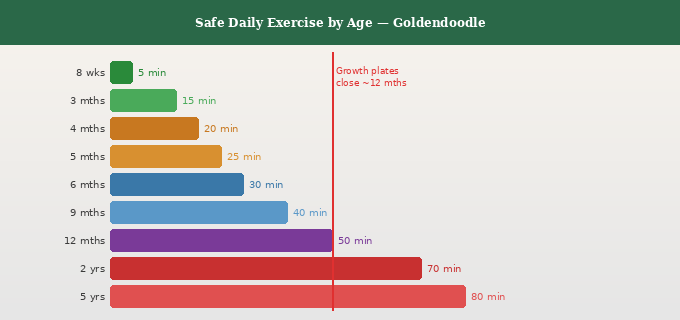
How much exercise does a Goldendoodle need by age? At 8 weeks: 5 minutes twice daily. At 3 months: 15 minutes twice daily. At 6 months: 30 minutes twice daily. Adult Standard Goldendoodle: 60–90 minutes daily. Adult Mini Goldendoodle: 45–60 minutes daily. Senior (7+): 20–40 minutes daily at lower intensity, adjusted to the individual dog’s mobility and energy. These are structured exercise figures — free play at the puppy’s own pace does not count toward the limit.
The most common exercise mistake with Goldendoodle puppies runs in both directions simultaneously — the owner restricts formal walks correctly but allows two hours of garden zoomies, fetch, and rough play with children, then wonders why the puppy is limping at 18 months. Understanding what counts as exercise and what does not is as important as knowing the right numbers.
This guide covers:
- The 5-minute rule explained — what it is and why it exists
- Exercise needs by age from 8 weeks to senior years
- What counts as exercise and what does not
- Signs of too much exercise versus too little
- Exercise differences between Mini, Medium, and Standard Goldendoodles
- Mental exercise and why it matters as much as physical activity
In This Guide
- Goldendoodle Exercise Needs by Age: The 5-Minute Rule Explained
- Exercise by Life Stage — Puppy Through Senior
- What Counts as Exercise and What Does Not
- Signs of Too Much or Too Little Exercise
- Exercise Differences by Size
- Mental Exercise — Why It Matters as Much as Physical
- Frequently Asked Questions
Goldendoodle Exercise Needs by Age: The 5-Minute Rule Explained
The 5-minute rule is the most widely recommended guideline for puppy exercise and is particularly important for larger breeds like Standard and Medium Goldendoodles. The rule states: no more than 5 minutes of structured exercise per month of age, twice per day, until growth plates close.
A 2-month-old puppy (8 weeks): 10 minutes maximum per day in two 5-minute sessions. A 4-month-old puppy: 20 minutes per day in two 10-minute sessions. A 6-month-old puppy: 30 minutes per day in two 15-minute sessions. The limit increases by 5 minutes per session for each month of age.
The biological reason for this limit is the growth plate — the soft cartilage disc at the end of each developing long bone. While growth plates are open and cartilaginous rather than fully ossified bone, they are vulnerable to mechanical stress. Repeated high-impact exercise on open growth plates causes microdamage that accumulates over months. This damage manifests later as hip dysplasia, osteochondrosis, elbow dysplasia, or early osteoarthritis — conditions that are painful, expensive to manage, and lifelong.
Growth plates in Goldendoodles close at different times depending on size. For guidance on general puppy development and activity, the AKC’s guide to puppy exercise outlines the key principles that apply across all breeds. Mini Goldendoodles typically close their growth plates between 10 and 12 months. Medium Goldendoodles between 12 and 15 months. Standard Goldendoodles between 15 and 18 months. The larger the dog, the longer the growth plates remain vulnerable.
Exercise by Life Stage — Puppy Through Senior
Goldendoodle Exercise Needs by Age — Reference Guide
| Age | Daily Exercise Limit | Type of Exercise | Notes |
|---|---|---|---|
| 8–12 weeks | 5 min × 2 per day | Gentle garden exploration, short lead introduction on soft ground | No stairs, no jumping, no fetch. Free play at puppy’s own pace only. |
| 3 months | 15 min × 2 per day | Short lead walks on soft surfaces, socialisation walks (carried where needed) | Avoid sustained hard-surface walking. Grass and earth preferred. |
| 4 months | 20 min × 2 per day | Lead walks, puppy training class, gentle play sessions | Still no sustained ball chasing or jumping. Monitor for limping after exercise. |
| 5 months | 25 min × 2 per day | Varied lead walks, controlled play, nose work and training sessions | Adolescence may begin — maintain structured exercise schedule. |
| 6 months | 30 min × 2 per day | Regular lead walks, beginning loose lead training, off-lead in enclosed secure areas | Mini Goldendoodles may be approaching plate closure. Monitor for stiffness. |
| 9–12 months | 40–50 min × 2 per day | Longer lead walks, controlled off-lead, swimming (excellent low-impact option) | Get vet clearance before significantly increasing exercise at this stage. |
| Adult (2–7 yrs) | 60–90 min daily (Standard) 45–60 min daily (Mini) |
Lead walks, off-lead running, swimming, fetch, agility, hiking | Full exercise range now available. Vary terrain and activity type. |
| Senior (7+ yrs) | 20–40 min daily adjusted | Gentle lead walks, swimming, short off-lead sniff sessions | Reduce intensity not frequency. Little and often is better than one long session. |
What Counts as Exercise and What Does Not
This distinction matters particularly for puppy owners who follow the 5-minute rule for formal walks but then allow unlimited other physical activity. The rule covers all sustained, structured physical activity — not just walks.
What counts toward the exercise limit:
- Lead walks at any pace
- Fetch and ball games — particularly high-impact because of the repeated sudden stops, direction changes, and landing forces
- Sustained running, chasing, or tug sessions
- Rough play with other dogs that involves repeated jumping, wrestling, or running
- Stair climbing — this counts and should be restricted regardless of other exercise
- Agility work, jumping, or any activity involving repeated impact
What does not count toward the limit:
- Free sniffing and slow exploration in the garden at the puppy’s own pace
- Short bursts of spontaneous play that the puppy initiates and stops within a minute or two
- Training sessions — these are mental exercise primarily, with minimal physical stress
- Slow-paced socialisation walks where the puppy is frequently stopping to investigate
The practical implication is that a puppy allowed to do 40 minutes of fetch in the garden after a 5-minute walk has not been exercised within safe limits — it has been exercised far beyond them. The free-play exemption applies to genuine self-regulated play that involves natural stopping and resting, not to owner-directed sustained activity.
Signs of Too Much or Too Little Exercise
Both extremes are identifiable before they cause lasting damage. Checking for these signs after exercise sessions is part of responsible Goldendoodle care at every life stage.
👉 Related: Why Is My Goldendoodle So Hyper? — Understanding Energy and Exercise Imbalance
Signs of too much exercise in a puppy: Limping or favouring a leg during or after exercise. Reluctance to put weight on a leg when getting up after rest. Swelling around a joint. Lagging behind on walks when the puppy was previously happy to walk. Yelping when touched around the shoulders, hips, or elbows. Any of these warrant a veterinary examination before the next exercise session — not watchful waiting.
Signs of too little exercise: Destructive behaviour in the home — chewing furniture, digging, shredding items. Excessive barking or whining without apparent cause. Inability to settle in the evening. Zoomies that persist long after play sessions. Jumping on family members persistently. These behaviours are the dog’s energy finding an outlet — increasing structured exercise and mental stimulation typically reduces them significantly within a week.
👉 Related: Why Is My Goldendoodle Always Hungry? — Behaviour vs Energy Needs
Signs of too much exercise in an adult: Stiffness after rest, particularly after longer exercise sessions. Reluctance to go on walks the dog previously enjoyed. Changes in gait — favouring one side or shortening stride. Excessive licking of joints. These are early joint health signals that warrant veterinary assessment.
Signs of too much exercise in a senior: Pronounced stiffness after any exercise. Difficulty rising from lying down. Reduced interest in walks or reluctance to go beyond a short distance. Pain responses when touched around the hips or elbows. Senior Goldendoodles should have their exercise routine reviewed annually with a vet and adjusted for any changes in joint health.
Exercise Differences by Size
Goldendoodle exercise needs by age vary not just by the dog’s age but by its size. The three main size categories have meaningfully different requirements.
Mini Goldendoodle (under 15kg adult): Growth plates close earlier — typically 10 to 12 months — allowing a faster transition to full adult exercise. Adult exercise needs of 45–60 minutes daily are adequate for most Minis. They are typically more energetic relative to their size than Standard Goldendoodles and tire faster on shorter walks, making two sessions of 20–30 minutes more practical than one long walk.
Medium Goldendoodle (15–25kg adult): Growth plates close at 12 to 15 months. Adult requirements of 50–75 minutes daily. Handle a wider variety of terrain and exercise types than Minis. Good candidates for hiking, agility, and swimming once mature.
Standard Goldendoodle (25kg+ adult): Growth plates close latest — 15 to 18 months — making the exercise restriction period the longest. Full adult exercise of 60–90 minutes daily is needed to keep a Standard Goldendoodle mentally and physically content. Insufficient exercise in Standard Goldendoodles produces pronounced destructive and anxious behaviour. Swimming is particularly valuable for Standard Goldendoodles as it provides cardiovascular exercise with minimal joint impact at all ages.
Mental Exercise — Why It Matters as Much as Physical
One of the most important aspects of Goldendoodle exercise needs by age that most guides underemphasise is the role of mental exercise. Goldendoodles inherit cognitive drive from both parent breeds — both Golden Retrievers and Poodles were developed for tasks requiring focus, problem-solving, and sustained mental engagement. A Goldendoodle that is physically tired but mentally understimulated is still a difficult dog.
Recommended Mental Enrichment Tools for Goldendoodles
Mental stimulation helps reduce excess energy and supports balanced behaviour without stressing developing joints.
👉 Recommended: Best Food Puzzle Toys for Goldendoodles
👉 Recommended: Best Slow Feeder Bowls for Goldendoodles
👉 Related: Why Does My Goldendoodle Lick Me So Much? — Behaviour Linked to Understimulation
Mental exercise matters for three practical reasons. First, a 15-minute training session produces genuine tiredness in a Goldendoodle that rivals the effect of a 45-minute walk — and does so without any joint impact, making it the ideal complement to restricted physical exercise during puppyhood. Second, mental stimulation reduces the threshold at which physical exercise alone feels insufficient — a dog that has done a training session and some nose work in the morning needs less physical exercise to feel satisfied than one whose day has been purely physical. Third, mental exercise builds the dog’s capacity to settle, focus, and manage its own arousal — skills that make every other aspect of ownership easier.
Practical mental exercise options for every age: food puzzles and Kongs, nose work (hiding small food rewards around the house or garden for the dog to find), training new commands or reinforcing existing ones, sniff walks where the dog leads the pace and chooses what to investigate, and scatter feeding (throwing the kibble meal across grass for the dog to find) rather than bowl feeding.
👉 Related: Why Does My Goldendoodle Follow Me Everywhere? — Attachment and Stimulation Needs
⚠️ Watch Out
The most dangerous exercise mistake for Goldendoodle puppies is not the formal walk — it is the fetch session. Owners who carefully limit walks to 5 minutes per month of age then throw a ball for 30 minutes in the garden have exceeded safe exercise limits dramatically. Fetch involves repeated sprinting, sudden stops, and landing impacts that are significantly more stressful on developing joints than steady walking. Fetch should be avoided entirely until growth plates close, regardless of how well the walk limits are being followed.
Key Takeaways
- Goldendoodle exercise needs by age follow the 5-minute rule during puppyhood: 5 minutes of structured exercise per month of age, twice daily, until growth plates close
- Growth plates close at 10–12 months in Minis, 12–15 months in Mediums, and 15–18 months in Standard Goldendoodles — the larger the dog, the longer the restriction period
- Fetch, sustained ball chasing, and jumping count toward the exercise limit — they are not free play and should be avoided until growth plates close
- Adult Standard Goldendoodles need 60–90 minutes of exercise daily — insufficient exercise produces destructive and anxious behaviour
- Mental exercise via training sessions, nose work, and food puzzles produces genuine tiredness without joint impact and complements physical exercise at every age
- Any limping, joint swelling, or reluctance to weight-bear after exercise warrants a vet visit before the next session — not watchful waiting
Continue Learning About Goldendoodle Exercise and Behaviour
If this guide helped, these related articles will help you go further:
👉 Why Is My Goldendoodle So Hyper? — Energy and Exercise Balance
👉 Why Is My Goldendoodle Always Hungry? — Behaviour vs Feeding Needs
👉 Why Does My Goldendoodle Follow Me Everywhere? — Attachment and Activity
👉 Why Does My Goldendoodle Lick Me So Much? — Behaviour and Stimulation
👉 Recommended Tools: Best Food Puzzle Toys for Goldendoodles
👉 Explore more:Goldendoodle Puppy Guide — Browse all 40 puppy guides
Frequently Asked Questions
Can I take my 8-week Goldendoodle puppy for a walk?
Yes — very short walks are appropriate from 8 weeks, limited to 5 minutes at a time, twice daily. The bigger constraint at 8 weeks is vaccination status rather than joint health — your puppy should not walk in areas frequented by unknown dogs until two weeks after the final primary vaccination at 16 weeks. Short garden exploration and being carried to safe outdoor spaces for socialisation are appropriate at 8 weeks. As soon as vaccination status allows outdoor access, short lead walks on soft surfaces can begin.
Is swimming safe for Goldendoodle puppies?
Swimming is one of the best exercises for Goldendoodles of any age because it provides cardiovascular exercise with minimal joint impact. For puppies, the main constraints are water temperature (cold water causes muscle cramping in young dogs), supervision (puppies can tire quickly and should never swim unsupervised), and ear care (water in the ear canal after swimming needs to be dried thoroughly to prevent infection). Introduce swimming gradually in calm, shallow water and never force a puppy that is reluctant.
My Goldendoodle seems exhausted after a 30-minute walk — is this normal?
Whether it is normal depends on the dog’s age and size. A 4-month-old Mini Goldendoodle that is tired after 20 minutes of walking is within the expected range. An adult Standard Goldendoodle that is exhausted after 30 minutes may be getting insufficient regular exercise and losing fitness, or may be showing early signs of a health issue such as anaemia, heart disease, or joint pain. If the fatigue is new in a dog that was previously more energetic, veterinary assessment is appropriate.
How do I know if my Goldendoodle is getting enough exercise?
The most reliable indicators are behaviour and body condition. A well-exercised Goldendoodle settles in the evenings, does not engage in destructive behaviour, maintains a healthy weight with a visible waist and palpable ribs, and arrives home from walks tired but happy rather than frantic. A Goldendoodle that cannot settle, is destructive, barks excessively, or is gaining weight on its current routine likely needs more physical and mental exercise. A Goldendoodle that seems exhausted after modest activity or is reluctant to exercise may need veterinary assessment.
Does neutering affect Goldendoodle exercise needs?
Neutering before growth plate closure can actually extend the period during which exercise limits apply, because sex hormones play a role in signalling growth plate closure. Dogs neutered early may have growth plates that close slightly later than those of intact dogs of the same size. This is one of the reasons many veterinarians now recommend waiting until 12–18 months or later to neuter Goldendoodles — both for joint health and for behavioural maturity. Discuss timing with your vet if this is a consideration.
The information in this article is provided for general educational purposes only. King James Adjei is a researcher and enthusiast, not a veterinarian. For specific exercise guidance following injury, surgery, or if your dog shows signs of joint problems, always consult a qualified veterinarian.