5-minute read | Last updated March 2026 | Reviewed for accuracy
By King James Adjei | GoldendoodleReport.com
Researcher, Goldendoodle enthusiast, and founder of GoldendoodleReport. Every guide on this site is written to give owners reliable, clearly organised information — researched carefully and updated regularly.
 Why is my Goldendoodle whining? It is one of the most common questions Goldendoodle owners ask — and the answer depends entirely on which of four distinct whine types your dog is using. This guide covers how to identify each type by sound and context, and exactly how to respond to each one correctly.
Who This Guide Is For
This article is most useful if you:
- Have a Goldendoodle that whines persistently and you are not sure whether it is pain, anxiety, boredom, or demand
- Want to understand the difference between whine types so you can respond correctly to each
- Have been responding to whining and noticed it is getting more frequent rather than less
- Are concerned that your dog may be whining because it is in pain or distress
→ Start here: Goldendoodle FAQ & Seasonal — Complete Owner Guide
Quick Summary
Goldendoodles whine more than many breeds because both parent breeds are genetically predisposed to vocal communication with humans. The whining is not manipulation — it is the most nuanced vocal tool dogs have, and different whine types carry genuinely different messages. Learning to distinguish pain whining from anxiety whining from excitement whining from demand whining tells you exactly how to respond — and responding incorrectly to any of these makes the underlying situation worse.
Quick Answer
Why is my Goldendoodle whining? Because it is communicating something it cannot express any other way. The four main causes are pain or physical discomfort, anxiety or stress, excitement and anticipation, and learned demand behaviour. Each produces a distinct whine pattern that differs in pitch, rhythm, and context. Identifying which type you are hearing is the first step — because the correct response to pain whining is the opposite of the correct response to demand whining.
Whining is the most sophisticated vocal communication tool in a dog’s repertoire. It carries more nuanced information than barking, is more socially targeted than howling, and is specifically calibrated to produce a response from humans — which is why dogs do it to us and not to each other. A Goldendoodle that whines frequently is a dog that is trying, with considerable effort and persistence, to tell you something. The question is learning what.
This guide covers:
- Why Goldendoodles are more vocal than many breeds
- The four whine types — how to identify each by sound and context
- The one whine type that must never be ignored
- Why responding to the wrong whine type makes things worse
- How to reduce demand whining without making anxiety whining worse
- When whining signals something requiring veterinary attention
In This Guide
Why Is My Goldendoodle Whining? The Breed Reason
Vocalisation in dogs is partly temperament and partly genetic predisposition shaped by selective breeding. Goldendoodles sit at the more vocal end of the spectrum for two breed-specific reasons.
Poodles are among the most communicative working breeds. Originally bred as water retrievers and later as versatile performance dogs, they developed an extensive repertoire of vocalisations used in handler communication. Poodles whine, yodel, and make sounds that owners frequently describe as talking — a trait that made them expressive working partners and that passes strongly to their offspring.
Golden Retrievers use soft vocalisations extensively in communication with both handlers and other dogs. The breed is known for its expressiveness — whimpering, soft whining, and gentle vocalisations that owners associate with the breed’s emotional attunement.
The Goldendoodle inherits vocal communication tendencies from both sides. A Goldendoodle that whines is not being dramatic or manipulative in a calculated sense — it is using the most direct communication tool it has, in a breed that is genetically inclined to use it frequently.
For a broader overview of dog vocalisation and what different sounds communicate, the American Kennel Club’s guide to why dogs whine covers the general foundations that apply across all breeds.
The Four Whine Types — How to Tell Them Apart
1. Pain or physical discomfort whining
This is the whine type that must never be ignored, and it is distinguishable from others by specific characteristics.
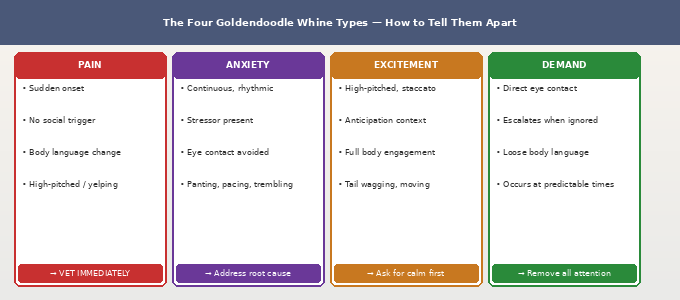
Pain whining tends to be sudden in onset rather than gradually escalating. It is often high-pitched, sometimes with a yelping quality, and appears without an obvious social trigger — the dog is not looking at you, not at a door, not anticipating food. It may be accompanied by reluctance to move, guarding of a specific body area such as licking or avoiding touching a paw, flank, or joint, changes in posture, or unusual stillness.
→ Related: Why Is My Goldendoodle So Hyper? — Understanding Arousal and Excitement
A dog whining while getting up from rest, while being touched in a specific area, or during or after exercise may be communicating pain. In older Goldendoodles, whining that has gradually increased over weeks can indicate chronic pain from arthritis or joint deterioration.
If whining has appeared suddenly with no behavioural explanation, or is accompanied by any physical signs, a veterinary assessment is the correct first response.
2. Anxiety or stress whining
Anxiety whining is continuous, often rhythmic, and appears in response to specific stressors — being left alone, thunderstorms, car journeys, the presence of strangers, or any situation the dog finds threatening or unpredictable.
It is accompanied by other anxiety signs: panting, pacing, yawning, lip licking, trembling, ears back, tail low. The dog is not seeking interaction — it is expressing distress. Eye contact during anxiety whining is often avoided rather than sought, which distinguishes it from demand whining.
The correct response to anxiety whining is not reassurance in the conventional sense — speaking soothingly, stroking, or holding the dog in response to the whining can inadvertently reinforce the distressed state. The most effective approach is calm, matter-of-fact presence that neither rewards the whining nor adds to the anxiety. Addressing the underlying anxiety through desensitisation, environmental management, or in significant cases veterinary support is the long-term solution.
→ Related: Why Does My Goldendoodle Follow Me Everywhere? — Understanding Attachment Behaviour
3. Excitement and anticipation whining
This whine type is the most obviously distinct. It is high-pitched, often accompanied by movement and a wagging tail, and appears in contexts of positive anticipation — before a walk, when the owner picks up the lead, when a favourite person arrives, during play that is building toward a peak.
Goldendoodles are particularly prone to excitement whining because of their high arousal threshold and emotional expressiveness. The sound is genuinely different from anxiety whining — lighter, more staccato, often mixed with higher-pitched sounds, and associated with full-body engagement rather than the shut-down body language of stress.
Excitement whining is the least concerning type but can become habitual and escalate if it consistently produces the excitement stimulus such as the walk beginning or the game starting. Asking for a calm behaviour — a sit, four paws on the floor — before the anticipated event begins gradually teaches the dog that calm behaviour, not excited whining, is what triggers the good thing.
4. Demand or attention-seeking whining
This is the type most owners are dealing with when the whining appears persistently at specific times — when the owner is eating, working, on the phone, or interacting with someone else.
Demand whining is characterised by direct eye contact with the owner, escalation when ignored, and a pattern that has developed over time in response to owner responses. The dog has learned that whining produces attention, engagement, or access to something it wants. It is not in distress — its body language is generally loose and engaged rather than tense and avoidant.
The distinction that matters most: demand whining and anxiety whining can look superficially similar, and treating demand whining as anxiety by providing comfort and reassurance reinforces the demand. Treating anxiety whining as demand by ignoring it completely can worsen the underlying anxiety. Reading the accompanying body language — particularly whether the dog is seeking eye contact or avoiding it — is the most reliable way to distinguish them.
👉 Related: Why Is My Goldendoodle Always Hungry? — Demand Behaviour Explained
Why Responding to the Wrong Whine Type Makes Things Worse
This is the core practical challenge with Goldendoodle whining, and it explains why so many owners find the whining gets progressively more persistent despite their efforts to address it.
Responding to demand whining with comfort reinforces the behaviour. The dog learns that whining produces contact and attention.
Ignoring anxiety whining without addressing the underlying anxiety does not reduce the whining — the anxiety remains, and the dog finds other ways to express it, sometimes in more problematic forms like destruction or house-soiling.
Correcting or punishing excitement whining adds anxiety to a positive anticipation context — the dog now whines with both excitement and anxiety about the correction, producing a more complex and harder-to-address behaviour.
Missing pain whining because it is assumed to be demand behaviour allows the underlying physical issue to progress untreated.
The correct response sequence for any new or changed whining is: first rule out pain, especially in puppies or dogs whose whining has changed suddenly, then assess anxiety versus demand by reading body language, then respond appropriately to whichever type is present.
→ Related: Why Does My Goldendoodle Lick Me So Much? — Reinforced Behaviour Patterns
Reducing Demand Whining — Step by Step
Once pain and anxiety have been ruled out and demand whining has been identified, the approach is consistent and specific.
Helpful Tools to Reduce Whining Behaviour
Providing structured outlets can reduce attention-seeking and help reinforce calm behaviour.
👉 Recommended: Best Interactive Toys for Goldendoodles
👉 Recommended: Best Chew Toys for Goldendoodles
- Remove all reinforcement. No eye contact, no speech, no touch when the whining occurs. Turn your body away. If the whining continues, leave the room quietly.
- Return only when quiet. Even a three-second pause in whining is enough to re-engage calmly. The dog learns that silence produces access to you, not whining.
- Anticipate and pre-empt. If whining predictably occurs when you sit at your desk, ask for a settle on the dog’s mat before sitting down and provide a high-value chew. The dog is already settled and rewarded before the trigger moment arrives.
- Reinforce quiet proactively. When the dog is calm and quiet in a context where it would normally whine, mark the calm with a quiet reward. You are teaching the dog that silence is also worth something.
- Be consistent across all household members. One person consistently responding to whining while another does not creates a variable reinforcement schedule that maintains the behaviour. All household members need to apply the same non-response approach.
⚠️ Watch Out
Whining at night that is new in an adult dog — particularly if it does not follow any of the four recognised patterns and appears without a clear trigger — can occasionally be a sign of cognitive dysfunction in older dogs, or pain that is more noticeable when the dog cannot be distracted by daytime activity. If you are asking why is my Goldendoodle whining at night and this has appeared suddenly in a dog over 8 years old, a veterinary check is the right next step.
When to See a Vet
- Whining has appeared suddenly with no obvious behavioural trigger or context
- Whining is accompanied by guarding a body area, reluctance to move, changes in posture, or reduced appetite
- Whining has gradually increased in frequency or intensity over weeks or months in an adult dog
- New-onset night whining in a dog over 7–8 years old
- Whining is severe, continuous, and accompanied by full anxiety signs that are not resolving with management
Key Takeaways
- Why is my Goldendoodle whining? Because both parent breeds are genetically predisposed to vocal human communication — it is a feature of the breed, not a behaviour problem
- The four whine types are pain, anxiety, excitement, and demand — each has a distinct sound profile and context and requires a different response
- Pain whining is the one type that must never be ignored — it is distinguished by sudden onset, absence of a social trigger, and often accompanies body language changes
- Demand whining is distinguished from anxiety whining by direct eye contact, escalation when ignored, and loose rather than tense body language
- Responding incorrectly to any whine type makes the situation worse — comforting demand whining reinforces it; ignoring anxiety whining without addressing the cause does not resolve it
- New or changed whining in an adult dog, particularly at night, warrants veterinary assessment to rule out pain or cognitive decline
Continue Learning About Goldendoodle Behaviour
If this guide helped, these related articles will help you go further:
- Why Is My Goldendoodle So Hyper? — Understanding Arousal and Excitement
- Why Does My Goldendoodle Follow Me Everywhere? — Attachment Behaviour
- Why Is My Goldendoodle Always Hungry? — Demand Behaviour Explained
- Why Does My Goldendoodle Lick Me So Much? — Communication Patterns👉 Recommended Tools: Best Interactive Toys for Goldendoodles
👉 Explore more: Goldendoodle FAQ & Seasonal — Common Questions and Owner Guides
Frequently Asked Questions
Is it normal for Goldendoodles to whine a lot?
More so than many breeds, yes. Both parent breeds are genetically predisposed to vocal human communication, and Goldendoodles inherit this tendency strongly. Some degree of whining is normal and expected for the breed. It becomes a concern when it is persistent, escalating, or accompanied by signs that suggest pain or significant anxiety.
Why does my Goldendoodle whine when I leave the room?
This is typically either anxiety whining — the dog finds separation from the owner stressful — or demand whining that has been reinforced by returning when the dog whines. The distinction is in what happens when you do not return: anxiety whining tends to continue and may escalate to other distress behaviours, while demand whining often reduces if consistently not reinforced.
Why does my Goldendoodle whine at night?
Night whining in puppies is almost always separation distress — the puppy is in a new environment, away from its littermates, and is communicating discomfort. Graduated comfort — placing the crate or bed near your own initially, then gradually increasing distance — addresses this more effectively than ignoring it completely. Night whining that appears suddenly in an adult dog with no history of it warrants veterinary assessment, particularly in older dogs.
How do I stop my Goldendoodle from whining for attention?
Remove all reinforcement from the whining — no eye contact, no speech, no touch when whining occurs. Return to interaction only during quiet moments, even brief ones. Anticipate whining trigger contexts and pre-empt with a settle cue and a high-value chew before the trigger arrives. Consistency across all household members is essential — partial reinforcement from one person maintains the behaviour.
Could my Goldendoodle be whining because it is in pain?
Yes — pain whining is distinguished by sudden onset without a clear social trigger, high-pitched or yelping quality, and often accompanies body language changes such as guarding a body area, reluctance to move, or unusual stillness. If whining has appeared suddenly in a dog that was not previously a frequent whiner, or is accompanied by any physical signs, a veterinary assessment is the correct first step.
The information in this article is provided for general educational purposes only. King James Adjei is a researcher and enthusiast, not a veterinarian or certified behaviourist. For whining that may indicate pain, medical issues, or significant anxiety, always consult a qualified veterinarian or certified dog behaviourist.