6-minute read | Last updated March 2026 | Reviewed for accuracy
By King James Adjei | GoldendoodleReport.com
Researcher, Goldendoodle enthusiast, and founder of GoldendoodleReport. Every guide on this site is written to give owners reliable, clearly organised information — researched carefully and updated regularly.
The best chew toys for teething Goldendoodles are not the same product at every stage of the teething process — because the chewing drive at 10 weeks, which is driven by gum pressure and eruption pain, is biologically different from the chewing drive at 5 months, which is driven by habit and the satisfaction of using newly-erupted adult teeth. Understanding the two drivers and the four-stage timeline makes the buying decision specific rather than general.
Who This Guide Is For
This article is most useful if you:
- Have a Goldendoodle puppy in the teething phase and want to know which chew toys actually provide relief
- Have tried several chew toys and the puppy loses interest quickly or still chews household items
- Want to understand the teething timeline so you know when the hardest phase ends
- Want to know which chews are safe for puppy teeth and which are too hard
For the broader toy context the chew toys sit within, see Best Toys for Goldendoodle Puppies.
Quick Summary
The best chew toys for teething Goldendoodles are matched to the teething stage. From 8 to 12 weeks — soft rubber chews and frozen wet cloths for gum pressure relief. From 12 to 20 weeks (peak teething) — frozen Kong Puppy and Nylabone Puppy for eruption pain relief. From 20 weeks — harder rubber options as adult teeth arrive. The freezing protocol is the single most effective way to extend chew toy engagement and provide genuine gum relief — cold numbs inflamed tissue and more than triples the average engagement time compared to a room-temperature equivalent.
Quick Answer
The core teething kit for a Goldendoodle puppy: one Kong Puppy (freeze stuffed with wet food or broth), one Nylabone Puppy in the appropriate size, one rubber ring chew, and two to three frozen wet cloths (free). Freeze the Kong and rubber ring before every session. Replace the frozen cloth when it thaws. Never give rawhide, ice cubes, adult dog chews, or antlers before 6 months.
Quick Diagnosis
- If the puppy is biting hands and arms specifically → teething is at peak eruption phase — increase access to frozen chews and redirect every bite to a frozen toy immediately
- If the puppy chews a toy briefly then abandons it → toy is at room temperature — freeze it before the next session
- If the puppy is targeting specific household items repeatedly → those items have a texture or temperature that matches what the puppy needs — replace with a frozen chew of similar firmness
- If the puppy shows drooling, reluctance to eat hard kibble, or pawing at the mouth → active tooth eruption in progress, peak discomfort phase — prioritise frozen soft rubber over harder options
Your 14-week Goldendoodle has three chew toys on the floor. It picks each one up, chews for thirty seconds, drops it, then goes to the sofa leg. You think the puppy is rejecting the toys and buy two more. Same result. The problem is not variety — it is temperature. All five toys are at room temperature. The puppy is not seeking a new texture. It is seeking the cold pressure that the room-temperature toys cannot provide. Freeze the Kong tonight. Tomorrow morning it will be the only toy the puppy wants.
Goldendoodle puppies go through teething twice — the arrival of the 28 baby teeth between 3 and 6 weeks, which the owner rarely observes, and the replacement of those baby teeth with 42 permanent adult teeth between 12 and 26 weeks, which the owner observes very much. The second teething phase is the one that drives the furniture destruction, the hand-biting escalation, and the frantic searching for anything to chew. It is not a behaviour problem — it is a biological process with a specific timeline that ends.
This guide covers:
- The teething timeline — four stages with specific ages and what to expect at each
- The two chewing drivers — eruption relief and habit chewing
- The freezing protocol — why cold works and how to apply it
- Safe vs unsafe chews for teething Goldendoodles
- The complete teething kit by stage
In This Guide
Best Chew Toys for Teething Goldendoodles: The Four-Stage Timeline
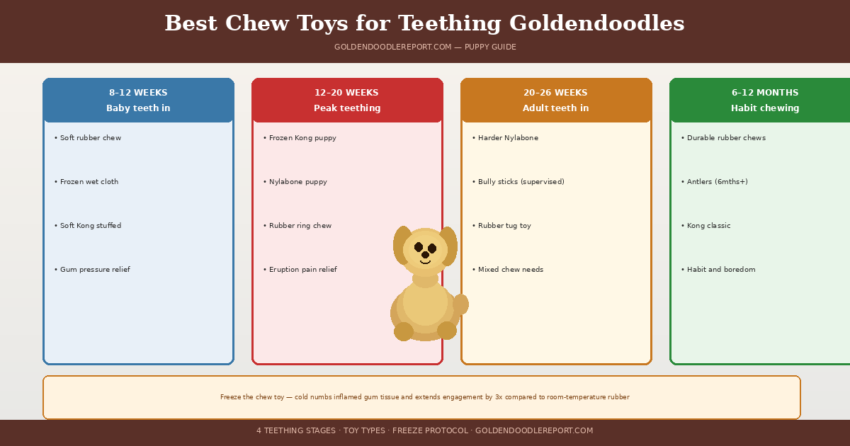
The teething process in Goldendoodle puppies follows a consistent four-stage timeline. Each stage has a different dental event, a different chewing behaviour, and a different chew toy requirement. For a clear overview of the canine teething process and what owners should expect, the American Kennel Club’s puppy teething guide covers the full timeline and symptom progression clearly.
Goldendoodle Teething Timeline — Stages and Toy Requirements
| Stage | Age | Dental Event | Chewing Behaviour | Best Toy Type |
|---|---|---|---|---|
| Stage 1 | 8–12 weeks | Baby teeth present — gum sensitivity from normal oral contact | Mouthing and gentle chewing — everything goes in the mouth | Soft rubber chews, frozen wet cloth, stuffed Kong |
| Stage 2 | 12–20 weeks | Peak teething — adult teeth erupting through gum tissue | Intensified biting — genuine discomfort driving chewing urgency | Frozen Kong Puppy, Nylabone Puppy, rubber ring (frozen) |
| Stage 3 | 20–26 weeks | Adult teeth arriving — gum discomfort reducing, bite force increasing | Chewing intensity shifting from pain-driven to force-driven | Harder Nylabone, rubber tug toy, bully sticks (supervised) |
| Stage 4 | 6–12 months | Adult dentition complete — all 42 permanent teeth present | Habit and boredom chewing — not driven by teething discomfort | Durable rubber chews, Kong Classic, antlers (6 months+) |
Stage 2 is the most difficult period for owners and the most important time to have the right toys available. The bite intensity escalates sharply between 12 and 16 weeks as adult incisors begin erupting through gum tissue — a genuinely painful process that produces urgent chewing as a pain-management behaviour. The puppy is not misbehaving during this stage. It is responding to biological discomfort with the only tool available to it.
The Two Chewing Drivers — Eruption Relief vs Habit Chewing
Understanding the difference between the two chewing drivers is what makes the difference between a toy selection that actually works and one that the puppy ignores in favour of the furniture leg.
Driver 1 — Eruption relief (Stage 2, 12 to 20 weeks). This chewing is pain-driven. Adult teeth erupting through gum tissue create inflammation and pressure that the puppy relieves by chewing on firm objects. The chewing behaviour is urgent, persistent, and targeted at objects with a specific firmness and temperature — not too soft to provide counter-pressure, not too hard to cause additional pain on already-sensitive gum tissue. The ideal object for eruption-relief chewing is a moderately firm, cold surface that provides counter-pressure while numbing the inflamed tissue simultaneously. A frozen rubber chew satisfies all three requirements — firmness, cold, and safe for sensitive teeth.
A puppy in eruption-relief mode will chew a room-temperature rubber toy briefly — enough to establish that it does not provide what it needs — then seek out something that does. The furniture leg, the shoe, the book — these objects were found by trial and error to provide the right combination of resistance and novel sensation. The frozen chew toy replaces this search with a reliably correct option.
Driver 2 — Habit chewing (Stage 4, 6 to 12 months). This chewing is not driven by pain. Adult dentition is complete. The gum discomfort of teething is gone. What remains is the chewing behaviour itself — now established as a habit, reinforced by thousands of repetitions across the teething period, and supported by the general boredom and energy of adolescence. A puppy at this stage chews because it has chewed everything for months and chewing is what it does.
Habit chewing requires a different response than eruption chewing. Cold is less important. Durability is more important — the puppy now has full adult bite force and will fragment anything too soft. The appropriate toys shift from frozen soft rubber to durable rubber, harder Nylabones, and natural chews appropriate for the age.
The Freezing Protocol — Why Cold Works
Cold reduces inflammation and numbs nerve endings — this is the same mechanism behind applying ice to a sprained ankle. When gum tissue is inflamed from tooth eruption, cold applied to that tissue produces two simultaneous effects: vasoconstriction reduces the inflammatory swelling, and cold-induced reduction in nerve signal transmission temporarily reduces pain perception. A frozen chew toy provides both effects at every chewing session.
The engagement difference between a frozen and a room-temperature chew toy is significant and consistent. A puppy at peak teething will typically engage with a room-temperature rubber chew for 1 to 3 minutes before abandoning it. The same toy frozen will hold engagement for 5 to 15 minutes — because the cold is actively addressing the discomfort the puppy is chewing to relieve.
The freezing protocol:
Kong Puppy: Stuff with wet food, broth, mashed banana, or any soft food mixed with a small amount of peanut butter (xylitol-free). Plug the bottom hole with a piece of dry kibble or soft chew. Freeze overnight or for a minimum of 4 hours. The frozen stuffing extends the session further because the puppy must work to access the food as it thaws, combining enrichment with cold gum relief.
Rubber ring chews and rubber teething toys: Soak in water or low-sodium broth for 30 minutes, then freeze for 2 to 4 hours. The frozen water within the rubber provides sustained cold contact as the puppy chews. Refresh daily.
Wet cloth: Wet a small clean flannel or washcloth with water or broth, wring partially, twist loosely, and freeze for 2 hours. This is the free teething relief option — no purchase required. Most puppies engage willingly with a frozen cloth because the texture matches the eruption pressure they are seeking. Replace when fully thawed — a thawed cloth provides no cold relief and is not hygienic for repeated use.
Prepare frozen chews the evening before they are needed — not immediately before. A chew frozen for 2 hours provides less sustained cold relief than one frozen overnight. Keep a rotation of two to three frozen Kongs in the freezer at all times during the peak teething phase so one is always ready.
Safe vs Unsafe Chews for Teething Goldendoodles
Safe options by stage:
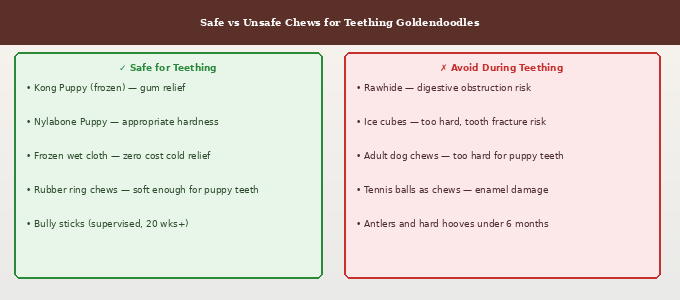
Kong Puppy (frozen): The puppy-specific formula uses a softer rubber than the adult Kong Classic — appropriate for the baby and transitional teeth of the 8 to 20 week period. Do not substitute with the adult Kong during peak teething — the rubber hardness is genuinely different and the softer formula is selected for puppy dental safety.
Nylabone Puppy: Specifically engineered for puppy chewing force — softer than adult Nylabones and designed to produce small edible granules under chewing rather than large fragments. Buy the puppy-specific size for your Goldendoodle’s weight. Discard and replace when the chew becomes small enough to swallow or when ridges are significantly worn.
Bully sticks from 20 weeks: Natural, digestible, and highly engaging for the stage 3 and 4 chewing drive. Supervise at all times — never leave unsupervised — and discard when the stick becomes short enough to swallow as a single piece.
Unsafe options at any teething stage:
Rawhide: The primary risk is digestive obstruction. Rawhide softens in the mouth and puppies swallow large pieces that do not break down reliably in the digestive system. The intestinal obstruction risk from rawhide ingestion is serious and has been documented repeatedly. Do not give rawhide to puppies or adults.
Ice cubes: Widely recommended as a teething remedy but inappropriate. Ice is too hard for puppy teeth — both baby teeth and newly-erupted adult teeth are more brittle than fully-established adult teeth and can fracture on ice. Frozen rubber toys provide the cold benefit without the hardness risk.
Adult dog chews during peak teething: Any chew designed for adult chewing force — adult Kongs, adult Nylabones, hard rubber chews marketed for aggressive chewers — is too hard for the transitional teeth of the 12 to 20 week teething period. Use puppy-specific versions until all adult teeth are established at approximately 26 weeks.
Antlers and hard hooves before 6 months: Too hard for puppy teeth at any stage before 6 months — significant tooth fracture risk. From 6 months, moose and elk antlers are appropriate as durable long-lasting chews with supervision.
The Complete Teething Kit by Stage
Stage 1 and 2 kit (8 to 20 weeks — the core teething period): One Kong Puppy in the correct size, kept stuffed and frozen. Two to three frozen wet cloths rotated through the freezer. One Nylabone Puppy in the correct size. One soft rubber ring chew kept frozen. This four-item kit addresses all teething needs at peak intensity with every item available at short notice.
Stage 3 kit addition (20 to 26 weeks — adult teeth arriving): Add a harder Nylabone variant (still puppy-specific, harder grade). Introduce supervised bully stick sessions two to three times per week. Continue frozen Kong but the stuffing can be less frequent as the food-motivation driver reduces.
Stage 4 kit transition (6 to 12 months — habit chewing phase): Transition to Kong Classic from Kong Puppy. Add durable rubber chews appropriate for adult chewing force. Introduce antlers or other natural hard chews under supervision. Frozen options become optional rather than essential.
Action Plan — Building the Teething Kit
- Identify the current teething stage from the table above. Match your puppy’s age to the stage and note the corresponding toy type.
- Buy a Kong Puppy in the correct weight size today. Stuff it with wet food or broth mixed with a small amount of peanut butter. Freeze overnight. This is the most impactful single purchase available for a teething Goldendoodle.
- Add a Nylabone Puppy in the correct weight range. Check the weight guide on the packaging — buying the wrong size produces a chew that is too small to hold safely or too large to engage with.
- Make three frozen wet cloths tonight. Wet, partially wring, fold, freeze. Zero cost. Available tomorrow morning. Replace daily.
- Set up a frozen chew rotation. Two to three frozen Kongs in the freezer at all times during peak teething. One thaws while another is in use. Always have a frozen option ready rather than improvising when the biting escalates.
- Redirect every bite to the nearest frozen chew immediately. Do not delay the redirection. The faster the redirect, the faster the puppy learns that chewing discomfort is addressed by the frozen toy, not the hand, furniture, or shoe.
What to Expect
Timeline: Peak teething intensity runs from approximately 12 to 20 weeks. It will end. A Goldendoodle at 7 months is not still teething in the eruptive sense — any chewing at that stage is habit-driven and managed differently. The 8-week period of peak intensity is the hardest. Freezing, redirecting, and keeping frozen options constantly available makes it manageable.
Friction: The frozen chew rotation requires a daily preparation habit. Stuffing and freezing a Kong the evening before requires 3 minutes. The most common failure point is running out of frozen options during the day because the preparation habit was not established. Set a phone reminder for 9 PM every evening to prepare the next day’s frozen chews.
Signs the approach is working: Puppy goes to the frozen chew independently when the biting urge begins — without being redirected. Household item chewing reduces progressively across 2 to 3 weeks of consistent availability. Peak biting intensity reduces noticeably by 20 weeks as the worst eruption phase passes.
Your Next Step
Buy a Kong Puppy today, stuff it with wet food and peanut butter (xylitol-free), and freeze it overnight. Tomorrow morning place it in the puppy’s space first thing. Observe the engagement difference compared to a room-temperature toy. Then set up the daily preparation habit before anything else in the teething kit.
What Most Owners Get Wrong
Mistake 1 — Giving room-temperature chew toys and concluding they do not work. A room-temperature rubber chew provides texture satisfaction but does not address the cold-seeking pain relief drive of the peak teething phase. The same toy frozen holds engagement for three to five times longer and produces visible preference from the puppy. Conclude that a chew toy does not work only after testing it frozen — not at room temperature.
Mistake 2 — Giving rawhide for teething relief. Rawhide is widely available, inexpensive, and heavily marketed as a chew product. It is also the chew type with the most documented digestive obstruction incidents in puppies. Rawhide softens under saliva and puppies swallow pieces that do not break down in the digestive system. The obstruction risk is real and the emergency veterinary treatment for intestinal obstruction from rawhide ingestion is expensive and serious. There is no situation where rawhide is the right choice over safer alternatives.
Mistake 3 — Expecting the teething phase to end at 3 months. The most common teething misconception is that it is over by 12 weeks. The eruptive phase — when adult teeth are actively pushing through gum tissue — peaks between 12 and 20 weeks. The biting behaviour typically intensifies at exactly the point owners thought it would be ending. Understanding that peak teething is at 12 to 20 weeks, not before, removes the confusion and frustration of an escalating behaviour that was expected to be resolving.
Signs Your Teething Management Is Working
- Puppy goes to the frozen chew independently when the biting drive begins
- Household item chewing reduces progressively across 2 to 3 weeks of consistent frozen toy availability
- Biting intensity on hands and arms decreases noticeably from 20 weeks onward as the worst eruption phase passes
- Puppy engages with frozen chews for 5 minutes or more per session rather than abandoning after 30 seconds
⚠️ Watch Out
Never use xylitol-containing peanut butter in frozen Kong stuffing. Xylitol is highly toxic to dogs and found in many “reduced sugar” or “natural” peanut butter brands. Check every peanut butter label before use. The ingredient list must show no xylitol and no “sugar alcohol.” Regular full-fat peanut butter from a standard brand is generally safe — confirm the label specifically before every use as formulations change.
Contact Your Vet If
- A baby tooth has not fallen out by 6 months and the adult tooth is erupting alongside it — retained baby teeth require veterinary removal
- The puppy shows excessive drooling, bleeding gums beyond minor spotting, or significant reluctance to eat during the teething phase
- Any chew object is swallowed and the puppy shows vomiting, gagging, or abdominal discomfort — contact your vet the same day
Key Takeaways — Best Chew Toys for Teething Goldendoodles
- Peak teething is at 12 to 20 weeks — not 8 to 12 weeks as commonly believed — biting intensity typically escalates at exactly the point owners thought it would ease
- Two chewing drivers require different toy responses — eruption relief (12 to 20 weeks) needs frozen soft rubber, habit chewing (6 months plus) needs durable harder options
- Freezing the chew toy is the single most effective teething intervention available — cold numbs inflamed gum tissue and triples average engagement time
- Never give rawhide — digestive obstruction risk is serious and safer alternatives are universally available
- Never give ice cubes — too hard for puppy teeth and fracture risk is real
- The teething phase ends — by 26 weeks adult dentition is complete and the eruption-driven urgency is over
Related Goldendoodle Puppy Guides
- Best Toys for Goldendoodle Puppies — The full toy framework the chew toys sit within
- Goldendoodle Puppy Biting Phase Guide — How teething-driven biting is managed alongside the chew toy programme
- Best Puppy Treats for Goldendoodles — What goes in the frozen Kong alongside the chew toys
- Goldendoodle Puppy Care Guide — Complete first-year overview including teething management
- Goldendoodle Puppy Growth Stages — How teething fits into the full developmental timeline
Part of the Goldendoodle Puppy Guide resource hub:
→ Goldendoodle Puppy Guide — Browse all 40 puppy guides
Frequently Asked Questions
When do Goldendoodle puppies start teething?
Goldendoodle puppies have their baby teeth by 6 to 8 weeks — usually complete before the owner receives them from the breeder. The teething that owners experience — the escalating biting, the chewing urgency, the furniture destruction — is the second teething phase, when adult teeth replace baby teeth between 12 and 26 weeks. Peak intensity is at 12 to 20 weeks. By 26 weeks all 42 adult teeth are typically in place and the eruption-driven urgency is over.
Is it OK to give a puppy a frozen chew toy?
Yes — frozen rubber chew toys and frozen wet cloths are safe and highly effective teething relief. The cold numbs inflamed gum tissue and reduces the pain of tooth eruption. This is different from ice cubes, which are too hard for puppy teeth and carry a tooth fracture risk. Always freeze purpose-designed rubber toys and cloth — never give ice cubes as a teething remedy.
What can I put in a Kong for a teething puppy?
Wet puppy food, low-sodium chicken broth, mashed banana, xylitol-free peanut butter, or any combination of these. Plug the small hole at the bottom with a piece of kibble or soft food before stuffing the main cavity. Freeze overnight. Confirm that every ingredient is xylitol-free before use — xylitol is toxic to dogs and present in many reduced-sugar or natural peanut butter products.
How long does the teething phase last in Goldendoodles?
The eruptive teething phase — the period of genuine gum discomfort from adult teeth pushing through — runs from approximately 12 to 26 weeks, with peak intensity between 12 and 20 weeks. After 26 weeks all adult teeth are typically in place and the eruption pain is gone. The chewing behaviour that developed during teething continues as a habit and requires management for several more months, but the urgent, pain-driven biting of the 12 to 20 week peak is over by approximately 5 to 6 months.
Is rawhide safe for teething Goldendoodle puppies?
No — rawhide is not safe for puppies or adult dogs. It softens under saliva and puppies swallow pieces that do not reliably break down in the digestive system, causing intestinal obstruction — a serious condition requiring emergency veterinary treatment. Safer alternatives include frozen Kong Puppy, Nylabone Puppy, rubber ring chews, and bully sticks (from 20 weeks, supervised). None of these carry the digestive obstruction risk that rawhide does.
The information in this article is provided for general educational purposes only. King James Adjei is a researcher and enthusiast, not a veterinarian. For retained baby teeth, significant gum bleeding, or concerns about any chew object ingestion, always consult a qualified veterinarian promptly.