Affiliate Disclosure: Some links in this guide are affiliate links. If you purchase through them, we may earn a small commission at no extra cost to you. Read our full affiliate disclaimer here.
By King James Adjei — Researcher and Goldendoodle enthusiast, founder of GoldendoodleReport.com. Every guide on this site is carefully researched and written to give owners reliable, clearly organised information — updated regularly and honest about uncertainty. → About this site
📖 18-minute read | Last updated April 2026 | Reviewed for accuracy
The goldendoodle puppy guide you are reading right now was written because most puppy guides list what to do without explaining why any of it works — or why skipping it causes the exact problems owners spend months trying to fix. If you have a Goldendoodle puppy arriving soon, or one already at home and the first week has not gone quite how you imagined, this is the guide that maps the whole picture.
👤 Who This Guide Is For
- You are bringing a Goldendoodle puppy home for the first time and want to understand what the first year actually involves
- You have a puppy at home right now and something — the biting, the sleep chaos, the energy — is not what you expected
- You want to understand the full landscape before going deep on any single topic
- You are preparing your home, your schedule, and your household before pickup day and want a complete reference to work from
⚡ Quick Summary
Raising a Goldendoodle puppy successfully comes down to five things: preparing your home and routine before the puppy arrives, covering health and vaccination milestones on schedule, using the 8–16 week socialisation window deliberately, managing the biting phase with consistency from day one, and matching exercise and sleep to developmental age rather than energy level. The first 16 weeks shape your dog’s behaviour for years. What you do — and do not do — during this window has more long-term impact than anything that comes after.
Most Goldendoodle owners describe the first week the same way: exciting, exhausting, and nothing like they expected. The puppy cried at night. The biting was relentless. The toilet training felt impossible. The puppy slept for what seemed like half the day and then woke up like a furry hurricane. That is a completely typical first week — and it is also a week where several habits, good and bad, begin forming simultaneously.
If you are already in it and finding it harder than expected, that is the experience of almost every new Goldendoodle owner. The breed is loving, intelligent, and deeply rewarding to raise — and demanding in ways that puppy photos do not prepare you for. This guide gives you the map.
📊 Quick Facts — Goldendoodle Puppy Development
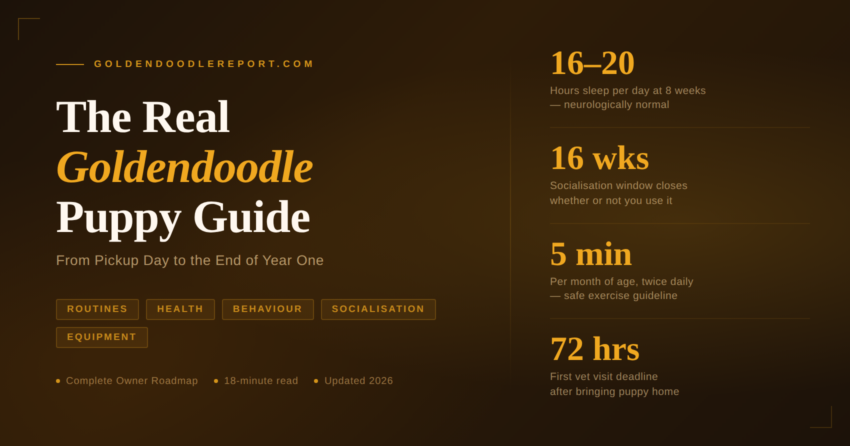
- Goldendoodle puppies sleep 16–20 hours per day at 8 weeks — this is neurologically normal and should not be interrupted
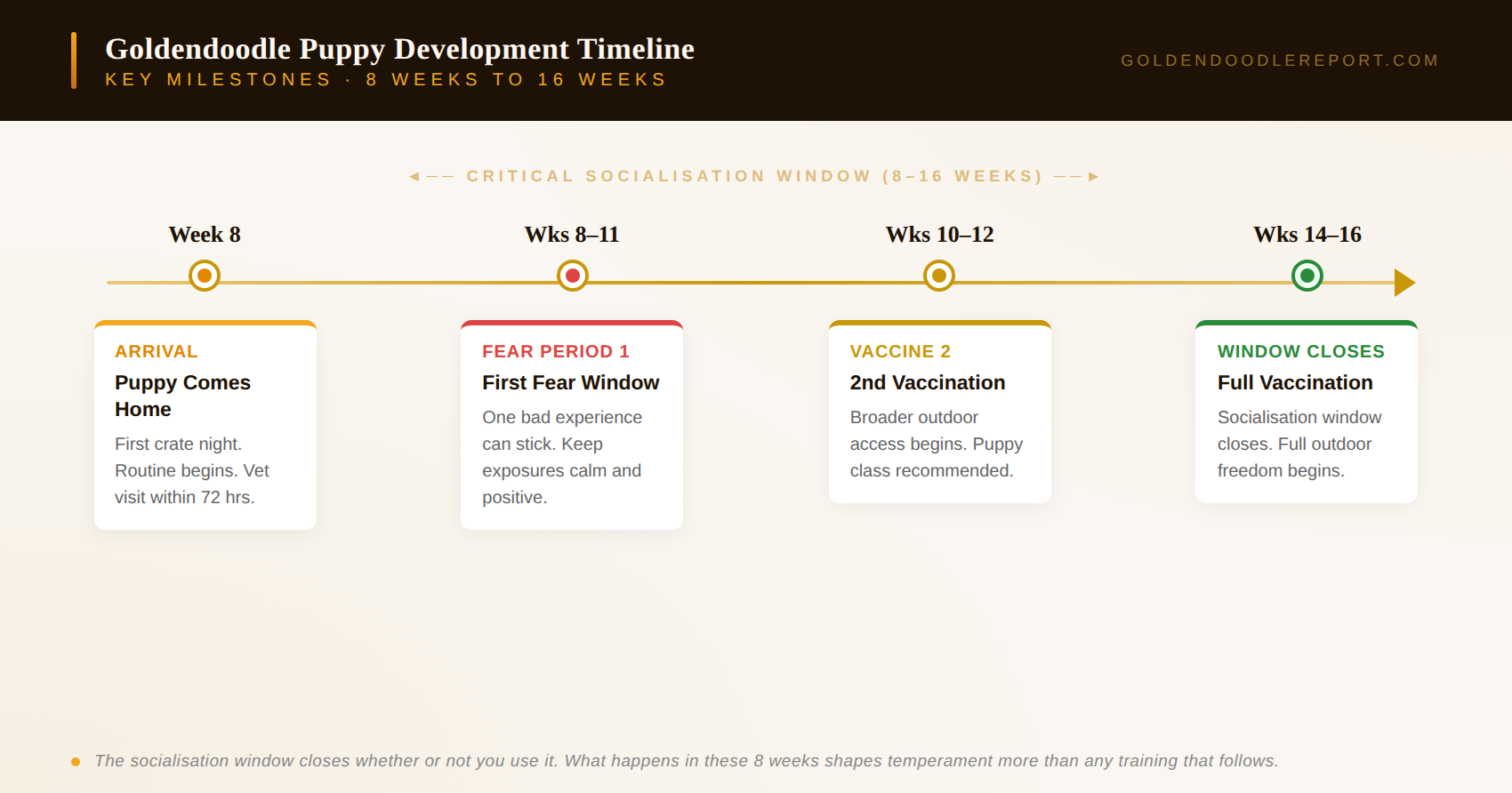
- The socialisation window closes at approximately 16 weeks — experiences during this period have more lasting impact than training at any later stage
- The safe exercise guideline used by most vets is 5 minutes per month of age, twice per day — a 3-month-old needs 15 minutes maximum
- Mini Goldendoodles typically reach adult size by 9–12 months; Standard Goldendoodles may continue filling out until 18 months
- Two fear periods occur during puppy development: approximately 8–11 weeks and again between 6–14 months — a single frightening experience during these windows can create a lasting negative association
🔍 Quick Diagnosis — Where Are You Right Now?
Find your situation and go directly to the guide you need most.
- Puppy not yet home — preparing now: Start with Goldendoodle Puppy Checklist and Preparing Your Home for a Goldendoodle Puppy
- First night or first week — puppy won’t settle: Go to Goldendoodle Puppy First Night at Home and First Week With a Goldendoodle Puppy
- Biting is out of control: Read Goldendoodle Puppy Biting Phase Guide — this is developmental, not aggression, and it is manageable
- Worried about health, vaccines, or vet visits: See Goldendoodle Puppy Vaccination Timeline and Goldendoodle Puppy First Vet Visit
- Struggling with sleep — yours or the puppy’s: Go to Goldendoodle Puppy Sleep Schedule and How Much Sleep Does a Goldendoodle Puppy Need?
- Unsure about exercise, stairs, or going outside: See Goldendoodle Exercise Needs by Age and When Can a Goldendoodle Puppy Go Outside?
- Puppy seems hyper all the time: Read When Do Goldendoodle Puppies Calm Down? — the answer is likely overtiredness, not excess energy
- Wondering what to buy: Go to the equipment section of this guide or the Goldendoodle Puppy Care Guide
📖 Real Scenario
It is 11pm on day three. The puppy has been in the crate for 40 minutes and is still crying. The owner has already taken them out twice, confirmed they are not hungry, and checked there is nothing wrong. The instinct is to bring the puppy into the bed — just this once — to stop the crying and get some sleep. That decision, made on night three out of pure exhaustion, is the beginning of a habit that takes weeks to undo. Understanding why the crate crying happens, what a puppy is actually experiencing, and what the correct response is changes the outcome of that moment entirely.
📋 Table of Contents
- What the Goldendoodle Puppy Guide Covers
- Why the First 16 Weeks Define Everything
- Before Your Puppy Arrives — Preparation
- Puppy Development by Size and Stage
- The 5 Most Costly Goldendoodle Puppy Mistakes
- Signs You Are Raising Your Puppy Correctly
- When to Call the Vet
- Essential Equipment
- Your First 16-Week Action Plan
- Key Takeaways
- Start Here — Essential Guides
- Related Topics
- All Goldendoodle Puppy Guides
- Frequently Asked Questions
What the Goldendoodle Puppy Guide Covers — and How to Use It
A goldendoodle puppy guide that works is not a checklist. It is a developmental map — a way of understanding what is happening inside your puppy at each stage, why certain owner actions produce good outcomes while others quietly create problems, and where to go deep when a specific situation needs more than an overview can give.
This guide covers the full landscape of the first year, organised by what matters most and when. Each section stays at overview level and links directly to the dedicated cluster article for that topic — so you can read this guide end to end for the full picture, or jump straight to the section you need right now using the Quick Diagnosis block above.
One principle runs through everything in this guide: consistency in the first 16 weeks is worth more than any single intervention later. The habits, associations, and tolerance levels a Goldendoodle puppy builds during this window tend to stay. Understanding that is the real starting point. Browse the full category index here: Goldendoodle Puppy Guide category.
Why the First 16 Weeks Define Everything
Developmental science in dogs is clear on this: the period between roughly 3 and 16 weeks is when a puppy’s brain most actively forms associations with the world. Positive experiences during this window tend to produce a confident, adaptable adult dog. Missed socialisation during the window tends to produce anxiety and reactivity that is significantly harder to address later — not impossible, but much harder. This is not about pressure; it is about timing.
The overtiredness trap — and why it causes more problems than most owners realise
One of the most widely missed cause-effect patterns in Goldendoodle puppy raising is this: an overtired puppy does not look tired. They look hyper. They bite harder. They cannot settle. They seem to have boundless energy at exactly the moment they most need to sleep.
This happens because overtired puppies lose the ability to self-regulate. The cortisol spike from missed sleep triggers increased arousal, which presents as frantic behaviour and intensified biting. Owners who interpret this as excess energy and add more exercise typically make it significantly worse. The correct response is enforced rest — usually in the crate with the door closed — even when the puppy is protesting loudly. Understanding this one cause-effect chain resolves a significant proportion of the “my puppy is out of control” situations new Goldendoodle owners experience in weeks two through six.
Owner consistency is the controlling variable
Puppy development research consistently shows that individual variation between puppies is real but smaller than most owners assume. The larger variable is owner consistency. A puppy who receives inconsistent responses — sometimes the biting gets a reaction, sometimes it ends the interaction, sometimes it is laughed at — takes significantly longer to learn than one who receives the same clear response every single time. This means the outcome is largely within the owner’s control. The breed’s intelligence works in your favour when you are consistent and against you when you are not.
Before Your Puppy Arrives — Preparation That Changes the First Week
The owners who find the first week most manageable are almost always those who prepared the right things before pickup day — not just bought equipment, but set up the physical space, established household rules, and understood what the puppy would need in the first 48 hours specifically.
Puppy-proofing your home
Goldendoodle puppies explore with their mouths and move faster than new owners expect. Before your puppy arrives, work through every room at puppy height — which means getting on your hands and knees and looking at what is accessible. Electrical cables need to be concealed, toxic plants removed, gaps under furniture blocked, and cleaning products and medications locked away.
The American Kennel Club maintains a list of plants and substances toxic to dogs — a useful reference when puppy-proofing room by room. See the toxic plant guide at the AKC. For the full room-by-room walkthrough, see Preparing Your Home for a Goldendoodle Puppy.
What to have ready before pickup day
Certain items must be in place before the puppy arrives. The crate needs to be set up and familiar-smelling before the puppy enters it for the first time. The food needs to be the same brand the breeder was using to avoid adding a food transition on top of an already stressful relocation. The sleeping area needs to be decided and ready. The complete equipment list is in the Goldendoodle Puppy Checklist.
The first week — what to protect
Your puppy has just been separated from their mother and littermates for the first time. Their entire sensory world has changed in 24 hours. The goal of week one is not to begin a comprehensive training programme — it is to help the puppy feel safe, establish a predictable routine, and start building trust. Visitors, excessive handling, and overstimulation in the first 72 hours tend to extend the settling-in period significantly. For a day-by-day breakdown see First Week With a Goldendoodle Puppy and for the first night specifically, Goldendoodle Puppy First Night at Home.
Puppy Development by Size, Stage, and Situation
Not all Goldendoodle puppies develop on the same timeline. Size is the primary variable — and it matters more than most general puppy guides acknowledge.
Mini Goldendoodle puppies (under 30 lbs adult weight)
Mini Goldendoodles tend to reach physical maturity earlier — typically by 9–12 months. Their energy levels often peak earlier and settle earlier than Standards. They may also be more sensitive to handling during the fear periods. Their smaller size means the safe exercise guideline (5 minutes per month of age) applies with even more caution — small joints are proportionally more vulnerable to impact damage from stairs and jumping.
Standard Goldendoodle puppies (45–65 lbs adult weight)
Standard Goldendoodles grow for longer — physical maturity often extends to 15–18 months, with some continuing to fill out until 24 months. The adolescent period — higher energy, regression in trained behaviours — tends to run longer as a result. The calm-down timeline is later than most owners expect, often not arriving fully until 18–24 months.
👉 Full growth timeline detail: Goldendoodle Puppy Growth Stages
👉 When the energy settles: When Do Goldendoodle Puppies Calm Down?
Apartment vs house with garden
A house with a garden is not automatically better for a Goldendoodle puppy than an apartment. A puppy left in a garden unsupervised is a puppy that is not being trained, socialised, or managed. Apartment Goldendoodles can thrive when their mental and physical needs are met — and often develop stronger focus and impulse control because they have to.
👉 Full guide: Apartment Living With a Goldendoodle
The 5 Most Costly Goldendoodle Puppy Mistakes
These are the mistakes that show up most consistently among new Goldendoodle owners — not because owners are careless, but because the correct approach is often counterintuitive.
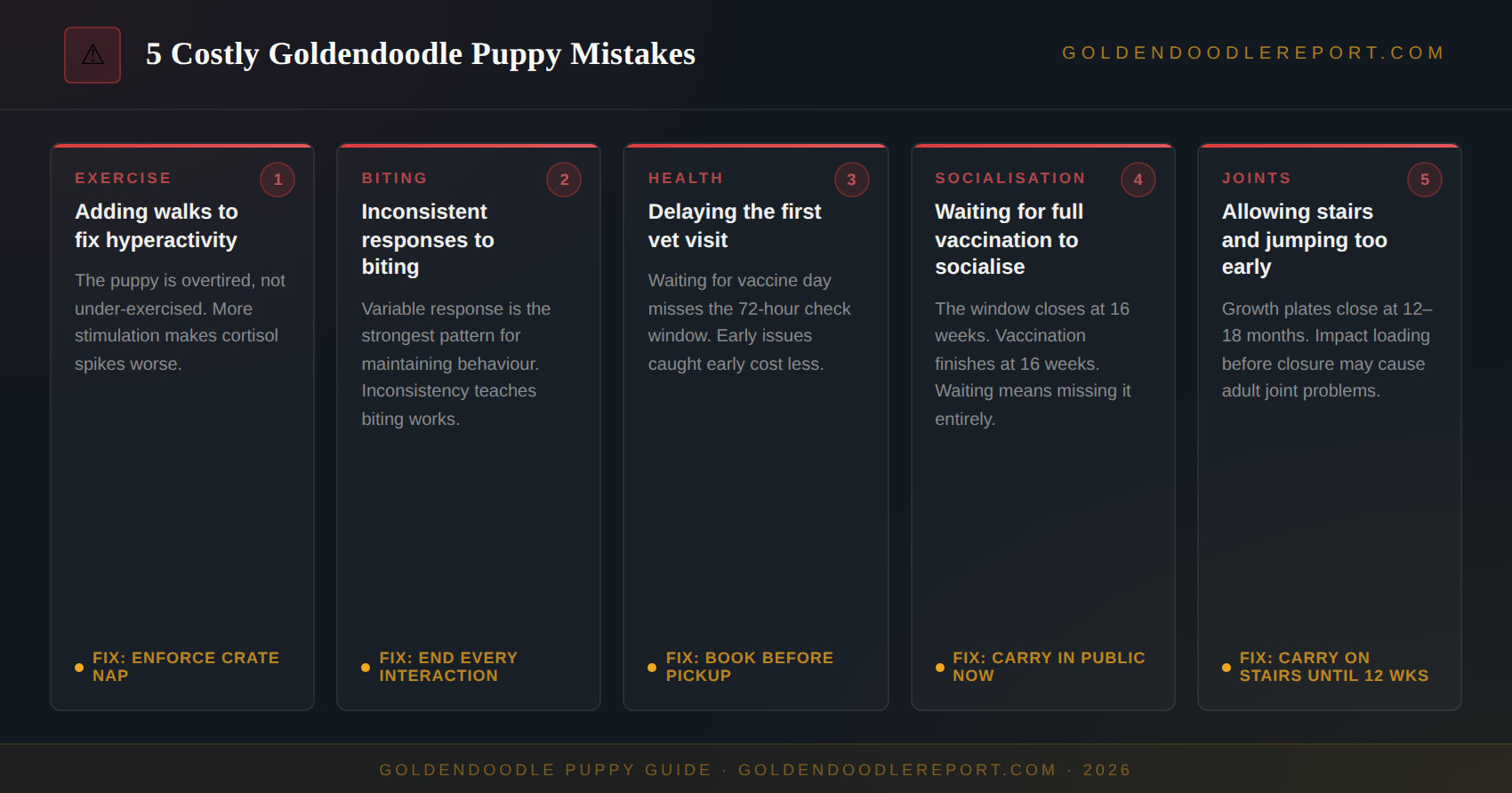
Mistake 1 — Adding exercise to fix hyperactivity
A frantic, biting puppy almost always needs less stimulation, not more. The puppy is overtired — cortisol from missed sleep is driving the behaviour — and a longer walk typically makes it worse. The correction is an enforced crate nap of 1–2 hours. The behaviour usually resolves within 20 minutes of the puppy going down.
Mistake 2 — Inconsistent responses to biting
Variable reinforcement — where a behaviour sometimes gets a response and sometimes does not — is the strongest pattern for maintaining behaviour. A puppy who sometimes gets a reaction to biting and sometimes does not is being actively taught that biting is worth trying. The correction is absolute consistency: every single time teeth touch skin, the interaction ends. See Goldendoodle Puppy Biting Phase Guide for the full method.
Mistake 3 — Delaying the first vet visit
Waiting until the first scheduled vaccine appointment means skipping a critical early check. Health issues from the breeder — parasites, infections, heart murmurs — may not be visible to the owner but are detectable at a vet check. Book the first appointment before pickup day and plan to go within 72 hours of arrival. See Goldendoodle Puppy First Vet Visit.
Mistake 4 — Treating the socialisation window as low priority
The socialisation window peaks at 8–12 weeks and closes at around 16 weeks. Full vaccination also typically finishes at 16 weeks. Waiting for full vaccination before exposing the puppy to the world means missing the most important developmental window entirely. Socialise during the window using controlled, safe environments — carried in arms in public, visiting homes of vaccinated dogs, car rides, sounds, surfaces. See Goldendoodle Puppy Socialisation Checklist.
Mistake 5 — Allowing stairs and jumping too early
Growth plates in a Goldendoodle puppy’s bones do not close until 12–18 months depending on size. Repetitive impact loading before closure — stairs, jumping off sofas, jumping up to greet — may contribute to joint problems that emerge in adulthood. Carry the puppy on stairs until at least 12 weeks and limit furniture access until the growth plates close. See When Can a Goldendoodle Puppy Climb Stairs?
⚠️ Watch Out
Do not take your Goldendoodle puppy to public pavements, dog parks, or areas used by unknown dogs until your vet confirms the vaccination course is complete. Parvovirus can survive in soil and on surfaces for months and is frequently fatal in unvaccinated puppies. Ask your vet exactly when outdoor access is safe — do not guess.
Signs You Are Raising Your Goldendoodle Puppy Correctly
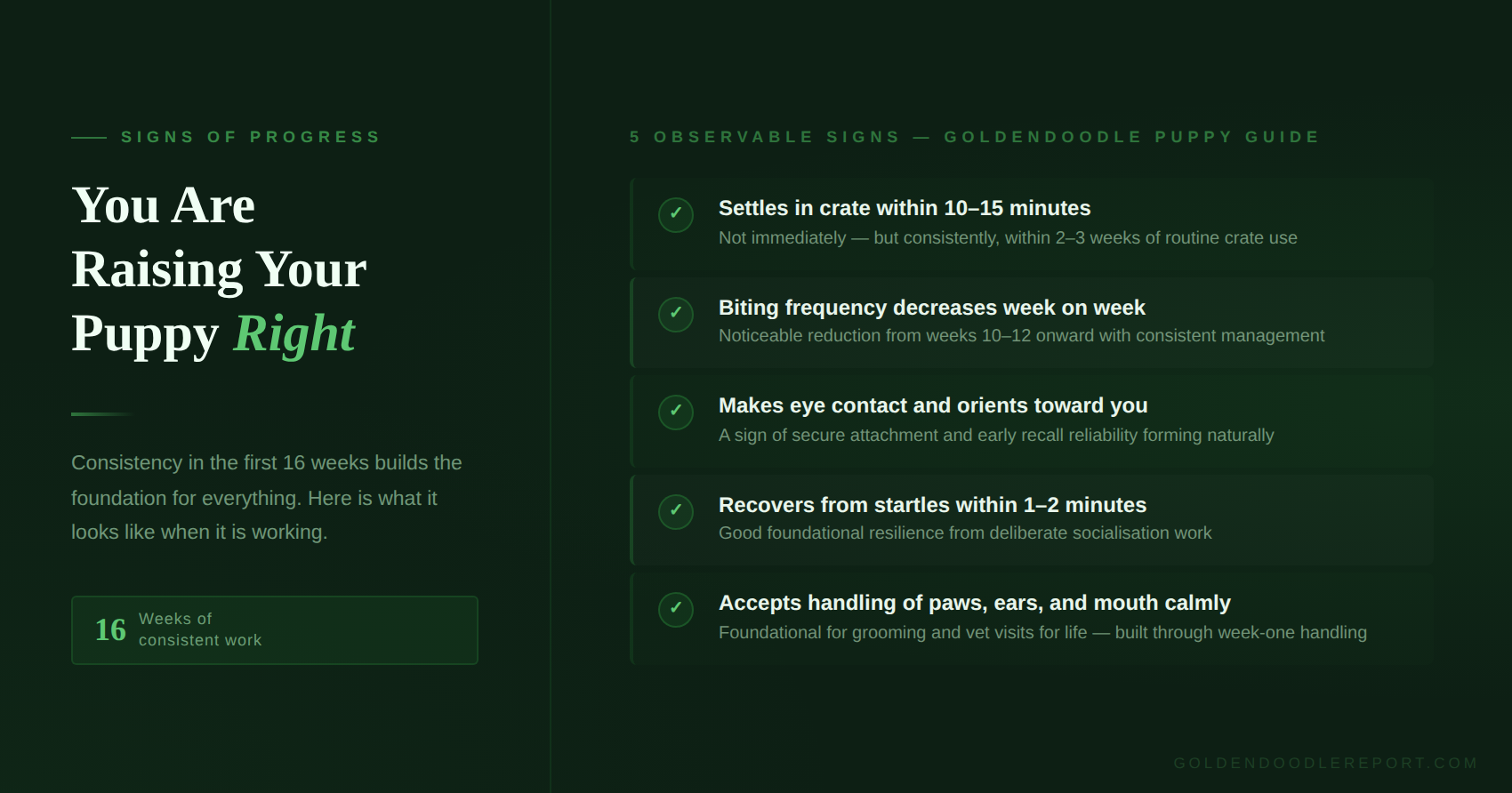
Most puppy guides tell you what to do. Fewer tell you what to look for as confirmation it is working. These are the observable signs that your approach is on track:
- Your puppy settles in the crate within 10–15 minutes of being placed there — not immediately, but consistently. This typically develops within 2–3 weeks of consistent crate use.
- Biting frequency and intensity decreases week on week from around 10–12 weeks onward when managed consistently. If it is not decreasing, the response is not consistent enough.
- Your puppy makes eye contact with you voluntarily and orients toward you in new environments — a sign of secure attachment and early recall reliability forming naturally.
- Your puppy recovers from startling experiences within 1–2 minutes rather than remaining vigilant or hiding — a sign of good foundational resilience from the socialisation work.
- Your puppy accepts handling of paws, ears, and mouth without escalating — foundational for grooming and veterinary visits for life. This develops through consistent gentle handling from week one.
When to Call the Vet — Escalation Thresholds
🩺 Contact Your Vet Immediately If:
- Vomiting more than twice in 24 hours, or any vomiting alongside lethargy
- Blood in stool or diarrhoea lasting more than 24 hours
- Complete loss of appetite lasting more than 24 hours in a puppy under 16 weeks
- Lethargy — puppy cannot be roused to normal activity, is limp, or unresponsive to stimulation
- Difficulty breathing, persistent coughing, or nasal discharge alongside lethargy
- Swollen abdomen, especially if the puppy seems uncomfortable or in pain
- Any seizure activity
- Signs of pain — yelping when touched, reluctance to move, guarding a limb
Puppies deteriorate faster than adult dogs. Do not wait and see with any of the above. Call your vet or an emergency animal clinic.
For non-emergency guidance on puppy health milestones, vaccination schedules, and what a standard first year of vet visits looks like, see the Goldendoodle Puppy Vaccination Timeline and Goldendoodle Puppy Deworming Guide.
The American Veterinary Medical Association provides guidance on puppy health and wellness that is worth bookmarking as a reference throughout the first year. See the puppy care guidance at the AVMA.
Essential Equipment for a Goldendoodle Puppy
You do not need to buy everything before pickup day — but certain items must be in place before the puppy arrives. The crate in particular should be set up in its final location with bedding several days beforehand so it develops a familiar smell. A correctly fitted harness matters from day one — a collar alone is not appropriate for a puppy whose neck structures are still developing. Appropriate toys need to be available at all times, not as entertainment but as redirection targets when teeth touch skin.
Complete equipment guides by category
- 👉 Best Crate for Goldendoodle Puppies
- 👉 Best Dog Bed for Goldendoodle Puppies
- 👉 Best Harness for Goldendoodle Puppies
- 👉 Best Puppy Playpen for Goldendoodles
- 👉 Best Puppy Food Bowls for Goldendoodles
- 👉 Best Toys for Goldendoodle Puppies
- 👉 Best Chew Toys for Teething Goldendoodles
- 👉 Best Puppy Treats for Goldendoodles
- 👉 Best Puppy Shampoo for Goldendoodles
Your First 16-Week Goldendoodle Puppy Action Plan
- Before pickup day: Complete the puppy-proofing checklist room by room. Set up the crate in its permanent location with bedding. Buy the same food brand as the breeder. Book the first vet appointment for within 72 hours of arrival.
- Days 1–3: Limit visitors and overstimulation. Focus on helping the puppy feel safe. Introduce the crate gradually with high-value treats. Establish toilet trip timing — every 45–60 minutes while awake.
- Week 1–2: Establish a consistent daily routine matching feeding, toilet, play, and nap times. Start handling exercises — gentle contact with paws, ears, mouth. Begin the crate overnight protocol and hold firm through the crying.
- Weeks 3–8 (while in the socialisation window): Begin deliberate, positive exposure to sounds, surfaces, people, and environments daily. Carry the puppy in public before vaccinations are complete rather than waiting. Expose to car travel, different flooring, different environments — always at the puppy’s pace.
- Weeks 8–12: Attend first puppy class if available in your area — this provides structured socialisation with other puppies in a safe environment. Continue crate training, biting management, and routine. Begin short 5-minute training sessions on name recognition and sit.
- Weeks 12–16: Complete vaccination course per vet schedule. Begin supervised outdoor access once vet confirms it is safe. Add grooming habituation — brush daily for 2–3 minutes regardless of coat need. Start building brief periods of independence so separation anxiety does not develop by default.
- Months 4–12: Maintain the routine structure established in the first 16 weeks. Increase exercise gradually as growth plates develop. Expect adolescent regression — this is normal, not a training failure. Keep training sessions short, positive, and consistent through the teenage phase.
⏱ What to Expect — Realistic Timeline
- Crate settling: Most puppies accept the crate without prolonged crying within 2–3 weeks of consistent use
- Biting reduction: Noticeable decrease in frequency typically by weeks 10–12 with consistent management; significant improvement by 16 weeks
- Reliable toilet training: Most Goldendoodles are reliably toilet trained by 4–6 months — not earlier
- Energy settling: Mini Goldendoodles often show the first real calming around 12 months; Standards closer to 15–18 months
- Friction points: Weeks 2–4 are typically the hardest. The combination of sleep deprivation, biting, and toilet accidents peaks here before it improves
✅ Where to Start
If you have just brought your puppy home or are in the first two weeks, the most useful next guide is the Goldendoodle Puppy Care Guide — it covers the complete first year of care in practical detail and is the best complement to this pillar. If you are preparing before arrival, start with the Goldendoodle Puppy Checklist.
🔑 Key Takeaways
- The 8–16 week socialisation window closes whether or not you use it — what happens during this period tends to shape temperament more than training at any later stage
- An overtired Goldendoodle puppy looks hyper, not tired — bites harder and cannot settle; the correct response is enforced rest, not more exercise
- Owner consistency is the largest variable in puppy development — the breed’s intelligence works in your favour when signals are consistent and against you when they are not
- Standard Goldendoodles often do not show significant calming until 15–18 months; Minis may settle closer to 12 months — both are within normal range
- The first vet visit should happen within 72 hours of arrival, not at the first scheduled vaccine date
- Growth plates may not close until 12–18 months — repetitive stair use, jumping, and high-impact exercise before this point may contribute to adult joint problems
Start Here — Essential Goldendoodle Puppy Guides
If you are new to this site or just starting your puppy journey, these are the six guides that matter most in the first weeks:
- 📌 Goldendoodle Puppy Checklist — everything to buy and set up before pickup day
- 📌 First Week With a Goldendoodle Puppy — what to expect and how to manage it day by day
- 📌 Goldendoodle Puppy Routine by 8 Weeks — the complete daily schedule that makes everything else easier
- 📌 Goldendoodle Puppy Socialisation Checklist — how to use the 8–16 week window correctly
- 📌 Goldendoodle Puppy Vaccination Timeline — health milestones and what to expect at each vet visit
- 📌 Goldendoodle Puppy Biting Phase Guide — the consistent approach that actually works
Related Topics
- 🔗 Goldendoodle FAQ & Seasonal Guide — answers to the most common Goldendoodle questions by season
- 🔗 Why Is My Goldendoodle So Hyper? — understanding energy levels and what drives them
- 🔗 Why Is My Goldendoodle Sleeping So Much? — when to be reassured and when to call the vet
- 🔗 Why Does My Goldendoodle Follow Me Everywhere? — attachment behaviour explained
- 🔗 Goldendoodle Summer Care Guide — managing heat, hydration, and exercise in warm weather
All Goldendoodle Puppy Guides
Every article in the Goldendoodle Puppy Guide category — use this as your complete reference index.
Preparation and First Days
- Goldendoodle Puppy Checklist
- Preparing Your Home for a Goldendoodle Puppy
- First Week With a Goldendoodle Puppy
- Goldendoodle Puppy First Night at Home
- Goldendoodle Puppy Care Guide
Routines and Daily Life
- Goldendoodle Puppy Routine by 8 Weeks
- Goldendoodle Puppy Sleep Schedule
- How Much Sleep Does a Goldendoodle Puppy Need?
- Apartment Living With a Goldendoodle
Health, Vaccination and Vet Visits
- Goldendoodle Puppy Vaccination Timeline
- Goldendoodle Puppy Deworming Guide
- Goldendoodle Puppy First Vet Visit
Development, Behaviour and Training
- Goldendoodle Puppy Growth Stages
- Goldendoodle Puppy Fear Stages
- Goldendoodle Puppy Socialisation Checklist
- Goldendoodle Puppy Biting Phase Guide
- Goldendoodle Puppy Teething Guide
- When Do Goldendoodle Puppies Calm Down?
- How to Bond With a Goldendoodle Puppy
Exercise, Movement and Safety
- Goldendoodle Exercise Needs by Age
- When Can a Goldendoodle Puppy Go Outside?
- When Can a Goldendoodle Puppy Climb Stairs?
Grooming and Bathing
Equipment and Product Guides
- Best Crate for Goldendoodle Puppies
- Best Dog Bed for Goldendoodle Puppies
- Best Harness for Goldendoodle Puppies
- Best Puppy Playpen for Goldendoodles
- Best Puppy Food Bowls for Goldendoodles
- Best Toys for Goldendoodle Puppies
- Best Chew Toys for Teething Goldendoodles
- Best Puppy Treats for Goldendoodles
Frequently Asked Questions
What age should a Goldendoodle puppy come home?
8 weeks is the standard recommended age. This is when the puppy has completed the earliest bonding period with their mother and littermates but is still within the socialisation window. Reputable breeders will not release puppies before 8 weeks. Puppies collected earlier than 8 weeks tend to show higher rates of anxiety and bite inhibition problems in adulthood.
How long does the Goldendoodle puppy phase last?
The puppy phase — characterised by high energy, biting, and constant learning — typically runs from 8 weeks to around 12–18 months depending on the size of the dog. Mini Goldendoodles often mature earlier, with many owners noticing a genuine shift in energy and impulse control around 10–12 months. Standard Goldendoodles commonly remain in a high-energy adolescent phase until 15–18 months. Both timelines are normal.
How do I stop my Goldendoodle puppy from biting so much?
Consistency is the answer — not any specific technique. Every time teeth touch skin, the interaction ends immediately. The puppy is not punished — the interaction simply stops. A toy is offered as an alternative. Over 2–4 weeks of absolutely consistent responses, biting frequency decreases significantly in most Goldendoodle puppies. Inconsistency — where biting sometimes gets a reaction, sometimes does not — actively maintains the behaviour. See the full guide: Goldendoodle Puppy Biting Phase Guide.
When can a Goldendoodle puppy go outside?
Before the full vaccination course is complete, puppies should only access private gardens and areas with no contact with unknown dogs or contaminated ground. After your vet confirms the course is complete — typically around 14–16 weeks — outdoor access is generally safe. Do not make assumptions about timing — confirm the specific safe date with your own vet. Full guide: When Can a Goldendoodle Puppy Go Outside?
How much does a Goldendoodle puppy sleep?
Between 16 and 20 hours per day at 8 weeks. This decreases gradually — by 6 months most Goldendoodles sleep 14–16 hours per day, though this varies. Interrupting nap time or preventing natural sleep often makes behaviour worse, not better. A puppy that seems hyper and cannot settle is often overtired rather than under-exercised. Full guide: How Much Sleep Does a Goldendoodle Puppy Need?
Is a Goldendoodle puppy hard to raise?
Harder than many buyers expect, easier than many fear. The breed is highly intelligent, which means they learn quickly — but also that they notice and respond to inconsistency quickly. The first 12 weeks are genuinely demanding: sleep disruption, biting, toilet training, and socialisation all run simultaneously. Most owners find the difficulty peaks around weeks 2–4 and begins to ease around weeks 10–12 as early training results start to show.
What are the most important things to do in the first week with a Goldendoodle puppy?
In order of priority: get to the vet within 72 hours of arrival, establish a consistent daily routine from day one, begin the crate conditioning process, limit overstimulation and visitors in the first 72 hours, and start deliberate gentle handling of paws, ears, and mouth daily. The first week is not the time for comprehensive training — it is the time for security, routine, and trust-building. Full guide: First Week With a Goldendoodle Puppy.
Disclaimer: The information in this article is provided for general educational purposes only. King James Adjei is a researcher and enthusiast, not a veterinarian or certified behaviourist. For health concerns, symptoms, or behaviour issues that may indicate a medical or welfare problem, always consult a qualified veterinarian or certified professional. Do not delay seeking veterinary advice based on information in this guide.