5-minute read | Last updated March 2026 | Reviewed for accuracy
By King James Adjei | GoldendoodleReport.com
Researcher, Goldendoodle enthusiast, and founder of GoldendoodleReport. Every guide on this site is written to give owners reliable, clearly organised information — researched carefully and updated regularly.
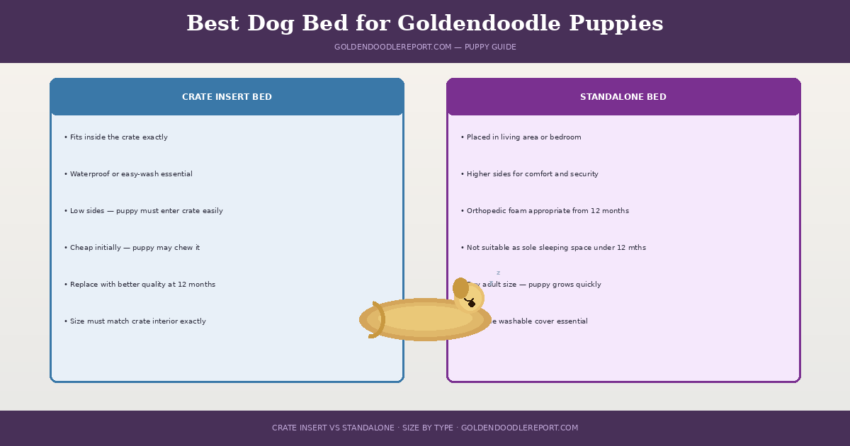
The best dog bed for Goldendoodle puppies is actually two different products serving two different functions — and buying the wrong type for each function is one of the most consistent puppy setup mistakes. A crate insert bed and a standalone living-area bed have entirely different specifications, and treating them as interchangeable produces beds that do not work, get destroyed, or go unused.
Who This Guide Is For
This article is most useful if you:
- Are buying a bed before the puppy arrives and want the right specification for your Goldendoodle type
- Have bought a bed and the puppy is destroying it or ignoring it and want to understand why
- Are unsure whether the puppy should sleep in a bed or a crate and want a clear answer
- Want to know when to upgrade from the basic crate insert to a better quality standalone bed
For the crate that the crate insert bed goes into, see Best Crate for Goldendoodle Puppies.
Quick Summary
The best dog bed for Goldendoodle puppies requires two purchases. First, a crate insert — a flat, waterproof, washable mat that fits the crate interior exactly, sized to the crate not the puppy. Second, a standalone bed for the living area or bedroom — sized for the adult dog, with raised sides for comfort and a removable washable cover. Do not buy an expensive orthopedic bed for a puppy under 12 months — it will be chewed. Buy inexpensive, washable, and replaceable for the crate stage and upgrade after reliable toilet training is established.
Quick Answer
Buy two beds: a flat waterproof fleece mat for the crate interior sized to fit exactly, and a bolster or donut bed sized for the adult dog for the living area. Mini needs a 24 to 30 inch standalone. Medium needs 30 to 36 inches. Standard needs 36 to 42 inches. Defer the expensive orthopedic bed until 12 months when reliable toilet training and reduced chewing make it a worthwhile investment.
Quick Diagnosis
- If the puppy is chewing and destroying its bed → crate insert is too expensive or too soft, replace with a basic washable fleece mat and defer upgrade until 12 months
- If the puppy ignores the standalone bed → bed is placed in a low-traffic area away from family movement, move it to where the family spends time
- If the puppy is toileting on the bed → remove the bed from the crate until toilet training is reliable, use the bare crate tray with a thin washable mat only
- If the puppy rolls off the standalone bed constantly → bed is too small for the adult size, upgrade to the correct size immediately
You buy a sixty-pound memory foam orthopedic dog bed before the puppy arrives because you want it to be comfortable. By week three the puppy has torn the cover, pulled out a section of foam, and is carrying chunks of it around the kitchen. You spend the same amount again on a replacement. By week six the second bed is also destroyed. The orthopedic bed was the right product — bought at the wrong developmental stage for a puppy that had not yet outgrown its chewing phase.
The confusion around puppy beds comes from treating bedding as a single category when it actually serves two entirely distinct purposes at two entirely different life stages. Once those two purposes are understood, the buying decision becomes straightforward — and the frustration of destroyed or ignored beds largely disappears.
This guide covers:
- The crate insert vs standalone distinction — two beds, two jobs
- Why puppies chew beds and how to manage it without removing bedding entirely
- Size by Goldendoodle type for both bed types
- What features actually matter and which are marketing
- When to upgrade to the quality standalone bed
In This Guide
- Best Dog Bed for Goldendoodle Puppies: Two Types, Two Functions
- Why Puppies Chew Beds — Managing It Without Removing Bedding
- Size by Goldendoodle Type — Crate Insert and Standalone
- Features That Matter vs Features That Are Marketing
- When to Upgrade to the Quality Standalone Bed
- What Most Owners Get Wrong
- Frequently Asked Questions
Best Dog Bed for Goldendoodle Puppies: Two Types, Two Functions
Understanding why the best dog bed for Goldendoodle puppies requires two purchases — not one — requires understanding what each bed is actually doing. These are not interchangeable products at different price points. They are different products with different specifications serving different purposes. For context on how sleep environment affects puppy development and settling behaviour, the American Kennel Club’s guide on where dogs should sleep covers the options and considerations clearly.
Best Dog Bed for Goldendoodle Puppies — Two Types Compared
| Specification | Crate Insert Bed | Standalone Bed |
|---|---|---|
| Purpose | Comfort and warmth inside the crate. Makes the crate den-like. Protects the plastic tray. | Resting spot in the living area or bedroom outside crate hours. The dog’s own place in the family space. |
| Profile | Flat or very low-sided — puppy must step in and out of the crate without obstruction | Raised sides (bolster or donut) — provides the enclosed feeling dogs seek when resting |
| Size | Matches the crate interior exactly — not the puppy’s current size | Sized for the adult dog — puppy grows into it |
| Material | Waterproof backing essential — accidents will happen. Fleece or sherpa top layer. | Removable washable cover essential. Base can be memory foam or polyfill depending on age. |
| Budget | Inexpensive — budget for replacements. Puppy will likely chew or soil several before reliable toilet training. | Medium investment initially — buy size correct for adult dog. Defer premium orthopedic until 12 months. |
| When to upgrade | Replace as needed through chewing and accidents — no timeline for quality upgrade until 12 months | Replace with orthopedic quality at 12 months when toilet training is reliable and chewing is reduced |
Why Puppies Chew Beds — Managing It Without Removing Bedding Entirely
Bed chewing in puppies is not a bedding problem — it is a teething and boredom problem that expresses itself on bedding. A puppy chewing its crate insert is not being destructive toward the bed specifically. It is chewing the most available soft object during a period of genuine oral discomfort, and the bed happens to be present and chewable. Removing the bed in response eliminates the target but not the behaviour — the puppy simply directs the chewing at the next available soft object.
The management approach that works is not removing the bed but making the bed less interesting than the appropriate chew alternatives. A frozen stuffed Kong placed in the crate simultaneously with the bed redirects chewing to the Kong, which is more satisfying for a teething puppy than fabric. A puppy with appropriate chew toys available in the crate will chew the toy in preference to the bed in most cases.
For the crate insert specifically, the correct response to chewing is to buy an inexpensive, replaceable fleece mat rather than an expensive bed, and to budget for two or three replacements during the teething period. A five-pound fleece mat bought four times costs less than one sixty-pound orthopedic bed bought once and destroyed within days. Match the bed investment to the developmental stage — inexpensive and replaceable during teething, quality and durable after 12 months.
If chewing of the crate insert is severe enough that the puppy is ingesting material — pulling out stuffing or large fabric sections — remove the bed from the crate entirely until the teething phase passes and use the bare crate tray with a thin rubber mat only. A puppy sleeping on a bare crate tray does not suffer — it is a short-term measure that eliminates an ingestion risk.
Size by Goldendoodle Type — Crate Insert and Standalone
Bed Size by Goldendoodle Type
| Type | Adult Weight | Crate Interior | Crate Insert Size | Standalone Bed Size |
|---|---|---|---|---|
| Mini | 7–15 kg | 36 inch crate | ~90 x 57 cm flat mat | S/M bolster — 60–75 cm diameter or length |
| Medium | 15–25 kg | 42 inch crate | ~105 x 67 cm flat mat | M/L bolster — 80–90 cm diameter or length |
| Standard | 25–40 kg | 48 inch crate | ~120 x 75 cm flat mat | XL bolster — 100–110 cm diameter or length |
The crate insert dimensions above are the interior floor dimensions of the corresponding crate sizes. Measure the actual interior of your specific crate before purchasing — manufacturer interior dimensions vary by brand by up to 5 cm in each direction. A mat that is 3 cm too large cannot lie flat inside the crate, which defeats its purpose entirely. Measure first and buy to those measurements.
Features That Matter vs Features That Are Marketing
Features that genuinely matter for a crate insert bed: waterproof or water-resistant backing (not optional — accidents are inevitable during toilet training), machine washable at 40 degrees or above, non-slip base that prevents the mat sliding on the crate tray, and a thickness of 2 to 4 cm — thin enough not to obstruct crate entry but enough to insulate from the plastic tray.
Features that genuinely matter for a standalone puppy-to-adult bed: a removable, machine-washable cover (the cover will be washed weekly — make it easy), a base that holds its shape after repeated washing, and sides high enough that the dog can rest its chin on them without the head drooping. The sides perform a comfort function — dogs rest more easily when they have a surface to support their head and neck.
Features that are primarily marketing at the puppy stage: memory foam for puppies under 12 months (the joint benefit is real but premature — a growing puppy’s body does not require orthopedic support in the way an aging joint does, and memory foam is typically the most expensive component of any dog bed), cooling gel inserts (useful for adult dogs in summer but not relevant to puppy settling behaviour), and premium fabric covers described as velvet or suede (beautiful until the first accident, then a cleaning challenge).
When to Upgrade to the Quality Standalone Bed
The upgrade from a budget standalone bed to a quality orthopedic or premium bed has a specific trigger point: reliable toilet training combined with significantly reduced chewing behaviour. Both conditions are typically met together at approximately 12 months — which is not coincidental, as both toilet training reliability and reduced chewing intensity are products of the same developmental maturation.
A puppy that is consistently dry overnight, does not toilet on the bed, and is no longer actively chewing soft objects during crate time has cleared both tests. At this point the investment in a quality orthopedic bolster bed is appropriate and worthwhile — the dog will use it consistently for the next decade, and joint support becomes genuinely relevant as the adult dog ages. Buying before these conditions are met is not wrong in principle but is likely to be followed by a replacement purchase after an accident or chewing incident makes the premium bed unwearable.
The crate insert does not require a similar upgrade. Once toilet training is reliable, the crate insert can be upgraded to a higher quality version — a more padded fleece mat or a low-sided cushion — but the functional requirement remains the same: flat, washable, fits the crate interior exactly.
Action Plan — Buying the Right Beds Before the Puppy Arrives
- Measure the interior of your crate before buying the crate insert. Do not rely on published crate dimensions — measure the actual interior floor space. Buy the crate insert to those measurements.
- Buy a basic waterproof fleece mat for the crate insert. Budget five to fifteen pounds and buy two — one in use, one in the wash. Do not buy an expensive crate pad at this stage.
- Buy the standalone bed in the adult size for your Goldendoodle type. Use the size table above. The puppy will be too small for it initially but grows into it within months. Buying the puppy size means buying again at 6 months.
- Choose a standalone bed with a removable, machine-washable cover. Confirm this before purchasing — not all beds with removable covers are machine washable. Check the label.
- Place the standalone bed where the family spends most time. The kitchen or living room — not a quiet corner or spare room. Dogs seek proximity to the family pack. A bed in an isolated location is a bed that does not get used.
- Set a 12-month upgrade reminder. Once toilet training is reliable and chewing has reduced, the orthopedic upgrade is appropriate. Set the reminder now so the decision is planned rather than reactive.
What to Expect
Timeline: The crate insert will likely be chewed or soiled in the first weeks — this is normal and expected. Replace as needed with the budget option. The standalone bed may be ignored initially — persist with placement in the family area and the dog will begin using it within the first two to four weeks as it identifies its place in the household routine.
Friction: The puppy sleeping in the crate with a basic mat rather than a beautiful dog bed can feel inadequate to owners who want to provide comfort. The crate with a clean fleece mat and a stuffed Kong is genuinely comfortable for the puppy. Comfort at this stage is cleanliness, warmth, and security — not premium materials.
Signs the setup is working: Puppy enters the crate voluntarily when the door is open. Puppy uses the standalone bed during family time without being directed to it. No toileting on either bed after the first four to six weeks.
Your Next Step
Measure the crate interior today and order the fleece mat to those measurements. Select the standalone bed in the adult size for your Goldendoodle type from the table above. Both should be in place before the puppy arrives — the first night is not the time to improvise sleeping arrangements.
What Most Owners Get Wrong
Mistake 1 — Buying an expensive orthopedic bed for a puppy under 12 months. The orthopedic bed is the right product for an adult Goldendoodle — particularly as the dog ages and joint support becomes relevant. It is the wrong product for a puppy that will chew it, soil it, and outgrow the puppy size within months. The investment is not wasted if the timing is correct. It is frequently wasted when made at 8 weeks.
Mistake 2 — Buying one bed and expecting it to serve both functions. A bolster bed placed inside a crate blocks crate entry and exit. A flat crate mat placed in the living room provides no enclosure or head support. One product cannot optimally serve both functions. The two-bed approach costs less overall than buying one inappropriate bed, having it fail its function, and replacing it with something else.
Mistake 3 — Removing the bed entirely when the puppy chews it. A puppy without bedding in the crate sleeps on the bare plastic tray — which is acceptable as a short-term measure but not a permanent solution. The goal is to make the bed less interesting than the appropriate chew alternative, not to remove the comfort option. Pair the bed with a frozen Kong in the crate. The Kong addresses the chewing drive and the bed remains available for settling and comfort.
Signs Your Bed Setup Is Working
- Puppy enters the crate voluntarily and settles on the mat without prolonged distress
- Standalone bed is being used during family time — puppy gravitates toward it independently
- Crate mat remains intact between replacements — chewing directed to Kong rather than mat
- No toileting on the standalone bed after reliable toilet training is established
⚠️ Watch Out
If the puppy is ingesting significant amounts of bed material — pulling out and swallowing stuffing or large fabric pieces — remove the bed from the crate immediately and contact your vet. Fabric and foam ingestion can cause intestinal obstruction. Use the bare crate tray with a thin rubber mat until the chewing phase reduces. This is not a permanent measure — it is a safety response to a specific ingestion risk.
Contact Your Vet If
- The puppy has ingested a significant quantity of bed stuffing or foam — same-day contact regardless of whether symptoms are present
- Vomiting, loss of appetite, or difficulty defecating after a chewing incident involving bed material warrants immediate veterinary contact
Key Takeaways — Best Dog Bed for Goldendoodle Puppies
- Two beds are needed — a flat waterproof crate insert and a raised standalone bed for the living area — they serve different functions and require different specifications
- The crate insert must fit the crate interior exactly — measure the actual interior, not the published crate size
- Buy inexpensive and washable for the crate insert stage — budget for replacements during the teething and toilet training period
- Buy the standalone bed in the adult size — Mini 60 to 75 cm, Medium 80 to 90 cm, Standard 100 to 110 cm
- Defer the orthopedic upgrade until 12 months when toilet training is reliable and chewing has reduced significantly
- Bed chewing is managed by pairing with a frozen Kong in the crate — not by removing the bed
Related Goldendoodle Puppy Guides
- Best Crate for Goldendoodle Puppies — The crate that the crate insert bed goes into — size and type guide
- Goldendoodle Puppy Crate Training Guide — How bedding integrates with the full crate training protocol
- Goldendoodle Puppy First Night Guide — Where to position the bed and crate on night one
- Best Chew Toys for Teething Goldendoodles — The Kong protocol that redirects bed chewing
- Goldendoodle Puppy Care Guide — Complete first-year equipment overview
Part of the Goldendoodle Puppy Guide resource hub:
→ Goldendoodle Puppy Guide — Browse all 40 puppy guides
Frequently Asked Questions
What size dog bed does a Goldendoodle puppy need?
For the crate insert — the bed must match the crate interior exactly. Measure the actual interior floor of your crate and buy to those dimensions. For the standalone bed — buy for the adult size, not the puppy’s current size. Mini Goldendoodles need a 60 to 75 cm bed, Medium need 80 to 90 cm, and Standard need 100 to 110 cm. The puppy will be too small for the standalone initially but grows into it rapidly and you avoid buying a replacement within months.
Should a Goldendoodle puppy sleep in a bed or a crate?
In a crate with a bed inside it, for the first 12 months. The crate provides the structure that supports toilet training, prevents destructive behaviour overnight, and gives the puppy a secure den space. The bed inside the crate provides the comfort and warmth. These are complementary rather than alternative arrangements. A puppy sleeping in a standalone bed without a crate during the first year has no toilet training structure and no safe overnight containment. Introduce the standalone bed as a daytime resting spot alongside the crate, not as a replacement for it.
My Goldendoodle puppy keeps chewing its bed — what should I do?
Replace the current bed with a basic inexpensive fleece mat and pair every crate session with a frozen stuffed Kong. The Kong addresses the oral drive that the bed is currently receiving. Most puppies will redirect to the Kong in preference to the mat when both are available. Budget for two or three mat replacements during the teething period — this is normal and expected. Do not buy an expensive replacement bed until chewing has reduced at 12 months.
Is an orthopedic dog bed worth it for a Goldendoodle puppy?
Not at the puppy stage — defer it until 12 months. The orthopedic benefit — joint support and pressure distribution — is genuinely valuable for an adult Goldendoodle, particularly as the dog ages. At the puppy stage the joint-support benefit is premature, and the cost of a premium orthopedic bed is likely to be written off in a chewing or toileting incident before the dog reaches the age where the product’s benefits become relevant. Buy it at 12 months when toilet training is reliable and chewing has reduced.
Where should I put the dog bed in my house?
In the room where the family spends most time — typically the kitchen or living room. Dogs seek proximity to the family group when resting, and a bed placed in an isolated location is consistently ignored in favour of lying on the floor near family members. The bed should be the most comfortable option in the room where the dog naturally wants to be, not the only option in a room the dog has no reason to visit.
The information in this article is provided for general educational purposes only. King James Adjei is a researcher and enthusiast, not a veterinarian. For concerns about bed material ingestion or any signs of gastrointestinal distress, always consult a qualified veterinarian promptly.