6-minute read | Last updated March 2026 | Reviewed for accuracy
By King James Adjei | GoldendoodleReport.com
Researcher, Goldendoodle enthusiast, and founder of GoldendoodleReport. Every guide on this site is written to give owners reliable, clearly organised information — researched carefully and updated regularly.
The best toys for Goldendoodle puppies are not chosen by how much the puppy likes them in the first five minutes but by what developmental function they serve. A puppy that destroys every toy immediately, ignores the expensive puzzle feeder, or only engages with one toy out of the twelve bought is not being difficult — it is responding to a toy selection that has no structure behind it. This guide gives you that structure: four categories by function, a rotation system that maintains engagement, and specific guidance on what is safe for a Goldendoodle puppy’s jaw strength.
Who This Guide Is For
This article is most useful if you:
- Have a new Goldendoodle puppy and want to buy the right toys before or immediately after it arrives
- Have bought several toys and the puppy seems uninterested or destroys them immediately
- Want to understand why certain toys work for enrichment while others only entertain briefly
- Are looking for toys that tire the puppy out mentally as well as physically
For chew toys specifically during the teething phase, see Best Chew Toys for Teething Goldendoodles.
Quick Summary
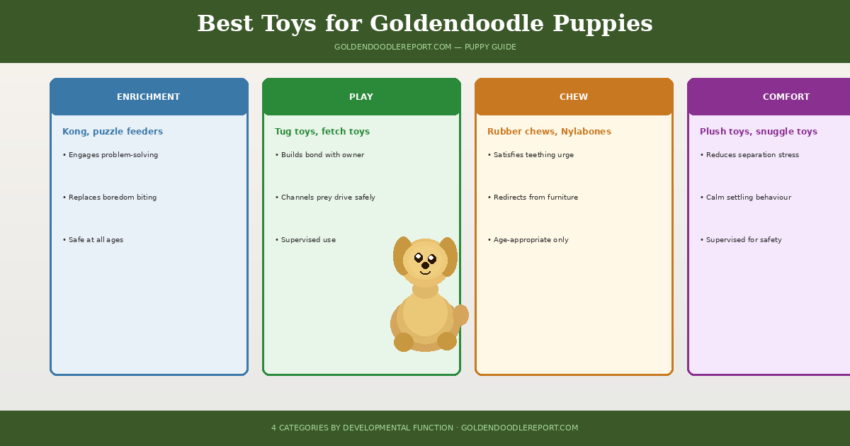
The best toys for Goldendoodle puppies fall into four categories — enrichment toys (Kong, puzzle feeders), play toys (tug, fetch), chew toys (rubber, Nylabone), and comfort toys (plush, snuggle). Each category serves a specific developmental function. Owning three to four toys total and rotating them every three to four days produces more sustained engagement than owning twelve toys simultaneously. Start with one toy from each category and rotate rather than purchasing a large collection.
Quick Answer
The best starting set for a Goldendoodle puppy is: one stuffable rubber toy (Kong Puppy), one soft tug toy, one soft rubber chew, and one plush comfort toy. Three to four toys out at any one time — rotate the rest every three days. Add puzzle feeders from 12 weeks. Add more durable chew options from 16 weeks as adult teeth emerge. Never leave unsupervised with rope toys or plush toys with button eyes or squeakers that can be removed.
Quick Diagnosis
- If puppy ignores most toys after a few days → too many toys out simultaneously, rotate down to three or four and reintroduce others weekly
- If puppy destroys every toy within minutes → toys are too soft for the puppy’s jaw strength, move to more durable rubber options
- If puppy is biting furniture and household items → insufficient chew toys, add a rubber chew and a Nylabone and ensure they are always accessible
- If puppy carries one toy everywhere and will not engage with others → this is the comfort toy, keep it available always and do not rotate it out
You buy fifteen toys before the puppy arrives — a mix of everything you saw recommended online. By week two the puppy has destroyed four, ignored seven, and fixates on two. You spend more money on replacements. At four months you have a corner full of broken toys and a puppy that still bites the sofa. The problem is not the puppy. It is that fifteen toys with no functional framework produces the same result as no toys — no structure, no sustained engagement, no redirected biting.
Goldendoodles are among the most toy-engaged breeds because both parent breeds — Golden Retrievers and Poodles — were developed for work involving object interaction. Golden Retrievers retrieve, carry, and hold objects as their primary working function. Poodles were water retrievers with high problem-solving drive. The result is a puppy with strong mouthy behaviour, high motivation for object interaction, and genuine capacity for puzzle engagement — all of which need to be channelled rather than suppressed. The toy selection framework does exactly that.
This guide covers:
- The four toy categories and what each one is actually doing for the puppy
- The rotation system — why fewer toys out produces more engagement
- The durability vs safety trade-off for Goldendoodle jaw strength
- Toys to avoid and why
- Age-by-category guidance from 8 weeks to 12 months
In This Guide
- Best Toys for Goldendoodle Puppies: The Four Categories by Function
- The Rotation System — Why Fewer Toys Produces More Engagement
- Durability vs Safety — The Goldendoodle Puppy Trade-Off
- Toys to Avoid and Why
- Age-by-Category Guidance — 8 Weeks to 12 Months
- What Most Owners Get Wrong
- Frequently Asked Questions
Best Toys for Goldendoodle Puppies: The Four Categories by Function
Every toy a Goldendoodle puppy interacts with is doing one of four developmental jobs. Understanding which job each toy type performs is what allows owners to build a toy selection that serves the puppy’s actual needs rather than accumulating objects at random. For an overview of how play behaviour develops in puppies, the American Kennel Club’s guide to dog toy preferences covers the research on play motivation clearly.
Best Toys for Goldendoodle Puppies — Four Categories by Developmental Function
| Category | Examples | Developmental Function | When to Introduce | Supervision |
|---|---|---|---|---|
| Enrichment | Kong Puppy, Licki Mat, puzzle feeders, snuffle mat | Engages problem-solving circuits — produces genuine mental tiredness. Reduces boredom biting. Builds independent play capacity. | From 8 weeks — Kong immediately, puzzle feeders from 12 weeks | Unsupervised safe for Kong and Licki Mat |
| Play | Tug toy (rubber or fleece), soft fetch ball, flirt pole | Builds owner-puppy bond. Channels prey drive into appropriate outlet. Supports training — tug is a powerful training reward for Goldendoodles. | From 8 weeks — soft tug from day one | Supervised use only — play toys are interactive |
| Chew | Kong Puppy (frozen), Nylabone Puppy, KONG Teething Stick | Satisfies the teething urge safely. Redirects chewing from furniture, shoes, and people. Provides jaw exercise appropriate to developmental stage. | From 8 weeks — soft rubber. Harder options from 16 weeks as adult teeth emerge | Supervised initially until chewing pattern established |
| Comfort | Soft plush toy (no button eyes), snuggle puppy heartbeat toy | Reduces separation anxiety and settling distress — particularly during the first weeks. Provides a safe fixation object. Supports crate acceptance. | From day one — particularly in the crate during the first 2 weeks | Supervised — check regularly for damage to avoid ingestion of filling |
The Rotation System — Why Fewer Toys Produces More Engagement
The rotation system is the single most practical insight in Goldendoodle puppy toy management — and almost no mainstream article mentions it. When a puppy has access to twelve toys simultaneously, each individual toy becomes background noise. The puppy investigates all of them briefly in the first day, identifies a favourite or two, and ignores the rest. The ignored toys lose engagement value entirely because familiarity eliminates novelty — and novelty is what drives the investigation and engagement response in the first place.
The rotation system works by keeping a small number of toys accessible at any one time — three or four — and cycling others in and out every three to four days. A toy that has been out of sight for four days is treated with near-novel interest when it reappears. The same toy the puppy ignored on day five becomes genuinely engaging on day nine when it comes back into rotation. This maintains sustained engagement with a smaller toy investment and prevents the habituation that makes expensive toys irrelevant within a week.
Practical rotation protocol: Keep four toys accessible at any time — one from each category. Every three to four days, swap out the enrichment toy and the play toy for others from the rotation stock. Keep the current comfort toy and current chew toy stable — these serve ongoing needs rather than novelty-based engagement. The comfort toy in particular should not be rotated out if the puppy has formed an attachment to it.
Durability vs Safety — The Goldendoodle Puppy Trade-Off
Goldendoodle puppies are mouthy, persistent chewers — both parent breeds were working dogs that interacted with objects constantly. A toy that a Labrador puppy leaves intact for three months may last a Goldendoodle puppy three days. This creates a specific management challenge: the owner wants durable toys that survive, but the safest toys for puppies are often softer options that are destroyed quickly.
The resolution is to match durability to the puppy’s developmental stage rather than buying the most durable toy available from day one. At 8 to 12 weeks, puppy teeth are small and the jaw is not yet fully developed — soft rubber Kong-type toys and soft plush items are appropriate because the chewing force cannot yet compromise them into dangerous fragments. The safety concern at this stage is not the toy breaking but the puppy ingesting detached components — buttons, squeakers, string, or fabric stuffing.
From 16 weeks as adult teeth begin emerging, chewing force increases significantly. Softer toys begin breaking into fragments. This is the point to introduce harder rubber options — Nylabones designed for puppies, harder Kong variants — that resist fragmentation under increased jaw pressure. The phrase “indestructible” on toy packaging describes adult dog testing, not puppy testing. A toy described as indestructible for an adult Labrador may be fragmentable by a teething Goldendoodle whose adult teeth are at peak sharpness between 16 and 20 weeks.
The safety rule that resolves the trade-off: if a puppy can detach a piece of the toy, the toy is no longer safe regardless of its original durability rating. Inspect every toy every day. Replace any toy showing fragmentation, large gouges, or detached components immediately.
Toys to Avoid and Why
Rope toys under 16 weeks. Rope toys are widely sold for puppies but present a specific ingestion risk. The individual fibres separate when chewed and, unlike rubber fragments, pass through the digestive system poorly. Rope fibre ingestion can cause intestinal obstruction — a surgical emergency. Rope toys are acceptable from 16 weeks with consistent supervision and regular inspection, but are not appropriate as unsupervised toys at any age.
Plush toys with button eyes, plastic noses, or removable squeakers. These components detach under persistent chewing and are choking hazards or intestinal obstruction risks. A plush toy is safe only if it has no removable components and its seams are tight enough to resist gutting by a determined puppy. Inspect plush toys before purchase and weekly during use.
Hard natural chews — antlers, hooves, hard bones — under 6 months. These products are marketed as natural and long-lasting, which they are. They are also hard enough to fracture puppy teeth, which are more brittle than adult teeth. The pressure required to chip a puppy tooth is lower than most owners assume. Natural chews are appropriate from 6 months — earlier than this, rubber and Nylabone puppy options are safer.
Tennis balls as regular chew toys. Tennis ball felt material is abrasive against tooth enamel and wears it down with repeated chewing. Tennis balls are appropriate as supervised fetch toys — brief interaction during a game — but not as chew objects left with the puppy for extended periods.
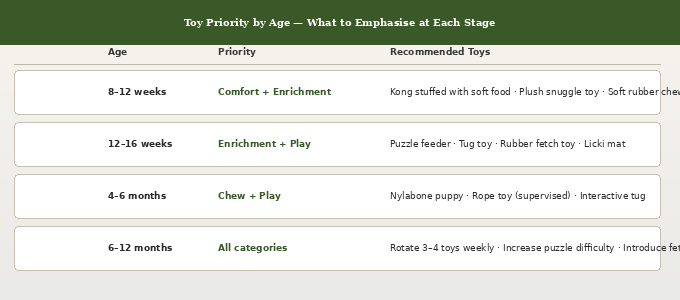
Age-by-Category Guidance — 8 Weeks to 12 Months
Toy Priority by Age — Goldendoodle Puppy
| Age | Priority Categories | Specific Recommendations | Avoid |
|---|---|---|---|
| 8–12 weeks | Comfort + Enrichment | Stuffed Kong Puppy (frozen) · Snuggle Puppy heartbeat toy · Soft rubber chew · Licki mat | Rope toys · Puzzle feeders (too complex) · Hard antlers or hooves |
| 12–16 weeks | Enrichment + Play | Beginner puzzle feeder · Soft fleece tug toy · Rubber fetch ball · Kong Classic stuffed | Rope toys unsupervised · Tennis balls as chews · Hard natural chews |
| 4–6 months | Chew + Play | Nylabone Puppy · Harder rubber Kong · Supervised rope toy · Intermediate puzzle feeder | Antlers and hard hooves · Unsupervised rope · Soft plush as sole chew outlet |
| 6–12 months | All categories | Full rotation of all four categories · Advanced puzzle feeders · Flirt pole (low-impact) · Durable rubber chews | High-impact fetch (growth plates) · Antlers until 6 months confirmed |
Action Plan — Building the Right Toy Set
- Buy one toy from each category only. For a puppy arriving at 8 weeks: one Kong Puppy, one soft tug toy, one soft rubber chew, and one plush comfort toy. Four toys. No more until the rotation system is established.
- Set up the rotation stock from week two. Buy two additional enrichment toys and one additional play toy to rotate. Keep a total of seven to eight toys — four accessible at any time, the rest in rotation.
- Stuff the Kong before every nap and crate session. Freeze it the night before for longer engagement. Stuffed Kong in the crate every time eliminates most crate resistance within the first two weeks.
- Introduce a beginner puzzle feeder at 12 weeks. Start with the simplest level available — the puppy solving it quickly on the first attempt is the right starting point. Increase difficulty across four to six weeks.
- Add a Nylabone Puppy at 16 weeks as adult teeth begin emerging. Place it near any surface the puppy is targeting for chewing. Physical proximity to the target surface reinforces the redirection.
- Inspect all toys daily. Any toy showing fragmentation, large gouges, or detachable components is removed immediately regardless of cost or how recently it was purchased.
What to Expect
Timeline: The stuffed Kong produces immediate crate-settling improvement from day one. The rotation system produces noticeable increased toy engagement within two weeks. Puzzle feeder proficiency develops across 4 to 8 weeks — do not increase difficulty until the current level is solved within 3 minutes.
Friction: Freezing the Kong the night before requires a daily habit to establish. The first few days it will not be ready — stuff it fresh and refrigerate for an hour as an acceptable substitute until the habit forms.
Signs the approach is working: Puppy settles in the crate faster when a stuffed Kong is present. Puppy approaches the puzzle feeder willingly. Furniture and shoe chewing reduces as chew toys become the established outlet.
Your Next Step
If the puppy has just arrived — buy the four-toy starting set today and stuff the Kong before the first nap. If the puppy is already home and you have too many toys out — remove all but four, put the rest in a box, and begin the rotation cycle this week. The improvement in engagement will be visible within days.
What Most Owners Get Wrong
Mistake 1 — Buying too many toys and leaving them all accessible. Twelve toys simultaneously produces habituation to all twelve within 48 hours. The puppy with four toys in rotation shows more sustained engagement with each individual toy than the puppy with unrestricted access to twelve. More toys is not better enrichment — it is diluted enrichment. Three to four out at a time, rotated every three to four days, is the correct approach.
Mistake 2 — Treating toy destruction as a failure rather than information. A puppy that destroys a toy quickly is not misbehaving — it is communicating that the toy is too soft for its current chewing force. The response is to move to a more durable option, not to keep replacing the same toy or to take toys away. Destruction is feedback. Use it to calibrate the durability level appropriately for the puppy’s developmental stage.
Mistake 3 — Using toys to replace interaction rather than supplement it. Enrichment toys — Kongs, puzzle feeders, snuffle mats — are correctly used during crate time, nap preparation, and short independent periods. They are not a substitute for the interactive play and training sessions that provide the bonding and mental engagement a Goldendoodle needs. A puppy that is managed entirely through enrichment toys without owner interaction is not enriched — it is isolated with objects. The play category toys exist precisely because interaction between owner and puppy is a non-replaceable component of the toy programme.
Signs Your Toy Programme Is Working
- Puppy approaches the Kong or puzzle feeder with immediate engagement when offered
- Furniture and household item chewing has reduced as chew toys are consistently available
- Puppy carries its comfort toy to the crate voluntarily during settling time
- Rotated toys are greeted with near-novel interest when reintroduced after three to four days away
⚠️ Watch Out
The most dangerous toy situation is a plush toy with a removed squeaker or detached component left unsupervised with a puppy. Squeakers are sized such that they can cause intestinal obstruction in a puppy. Check every plush toy before each session. If the squeaker is accessible — remove it before giving the toy, or replace the toy. This takes ten seconds and eliminates a significant ingestion risk.
Contact Your Vet If
- The puppy has ingested a squeaker, button eye, or significant piece of toy material — contact your vet the same day regardless of whether symptoms are present
- Vomiting, loss of appetite, or straining to defecate after chewing a toy warrants same-day veterinary contact
- A fragment of toy material is visible in faeces — confirm complete passage with your vet before resuming unsupervised toy access
Key Takeaways — Best Toys for Goldendoodle Puppies
- Four toy categories serve different developmental functions — enrichment, play, chew, and comfort — and all four are needed, not just whichever the puppy favours
- Three to four toys accessible at a time, rotated every three to four days, produces more sustained engagement than unrestricted access to a large collection
- Toy durability must match the puppy’s developmental stage — soft rubber at 8 weeks, harder options from 16 weeks as adult teeth emerge
- Rope toys, button-eyed plush toys, and hard natural chews are not appropriate for unsupervised puppy use at any age
- The stuffed frozen Kong is the single most effective crate-settling tool available — use it at every nap and every crate session from day one
- Toy destruction is feedback about durability fit, not misbehaviour — adjust the toy hardness rather than replacing identically
Related Goldendoodle Puppy Guides
- Best Chew Toys for Teething Goldendoodles — Deep dive into the chew category during the 16 to 24 week teething peak
- Goldendoodle Puppy Biting Phase Guide — How toys integrate with the biting management programme
- Best Crate for Goldendoodle Puppies — The crate setup that makes the stuffed Kong protocol most effective
- Goldendoodle Puppy Care Guide — Full first-year overview including all essential equipment
- How to Bond With a Goldendoodle Puppy — Why play toys are bonding tools as much as entertainment
Part of the Goldendoodle Puppy Guide resource hub:
→ Goldendoodle Puppy Guide — Browse all 40 puppy guides
Frequently Asked Questions
What toys are safe for Goldendoodle puppies?
Safe toys for Goldendoodle puppies at 8 to 12 weeks are soft rubber toys (Kong Puppy), plush toys without removable components, and soft rubber chews. From 16 weeks as adult teeth emerge, harder rubber options and Nylabone puppy variants become appropriate. Rope toys are safe only under direct supervision from 16 weeks — not as unsupervised toys at any age. Hard natural chews (antlers, hooves) are not recommended before 6 months due to puppy tooth fracture risk.
How many toys does a Goldendoodle puppy need?
A starting set of four — one from each category — is sufficient for the first weeks. A rotation stock of seven to eight total toys provides enough variety for the rotation system to work effectively. Beyond eight to ten toys the additional investment produces diminishing returns because the rotation cycle cannot extend long enough for genuine novelty to develop. More toys is not better enrichment — structured rotation of fewer toys is.
Are squeaky toys safe for Goldendoodle puppies?
Squeaky toys are safe under direct supervision when the squeaker is securely enclosed and the puppy cannot access it. They are not safe unsupervised because determined chewing will eventually access the squeaker, which is a choking and obstruction risk. If offering a squeaky toy, stay present for the session. Remove the toy when supervision ends. Replace any squeaky toy the moment the squeaker becomes accessible through chewing damage.
My Goldendoodle puppy destroys every toy within minutes — what should I do?
Move to a more durable rubber option immediately. Toy destruction means the current toy is too soft for the puppy’s jaw strength and chewing persistence — it is not a behaviour problem. The Kong Puppy range and the Nylabone Puppy range are specifically designed to resist the chewing force of puppy teeth. If the puppy is destroying these also, contact the manufacturer with the puppy’s age and weight — both brands have a replacement programme for toys destroyed faster than the developmental stage suggests they should be.
Should I let my Goldendoodle puppy play with rope toys?
Rope toys can be used under direct, uninterrupted supervision from 16 weeks onward. They are not appropriate as unsupervised toys at any age because rope fibres separate when chewed and can cause intestinal obstruction when ingested. The rule is simple: if you cannot watch the puppy interact with the rope toy for the entire session, the rope toy is not out. Store it when supervision ends. This applies for the dog’s entire life, not just during puppyhood.
The information in this article is provided for general educational purposes only. King James Adjei is a researcher and enthusiast, not a veterinarian. For concerns about toy ingestion or any signs of gastrointestinal distress, always consult a qualified veterinarian promptly.