10-minute read | Last updated March 2026 | Reviewed for accuracy
By King James Adjei | GoldendoodleReport.com
Researcher, Goldendoodle enthusiast, and founder of GoldendoodleReport. Every guide on this site is written to give owners reliable, clearly organised information — researched carefully and updated regularly.
 This Goldendoodle puppy care guide covers everything you need to get the first year right — feeding, grooming, health, training, socialisation, and the daily routine that makes all of it manageable. If you have just brought a Goldendoodle puppy home, or you are about to, this is the guide to read first.
Who This Guide Is For
This article is most useful if you:
- Have just brought a Goldendoodle puppy home and want a complete first-year overview
- Are preparing to bring one home and want to know what the first weeks actually involve
- Have had dogs before but not Goldendoodles specifically and want to understand what is different about this breed
- Want one place that covers all the major care areas without having to search for each topic separately
For the specific checklist of everything to buy before pickup day, see the Goldendoodle Puppy Checklist.
Quick Summary
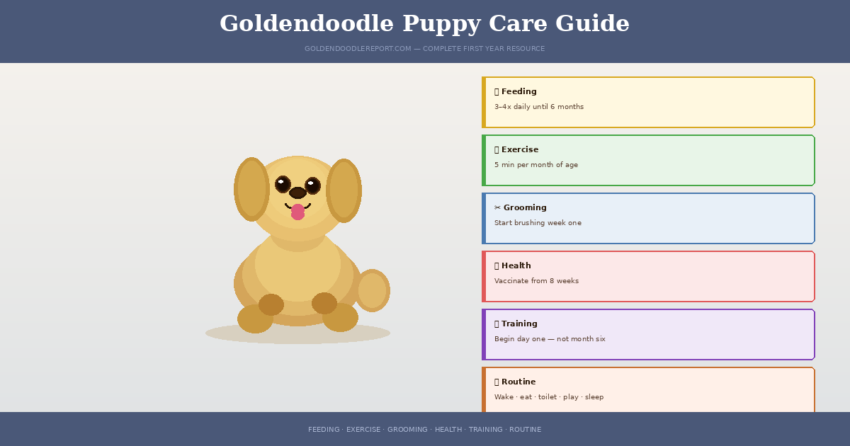
Goldendoodle puppy care in the first year revolves around six areas: feeding the right amount at the right frequency, protecting developing joints through controlled exercise, building grooming tolerance early so professional grooming is never a fight, vaccinating on schedule and socialising within the safe window, training from day one rather than waiting for bad habits to form, and creating a consistent daily routine that gives the puppy the structure it needs to become a settled adult dog. None of these are complicated. All of them require consistency.
Quick Answer
What does a Goldendoodle puppy care guide actually cover? The full picture: feeding 3–4 times daily until 6 months then twice daily, brushing at least 3 times per week from week one, limiting exercise to 5 minutes per month of age twice daily until growth plates close, vaccinating on the standard schedule from 8 weeks, socialising during the critical 8–16 week window, and crate training from night one. The decisions you make in the first 16 weeks shape the dog your Goldendoodle becomes at 3 years.
Most new Goldendoodle owners are prepared for the puppy to be adorable. Fewer are prepared for how much the first 16 weeks actually determine. The socialisation window closes. The fear stages arrive without warning. The biting phase peaks. The coat starts to change. A Goldendoodle puppy is not difficult — but it is demanding in specific ways that this guide covers honestly and in full.
This guide covers:
- Feeding — how much, how often, and when to transition to adult food
- Exercise — the 5-minute rule and why over-exercising a puppy causes lasting joint damage
- Grooming — when to start, what tools to use, and how to build tolerance that lasts a lifetime
- Health — vaccinations, deworming, and the first vet visit
- Training and socialisation — what to prioritise in the critical first weeks
- Daily routine — what a well-structured Goldendoodle puppy day looks like
- The first-year milestones — what to expect month by month
In This Guide
- Feeding Your Goldendoodle Puppy Care Guide: Amounts, Frequency, and Timing
- Exercise: The 5-Minute Rule and Why It Matters
- Grooming: Starting Early Is the Most Important Decision You Make
- Health: Vaccinations, Deworming, and the First Vet Visit
- Training and Socialisation: The Window That Closes at 16 Weeks
- Daily Routine: What a Well-Structured Goldendoodle Puppy Day Looks Like
- First-Year Milestones: What to Expect Month by Month
- Frequently Asked Questions
Feeding Your Goldendoodle Puppy Care Guide: Amounts, Frequency, and Timing
Goldendoodle puppies need to be fed 3 to 4 times daily until 6 months of age, then twice daily from 6 months through adulthood. The reason for higher frequency early on is straightforward — puppies have small stomachs and fast metabolisms, and spreading meals across the day keeps blood sugar stable, reduces the risk of hypoglycaemia in very young pups, and supports steady growth rather than boom-and-bust energy cycles.
The amount to feed depends on the food, the puppy’s current weight, and the size the dog will be as an adult. Every high-quality puppy food has a feeding guide on the packaging calibrated to body weight. Use that as a starting point, then adjust based on body condition — you should be able to feel the puppy’s ribs easily under light pressure but not see them clearly.
General reference points for a Goldendoodle puppy on a standard dry kibble at 3 months old are around half a cup per meal for Mini puppies (expected adult weight under 15kg), three-quarters of a cup per meal for Medium puppies (15–25kg adult), and one cup per meal for Standard puppies (25kg and above). These are starting points, not fixed amounts — adjust as the puppy grows and monitor condition monthly.
The transition to adult food should happen gradually at around 12 months for Mini and Medium Goldendoodles and at 12–18 months for Standard Goldendoodles, which take longer to reach full size. An abrupt food change causes digestive upset. Transition over 7–10 days by mixing increasing amounts of adult food with decreasing amounts of puppy food until the changeover is complete.
What to feed: Choose a puppy food with a named protein source (chicken, lamb, salmon) as the first ingredient, formulated specifically for puppies or all life stages, and meeting AAFCO nutritional standards. For Goldendoodles specifically, avoid grain-free diets — the FDA has been investigating a potential link between grain-free diets and dilated cardiomyopathy in dogs, and Goldendoodles inherit cardiac sensitivity from their Golden Retriever heritage. For the most current guidance on puppy nutrition, the AKC’s puppy nutrition guide provides a reliable overview of what to look for and what to avoid.
Exercise: The 5-Minute Rule and Why It Matters
The 5-minute rule is the most important exercise guideline for any puppy and is especially critical for Goldendoodles. The rule states that a puppy should receive no more than 5 minutes of structured exercise per month of age, twice per day. A 3-month-old puppy gets 15 minutes maximum, twice daily. A 5-month-old puppy gets 25 minutes, twice daily.
The reason is biological. A Goldendoodle puppy’s growth plates — the soft cartilage at the ends of developing bones — do not close until 12 to 18 months of age depending on size. Standard Goldendoodles close later than Minis. While the growth plates are open, excessive or high-impact exercise puts mechanical stress on cartilage that is not yet bone. This stress can cause microdamage that results in hip dysplasia, elbow problems, or early-onset arthritis — conditions that are expensive to manage and painful for the dog throughout its life.
What counts as exercise under this rule is structured activity — walks on lead, running, playing fetch. What does not count is free play in the house or garden at the puppy’s own pace. A puppy that chooses to run, stop, and rest as it pleases is self-regulating. A puppy being kept at pace by an owner on a 45-minute walk is not.
Beyond the 5-minute rule, avoid the following until growth plates close: running on hard surfaces for sustained periods, jumping on or off furniture, stair climbing in very young puppies under 12 weeks, and high-impact games like extended ball chasing that involve repeated landing impact.
Mental exercise counts. A 15-minute training session with a food-motivated Goldendoodle puppy produces genuine tiredness that rivals a longer physical walk. Puzzle feeders, nose work, and learning new commands burn energy without joint impact and are appropriate at any age.
Grooming: Starting Early Is the Most Important Decision You Make
The single most impactful Goldendoodle puppy care decision you make in the first months has nothing to do with food or training — it is how early and how consistently you handle your puppy’s coat, ears, paws, and mouth. A Goldendoodle that is groomed comfortably for life is one that was handled thoroughly and positively in the first 16 weeks. A Goldendoodle that fights the groomer or the brush is almost always one whose tolerance was never built in puppyhood.
Brushing should start from week one, even if the puppy coat is soft and does not technically need it. Use a soft slicker brush and keep sessions to 2–3 minutes initially, pairing every session with treats and praise. The goal is not to groom — it is to teach the puppy that being touched all over its body is a normal, pleasant experience. Frequency should be at least 3 times per week. When the coat begins transitioning to the adult coat at 6–12 months, daily brushing becomes essential as the two coat textures combine into a perfect matting environment.
The first professional grooming appointment should happen between 16 and 20 weeks — after the second vaccination but during the critical socialisation window. Do not wait until the puppy is 6 months old. By then the socialisation window has closed and new experiences are significantly harder to introduce without anxiety. A puppy’s first grooming visit should be a socialisation appointment — ask for a bath, blow dry, and brush-out only, with no clipping. The goal is a positive introduction to the salon environment, sounds, and handling.
Ears need checking weekly. Goldendoodles are at elevated risk of ear infections because their floppy ear flaps trap moisture and their coat grows into the ear canal. Weekly inspection for redness, discharge, or smell, combined with gentle cleaning using a veterinarian-recommended ear cleaner, prevents most ear problems before they start.
Teeth and nails should also be introduced in puppyhood. Touch the puppy’s mouth and gums daily from week one. Introduce a finger brush at 8–10 weeks. Tap the puppy’s paws and press gently between the toes regularly so nail trims are never a battle. These habits, built in the first months, last the entire lifespan.
Health: Vaccinations, Deworming, and the First Vet Visit
The Goldendoodle puppy vaccination timeline starts at 8 weeks and runs through 16 weeks for the primary series, with a booster at 12–16 months. The core vaccines cover distemper, parvovirus, adenovirus, and parainfluenza — often given as a combined DHPP vaccine. Rabies vaccination is typically given at 12–16 weeks and is legally required in most US states. Your breeder should have given the 6–8 week vaccination before pickup; your vet will continue the schedule from there.
The first vet visit should happen within 48 hours of bringing the puppy home, regardless of how recently the breeder gave the first vaccination. This visit serves as a baseline health check — the vet examines the puppy for congenital issues, confirms vaccination records, establishes a deworming schedule, and gives you the specific guidance relevant to your puppy’s weight and condition. Bring the breeder’s health records, any paperwork you received, and a list of questions.
Deworming should begin at 2 weeks of age in the litter (the breeder’s responsibility) and continue at 2-week intervals until 8 weeks, then monthly until 6 months. Your vet will confirm the schedule and recommend an appropriate dewormer for your puppy’s age and weight. Do not self-medicate with over-the-counter dewormers — dosage accuracy matters and the wrong product can cause toxicity in young puppies.
Flea and tick prevention should be discussed at the first vet visit. The appropriate product depends on your geographic region and the puppy’s age and weight — not all flea products are safe for puppies under 8 weeks or below certain weight thresholds. Your vet will recommend a safe product for your specific situation.
Pet insurance is worth taking out before the first vet visit if possible — before any conditions are recorded that could become pre-existing exclusions. Goldendoodles are genetically predisposed to hip dysplasia, ear infections, skin allergies, and eye conditions. A single orthopaedic surgery can cost more than several years of insurance premiums.
Training and Socialisation: The Window That Closes at 16 Weeks
The most time-sensitive element of the entire Goldendoodle puppy care guide is this: the critical socialisation window opens at approximately 3 weeks of age and closes at 16 weeks. During this window, a puppy’s brain is wired to accept novel experiences as normal rather than threatening. After the window closes, the same experiences require significantly more exposure to habituate and may never fully desensitise an anxious dog.
What this means practically is that the weeks between bringing the puppy home at 8 weeks and the window closing at 16 weeks are among the most important of the dog’s entire life. Every positive exposure during this period — to different people, surfaces, sounds, environments, handling, other animals, vehicles, umbrellas, children, elderly people, uniforms — makes the adult dog more confident and less reactive.
The vaccination concern is real but manageable. A puppy is not fully protected until 2 weeks after the final primary vaccination at 16 weeks. But social deprivation is also a welfare risk — a puppy kept isolated until fully vaccinated misses the socialisation window entirely and is at high risk of anxiety and fear-based behaviour as an adult. The answer is controlled exposure — puppy classes at clean, reputable facilities, visits to the homes of vaccinated dogs, carrying the puppy in areas where unvaccinated dogs are unlikely, and introducing experiences on safe surfaces.
Basic training starts from day one. A Goldendoodle puppy is capable of learning sit, down, stay, come, and leave it within the first weeks. Short sessions of 3–5 minutes using high-value treats, multiple times per day, are more effective than longer sessions. The breed’s intelligence and food motivation make training fast — the risk is not that they are slow to learn but that they are equally fast to learn bad habits if those go unaddressed.
Crate training from the first night is one of the most important things you do for your Goldendoodle’s long-term wellbeing. A dog that is comfortable in a crate has a safe space of its own, travels safely, and is far less likely to develop separation anxiety than one who has never learned to settle independently. The crate should be introduced as a positive space with treats and meals, never used as punishment, and sized appropriately — large enough for the puppy to stand, turn, and lie down, with a divider to prevent accidents in excess space.
Daily Routine: What a Well-Structured Goldendoodle Puppy Day Looks Like
A consistent daily routine is the single most effective tool for raising a settled Goldendoodle puppy. Puppies regulate their behaviour — and their nervous systems — through predictability. A puppy that knows what happens next is calmer, easier to toilet train, and less prone to anxiety than one whose day is unpredictable.
A basic daily routine for an 8–12 week Goldendoodle puppy looks like this:
Goldendoodle Puppy Daily Routine — 8 to 12 Weeks
| Time | Activity | Notes |
|---|---|---|
| 6:30–7:00 AM | Wake, immediate toilet trip outside | Take outside before any play or greeting |
| 7:00 AM | Meal 1 — puppy food in crate or quiet area | Feed in crate to build positive crate association |
| 7:20 AM | Toilet trip immediately after eating | Puppies need out within 15 minutes of every meal |
| 7:30–8:00 AM | Short supervised play and training (5–10 min) | Sit, name recall, gentle handling practice |
| 8:00–9:30 AM | Nap in crate | Puppies need 16–18 hours sleep daily — enforce rest |
| 9:30 AM | Wake, toilet trip | Always outside immediately on waking |
| 10:00 AM | Meal 2 + toilet trip | Second of 3–4 daily meals |
| 10:30 AM–12:00 PM | Nap | Do not skip naps — overtired puppies bite harder and are harder to settle |
| 12:00–1:00 PM | Wake, toilet, play, brief socialisation exposure | Carry outside for safe socialisation before full vaccination |
| 1:00 PM | Meal 3 + toilet trip | Third meal for puppies under 6 months |
| 1:30–3:30 PM | Nap | Longest daytime rest period |
| 3:30–5:00 PM | Wake, toilet, play, training session | Best window for active learning — puppy is rested |
| 5:00 PM | Meal 4 + toilet trip | Last full meal — keep this consistent time to regulate toilet schedule |
| 6:00–8:00 PM | Calm family time, settle practice | Wind down — avoid rough play that raises arousal before bed |
| 10:00 PM | Last toilet trip, crate for night | Set alarm for 2 AM toilet trip for first weeks |
| 2:00 AM | Night toilet trip (first 4–6 weeks) | Keep lights low, no play — straight back to crate |
This schedule becomes less rigid as the puppy matures. By 6 months, 3 meals are sufficient. By 12 months, a Goldendoodle can typically hold through the night without a toilet trip. The core structure — wake, toilet, eat, toilet, play, sleep — remains the same at every age.
First-Year Milestones: What to Expect Month by Month
Knowing what is coming in the first year removes the surprise from the hardest moments. Here is an honest month-by-month overview of what your Goldendoodle puppy care guide needs to account for.
8–10 weeks: The puppy arrives. Socialisation window is open and ticking. Crate training begins night one. Biting begins — this is normal. Sleep is 16–18 hours daily. First vet visit within 48 hours. Second DHPP vaccination due at 10–12 weeks.
10–12 weeks: Biting peaks. Toilet training reliability improves with consistency. First grooming socialisation appointment ideal at or just after 12 weeks. Fear period 1 may begin — things that were fine last week may suddenly be frightening. Do not force exposure during fear periods. Third DHPP vaccination at 14–16 weeks.
12–16 weeks: Socialisation window closes. The exposures your puppy had or missed in this window are now largely set. Training accelerates — the puppy’s capacity to learn is at its peak. Rabies vaccination at 16 weeks. Biting begins to reduce if extinction protocol has been applied consistently.
4–6 months: Teething begins. Adult teeth replace deciduous teeth. Chewing intensifies — provide appropriate chew toys. Puppy may seem to forget commands learned earlier — this is adolescent brain development, not regression. Reduce meals to 3 times daily at 4 months, twice at 6 months.
6–12 months: Adolescence arrives. The Goldendoodle that was making progress may seem to stop listening. This is neurological — the prefrontal cortex, responsible for impulse control, is not yet fully developed. Fear period 2 typically arrives between 6 and 14 months. Coat transition begins — daily brushing becomes essential. First professional haircut may be needed.
12–18 months: Growth plates begin to close in smaller dogs. Exercise restrictions can be gradually lifted. The adult personality begins to settle. Energy level starts to moderate — though full emotional maturity in Goldendoodles does not typically arrive until 2–3 years.
⚠️ Watch Out
The most common Goldendoodle puppy care mistake is responding to bad behaviour with attention — even negative attention. A puppy that bites and gets pushed away, spoken to sharply, or picked up learns that biting produces a result. A puppy that bites and is calmly redirected to a toy, or whose owner stands up and leaves the room, learns that biting ends interaction. The rule applies to jumping, barking, and demanding behaviour as well. Any attention — positive or negative — reinforces the behaviour that produced it.
When to Call a Vet
- The puppy has not eaten for more than 24 hours and is lethargic
- Vomiting or diarrhoea lasting more than 24 hours, or with blood present at any point
- The puppy is limping and will not bear weight on a leg
- Swollen abdomen, laboured breathing, or gums that are pale, white, blue, or grey
- The puppy ingested something potentially toxic — chocolate, grapes, raisins, xylitol, onions, certain plants
- Eye discharge, swelling, or cloudiness that appears suddenly
- Any seizure, collapse, or loss of consciousness — these are emergencies requiring immediate veterinary attention
Key Takeaways
- This Goldendoodle puppy care guide covers six core areas — feeding, exercise, grooming, health, training and socialisation, and daily routine — all of which need to begin from week one
- The 5-minute exercise rule protects developing growth plates — over-exercising a Goldendoodle puppy in the first year is one of the leading causes of hip dysplasia and joint problems
- Grooming tolerance must be built in the first 16 weeks — a puppy that learns early that handling is safe and pleasant will be easy to groom for life
- The socialisation window closes at 16 weeks — every positive exposure during this period shapes adult confidence and reduces future reactivity
- Crate training from night one is the single most effective tool for preventing separation anxiety in a breed that is genetically prone to it
- Consistency in daily routine, meal times, and training responses is what separates a settled Goldendoodle from a difficult one — the decisions made in the first 16 weeks shape the dog for years
Related Goldendoodle Puppy Guides
- Goldendoodle Puppy Checklist — Everything to buy and prepare before pickup day
- First Week With a Goldendoodle Puppy — Day-by-day guide to the most important week
- Goldendoodle Puppy Vaccination Timeline — The complete first-year vaccination schedule
- Goldendoodle Puppy Socialization Checklist — What to expose your puppy to before the window closes
- Goldendoodle Puppy Biting Phase Guide — Why it happens and how to stop it
Part of the Goldendoodle Puppy Guide resource hub:
→ Goldendoodle Puppy Guide — Browse all 40 puppy guides
Frequently Asked Questions
How much does it cost to care for a Goldendoodle puppy in the first year?
First-year costs for a Goldendoodle puppy typically run between $3,000 and $6,000 beyond the purchase price, covering vaccinations, spay/neuter, veterinary check-ups, food, grooming (approximately every 6–8 weeks at $80–150 per session), puppy classes, supplies, and pet insurance. Costs vary significantly by location and size — Standard Goldendoodles eat more and cost more to groom than Minis.
When should I start training my Goldendoodle puppy?
From the day you bring the puppy home. An 8-week-old Goldendoodle is fully capable of learning sit, name recognition, and basic recall. The longer you wait, the longer the puppy practises the wrong behaviours — jumping, biting, barking for attention — and the harder those habits become to change. Short sessions of 3–5 minutes using high-value treats, multiple times per day, are far more effective than longer sessions once a day.
Is a Goldendoodle puppy suitable for first-time dog owners?
Yes — with research and realistic expectations. Goldendoodles are among the most trainable and people-oriented breeds, which makes them more forgiving of early owner mistakes than many other dogs. The areas first-time owners most commonly underestimate are the grooming commitment, the emotional needs of the breed, and the importance of the socialisation window. Owners who prepare for those three things specifically do very well with this breed.
How do I stop my Goldendoodle puppy from biting?
The most effective approach is removing all reward for biting — which means no reaction, no eye contact, no pushing away. When the puppy bites, say nothing, stand up, and leave the room for 30 seconds. Return calmly and resume interaction. The puppy learns that biting ends play. Simultaneously, redirect biting to appropriate chew toys every time the puppy mouths. The biting phase typically peaks between 12 and 16 weeks and diminishes significantly by 5–6 months with consistent response.
How long does it take to toilet train a Goldendoodle puppy?
With consistent crate training and a regular toilet schedule — outside immediately after waking, after every meal, after every play session, and every 2 hours in between — most Goldendoodle puppies show reliable house training by 4–5 months of age. The breed’s intelligence and handler-orientation make them faster to house train than average. Inconsistency is the main reason house training takes longer than it should.
The information in this article is provided for general educational purposes only. King James Adjei is a researcher and enthusiast, not a veterinarian or certified behaviourist. For health concerns, always consult a qualified veterinarian. For persistent behaviour issues, consider working with a certified dog behaviourist.