6-minute read | Last updated March 2026 | Reviewed for accuracy
By King James Adjei | GoldendoodleReport.com
Researcher, Goldendoodle enthusiast, and founder of GoldendoodleReport. Every guide on this site is written to give owners reliable, clearly organised information — researched carefully and updated regularly.
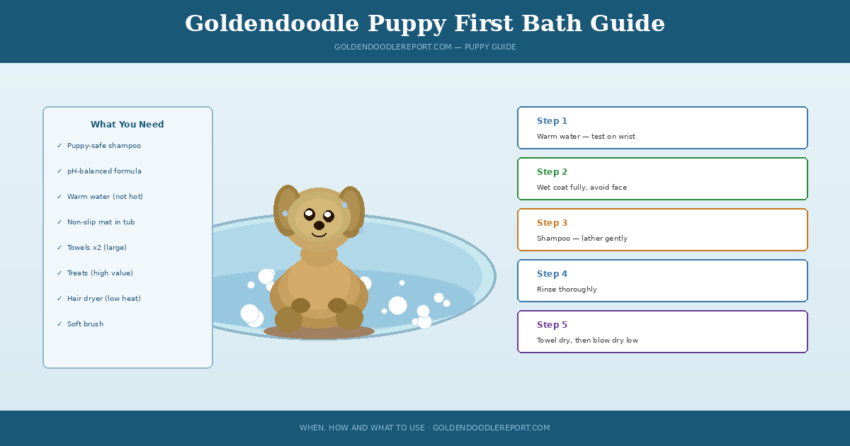
The Goldendoodle puppy first bath is not primarily about getting the puppy clean — it is about establishing the puppy’s relationship with water, bathing, and the grooming process for the rest of its life. A first bath handled well creates a puppy that tolerates and eventually accepts bathing as unremarkable. A first bath handled badly — too cold, too rushed, too much restraint — creates a dog that fights every bath and every grooming appointment for years. This guide covers exactly when to do it, how to do it correctly, and which products are safe for puppies.
Who This Guide Is For
This article is most useful if you:
- Have a Goldendoodle puppy and want to know when the first bath should happen and how to do it
- Are concerned about using the wrong products on a young puppy’s skin
- Want to make bathing a positive experience rather than a battle
- Have already had a difficult first bath experience and want to reset the association
For the first professional grooming appointment, see Goldendoodle Puppy First Grooming Guide.
Quick Summary
The Goldendoodle puppy first bath should happen between 10 and 12 weeks — after the puppy has settled into its new home but within the socialisation window so the experience is easier to make positive. Use a puppy-specific pH-balanced shampoo, warm (not hot) water, a non-slip mat, and high-value treats throughout every step. The bath itself takes 15 to 20 minutes. The experience you create in those 20 minutes determines how the puppy responds to every bath and every grooming appointment for the next 15 years.
Quick Answer
When should a Goldendoodle puppy have its first bath? Between 10 and 12 weeks — after the puppy is settled at home but within the socialisation window where new experiences are easier to introduce positively. Do not bath before 8 weeks (the puppy cannot regulate body temperature adequately). Bath before 16 weeks so the experience is introduced during the critical learning period. Use puppy-specific shampoo only — never human shampoo or adult dog shampoo on a puppy under 6 months.
The connection between the Goldendoodle puppy first bath and lifetime grooming tolerance is direct and well-established. Puppies that experience positive grooming introductions during the socialisation window — including bathing, blow-drying sounds, brush contact, and restraint during washing — develop tolerance that persists even when individual grooming sessions are imperfect later. Puppies that miss this window or have early negative experiences require significantly more counter-conditioning work and may never fully relax during grooming. For broader context on establishing grooming tolerance, the AKC’s guide to bathing a puppy covers the key principles applicable to all breeds.
This guide covers:
- When to give the first bath and why the timing matters
- What to prepare before bath time
- Safe products — shampoos and what to avoid
- The step-by-step bathing process
- Drying — why this matters as much as the bath itself
- What to do if the puppy hates the bath
In This Guide
Goldendoodle Puppy First Bath: When to Do It
The optimal window for the Goldendoodle puppy first bath is 10 to 12 weeks. This timing is a balance between three factors:
Body temperature regulation: Puppies under 8 weeks have limited ability to regulate their own body temperature. A bath in cold water — or even a bath in warm water followed by inadequate drying — can cause dangerous hypothermia. By 10 weeks, thermoregulation is more developed, and if drying is handled correctly (warm towels, low-heat blow drying), temperature management is straightforward.
Socialisation window: The critical period for introducing novel experiences positively runs to 16 weeks. A bath introduced at 10 to 12 weeks is happening during a window where the puppy’s brain is still relatively open to accepting new experiences as normal. The same bath introduced at 20 weeks requires more preparation and positive reinforcement to achieve the same outcome.
Settlement period: Do not bathe on the first day or first week at home. Give the puppy time to acclimatise to the household, the crate, and the daily routine before introducing the additional novelty of a bath. A puppy that is already stressed by the rehoming adjustment has a lower threshold for a negative bath experience. Week two or three at home is the ideal timing.
Do not delay the first bath past 16 weeks without specific reason. After the socialisation window, introducing bathing requires more patience and deliberate counter-conditioning, and the association formed is typically less deep than one established within the window.
What to Prepare Before Bath Time
Preparation before the Goldendoodle puppy first bath matters more than the bath itself. A puppy that enters a prepared, warm, treat-filled environment has a fundamentally different experience than one that is picked up unexpectedly and placed in a cold tub.
Prepare everything in advance so the entire process can be completed without stopping to fetch items while a wet, cold puppy waits:
- Non-slip mat in the bath or sink — this is the single most important preparation item. A puppy that slips in the bath becomes immediately distressed and the association formed is fear, not acceptance. A rubber mat or folded towel on the bath floor provides secure footing and changes the experience entirely
- Warm room — close the bathroom door and let the room warm before bringing the puppy in. A cold bathroom extends the negative experience of being wet
- Lukewarm water already running — test the temperature on your inner wrist the way you would for a baby’s bath. It should feel warm but not hot. Run it before the puppy is in the bath so there is no startling sound change during the session
- Puppy shampoo within reach — do not have it in a cupboard you need to open while the puppy is wet
- Two large towels warmed — one for immediate drying, one for wrapping the puppy after
- High-value treats in a reachable container — small pieces of cooked chicken or soft commercial treats. These are used throughout every step
- Someone to help — for the first bath, a second person to handle treats and reassurance while the owner handles washing makes the experience significantly calmer
Safe Products — What to Use and What to Avoid
Product choice for the Goldendoodle puppy first bath is non-negotiable. Puppy skin has a different pH from adult dog skin and from human skin. Using the wrong product disrupts the skin barrier, causes irritation, and makes subsequent baths harder to manage.
Bath Products — Safe vs Unsafe for Puppies
| Product | Safe? | Notes |
|---|---|---|
| Puppy-formulated dog shampoo | ✓ Safe | pH-balanced for dogs, gentle enough for puppy skin. Look for “puppy” on the label specifically. |
| Adult dog shampoo (gentle formula) | ⚠ Use with caution | Some adult formulas are appropriate for puppies over 12 weeks. Check the label for age guidance. Avoid medicated or flea-treatment shampoos. |
| Oatmeal-based dog shampoo | ✓ Generally safe | Good for Goldendoodles with sensitive skin. Confirm it is formulated for dogs, not humans. |
| Human shampoo (including baby shampoo) | ✗ Do not use | Human skin pH is 5.5; dog skin pH is 6.2–7.4. “Tear-free” does not mean appropriate for dogs. Disrupts the skin barrier and encourages bacterial and yeast overgrowth. |
| Flea shampoo | ✗ Not for first bath | Active insecticide ingredients are not appropriate for young puppies. Flea prevention should be handled through vet-prescribed topical or oral products, not shampoo. |
| Dish soap or household cleaners | ✗ Never | Despite online myths, dish soap is not a safe or appropriate puppy shampoo substitute. Avoid entirely. |
The Step-by-Step Bathing Process
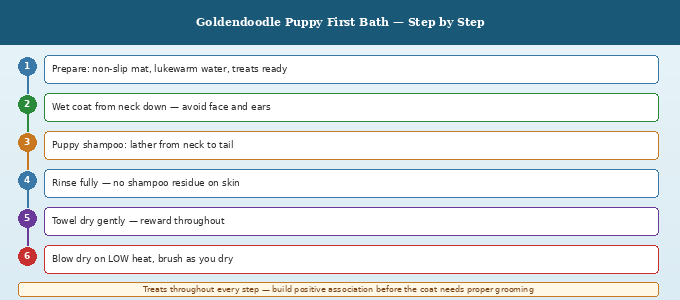
The process for the Goldendoodle puppy first bath is deliberate and slow. This is not about efficiency — it is about building a positive association one step at a time. The entire session should take 20 to 30 minutes.
Step 1 — Introduce the space. Bring the puppy into the bathroom before any water is running. Let it sniff and explore the bath or sink. Treat generously for calm behaviour near the bath. This step alone can take 3 to 5 minutes and is worth doing properly.
Step 2 — Place the puppy in the empty bath. Before turning on water. Treat. Let the puppy stand on the non-slip mat and acclimatise to the feel of the tub. Treat more. If the puppy is calm, move to step 3. If the puppy is distressed, continue treating and take your time.
Step 3 — Begin wetting with lukewarm water. Start at the back of the neck and work toward the tail. Keep water pressure low — a gentle flow, not a spray. Avoid the face, ears, and top of the head on the first bath. These are the highest-stress areas and can wait until the puppy is more acclimatised. Treat throughout.
Step 4 — Apply shampoo. A small amount worked into a lather from the neck toward the tail. Avoid the face. Pay attention to the paws, underbelly, and armpits where dirt accumulates. Do not scrub forcefully — gentle circular massage.
Step 5 — Rinse thoroughly. This is the step most owners rush. Shampoo residue left on the skin causes irritation and hot spots, particularly in a breed with a dense coat. Rinse until the water running off the coat is completely clear and no suds remain. Check under the belly, between the legs, and around the neck.
Step 6 — Lift the puppy out onto the warm towel. Wrap immediately and hold gently. Treat. The wrapping and holding step is its own socialization element — a puppy comfortable being wrapped and held is easier to groom for life.
Drying — Why It Matters as Much as the Bath
Drying is not an afterthought — it is a critical part of the Goldendoodle puppy first bath experience and of every bath that follows. A Goldendoodle with its dense coat holds water against the skin long after it appears surface-dry. Skin that remains damp is a breeding environment for yeast and bacteria, particularly in the ear canals, skin folds, and under the legs.
Towel drying first. Use the first warm towel to absorb as much water as possible. Press the towel into the coat rather than rubbing vigorously — rubbing creates mats in Goldendoodle coat. Change to the second towel when the first is saturated.
Blow drying. A blow dryer on the lowest heat setting, held at least 20 cm from the coat, and kept moving continuously rather than focused on one spot. Introduce the blow dryer sound before using it on the puppy — turn it on in the same room, treat, let the puppy investigate the noise, then begin using it at a distance and gradually closer. A puppy that panics at a blow dryer will fight every grooming appointment. Treat throughout the drying process.
Brush while drying. Using a slicker brush while blow drying produces a well-finished coat and is standard practice in professional grooming. Even a brief brush-out while drying from the first bath onwards begins building tolerance for this dual sensation.
Check the ears after every bath. Use a veterinarian-recommended ear cleaner and a cotton ball to gently dry the outer ear canal after bathing. Water trapped in the ear canal is one of the most common causes of Goldendoodle ear infections.
What to Do If the Puppy Hates the Bath
Some puppies resist bathing despite good preparation and positive handling. If the puppy is showing significant distress — sustained high-pitched crying, frantic struggling, refusing treats — stop the bath before it is complete, dry as thoroughly as possible, and end on the best positive note available. A half-bath that ends positively is better than a complete bath that ends with the puppy in distress.
Over subsequent sessions, desensitise to each individual component before attempting a full bath: the bathroom environment, the empty bath, the sound of running water, the feel of water on the paws, water on the body. Progress through these in separate sessions over days or weeks, treating heavily for each. Full bath tolerance builds on top of component tolerance — it cannot be rushed.
If the puppy’s distress is extreme and does not respond to systematic desensitisation over several weeks, a certified groomer with experience in anxious puppies can often achieve results that home bathing cannot — the neutral environment, the professional handling skills, and the absence of the owner’s anxiety all contribute to a different experience for the dog.
⚠️ Watch Out
The most common Goldendoodle puppy first bath mistake is using hot water. What feels pleasantly warm to an adult human hand can be uncomfortably warm for a puppy, particularly under a dense coat that holds heat. Test the water temperature on your inner wrist — it should feel barely warm, not hot. A surprised reaction from a puppy that was expecting a pleasant experience is one of the hardest associations to undo.
Key Takeaways
- The Goldendoodle puppy first bath should happen between 10 and 12 weeks — within the socialisation window, after the puppy has settled at home
- Preparation matters more than the bath itself — non-slip mat, warm room, treats ready, warm water already running
- Use puppy-specific, pH-balanced shampoo only — never human shampoo, baby shampoo, or flea shampoo on a puppy under 6 months
- Rinse more thoroughly than seems necessary — shampoo residue in a dense Goldendoodle coat causes skin irritation and hot spots
- Dry completely, including blow drying on low heat with treats throughout — damp coat against skin breeds yeast and bacteria
- Check and dry the ear canals after every bath — Goldendoodles are at elevated risk of ear infections from retained moisture
Related Goldendoodle Puppy Guides
- Goldendoodle Puppy First Grooming Guide — The professional grooming appointment that follows the home bathing introduction
- Best Puppy Shampoo for Goldendoodles — Safe ingredients and what to look for by coat type
- Goldendoodle Puppy Socialization Checklist — Why bathing is part of the socialisation checklist
- Goldendoodle Puppy Care Guide — Complete first-year overview including grooming milestones
- Goldendoodle Puppy Teething Guide — Bath timing relative to the teething phase
Part of the Goldendoodle Puppy Guide resource hub:
→ Goldendoodle Puppy Guide — Browse all 40 puppy guides
Frequently Asked Questions
How often should I bathe my Goldendoodle puppy?
For most Goldendoodle puppies, once every 4 to 6 weeks is sufficient — the same frequency as professional grooming appointments. Bathing more frequently than every 2 to 3 weeks strips the natural oils from the coat and skin, which can cause dryness, itching, and paradoxically more coat odour as the sebaceous glands compensate by overproducing oil. If the puppy gets genuinely dirty between scheduled baths — mud, something it rolled in — a spot clean or a full bath as needed is fine. Base frequency on genuine need, not a fixed schedule.
Do I need to bathe my Goldendoodle puppy before its first grooming appointment?
Not necessarily — reputable groomers bath puppies as part of the grooming service. However, having done a home bath first means the puppy’s first grooming appointment is not also its first bath experience. Separating these events means the puppy has already had some positive water and drying experience before encountering the professional grooming environment, sounds, and handling. If possible, do at least one home bath between pickup and the first grooming appointment at 16 to 20 weeks.
My Goldendoodle puppy got muddy — can I bath it before 10 weeks?
If genuinely necessary, a localised spot clean with warm water and minimal puppy shampoo is preferable to a full bath for puppies under 10 weeks. If a full bath is absolutely needed, keep it short, use very warm water, dry immediately and thoroughly with warm towels and a low-heat dryer, and do it in a warm room. The risk for young puppies is body temperature loss rather than the bathing itself — thorough and immediate drying mitigates this risk significantly.
How do I clean my Goldendoodle puppy’s face without getting water in the eyes and ears?
The face should not be rinsed with running water — this is the most common cause of water entering the ear canals. Use a damp washcloth or sponge for the face and around the ears, wiping gently rather than pouring or spraying. The rest of the body can be wetted with running water as normal. After the bath, use a cotton ball with veterinarian-recommended ear cleaner to gently dry the outer ear canal — do not insert cotton into the canal, only the visible outer section.
Should I brush my Goldendoodle before or after a bath?
Before the bath, brush out any tangles or mats — wet mats tighten significantly and become much harder to remove after wetting. After the bath, brush while blow drying using a slicker brush. This technique, standard in professional grooming, produces a well-finished coat and builds the puppy’s tolerance for simultaneous brushing and drying handling that every future professional grooming appointment will involve.
The information in this article is provided for general educational purposes only. King James Adjei is a researcher and enthusiast, not a veterinarian. For skin conditions, persistent itching, or concerns about product reactions, always consult a qualified veterinarian.