6-minute read | Last updated March 2026 | Reviewed for accuracy
By King James Adjei | GoldendoodleReport.com
Researcher, Goldendoodle enthusiast, and founder of GoldendoodleReport. Every guide on this site is written to give owners reliable, clearly organised information — researched carefully and updated regularly.
The best crate for Goldendoodle puppies is not chosen by what fits the puppy today but by what the adult dog will need — then sized down with a divider. Getting this wrong is one of the most common puppy setup mistakes, and it has a direct and immediate consequence: an oversized crate undermines toilet training from the first night home.
Who This Guide Is For
This article is most useful if you:
- Are buying a crate before or just after the puppy arrives and want the right size for your specific Goldendoodle type
- Have been told to buy the adult size but are not sure what that is for a Goldendoodle
- Want to understand the difference between wire, plastic, and soft-sided crates for a puppy specifically
- Are not sure whether a crate divider is necessary or optional
For the full crate training method once you have the right crate, see Goldendoodle Puppy Crate Training Guide.
Quick Summary
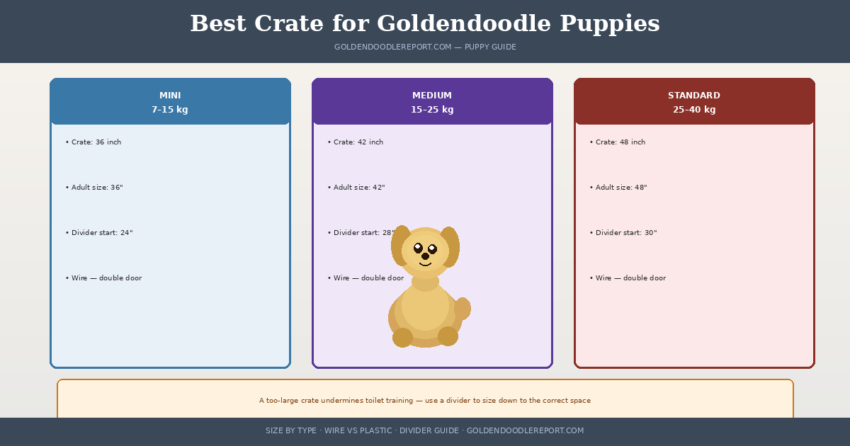
The best crate for Goldendoodle puppies is a wire crate sized for the adult dog with a divider installed. Mini Goldendoodles need a 36-inch crate. Medium Goldendoodles need a 42-inch crate. Standard Goldendoodles need a 48-inch crate. The divider starts at roughly 60 percent of adult crate length and expands as the puppy grows. Soft-sided crates are not suitable for puppies. Plastic airline crates work for smaller types but limit airflow. Wire double-door crates are the most practical choice for every Goldendoodle size.
Quick Answer
Buy a wire double-door crate sized for the adult dog — 36 inches for Mini, 42 inches for Medium, 48 inches for Standard. Install the included divider at roughly 60 percent of crate length so the puppy has space to stand, turn, and lie flat but not enough space to toilet in one end and sleep in the other. Expand the divider monthly as the puppy grows. Remove it entirely after growth plate closure and reliable toilet training.
Quick Diagnosis
- If your puppy is toileting inside the crate → crate is too large, install divider or replace with smaller temporary option immediately
- If your puppy cannot stand or turn comfortably → crate is too small, advance the divider or move to the next size
- If your puppy is escaping the soft-sided crate → replace with wire crate, soft-sided is not suitable for puppies
- If you are unsure of the adult size → use the size table in Core Section 2 to select based on Goldendoodle type
You buy a 48-inch crate for your 8-week Standard Goldendoodle because you read to buy the adult size. You do not include the divider. By day three the puppy is toileting in the back corner and sleeping in the front. Toilet training is already going backwards — the puppy has learned that the crate is a place where elimination is acceptable. The mistake was not the crate size. It was the missing divider.
Crate selection for a Goldendoodle puppy involves three decisions: the right size for the adult dog, the right starting position for the divider, and the right material for a dog that will chew, push, and test every structural weakness in the first six months. Getting all three right on day one makes crate training significantly easier. Getting any one of them wrong creates problems that take weeks to undo.
This guide covers:
- Why crate size directly affects toilet training — the mechanism
- The right crate size by Goldendoodle type — specific inch measurements
- Wire vs plastic vs soft-sided — which material suits puppies
- How to use a divider correctly from day one
- What features to look for and what to avoid
In This Guide
Best Crate for Goldendoodle Puppies: Why Size Affects Toilet Training
Dogs have a strong innate instinct to avoid eliminating in the area where they sleep. This instinct is the biological foundation that makes crate training work at all — the puppy holds its bladder while in the crate because the crate is its sleeping space and the instinct prevents fouling it. The critical word in that mechanism is the area where they sleep. If the crate is large enough that one end serves as a sleeping area and the other end serves as a different space entirely, the instinct applies only to the sleeping end. The puppy walks to the far end of the crate, toilets there, and returns to its sleeping area — with no instinctive conflict whatsoever.
This is why an oversized crate without a divider actively undermines toilet training rather than simply failing to assist it. It creates the conditions for the puppy to learn the opposite of what crate training is designed to teach. A puppy that has established the habit of toileting in the crate will take significantly longer to achieve reliable indoor cleanliness than one that never learned that habit. For the broader toilet training context this sits within, the American Kennel Club’s crate training guide explains the instinct mechanism and the timing requirements clearly.
The correct crate size for toilet training purposes is the size that allows the puppy to stand up without its head touching the roof, turn in a full circle, and lie fully extended — and no larger. This is what the divider achieves when used correctly in an adult-sized crate. It creates a puppy-appropriate space inside a crate that will serve the dog for its entire adult life, eliminating the need to buy twice.
The Right Crate Size by Goldendoodle Type
Best Crate for Goldendoodle Puppies — Size by Type
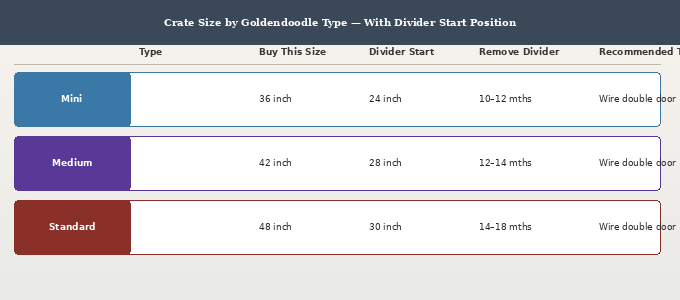
| Type | Adult Weight | Buy This Crate | Divider Start | Remove Divider | Best Type |
|---|---|---|---|---|---|
| Mini | 7–15 kg | 36 inch | ~22 inch | 10–12 months | Wire double door |
| Medium | 15–25 kg | 42 inch | ~26 inch | 12–14 months | Wire double door |
| Standard | 25–40 kg | 48 inch | ~30 inch | 14–18 months | Wire double door |
If you are uncertain whether your puppy will be a Mini, Medium, or Standard, ask the breeder for the parent weights. Adult Goldendoodle weight is broadly predictable from parent weights. A puppy from two parents totalling 30 kg will be a Mini. Parents totalling 50 to 60 kg produce a Medium. Parents totalling 70 kg or above produce a Standard. This is not exact — individual variation exists — but it is sufficient for crate size selection.
Wire vs Plastic vs Soft-Sided — Which to Choose
Crate Material Comparison — Goldendoodle Puppies
| Type | Suitable for Puppies? | Advantages | Disadvantages for Puppies |
|---|---|---|---|
| Wire (double door) |
✓ Best choice | Maximum airflow. Includes divider. Two doors increase placement flexibility. Collapses flat. Suitable for the dog’s entire life. | Heavier than other options. Noisier if puppy rattles the door. Some puppies push noses through wire — choose a model with smaller wire spacing. |
| Plastic (airline style) |
~ Acceptable for Mini | More den-like — suits puppies that find wire crates overstimulating. Airline approved. Durable against chewing. | Limited airflow. Does not include divider. Awkward to clean. Not practical for Medium or Standard sizes. |
| Soft-sided (fabric) |
✗ Not suitable | Lightweight. Folds flat. Fine for fully trained adult dogs. | A puppy will chew through the fabric or unzip the door within days. Provides no structural resistance to escape attempts. Not a puppy crate. |
The wire double-door crate is the practical choice for all three Goldendoodle sizes. The double-door configuration means the crate can be placed with either the front or side opening accessible — useful in bedrooms, alcoves, or tight spaces. The included divider is what makes buying the adult size from day one viable. Most quality wire crates include a divider panel in the purchase price — if the model you are considering does not include one, factor in the additional cost.
How to Use the Divider Correctly
The divider is a panel that slides into the crate at a chosen position to reduce the usable floor space. Used correctly it provides exactly the space the toilet training mechanism requires — enough for the puppy to be comfortable, not enough for it to designate a separate toileting area. Used incorrectly — set too far back — it provides no benefit over an undivided crate.
The correct divider position at each stage:
At 8 to 10 weeks the puppy needs approximately 60 to 65 percent of the adult crate length. For a 48-inch crate this means the divider at approximately 30 inches. The puppy should be able to stand, turn in a full circle, and stretch out fully in this space. If it cannot, advance the divider slightly. If it can walk three or four steps before reaching the divider, move it back.
Advance the divider monthly by 2 to 3 inches as the puppy grows. By 6 months the puppy occupies approximately 70 to 75 percent of the adult crate length. By 10 to 12 months the divider can be removed for Mini and Medium Goldendoodles. For Standards, remove the divider after growth plate closure and consistently reliable toilet training — typically 14 to 18 months.
The sign the divider position is correct is that the puppy is not toileting inside the crate during appropriately timed intervals. If toileting inside the crate persists after the divider is installed, check two things: the divider position (still may be too far forward) and the interval length (the puppy may need more frequent toilet trips rather than a divider adjustment).
Features to Look For and What to Avoid
Look for: a removable plastic tray at the base (makes cleaning accidents significantly easier), a dual-latch door mechanism (single-latch doors are opened by determined puppies within days), a wire gauge heavy enough to resist the puppy pushing through it (look for 12-gauge wire as the minimum), and carry handles if the crate will be moved between rooms.
Avoid: crates with sharp wire ends on the interior edges, models with the divider sold separately, crates with clips rather than slide-bolt latches on the doors, and any model described as “economical” or “lightweight” for a puppy — these phrases indicate wire gauge too thin for a Goldendoodle puppy’s structural testing.
On size accuracy: crate sizes are measured by internal length. The 36-, 42-, and 48-inch figures in this guide refer to internal floor length — not the external dimension of the product. Check the internal measurement in the product specification before purchasing. External dimensions are typically 3 to 4 inches larger than the internal length.
Action Plan — Buying and Setting Up the Crate
- Identify your Goldendoodle’s type using parent weights. Use the table above to select the correct crate size. If unsure, choose the larger option — the divider manages the space until the dog grows into it.
- Buy a wire double-door crate that includes a divider. Confirm the divider is included in the product listing. Confirm the internal floor length matches the size in the table.
- Set the divider at 60 to 65 percent of crate length before the puppy arrives. Do this before bringing the puppy home so the crate is ready for the first night.
- Place the crate in the bedroom for the first 4 weeks. The puppy settles faster and night-waking is addressed before it escalates. Move to the intended permanent location gradually from week four onward.
- Add a crate cover for three sides. A blanket or fitted crate cover over the back and sides reduces visual stimulation and increases the den-like quality that helps puppies settle. Leave the front open for airflow.
- Advance the divider monthly. Check every four weeks whether the puppy can still stand, turn, and stretch in its current space. Advance by 2 to 3 inches when it can no longer fully extend without reaching the divider.
What to Expect
Timeline: A correctly sized crate with the divider set correctly produces measurable improvement in toilet training within the first week. The crate serves the dog from day one through adulthood — the total lifespan cost of one good wire crate is lower than buying multiple incorrectly sized options.
Friction: Some puppies vocalise in the crate initially — this is normal and settles with consistent use. Do not remove the divider in response to vocalisation. The space is correct. The settling takes days to weeks depending on the individual puppy.
Signs the setup is working: Puppy is not toileting inside the crate during appropriate intervals. Puppy enters the crate willingly with a treat motivation. Puppy settles within 10 to 15 minutes of being crated.
Your Next Step
Identify your Goldendoodle’s type, select the correct crate size from the table, and confirm the model includes a divider. If the puppy is arriving in less than a week — order today. The crate needs to be in position with the divider set before the first night home.
What Most Owners Get Wrong
Mistake 1 — Buying the adult size without using a divider. This is the most direct way to guarantee toilet training problems from night one. The crate size advice — buy for the adult dog — is correct. The divider requirement is inseparable from it. Buying the right crate without the divider produces the same outcome as buying a crate that is too large outright.
Mistake 2 — Buying a soft-sided crate for a puppy. Soft-sided crates are suitable for fully crate-trained adult dogs who will not test the structure. A puppy in a soft-sided crate will unzip the door, chew through the mesh, or push through the fabric within the first days. The crate then provides neither training value nor containment. This is a purchase that needs to be replaced rather than persevered with.
Mistake 3 — Choosing a crate that is too small to allow the divider to expand. Some owners buy a puppy-sized crate intending to upgrade later. The upgrade typically happens late — either the owner postpones it or the puppy grows faster than expected. The interim period in a too-small crate creates the opposite problem to a too-large one: a puppy that cannot stand or turn properly is not being managed humanely. Buying the correct adult size with a divider eliminates both problems permanently.
Signs Your Setup Is Working
- No toileting inside the crate during appropriate timed intervals
- Puppy enters the crate voluntarily when the door is opened and a treat is placed inside
- Puppy settles without prolonged vocalisation within the first two weeks
- Divider advancement is tracking with the puppy’s growth — the puppy can stretch out but not walk more than a body length before reaching the divider
⚠️ Watch Out
The most common crate-related mistake after purchase is using the crate as punishment. A puppy sent to the crate after misbehaviour learns that the crate predicts negative outcomes, which undermines every other aspect of crate training. The crate must always be a neutral-to-positive environment. It is where meals are fed, where Kongs appear, where rest happens. It is never a consequence.
When to Reassess the Crate Setup
- Persistent toileting inside the crate after divider installation — reassess divider position and toilet trip frequency
- Puppy is unable to stand without its head pressing on the roof — advance the divider or confirm the crate size is correct for the adult weight
- Consistent escape attempts that are bending the wire — the crate quality is insufficient for the dog’s size and strength, upgrade to a heavier gauge model
Key Takeaways — Best Crate for Goldendoodle Puppies
- Buy the adult size crate — 36 inches for Mini, 42 inches for Medium, 48 inches for Standard — and use a divider from day one
- The divider is not optional — it creates the appropriately sized space that makes the toilet-training instinct work
- Wire double-door crates are the correct choice for all Goldendoodle sizes — soft-sided crates are not suitable for puppies
- An oversized crate without a divider teaches the puppy that toileting inside the crate is acceptable — the opposite of what crate training is designed to achieve
- Set the divider at 60 to 65 percent of crate length from day one and advance it monthly as the puppy grows
- Never use the crate as punishment — it must remain a neutral-to-positive environment throughout the dog’s life
Related Goldendoodle Puppy Guides
- Goldendoodle Puppy Crate Training Guide — The full method for introducing the crate and building reliable settle behaviour
- Goldendoodle Puppy Toilet Training Guide — How the crate integrates into the full toilet training programme
- Goldendoodle Puppy First Night Guide — Where to place the crate and what to expect on night one
- Best Puppy Playpen for Goldendoodles — How a playpen complements the crate for daytime management
- Goldendoodle Puppy Care Guide — The full first-year setup including all essential equipment
Part of the Goldendoodle Puppy Guide resource hub:
→ Goldendoodle Puppy Guide — Browse all 40 puppy guides
Frequently Asked Questions
What size crate does a Goldendoodle puppy need?
The crate size is based on the adult dog’s expected weight, not the puppy’s current size. Mini Goldendoodles (7 to 15 kg adult) need a 36-inch crate. Medium Goldendoodles (15 to 25 kg) need a 42-inch crate. Standard Goldendoodles (25 to 40 kg) need a 48-inch crate. All three sizes require a divider installed at approximately 60 to 65 percent of crate length from day one, advancing monthly as the puppy grows.
Is a wire crate or plastic crate better for a Goldendoodle puppy?
A wire double-door crate is the better choice for all three Goldendoodle sizes. Wire crates provide maximum airflow, include a divider in most models, collapse flat for storage, and accommodate the dog from puppyhood through adulthood. Plastic airline-style crates are acceptable for Mini Goldendoodles but do not include a divider, limit airflow, and are impractical for Medium and Standard sizes. Soft-sided crates are not suitable for puppies of any size.
Do I need a crate divider for a Goldendoodle puppy?
Yes — the divider is essential, not optional. Without a divider, an adult-sized crate gives the puppy enough space to designate a toileting area separate from its sleeping area, which undermines the instinct that makes crate training work. The divider creates the correctly sized space that the toilet-training mechanism requires. Most quality wire crates include a divider panel. Confirm it is included before purchasing.
Where should I put the crate for a Goldendoodle puppy?
In the bedroom for the first 4 weeks. A puppy placed in the bedroom settles faster, night-waking is addressed before patterns establish, and the proximity to the owner during the most vulnerable period supports bond development without creating dependency. From week four, gradually move the crate to its permanent position — typically the kitchen or living area — over 7 to 10 days rather than as an abrupt transition.
How long can a Goldendoodle puppy stay in a crate?
At 8 weeks — a maximum of 1 hour between toilet trips during the day, 3 to 4 hours overnight. At 12 weeks — up to 2 hours daytime, 4 to 5 hours overnight. At 4 months — up to 3 hours daytime, 5 to 6 hours overnight. At 6 months — up to 4 hours daytime. No puppy should be crated for more than 4 to 5 hours during the day at any age. These are maximums — shorter intervals are always preferable when practical.
The information in this article is provided for general educational purposes only. King James Adjei is a researcher and enthusiast, not a veterinarian or certified trainer. For specific advice about crate training or behaviour, consult a qualified certified trainer or behaviourist.