7-minute read | Last updated March 2026 | Reviewed for accuracy
By King James Adjei | GoldendoodleReport.com
Researcher, Goldendoodle enthusiast, and founder of GoldendoodleReport. Every guide on this site is written to give owners reliable, clearly organised information — researched carefully and updated regularly.
The first week with a Goldendoodle puppy is the most important week of the next fifteen years. The habits, boundaries, and routines you establish — or fail to establish — in these seven days create patterns that define how your dog behaves for the rest of its life. This guide covers exactly what to do, what to avoid, and what to expect from each day of that critical first week.
Who This Guide Is For
This article is most useful if you:
- Are bringing a Goldendoodle puppy home for the first time and want to know exactly what to do on day one
- Have already had your puppy for a few days and want to check whether you are on the right track
- Have had dogs before but want guidance specific to Goldendoodles and what makes this breed different
- Want to understand which early decisions have the most long-term impact
For the full first-year overview including feeding, exercise, and grooming, see the Goldendoodle Puppy Care Guide.
Quick Summary
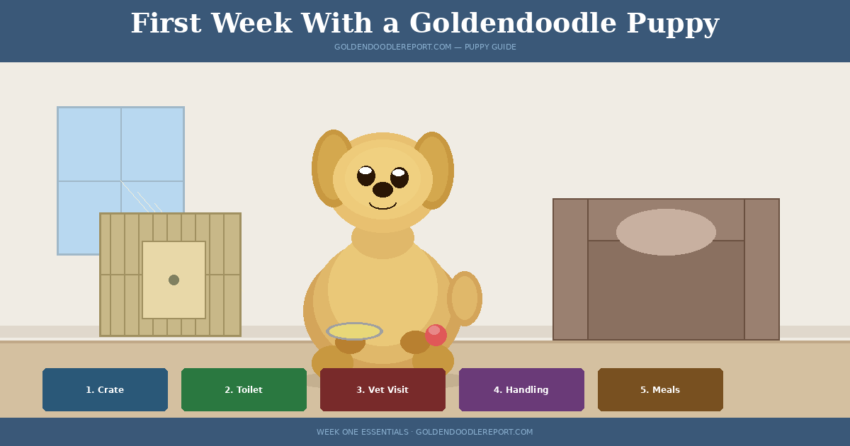
The first week with a Goldendoodle puppy is not about bonding — it is about structure. The puppy does not yet know the rules of its new home, what is expected of it, or how to regulate its own emotions in an unfamiliar environment. Your job in week one is to give it a consistent crate routine, a feeding schedule, a toilet protocol, the beginning of gentle handling for grooming tolerance, and a vet visit within 48 hours. Do those five things and the foundation is solid. Skip them and you spend the next six months fixing the gaps.
Quick Answer
What are the 5 things to do in the first week with a Goldendoodle puppy? Start crate training from night one. Establish the toilet routine immediately — outside every 2 hours and after every meal, sleep, and play session. Get a vet appointment within 48 hours. Begin gentle daily handling of paws, ears, and mouth. Set meal times and stick to them. Everything else — socialisation, training commands, puppy classes — builds on these five foundations.
Most owners spend the first week in a state of delighted overwhelm — enchanted by the puppy and simultaneously exhausted by the crying, the accidents, and the biting. That is normal. What matters is that underneath the chaos, the structure goes in from day one. A Goldendoodle that has a consistent routine from its first night at home becomes a settled, confident dog. One that spends week one on the owner’s lap being passed around the family, sleeping wherever it lands, and eating when it cries arrives at week two having learned that crying works, rules are optional, and the crate is a punishment.
This guide covers:
- What to do on the drive home and arrival
- The 5 non-negotiable actions of week one
- The day-by-day breakdown of what to expect
- The 3 mistakes that create the most lasting problems
- What the puppy is experiencing emotionally in week one
- When to call the vet
In This Guide
First Week With a Goldendoodle Puppy: The Drive Home and Arrival
The first week with a Goldendoodle puppy begins before you reach your front door. The drive home is the puppy’s first experience of the world outside the litter — new smells, sounds, motion, and the absence of everything familiar. How you handle it sets the tone for what follows.
The drive home: Bring a second person if possible so one can focus on driving while the other manages the puppy. Place the puppy in a crate or a lined box on the passenger’s lap rather than loose in the car. Bring a cloth or small item from the breeder with the litter’s scent if they offer one — the familiar smell is calming. The puppy may cry, may vomit, or may fall asleep. All three are normal. Keep the environment calm — no loud music, no overly excited energy.
Arrival: Take the puppy directly to the designated toilet area before bringing it inside. Do not go through the house first. The first time the puppy eliminates in the right place and is praised warmly for it, toilet training begins on the right foot. Then, and only then, bring the puppy inside to explore.
First exploration: Keep the puppy’s initial access to the home restricted. A puppy given free access to the whole house immediately is overwhelmed and impossible to monitor. Start with two or three rooms, use baby gates or a playpen to confine safely, and expand access as toilet training becomes reliable. This is not restriction — it is management that keeps the puppy safe and makes house training significantly faster.
Introductions: Keep the first day calm. Hold off on large family gatherings, neighbourhood visitors, and children’s friends until day two or three. The puppy needs to acclimatise to its primary caregivers first. Brief, calm introductions to household members on day one — then quiet. The socialisation push comes later in the week, once the puppy has found its footing.
The 5 Non-Negotiable Actions of Week One
These five actions are not optional extras. They are the structural foundations on which everything else in the first year is built. Skipping or delaying any of them creates problems that take months to correct.
1. Crate training from night one. The crate is the single most important tool in Goldendoodle puppy care. It gives the puppy a safe space of its own, supports toilet training by using the puppy’s natural reluctance to soil its sleeping area, and begins building the independent settling capacity that prevents separation anxiety. Place the crate in your bedroom for the first weeks so the puppy can hear and smell you. Feed meals inside the crate with the door open.
When the puppy settles inside voluntarily, close the door briefly and reward. Increase duration gradually. On night one, expect crying. Do not take the puppy out of the crate in response to crying — that teaches the puppy that crying opens the door. If you need to take the puppy out for a toilet trip at 2 AM, do so quietly and without fuss, then return immediately to the crate.
2. Toilet routine from hour one. Take the puppy outside to the toilet area every two hours during waking time, immediately after every meal, immediately after every nap, and immediately after every play session. Use one consistent phrase — “go toilet”, “be quick”, whatever you choose — and say it every time as the puppy eliminates. Reward the moment the puppy finishes with calm praise and a treat. Accidents inside the house should be cleaned with an enzymatic cleaner and ignored — no scolding, no drama. The puppy has no idea what went wrong and scolding after the fact teaches nothing except that the owner becomes frightening at random moments.
3. Vet visit within 48 hours. This is a health baseline check, not just a vaccination appointment. The vet assesses the puppy for congenital abnormalities, confirms the breeder’s vaccination records, sets up the deworming schedule, checks for parasites, and gives you weight-specific guidance on feeding and parasite prevention. Bring the breeder’s paperwork, any records you received, and a list of questions. For guidance on what the first visit involves, the AKC’s guide to the first puppy vet visit covers what to expect and how to prepare.
4. Daily handling from day one. Spend 2–3 minutes every day touching the puppy’s paws, between the toes, ears, inside the mouth, gums, and tail. Use treats throughout. Keep sessions calm and positive. This is not grooming — it is building a tolerance for being handled that makes every grooming appointment, veterinary examination, and nail trim for the rest of the dog’s life easy instead of a battle. A Goldendoodle that was thoroughly handled in the first 16 weeks of life is fundamentally different to groom than one whose tolerance was never built.
5. Consistent meal times. Feed at the same times every day from day one. Consistent meal times regulate the puppy’s digestive system and make toilet training significantly faster because elimination becomes predictable. Remove the food bowl after 15–20 minutes whether or not the puppy has finished — do not leave food down all day. A puppy that grazes whenever it likes is impossible to toilet train reliably because nothing about its elimination schedule is predictable.
Day-by-Day: What to Expect Each Day
First Week With a Goldendoodle Puppy — Day by Day
| Day | What to Do | What to Expect |
|---|---|---|
| Day 1 | Toilet trip on arrival. Restricted home access. Calm introductions. Crate routine begins tonight. | Crying in crate. Possible refusal to eat. Hiding or clinginess. Accidents. This is all normal. |
| Day 2 | Vet appointment. Continue toilet routine every 2 hours. Begin brief daily handling sessions. | Appetite may improve. Crate crying usually shorter. Puppy begins to map the home environment. |
| Day 3 | Introduce name — say it clearly before every treat and positive interaction. First 3-minute training session: sit only. | Biting begins or intensifies. Puppy is more alert and curious. Sleep still 16–18 hours daily. |
| Day 4 | Begin introducing mild novel stimuli — radio, TV at normal volume, different floor surfaces. Carry outside for safe socialisation. | More settled at night. Beginning to anticipate meal times. Personality starting to show. |
| Day 5 | Introduce the brush — 2 minutes, treats throughout. First paw handling with nail examination. | Zoomies may appear for the first time. Biting is at its most active — redirect, do not scold. |
| Day 6 | Introduce one calm visitor who will follow your rules about no rough play and not rewarding jumping or biting. | More confident exploring. Toilet training showing early reliability around meal times. |
| Day 7 | Review the week. Where are accidents clustering? Adjust toilet schedule if needed. | Puppy recognises its name. Crate routine is becoming normal. Foundation is in place. |
The 3 Mistakes That Create the Most Lasting Problems
These three mistakes are the most common causes of the behaviour problems that owners then spend months trying to fix. Every one of them happens out of kindness. Every one of them is counterproductive.
Mistake 1: Taking the puppy out of the crate when it cries. This is the most consequential mistake of week one. When a puppy cries in the crate and the owner opens the door, the puppy learns a direct and powerful lesson: crying opens the door. The puppy has no choice but to repeat and escalate the behaviour that worked. What follows is weeks of intensifying crate distress that the owner created by responding to it.
The correct approach on night one is to wait for a pause in the crying — even a brief one — and open the door during quiet. If you genuinely need to take the puppy out for a toilet trip, do so without fuss or eye contact, place it outside, return it to the crate immediately, and leave. Never take the puppy out of the crate as a reward for crying.
Mistake 2: Allowing behaviours in week one that you do not want at year one. A Goldendoodle puppy jumping up is adorable. A 30kg adult Goldendoodle jumping up is a liability. A puppy sleeping on the bed in week one because it is crying is not a problem — until it becomes a 3-year habit the owner then struggles to change. Whatever behaviour you allow in week one, you are training into the dog.
Mistake 3: Too much too soon. The first week generates enormous enthusiasm in new owners — and enormous anxiety in puppies. A puppy taken to a shopping centre, a busy park, a family party, and three separate friend’s houses in week one is not well socialised. It is overwhelmed. Socialisation at this age must be controlled, positive, and incremental. One new experience per day is plenty. Each experience should end on a positive note before the puppy shows signs of stress. A puppy that has a bad experience in week one has that experience logged in a neurological period where fear memories are particularly sticky.
What the Puppy Is Experiencing in Week One
Understanding the puppy’s emotional state in week one changes how owners respond to its behaviour. This is an 8-week-old animal that has never been alone in its life. It has lived in a warm pile of siblings with its mother’s presence as a constant. In the space of one day, all of that is gone — replaced by unfamiliar smells, unfamiliar sounds, unfamiliar people, and an unfamiliar sleeping space.
The crying on the first night is grief and disorientation, not manipulation. The clinginess is attachment-seeking in a creature whose survival instinct is to stay close to its group. The biting is normal puppy communication — in the litter, biting was how puppies played and tested boundaries, and getting bitten back by a littermate or growled at by the mother was how they learned bite inhibition.
What the puppy needs from you in week one is not excitement or constant stimulation — it is calm, predictable presence. An owner who moves through the routine quietly and consistently, who responds to crying with patience rather than anxiety, and who introduces new things slowly and positively is giving the puppy the emotional safety it needs to settle. The puppy does not need you to be its friend in week one. It needs you to be reliable.
Goldendoodles are particularly sensitive to owner emotional states. Both parent breeds — Golden Retrievers and Poodles — were developed for close handler partnership and are attuned to human emotional signals. A puppy whose owner is anxious and stressed will read and reflect that state. Calm owner energy in week one produces a calmer puppy.
When to Call the Vet
Beyond the planned 48-hour check-up, call your vet immediately if the puppy shows any of the following in the first week:
- Complete refusal to eat for more than 24 hours
- Vomiting more than twice in a day, or any vomiting with blood
- Diarrhoea lasting more than 24 hours, or diarrhoea with blood at any point
- Lethargy significantly different from normal puppy sleep — cannot be roused easily or shows no interest in food or play when awake
- Gums that are pale, white, blue, or grey rather than pink
- Laboured or rapid breathing not explained by exertion
- Any seizure or collapse
- Suspected ingestion of toxic items — chocolate, grapes, raisins, xylitol, onions, certain houseplants
Most puppies have loose stools in the first 2–3 days due to rehoming stress — this typically resolves on its own. If continuing the same food the breeder used and loose stools persist beyond 3 days, call the vet. Do not switch foods in week one.
⚠️ Watch Out
The first week with a Goldendoodle puppy exposes every inconsistency in household rules. If one family member lets the puppy jump up while another corrects it, the puppy learns that rules are person-specific rather than house rules. A five-minute family conversation before the puppy arrives — agreeing on crate rules, jumping rules, feeding rules, and what words to use for commands — prevents weeks of confusion for the puppy and frustration for the family. Goldendoodles are fast learners. They are equally fast at learning inconsistency.
When to Consult a Professional
- The puppy is showing aggression beyond normal puppy biting — snarling, snapping with intent, or resource guarding with genuine ferocity
- The puppy cannot be settled in the crate after 5–7 days of consistent, correct crate training
- Signs of genuine panic at separation — sustained high-pitched screaming, self-injury attempts, or complete inability to settle — may indicate a predisposition to separation anxiety that benefits from early professional support
Key Takeaways
- The first week with a Goldendoodle puppy establishes the habits and expectations the dog will carry for years — consistency from day one is the most important thing you can bring
- The 5 non-negotiable actions are: crate training from night one, toilet routine from hour one, vet visit within 48 hours, daily handling for grooming tolerance, and consistent meal times
- Never take the puppy out of the crate in response to crying — this is the single most common and most consequential mistake of week one
- Whatever behaviour you allow in week one you are training — the puppy that jumps up and gets attention is being taught to jump up
- Socialisation in week one must be calm and incremental — one new positive experience per day is sufficient and excessive stimulation is harmful
- The puppy’s crying and anxiety in week one is grief and disorientation, not manipulation — calm, consistent presence is the correct response
Related Goldendoodle Puppy Guides
- Goldendoodle Puppy Care Guide — The complete first-year overview covering all six care areas
- Goldendoodle Puppy Checklist — Everything to buy and set up before pickup day
- Goldendoodle Puppy First Night at Home — What to expect and exactly how to handle the first night
- Goldendoodle Puppy Biting Phase Guide — Why it happens and how to stop it
- Goldendoodle Puppy Socialization Checklist — What to expose your puppy to in the critical window
Part of the Goldendoodle Puppy Guide resource hub:
→ Goldendoodle Puppy Guide — Browse all 40 puppy guides
Frequently Asked Questions
Should I let my Goldendoodle puppy sleep with me in the first week?
This is a personal decision with long-term implications. A puppy that sleeps in bed with you in week one will expect to do so at year three — and a 30kg adult Goldendoodle in the bed is a different proposition to an 8-week-old puppy. If you are comfortable with the dog sleeping in your bed as an adult, week one is a reasonable time to establish it. If you do not want the adult dog in the bed, crate train from night one rather than allowing bed sleeping and removing it later. Removing a privilege is significantly harder than never granting it.
How much should a Goldendoodle puppy cry in the first week?
Crying in the crate and at separation is normal in week one and typically peaks on nights one and two before declining. By night four or five with consistent crate training, most puppies are settling within 10–15 minutes. If crying is sustained and panicked beyond day five despite correct crate introduction, discuss with your vet whether early anxiety support is appropriate.
When can my Goldendoodle puppy meet other dogs in the first week?
The puppy can meet vaccinated dogs whose health you can verify — dogs belonging to family or close friends — in the first week. It should not be taken to dog parks, pet shops, or areas frequented by unknown dogs until two weeks after the final primary vaccination at 16 weeks. The vaccination window does not mean isolation — it means controlled, verified exposure rather than uncontrolled exposure to unknown vaccination status.
My Goldendoodle puppy is not eating in the first week — should I be worried?
Reduced appetite in the first 24–48 hours is common due to rehoming stress and is not cause for alarm if the puppy is otherwise alert and not vomiting. Continue the same food the breeder was feeding, offer meals at consistent times, remove the bowl after 15 minutes whether or not the puppy has eaten, and avoid hand-feeding or adding extras to entice eating. If the puppy has not eaten for more than 24 hours or shows lethargy alongside the appetite loss, call the vet.
How often should I take my Goldendoodle puppy outside to toilet in week one?
Every 2 hours during waking time, and immediately after every meal, every nap, and every play session. An 8-week-old puppy has a bladder the size of a walnut and almost no voluntary control over when it uses it. The only way to prevent accidents is to create so many opportunities to go in the right place that accidents become rare. In week one rely on the schedule, not on the puppy signalling — signals come later as bladder control develops.
The information in this article is provided for general educational purposes only. King James Adjei is a researcher and enthusiast, not a veterinarian or certified behaviourist. For health concerns, always consult a qualified veterinarian. For persistent behaviour issues, consider working with a certified dog behaviourist.