7-minute read | Last updated March 2026 | Reviewed for accuracy
By King James Adjei | GoldendoodleReport.com
Researcher, Goldendoodle enthusiast, and founder of GoldendoodleReport. Every guide on this site is written to give owners reliable, clearly organised information — researched carefully and updated regularly.
The Goldendoodle puppy biting phase is one of the most universally reported challenges of new puppy ownership — and one of the most mishandled. Biting in puppies is completely normal developmental behaviour. What determines whether it stops at 5 months or continues into adolescence and beyond is almost entirely how the owner responds to it in the first weeks at home. This guide covers why puppies bite, the three stages of the biting phase, and the specific response protocol that actually works — along with the common responses that make it significantly worse.
Who This Guide Is For
This article is most useful if you:
- Have a Goldendoodle puppy that is biting and want to know the correct response
- Have tried saying “no” or “ouch” and found it is not working — or making things worse
- Want to understand why puppies bite and what the biting phase is trying to achieve developmentally
- Have children in the household and need the biting to stop as quickly as possible
For the physical teething process and chew toy guidance, see the Goldendoodle Puppy Teething Guide.
Quick Summary
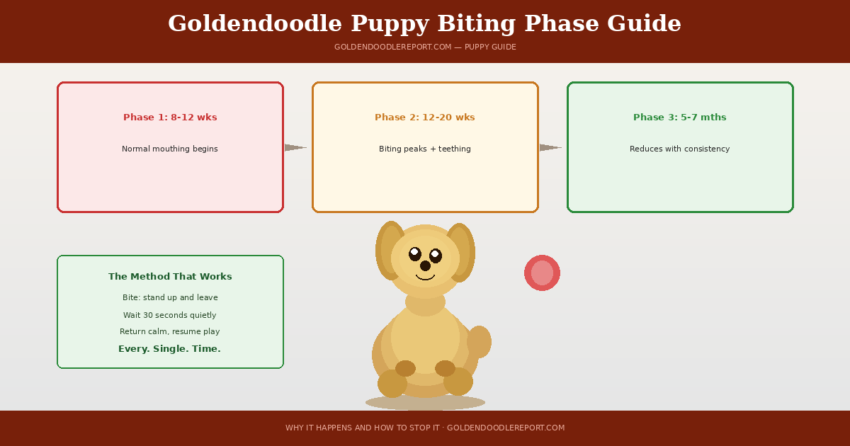
The Goldendoodle puppy biting phase is a normal developmental behaviour that peaks between 12 and 20 weeks and typically reduces significantly by 5 to 6 months with consistent handling. The only approach that reliably stops it is immediate, consistent removal of all owner attention the moment teeth touch skin — no verbal response, no pushing away, no eye contact. Every other common response either reinforces the biting directly or creates an attention-seeking cycle that intensifies it. Consistency from every person in the household is essential — one family member who responds differently to biting undoes the work of everyone else.
Quick Answer
How do you stop a Goldendoodle puppy biting? When teeth touch skin: say nothing, stand up immediately, and leave the room or turn your back completely for 30 seconds. Return calmly and resume interaction. If biting happens again, repeat immediately. Do this every single time, from every person, without exception. The puppy learns that biting ends interaction — the opposite of what it wants. This is the only method that produces reliable, lasting results.
The biting phase is particularly intense in Goldendoodles for a reason that is directly connected to their intelligence. Both parent breeds are fast learners who pick up behavioural consequences quickly. This means a Goldendoodle puppy learns just as rapidly what produces interaction — including the wrong kind of interaction — as it learns what ends it. An owner who says “no” sharply and pushes the puppy away has just given the puppy two things: a verbal cue that something interesting is happening, and physical contact. Both are rewarding to a puppy that wants engagement. The biting escalates because it is working.
This guide covers:
- Why puppies bite and what the biting phase is doing developmentally
- The three stages of the Goldendoodle puppy biting phase
- The response protocol that stops biting — step by step
- What makes biting worse — the responses to avoid
- Bite inhibition — what it is and why it matters
- Managing biting in households with children
- When the biting phase ends
In This Guide
- Goldendoodle Puppy Biting Phase: Why Puppies Bite
- The Three Stages of the Biting Phase
- The Response Protocol That Actually Works
- What Makes Biting Worse
- Bite Inhibition — Why Soft Mouthing Matters
- Managing Biting With Children in the Household
- When Does the Biting Phase End?
- Frequently Asked Questions
Goldendoodle Puppy Biting Phase: Why Puppies Bite
Biting is how puppies communicate, explore, play, and test boundaries. In the litter, puppies bite each other constantly — it is their primary interaction mode. They learn from littermate responses how hard is too hard: a puppy that bites too hard gets bitten back or receives a sharp yelp, which ends play. A puppy that bites softly gets continued engagement. This is the natural development of bite inhibition — the ability to control bite pressure — and it happens through direct feedback before the puppy ever comes home.
When the puppy arrives in a human household, it continues this same behaviour with its new companions. It does not understand that human skin is more sensitive than puppy fur, that humans do not play the same way littermates do, or that biting the owner’s hand is not the same as biting a sibling’s scruff. The puppy is not being aggressive. It is being a puppy.
The Goldendoodle puppy biting phase has an additional driver beyond normal play behaviour — the physical discomfort of teething between 12 and 24 weeks, which creates a compulsive need to chew and mouth that overlaps with and amplifies the play-biting phase. Understanding both drivers — communication and teething — helps owners respond to the behaviour rather than react to it.
For a broader overview of bite inhibition science and puppy behaviour, the AKC’s guide to puppy biting covers the developmental basis clearly.
The Three Stages of the Biting Phase
Goldendoodle Puppy Biting Phase — Three Stages
| Stage | Age Range | What Is Happening | Owner Priority |
|---|---|---|---|
| Stage 1 | 8–12 weeks | Normal play-biting and mouthing. Puppy is exploring its new environment with its mouth. Bite pressure is relatively light. | Begin the response protocol immediately from day one. Establish the rule before the habit forms. |
| Stage 2 | 12–20 weeks | Peak biting phase. Adult teeth pushing through intensify the need to mouth. The puppy is also testing boundaries more actively as confidence grows. This is when most owners feel the biting has “got worse”. | Consistent protocol application from every person in the household. Provide appropriate teething chews alongside the behaviour protocol. |
| Stage 3 | 5–7 months | Teething completes. With consistent protocol application, biting should reduce significantly during this stage. A puppy whose biting has been consistently unrewarded learns that mouthing humans ends engagement. | Maintain consistency even as the frequency reduces. Any inconsistent response resets the learning. |
The Response Protocol That Actually Works
The protocol is simple. Its power comes entirely from the consistency with which it is applied — not from the protocol itself, which is behavioural science in its most straightforward form.
Step 1: The moment teeth touch skin — say absolutely nothing. Do not say “no.” Do not say “ouch.” Do not say “stop.” Any verbal response is stimulating. The Goldendoodle puppy that bites and receives a verbal reaction — even a sharp one — has produced a response from the owner. Responses are engaging. Engagement is rewarding.
Step 2: Stand up immediately. Not slowly, not after a few more seconds of play. The moment teeth touch skin, stand up. Fold your arms. Turn away or leave the room. All physical interaction ends instantly.
Step 3: Wait 30 seconds. Behind a closed door or fully turned away with no eye contact. Thirty seconds is sufficient — this is not a long exclusion. It is a brief but immediate signal that biting ends play.
Step 4: Return calmly and resume interaction. Not excitedly. Not making a fuss over the puppy. Calmly, as if nothing happened. Resume play at a lower arousal level.
Step 5: If the puppy bites again — repeat step 1 immediately. The speed of the response matters. A five-second delay between bite and response reduces the puppy’s ability to connect the behaviour to the consequence.
This protocol works because it removes the one thing the puppy most wants — engagement — as a direct consequence of biting. The puppy is not punished. It is simply taught that biting produces the end of interaction rather than the continuation of it. Given enough consistent repetitions, the association becomes automatic.
The one non-negotiable: Every person who interacts with the puppy must apply this protocol in exactly the same way, every single time. One family member who laughs at biting, picks the puppy up when it nips, or continues play after a bite introduces a random reinforcement schedule — the most powerful reinforcement pattern in learning science. The puppy learns that biting sometimes works, which makes it try harder and more frequently, not less.
What Makes Biting Worse
These responses are given with good intentions. All of them make the biting phase longer and more intense.
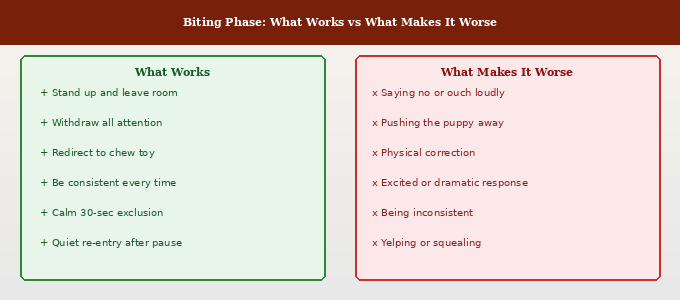
Saying “ouch” loudly. This was popularised as advice based on the idea that imitating a littermate’s pain response would teach bite inhibition. In practice with Goldendoodle puppies, a loud “ouch” produces one of two responses: the puppy freezes briefly and then comes back more excited (the sound was stimulating), or the puppy interprets the high-pitched sound as an invitation to play more intensely. Neither is the desired outcome.
Pushing the puppy away with your hands. This is physically engaging. The puppy is being touched and physically interacted with. From the puppy’s perspective, the game has become more physical and exciting. Pushing stimulates more biting, not less.
Physical correction — scruff shake, nose tap, alpha roll. These responses are harmful on multiple levels. They do not teach the puppy what to do instead. They damage trust and the relationship between puppy and owner, which undermines everything else in training. In a breed as sensitive and handler-oriented as the Goldendoodle, physical correction produces anxiety, not compliance. None of these techniques are endorsed by any credible veterinary or behaviourist organisation.
Continuing play after biting. Any continuation of interaction after a bite — even briefly — reinforces that the bite was acceptable. The end of interaction must be immediate and non-negotiable.
Being inconsistent. An inconsistently applied consequence is not a consequence at all — it is a variable reward schedule. Variable reward schedules produce the most persistent behaviour in animals. A puppy whose biting sometimes ends play and sometimes does not will bite more persistently and more intensely than one whose biting always ends play.
Bite Inhibition — Why Soft Mouthing Matters
Bite inhibition is different from stopping biting entirely. It refers specifically to a dog’s learned ability to control the pressure of its bite — to understand that mouths can touch without causing pain. This is an important distinction because a dog that has never learned to use its mouth gently, and that one day feels threatened or in pain, has no middle ground between “no bite” and a damaging bite. Bite inhibition is the safety mechanism.
The goal during the biting phase is not to teach the puppy never to use its mouth. It is to teach the puppy that soft mouthing is acceptable and hard biting is not — then gradually raise the standard until even soft mouthing on humans is no longer offered.
In practice this means applying the response protocol for any bite that causes pain or leaves a mark, while tolerating very soft mouthing initially. As the puppy progresses, the threshold for ending play is gradually lowered — first any pressure that would leave a mark, then any pressure that is perceptible, then eventually any mouth contact on human skin at all.
Managing Biting With Children in the Household
Biting is significantly more urgent when there are children in the home — both because children are less able to apply the protocol consistently and because puppy biting can genuinely frighten or hurt young children who do not have the physical resilience of adults.
The management approach in households with children has two components. First, the protocol is the same — but children need to be taught it explicitly in age-appropriate terms, supervised during practice, and supported to apply it rather than reacting with screaming or running (both of which stimulate the puppy). A child who screams and runs when the puppy bites is triggering prey-chase instinct and creating a highly aroused puppy that is now chasing a running child — a problematic pattern that escalates quickly.
Second, interactions between the puppy and young children should be fully supervised and time-limited during the biting phase. A puppy that has already had a play session and is approaching its awake window limit should be put in the crate before it reaches children. Overtired puppies bite harder and have less impulse control — managing the puppy’s schedule around children’s interaction times significantly reduces the incidence of biting incidents.
When Does the Biting Phase End?
With consistent protocol application from every person in the household, most Goldendoodle puppies show significant reduction in biting by 5 to 6 months. The combination of teething completing (removing the physical driver) and the learned association that biting ends play (removing the behavioural reward) typically produces a noticeable shift during this window.
Full mouth manners — the puppy reliably not mouthing people at all — typically consolidates between 6 and 12 months as the puppy gains impulse control alongside the physical maturity of having a full adult tooth set. The breed’s high trainability means Goldendoodles typically develop good mouth manners more quickly than average given consistent handling.
If biting has not reduced significantly by 6 months despite consistent application of the protocol, consider whether the protocol is genuinely being applied every time by everyone, whether overtiredness is a factor driving increased biting frequency, and whether there is any component of fear or anxiety driving the mouthing rather than pure play. Persistent, intense biting in a 6-month-old that shows no reduction with consistent handling warrants a conversation with a certified dog behaviourist.
⚠️ Watch Out
The most dangerous period for inconsistency in the Goldendoodle puppy biting phase is the first two weeks at home, when the puppy is so small and the biting is so minor that it does not feel urgent to address. Owners who find the 8-week biting “cute” and engage with it are training the puppy to bite as a communication and play strategy. The same behaviour at 5 months from a much larger, stronger puppy with a full set of adult teeth is no longer cute. The habits set in the first weeks are the ones that persist. Start the protocol from day one.
When to Seek Professional Help
- Biting shows no reduction by 6 months despite consistent, correct protocol application from all household members
- The puppy is biting with apparent intent — not play-biting but biting when touched, when food is near, or in response to being asked to do something
- Biting has injured a family member — broken skin beyond a superficial scratch — which is not typical of normal puppy play-biting
- The biting is accompanied by growling, stiff body posture, or other signs of genuine aggression rather than play excitement
Key Takeaways
- The Goldendoodle puppy biting phase is normal developmental behaviour — the puppy is communicating and exploring, not being aggressive
- The only response that reliably stops biting is immediate, silent withdrawal of all attention — stand up, leave the room, wait 30 seconds, return calmly
- Saying “ouch,” pushing the puppy away, and physical correction all make biting worse — they provide stimulation and engagement in response to the bite
- Consistency from every person is non-negotiable — one family member who responds differently introduces the most powerful reinforcement pattern possible
- Start the protocol from day one — the habits built with an 8-week puppy are the ones present at 5 months
- With consistent handling, most Goldendoodles show significant biting reduction by 5 to 6 months; persistent biting beyond this warrants professional assessment
Related Goldendoodle Puppy Guides
- Goldendoodle Puppy Teething Guide — The physical teething process and safe chew options that complement the behaviour protocol
- Best Chew Toys for Teething Goldendoodles — Safe redirection options by teething stage
- Goldendoodle Puppy Socialization Checklist — How socialisation during the biting phase builds handling tolerance
- First Week With a Goldendoodle Puppy — Why starting the protocol from day one matters
- Goldendoodle Puppy Care Guide — Complete first-year overview including the biting and teething phases
Part of the Goldendoodle Puppy Guide resource hub:
→ Goldendoodle Puppy Guide — Browse all 40 puppy guides
Frequently Asked Questions
Is it normal for Goldendoodle puppies to bite so much?
Yes — biting and mouthing is completely normal puppy behaviour for any breed, and Goldendoodles are no different. The breed’s high energy and engagement level can make the biting feel more intense than with calmer breeds, but the behaviour itself is universal. Most puppies brought home at 8 weeks will mouth and bite extensively — this is their primary communication and play mode from the litter. The question is not whether it happens but how consistently the household responds to it.
My Goldendoodle puppy bit a child — is this serious?
A single bite from a puppy in play context is not automatically serious, but it requires an honest assessment of what happened. Was it a typical play-nip that happened to catch skin, or was the puppy showing stress signals before the bite? A play-nip that frightened a child is an escalation signal — increase management, reduce unsupervised child-puppy time, and apply the protocol more rigorously. If the bite left a significant mark, broke skin badly, or occurred without obvious play provocation, discuss with your vet or a certified behaviourist before the next unsupervised interaction.
Should I use a spray bottle to stop my Goldendoodle puppy biting?
No. Spray bottles create an aversive association — with you, with the spray, or with the situation — without teaching the puppy what to do instead. They also do not work consistently and often become a novelty that the puppy habituates to. The attention-withdrawal protocol is more effective, faster to produce results, and does not damage the relationship between puppy and owner. There is no reputable veterinary or behaviourist organisation that recommends spray bottles for puppy biting management.
How long will the biting phase last?
With consistent protocol application from all household members from week one, most Goldendoodles show significant biting reduction by 5 to 6 months. The phase typically has a clear peak between 12 and 20 weeks during the teething intensification, followed by gradual reduction as teething completes and the behavioural association with attention-withdrawal builds. Without consistent handling, the biting phase can persist well into adolescence because the behaviour continues to produce intermittent rewards.
My puppy bites only me — not other family members. Why?
The most likely explanation is that the other family members are inadvertently responding differently — more consistently, less reactively, or in a way that is less stimulating to the puppy. Observe carefully how each person responds to biting. The person who is bitten most often is typically the one whose response the puppy finds most engaging — whether that is a louder reaction, more physical engagement, or more inconsistency in the protocol. Standardising the response across everyone, with the most-bitten person leading the change, typically produces rapid improvement.
The information in this article is provided for general educational purposes only. King James Adjei is a researcher and enthusiast, not a veterinarian or certified behaviourist. For biting that does not reduce with consistent protocol application or that involves apparent aggression, always consult a certified dog behaviourist or veterinarian.