6-minute read | Last updated March 2026 | Reviewed for accuracy
By King James Adjei | GoldendoodleReport.com
Researcher, Goldendoodle enthusiast, and founder of GoldendoodleReport. Every guide on this site is written to give owners reliable, clearly organised information — researched carefully and updated regularly.
Medical content notice: Deworming protocols and product recommendations should always be confirmed with your veterinarian, who will assess your puppy’s individual weight, health status, and parasite risk. This guide provides general information only — do not administer any dewormer without veterinary guidance.
This Goldendoodle puppy deworming guide covers the complete schedule from birth through adulthood, which intestinal parasites are most common in puppies, the signs that indicate a worm burden even when the puppy appears healthy, and why over-the-counter dewormers are often not the right choice for young puppies. This is a YMYL health topic — the information here is for education, not self-treatment. Always consult your veterinarian before administering any antiparasitic product to a puppy.
Who This Guide Is For
This article is most useful if you:
- Have just brought a Goldendoodle puppy home and want to understand the deworming schedule going forward
- Are not sure whether the breeder dewormed the puppy appropriately before pickup
- Want to know the signs of intestinal worms in puppies, including in apparently healthy dogs
- Have questions about the difference between prescription and over-the-counter deworming products
For the complete puppy health schedule including vaccinations, see the Goldendoodle Puppy Vaccination Timeline.
Quick Summary
The Goldendoodle puppy deworming guide in brief: puppies should be dewormed by the breeder starting at 2 weeks of age, repeated every two weeks until 8 weeks. From 8 weeks your vet continues the schedule monthly until 6 months of age, then moves to a quarterly or preventive protocol for adult dogs. Nearly all puppies carry some intestinal parasites — this is normal and not a reflection of the breeder’s care. Some worm burdens show no visible signs whatsoever, which is why routine deworming on schedule matters regardless of whether the puppy looks unwell.
Quick Answer
When should a Goldendoodle puppy be dewormed? Starting at 2 weeks by the breeder, then every 2 weeks until 8 weeks. Monthly from 8 weeks to 6 months. After 6 months, your vet will recommend a preventive protocol — typically monthly heartworm prevention that also covers common intestinal parasites, plus periodic faecal testing. Dewormers are prescription-grade products dosed by body weight — do not use over-the-counter products without veterinary guidance on a young puppy.
Intestinal parasites in puppies are extremely common — many puppies are born with roundworm larvae already present, transmitted from the mother through the placenta or through her milk. This is not unusual or a sign of poor breeding. It is a biological reality of canine reproduction, and it is why the deworming schedule begins at two weeks regardless of whether any signs of infestation are visible.
This guide covers:
- The complete Goldendoodle puppy deworming schedule
- The most common intestinal parasites in Goldendoodle puppies
- Signs of worm infestation — including in apparently healthy puppies
- Prescription versus over-the-counter dewormers
- Faecal testing — what it is and when to request it
- Adult deworming and ongoing parasite prevention
In This Guide
Goldendoodle Puppy Deworming Guide: The Complete Schedule
The standard deworming schedule follows guidelines from the Companion Animal Parasite Council (CAPC) and the recommendations of most US veterinarians. For the most current guidance on puppy parasite prevention, the AKC’s guide to deworming provides a clear overview of the process and what to expect.
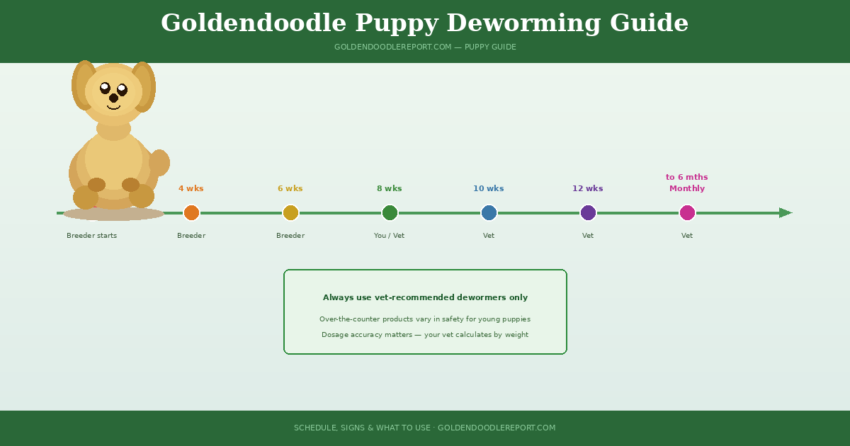
Goldendoodle Puppy Deworming Schedule
| Age | Deworming Action | Who is Responsible | Notes |
|---|---|---|---|
| 2 weeks | First deworming | Breeder | Targets roundworms (Toxocara canis) which may be present from birth via maternal transmission |
| 4 weeks | Second deworming | Breeder | Repeat treatment kills larvae that were not yet adult worms at the 2-week treatment |
| 6 weeks | Third deworming | Breeder | Continuing every 2 weeks to break the lifecycle. Ask the breeder to confirm this was done at pickup |
| 8 weeks | Fourth deworming | Breeder or your vet at first visit | Bring deworming records to first vet visit. Vet will confirm and continue the schedule |
| 10 weeks | Fifth deworming | Your veterinarian | Vet-prescribed product dosed to the puppy’s current weight |
| 12 weeks | Sixth deworming | Your veterinarian | Coincides with third DHPP vaccination appointment for most puppies |
| Monthly to 6 mths | Monthly deworming | Your veterinarian | Continue monthly from 3 to 6 months. Often combined with monthly heartworm preventive |
| 6 mths onward | Preventive protocol | Your veterinarian | Typically monthly heartworm/parasite preventive year-round, plus faecal testing 2–4 times per year |
The Most Common Intestinal Parasites in Puppies
Understanding which parasites are most likely to affect a Goldendoodle puppy explains why the deworming schedule is structured the way it is. Different parasites have different transmission routes, life cycles, and health impacts — and different dewormers target different species.
Common Intestinal Parasites in Goldendoodle Puppies
| Parasite | How Puppies Get It | Health Impact | Notes |
|---|---|---|---|
| Roundworms (Toxocara canis) |
In utero (placenta) or through mother’s milk. Most common route in puppies under 8 weeks. | Pot-bellied appearance, poor growth, diarrhoea. Heavy burdens can be life-threatening in young puppies. | Most common puppy parasite. Can infect humans — zoonotic. Standard dewormers highly effective. |
| Hookworms (Ancylostoma) |
Mother’s milk, skin penetration from contaminated soil, ingestion of larvae. | Anaemia, bloody diarrhoea, weakness. Can be fatal in young puppies due to blood loss. | Zoonotic — can cause cutaneous larva migrans in humans via skin contact with infected soil. |
| Whipworms (Trichuris vulpis) |
Ingestion of eggs from contaminated soil or surfaces. More common in older puppies with outdoor access. | Chronic diarrhoea, weight loss, anaemia in heavy burdens. | Eggs can survive in soil for years. Not covered by all standard dewormers — confirm with vet. |
| Tapeworms (Dipylidium/Taenia) |
Ingesting infected fleas (Dipylidium) or infected prey animals (Taenia). Requires flea control as part of prevention. | Usually mild — weight loss, scooting, visible segments in faeces or around the anus. | Not targeted by standard deworming protocols — requires praziquantel specifically. |
| Giardia (protozoan, not worm) |
Contaminated water, contact with infected faeces. Common in kennels and multi-dog environments. | Soft, greasy, often foul-smelling stools. Not always symptomatic. | Technically a protozoan, not a worm. Requires specific treatment — metronidazole or fenbendazole. |
Signs of Worm Infestation
The critical point about signs of intestinal parasites in puppies is that many infected puppies show no obvious signs at all — particularly at low to moderate worm burdens. This is one of the primary reasons routine deworming on schedule matters regardless of whether the puppy looks healthy. The absence of visible signs does not mean the absence of parasites.
Visible signs when present include:
- Pot-bellied appearance — the abdomen appears rounded and distended despite the puppy being otherwise thin. This is classic for heavy roundworm burden in young puppies
- Diarrhoea — particularly pale, mucousy, or bloody stools. Bloody diarrhoea in a puppy warrants immediate veterinary attention as hookworm anaemia can deteriorate quickly
- Visible worms in faeces or vomit — roundworms look like spaghetti segments, tapeworm segments look like small rice grains near the anus or in fresh faeces
- Scooting — dragging the bottom along the floor, often associated with tapeworm segments causing irritation around the anus
- Poor coat quality — a dull, dry, or patchy coat in a puppy receiving adequate nutrition may indicate a parasite burden diverting nutrients
- Failure to thrive — a puppy that is eating well but not gaining weight appropriately
- Coughing — in heavy roundworm infestations, larvae migrate through the lungs during part of their life cycle, causing a cough known as ascariasis pneumonitis
In puppies under 12 weeks, any of the above signs — particularly bloody diarrhoea, severe lethargy, or visible worms — warrant same-day veterinary contact rather than watchful waiting.
Prescription vs Over-the-Counter Dewormers
The most important practical point in this Goldendoodle puppy deworming guide is the distinction between prescription dewormers and over-the-counter products.
Prescription dewormers are dosed precisely to the puppy’s weight, confirmed effective against the specific parasite species identified or suspected, and selected for safety at the puppy’s age and health status. Common prescription dewormers include fenbendazole (Panacur), pyrantel pamoate, and milbemycin — each with different spectrums of activity.
Over-the-counter dewormers vary enormously in quality, spectrum of coverage, and safety profile. Some are appropriate for use in puppies. Many are not. The risk of under-dosing (ineffective treatment) or overdosing (toxicity) without weight-based calculation is real and particularly concerning in young puppies whose livers and kidneys are still developing. Some OTC products marketed for dogs are unsafe for certain breeds or ages.
The recommended approach is clear: bring the puppy to the vet, have a faecal sample tested to identify which parasites are present, and use the vet-prescribed product at the vet-calculated dose. This is faster, safer, and more effective than working through OTC options independently.
Faecal Testing — What It Is and When to Request It
A faecal flotation test is a laboratory examination of a fresh stool sample that identifies the eggs of intestinal parasites under microscopy. It is one of the most valuable and inexpensive diagnostics available for puppy health.
Bring a fresh stool sample (collected within a few hours, stored in a clean bag, and kept cool) to the first vet visit at 48 hours. Most vets will perform a faecal flotation at this visit as standard. The test identifies roundworm, hookworm, whipworm, tapeworm, and Giardia if present.
For puppies that have completed their primary deworming series, faecal testing two to four times per year is recommended by the Companion Animal Parasite Council — even in dogs that appear perfectly healthy and are on a regular preventive protocol. Environmental exposure continues throughout the dog’s life, and periodic testing catches reinfestation before it becomes a significant health burden.
Adult Deworming and Ongoing Prevention
After the intensive puppy deworming schedule is complete at 6 months, the ongoing prevention strategy typically involves monthly heartworm preventive products that also cover common intestinal parasites — products such as Heartgard Plus (pyrantel/ivermectin) or Interceptor Plus (milbemycin/praziquantel) provide broad-spectrum coverage against heartworm, roundworms, hookworms, whipworms, and in some formulations, tapeworms. These are given monthly year-round in most US regions.
Periodic faecal testing — typically twice yearly at minimum, four times yearly for dogs with significant outdoor exposure — allows the vet to identify any parasite species not covered by the monthly preventive and treat specifically. This is particularly relevant for whipworms and Giardia, which require different treatment approaches than the parasites covered by standard preventives.
⚠️ Watch Out
The most common Goldendoodle puppy deworming mistake is assuming that because the puppy looks healthy and the breeder said they dewormed it, no further action is needed on your part. Ask the breeder specifically when each deworming was given and which product was used. Confirm this with your vet at the first visit. A puppy that was dewormed at 2 and 4 weeks but not 6 or 8 weeks has an incomplete primary series and may still carry a significant parasite burden. Bring the records and let the vet assess.
When to Contact the Vet Immediately
- Blood in the puppy’s stools at any time — do not wait for the next scheduled appointment
- Visible worms in vomit — roundworms in vomit indicate a heavy burden that needs immediate treatment
- Rapid weight loss or failure to gain weight despite eating well
- Extreme lethargy combined with pale gums — possible hookworm anaemia, which can deteriorate rapidly in puppies under 12 weeks
- Persistent diarrhoea lasting more than 24 hours in a puppy under 12 weeks
Key Takeaways
- The Goldendoodle puppy deworming guide covers a schedule beginning at 2 weeks (breeder) and continuing every 2 weeks until 8 weeks, then monthly to 6 months
- Nearly all puppies carry intestinal parasites — this is normal and not a reflection of breeder quality. Routine deworming on schedule treats it regardless of visible signs
- Many worm burdens in puppies produce no visible signs — the absence of symptoms does not mean the absence of parasites
- Always use vet-prescribed dewormers dosed to the puppy’s weight — OTC products vary in safety, spectrum, and efficacy for young puppies
- Bring a fresh stool sample to the first vet visit — faecal testing identifies which specific parasites are present and guides treatment
- Adult prevention typically involves monthly heartworm preventive covering intestinal parasites, plus periodic faecal testing 2–4 times per year
Related Goldendoodle Puppy Guides
- Goldendoodle Puppy Vaccination Timeline — The complete vaccination schedule alongside the deworming milestones
- Goldendoodle Puppy First Vet Visit — What to bring and what to expect including faecal testing
- Goldendoodle Puppy Care Guide — Complete first-year overview including all health milestones
- New Goldendoodle Puppy Mistakes to Avoid — Common health and care mistakes in year one
Part of the Goldendoodle Puppy Guide resource hub:
→ Goldendoodle Puppy Guide — Browse all 40 puppy guides
Frequently Asked Questions
How do I know if my Goldendoodle puppy has worms?
You often cannot tell by observation alone — many puppy worm burdens produce no visible signs until they become heavy. The most reliable way to know is faecal testing at the vet, which identifies parasite eggs under microscopy. Visible signs when present include pot-bellied appearance, diarrhoea, visible worm segments in faeces or around the anus, scooting, and failure to thrive despite eating well. Any of these signs warrant a vet visit rather than self-treatment.
What dewormer did the breeder likely use and should I continue it?
Reputable breeders typically use pyrantel pamoate or fenbendazole for the early puppy series. At your first vet visit, bring the breeder’s deworming records including the product name and dates. Your vet will assess whether the schedule was followed appropriately, run a faecal test, and prescribe the appropriate product for continuation. Do not simply continue the breeder’s product without vet confirmation — the vet may want to use a different or broader-spectrum dewormer based on what the faecal test shows.
Can worms from my Goldendoodle puppy infect my family?
Yes — roundworms and hookworms are zoonotic, meaning they can infect humans. Roundworm larvae can cause visceral larva migrans (organ migration) or ocular larva migrans (eye damage) in humans, particularly children who have contact with contaminated soil. Hookworm larvae can cause cutaneous larva migrans — itchy, migrating skin tracks. The risk is managed by keeping the puppy’s deworming schedule current, washing hands after handling puppies or faeces, and preventing children from playing in areas that may be contaminated with puppy faeces.
My puppy is already on a monthly preventive — does it still need deworming?
Monthly heartworm preventives cover some intestinal parasites but not all of them — specifically, most do not cover tapeworms, and not all cover Giardia. Periodic faecal testing two to four times per year confirms whether the monthly preventive is providing adequate coverage for the parasites your specific dog is being exposed to. Discuss with your vet whether additional treatment is needed based on the test results.
Is the deworming schedule different for Mini vs Standard Goldendoodles?
The timing of the deworming schedule is the same regardless of size — it is age-based, not size-based. The dosage, however, is weight-based. A Mini Goldendoodle puppy at 8 weeks will receive a smaller dose of dewormer than a Standard Goldendoodle puppy of the same age because the dose is calculated per kilogram of body weight. This is one of the reasons vet-prescribed, weight-dosed products are strongly preferred over fixed-dose OTC products, particularly for small puppies.
The information in this article is provided for general educational purposes only and does not constitute veterinary advice. King James Adjei is a researcher and enthusiast, not a veterinarian. Deworming protocols should always be confirmed and managed by a qualified veterinarian. Never administer antiparasitic products to a puppy without veterinary guidance.