8-minute read | Last updated March 2026 | Reviewed for accuracy
By King James Adjei | GoldendoodleReport.com
Researcher, Goldendoodle enthusiast, and founder of GoldendoodleReport. Every guide on this site is written to give owners reliable, clearly organised information — researched carefully and updated regularly.
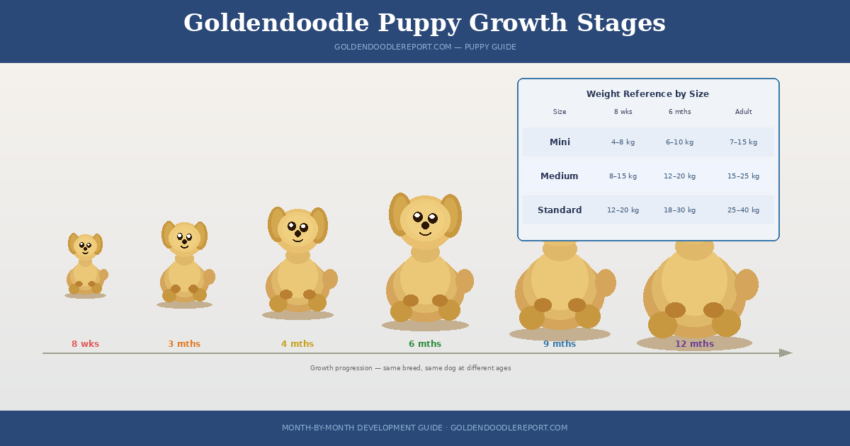
Understanding Goldendoodle puppy growth stages is one of the most practically useful things a new owner can do — not for the satisfaction of tracking numbers, but because knowing what is developmentally normal at each stage makes it possible to respond correctly to the behaviours and changes that otherwise feel random, alarming, or inexplicable. This guide covers what is happening physically and behaviourally at every stage of the first year, and the milestones that tell you things are progressing as they should.
Who This Guide Is For
This article is most useful if you:
- Want to know what to expect at each stage of your Goldendoodle puppy’s development
- Are concerned about whether your puppy’s weight or size is on track
- Have noticed a behaviour change — particularly at 6 to 8 months — and want to understand whether it is developmental
- Are planning ahead for the adolescence phase and want to know when it arrives and what it involves
For the specific developmental stage affecting behaviour at each point, see the Goldendoodle Puppy Fear Stages guide.
Quick Summary
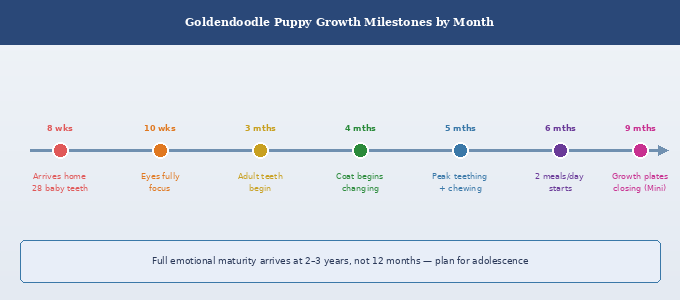
Goldendoodle puppy growth stages span from birth through approximately 18 months for full physical maturity — longer for Standard Goldendoodles — and through 2 to 3 years for full emotional and neurological maturity. The first year contains the most rapid physical changes: a puppy that arrives at 8 weeks weighing 2 to 5 kg will reach 70 to 90% of its adult weight by 9 to 12 months. Behavioural development follows a different and slower timeline — adolescence typically arrives at 6 to 9 months and full emotional regulation does not consolidate until 2 to 3 years regardless of physical size.
Quick Answer
What are the Goldendoodle puppy growth stages? Birth to 2 weeks: neonatal (eyes and ears closed). 2–4 weeks: transitional (senses open). 3–12 weeks: primary socialisation. 12–16 weeks: secondary socialisation, most critical window closes. 4–6 months: juvenile, teething peaks. 6–12 months: adolescence arrives. 12–18 months: physical maturity (earlier for Minis). 2–3 years: full emotional maturity. Each stage has specific physical and behavioural markers — this guide covers all of them.
The most important thing to understand about Goldendoodle puppy growth stages is the gap between physical maturity and emotional maturity. Many owners, seeing a large, physically developed Goldendoodle at 12 months, expect adult behaviour from it and become frustrated when the dog continues to show adolescent impulsivity, poor impulse control, and erratic response to known commands. This expectation mismatch — adult body, puppy brain — is the most common cause of owner disappointment in the second year. A Goldendoodle that is 12 months old is physically close to adult size but neurologically still a teenager. The brain catches up by 2 to 3 years.
This guide covers:
- Physical growth stages — weight, size, and coat changes
- Behavioural development stages — what is normal at each age
- The adolescence phase — when it arrives, what it looks like, how long it lasts
- Growth charts and weight ranges by size
- Signs that growth is on track versus signs to discuss with a vet
In This Guide
- Goldendoodle Puppy Growth Stages: Physical Development
- Weight and Size by Age — What to Expect
- Behavioural Development Month by Month
- Adolescence — When It Arrives and What It Involves
- The Coat Transition — When and What to Expect
- Signs Growth Is on Track vs When to See the Vet
- Frequently Asked Questions
Goldendoodle Puppy Growth Stages: Physical Development
Physical growth in Goldendoodle puppies follows a predictable sequence governed by genetics and nutrition. The rate of growth is most rapid in the first 6 months, then decelerates toward physical maturity. For a comprehensive overview of puppy developmental stages, the AKC’s guide to puppy development stages provides useful context across all breeds.
Goldendoodle Puppy Growth Stages — Physical Development
| Age | Physical Development | Key Physical Milestone | Owner Action |
|---|---|---|---|
| 0–2 weeks Neonatal |
Eyes and ears closed. Completely dependent on mother. Doubles birth weight in first week. | First breeder deworming at 2 weeks | Breeder responsible — ensure breeder deworming records obtained at pickup |
| 2–4 weeks Transitional |
Eyes open around day 10–14. Ears open around day 14–21. Baby teeth begin erupting. | First steps and wobbly walking begin | Breeder responsible |
| 4–8 weeks Socialisation 1 |
Rapid growth. All senses functioning. Weaning begins. All 28 baby teeth complete by 8 weeks. First DHPP vaccine at 6–8 weeks. | Bite inhibition learning from littermates and mother | Breeder — confirm vaccination and deworming records at pickup |
| 8–16 weeks Socialisation 2 |
Rapid weight gain. Coordination improves. Vaccination series continues. Baby teeth remain. Growth rate fastest of any post-birth stage. | Socialisation window open and closing | Maximum socialisation effort. Vet visits. Crate training. Biting protocol. |
| 4–6 months Juvenile |
Teething — adult teeth push through. Coat begins transitioning from soft puppy coat to adult coat. 50–70% of adult weight reached. | Meals reduce from 3 to 2 daily at 6 months | Increase brushing as coat transitions. Provide teething chews. |
| 6–12 months Adolescent |
Growth rate slows. 70–90% of adult weight at 9 months. Growth plates closing in Minis from 10 months. Adult teeth complete by 8 months. | Sexual maturity (if not neutered). Adolescence peaks. | Maintain training consistency through adolescent regression. Discuss neutering timing with vet. |
| 12–18 months Young Adult |
Physical growth complete in Minis and Mediums. Standards may continue gaining muscle mass to 18 months. Growth plates fully closed. | Full exercise range now permitted — growth plate closure confirmed | Transition to adult food if not already done. Adult exercise routine begins. |
Weight and Size by Age — What to Expect
Weight ranges for Goldendoodle puppies vary enormously between the three size categories. These figures are general guides based on typical growth curves — individual dogs vary based on genetics, nutrition, and health, and there is significant overlap between size categories depending on the specific parents.
Goldendoodle Puppy Weight by Age and Size
| Age | Mini (7–15 kg adult) | Medium (15–25 kg adult) | Standard (25–40 kg adult) |
|---|---|---|---|
| 8 weeks | 1.5–3.5 kg | 3–6 kg | 5–9 kg |
| 3 months | 3–6 kg | 6–12 kg | 10–18 kg |
| 6 months | 5–10 kg | 10–18 kg | 17–28 kg |
| 9 months | 6–13 kg | 12–22 kg | 20–34 kg |
| 12 months | 7–15 kg (near adult) | 14–24 kg (near adult) | 22–38 kg (may still grow) |
These are reference ranges only. A puppy that falls outside these ranges is not automatically problematic — genetics from the specific parents, body condition score, and individual variation all affect where a puppy lands. The most important assessment is not weight in isolation but body condition: you should be able to feel the ribs with light pressure but not see them clearly. A waist visible from above and a slight abdominal tuck from the side indicate healthy body condition.
Behavioural Development Month by Month
Physical growth and behavioural development run on separate timelines. Understanding both simultaneously gives the clearest picture of what to expect at each stage.
8–12 weeks: The puppy has left the litter and is in its primary human bonding period. It is highly impressionable — both positively (socialisation) and negatively (fear experiences). Sleep occupies 16–20 hours daily. Biting is at its earliest stage. Toilet training begins. This is the highest-leverage period of the entire relationship — what is built here lasts.
12–16 weeks: The socialisation window closes. The puppy’s capacity to accept new things as normal is declining. Training accelerates — the puppy can now learn sit, stay, come, down, and leave it reliably. First fear period may occur — things that were fine last week suddenly produce fear. Do not force exposure during the fear period. Vaccination series completes at 16 weeks.
4–6 months: The juvenile phase. The puppy is gaining confidence and independence. Testing boundaries becomes more active — rules that were accepted without question may now be tested. Teething peaks. Chewing intensifies. The puppy is still highly responsive to training but requires more consistency as confidence grows. Second set of vaccinations and boosters often occur in this window.
6–9 months: Adolescence begins. This is the period that most surprises owners who expected steady progress. The dog that was reliably sitting on command may appear to forget it. The puppy that was house-trained may have regression incidents. Recall that was excellent may deteriorate. This is neurological — the prefrontal cortex responsible for impulse control is entering its most significant developmental phase and temporarily becomes less effective as it is rebuilt. This is not a training failure. It is brain development.
9–12 months: Physical maturity approaching for Minis and Mediums. The adolescent erratic behaviour continues but may begin showing early signs of settling. Some dogs show a noticeable improvement around the 12-month mark; others remain deeply adolescent until 18 months. Consistency in routine, exercise, and training expectations during this period determines whether the dog that emerges from adolescence has solid foundations or not.
12–18 months: Physical maturity complete in Minis and Mediums. Standards continue. The dog begins to look adult. Behaviour is still adolescent in many cases — owners often describe this period as “the body of a dog, the brain of a puppy.” Full emotional regulation typically does not arrive until 2 to 3 years.
Adolescence — When It Arrives and What It Involves
Adolescence in Goldendoodles typically begins at around 6 to 9 months and lasts until approximately 18 months for Minis and Mediums, and up to 24 months for Standards. This is the most challenging period of dog ownership for most Goldendoodle owners — not because the dog is damaged or untrained, but because the neurological changes of adolescence produce behaviours that feel like regression from earlier progress.
The specific changes of adolescence that owners report most frequently include: deterioration of previously reliable recall, increase in impulsive behaviour and difficulty disengaging from distractions, apparent selective deafness to known commands, testing of social boundaries with other dogs, increase in marking behaviour in males, and occasionally renewed resource guarding or food-focused behaviour that was not present before.
All of these changes are driven by the same neurological process — the prefrontal cortex, responsible for impulse control and emotional regulation, undergoes significant remodelling during adolescence. The limbic system, responsible for immediate emotional responses and reward-seeking, becomes relatively more dominant during this period. This is the same developmental pattern seen in human adolescents and for the same evolutionary reasons.
The correct owner response to adolescence is not to lower expectations or stop training — it is to maintain structure, routine, and training consistency while recognising that the dog is doing its best within a neurological landscape that is temporarily making self-regulation harder. Dogs that have strong foundations from the first 6 months navigate adolescence more smoothly than those who do not, and emerge on the other side with excellent manners and solid training intact.
The Coat Transition — When and What to Expect
One of the most practically significant of the Goldendoodle puppy growth stages for owners is the coat transition — the shift from the soft, fluffy puppy coat to the adult coat that occurs between 6 and 12 months. This transition is significant for grooming requirements and is the period when matting becomes a serious risk for the first time.
The puppy coat is typically soft, low-maintenance, and mat-resistant. The adult coat is denser, may be curlier or wavier depending on generation, and requires significantly more regular brushing to prevent matting. During the transition, both coat textures exist simultaneously — the old puppy coat mixed with the new adult coat growing in beneath it. This mixed texture is the most mat-prone coat the dog will ever have, and owners who are brushing three times per week need to increase to daily brushing during this window.
The transition typically begins around the face and body, with the legs and tail following. Most owners first notice that brushing is “catching” more than usual — this is the early sign of the transition beginning. Establish daily brushing before the transition peaks rather than after matting has already developed.
Signs Growth Is on Track vs When to See the Vet
On Track vs See the Vet — Growth Signs
| Signs Growth Is on Track | Signs to Discuss with Vet |
|---|---|
| Steady weight gain each week during the first 6 months | Weight loss or stagnation over more than 2 weeks not explained by illness |
| Ribs palpable under light pressure, waist visible from above | Ribs clearly visible without touching — underweight |
| Alert, energetic during awake periods, settles during sleep periods | Persistent lethargy, failure to thrive despite eating well |
| Limbs straight, gait even, no obvious favouring | Limping, reluctance to put weight on a leg, bunny-hopping gait |
| Coat growing in evenly, shiny and clean-smelling | Patchy coat, excessive scratching, skin redness or hot spots |
| Baby teeth falling out as adult teeth erupt — matching positions | Retained baby teeth alongside adult teeth at 6 months or older |
⚠️ Watch Out
The most common Goldendoodle puppy growth stages mistake is expecting adult behaviour from a physically adult-sized dog. A Standard Goldendoodle at 12 months may weigh 30 kg and look fully grown — but its prefrontal cortex will not finish maturing until approximately 2 to 3 years of age. Expecting the impulse control, settled behaviour, and reliable response to commands of a mature adult dog from a 12-month-old Goldendoodle leads to frustration for the owner and confusion for the dog. Adjust expectations to brain development, not body size.
Key Takeaways
- Goldendoodle puppy growth stages span from birth to physical maturity at 12–18 months and emotional maturity at 2–3 years — these are different timelines
- The most rapid growth occurs in the first 6 months — a Mini Goldendoodle at 6 months has reached roughly 70% of its adult weight
- Adolescence begins at 6–9 months and produces apparent regression in training — this is neurological development, not a training failure
- The coat transition at 6–12 months is the highest-risk period for matting — daily brushing is essential during this window
- Assess body condition by feel rather than weight alone — palpable ribs with a visible waist indicates healthy condition
- Retained baby teeth at 6 months need veterinary attention — ideally removed at the same time as neutering to combine anaesthetic events
Related Goldendoodle Puppy Guides
- Goldendoodle Puppy Fear Stages — The two fear periods that occur within the growth stages and how to handle them
- Goldendoodle Exercise Needs by Age — Safe exercise limits at each growth stage
- When Do Goldendoodle Puppies Calm Down? — The brain maturity timeline and what to expect
- Goldendoodle Puppy Teething Guide — The teething stage in detail including relief options
- Goldendoodle Puppy First Grooming Guide — Preparing for the coat transition
Part of the Goldendoodle Puppy Guide resource hub:
→ Goldendoodle Puppy Guide — Browse all 40 puppy guides
Frequently Asked Questions
How big will my Goldendoodle puppy get?
Adult size depends primarily on the size of both parents. As a general guide: a Mini Goldendoodle (Toy/Mini Poodle parent) reaches 7 to 15 kg and 30 to 45 cm at the shoulder. A Medium Goldendoodle reaches 15 to 25 kg and 45 to 55 cm. A Standard Goldendoodle (Standard Poodle parent) reaches 25 to 40 kg and 55 to 65 cm. The most reliable way to predict adult size is to ask the breeder for the weights of both parents. A puppy will typically fall between those two weights at maturity.
When do Goldendoodle puppies stop growing?
Mini Goldendoodles reach full height by around 9 to 12 months and full adult weight by 10 to 14 months. Medium Goldendoodles reach full height by 12 months and adult weight by 12 to 15 months. Standard Goldendoodles reach full height by 12 to 14 months but may continue filling out in muscle mass until 18 months. Growth plate closure, which signals the end of bone growth, occurs at 10 to 12 months for Minis, 12 to 15 months for Mediums, and 15 to 18 months for Standards.
My Goldendoodle puppy seems to have stopped growing — is this normal?
Growth in puppies is not always linear — there are periods of noticeable growth followed by periods where size appears stable. This is normal, particularly in the 4 to 6 month window. If the puppy has not grown at all over a 4-week period and is also losing weight or appearing thin, discuss with your vet. A puppy that is maintaining healthy body condition, eating well, and active during its awake periods is almost certainly developing normally even if growth appears to have paused temporarily.
Is my Goldendoodle puppy overweight or underweight?
The most reliable assessment is body condition score rather than a weight chart — Goldendoodles vary too much in size for a simple weight number to be meaningful without knowing the adult size category. A healthy body condition means you can feel the ribs easily under light hand pressure but they are not visible through the skin, there is a visible waist when viewed from above, and there is a slight abdominal tuck when viewed from the side. If the ribs are clearly visible without touching, the puppy is underweight. If you cannot feel the ribs at all under light pressure, the puppy is overweight. Discuss either finding with your vet at the next scheduled visit.
Why does my Goldendoodle seem to have got worse at training — is this normal at 8 months?
Yes — this is textbook adolescent behaviour and is entirely normal at 6 to 10 months. The prefrontal cortex, responsible for impulse control and the ability to respond to learned commands under distraction, undergoes significant neurological remodelling during adolescence. The dog temporarily becomes less able to override immediate impulses — which manifests as apparent “forgetting” of commands it previously performed reliably. This is not regression in training and it is not a permanent change. Maintain routine, consistency, and positive reinforcement training through this period and the behaviour will stabilise, typically by 12 to 18 months.
The information in this article is provided for general educational purposes only. King James Adjei is a researcher and enthusiast, not a veterinarian. For concerns about growth, weight, or development, always consult a qualified veterinarian.