7-minute read | Last updated March 2026 | Reviewed for accuracy
By King James Adjei | GoldendoodleReport.com
Researcher, Goldendoodle enthusiast, and founder of GoldendoodleReport. Every guide on this site is written to give owners reliable, clearly organised information — researched carefully and updated regularly.
The Goldendoodle puppy socialization checklist is one of the most time-sensitive documents in puppy ownership. The socialisation window opens at approximately 3 weeks of age and closes at 16 weeks — after that, the brain’s capacity to accept new experiences as normal rather than threatening diminishes significantly.
What your puppy is exposed to positively during this window shapes the adult dog it becomes. What it misses can produce fear, reactivity, and anxiety that take years of counter-conditioning to address — and sometimes never fully resolve. This checklist tells you exactly what to cover, how to do it safely before full vaccination, and how to know when an exposure is going well versus when to stop.
Who This Guide Is For
This article is most useful if you:
- Have a puppy between 8 and 16 weeks and want a systematic checklist of what to socialise
- Are concerned about the vaccination window and want to know which exposures are safe before full protection
- Have heard conflicting advice about socialisation versus vaccination risk and want a balanced answer
- Want to understand how to socialise correctly — not just what to expose the puppy to but how to do it so exposures are positive
For vaccination timing and what is safe outdoors before full protection, see the Goldendoodle Puppy Vaccination Timeline.
Quick Summary
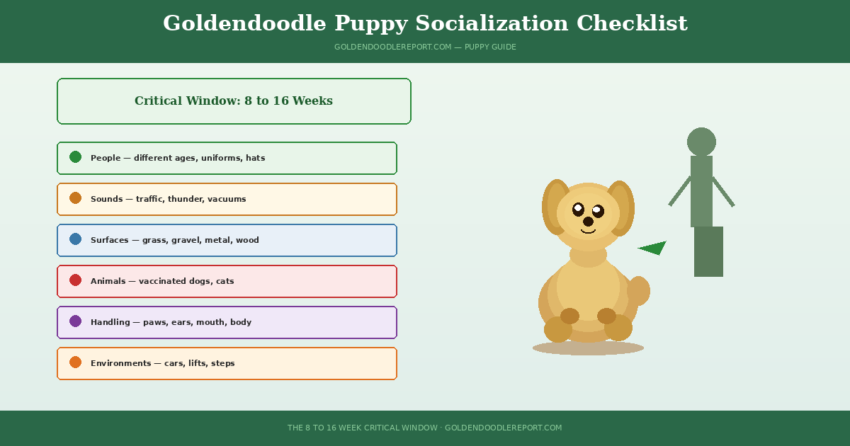
The Goldendoodle puppy socialization checklist covers six categories: people (different ages, appearances, and roles), sounds (household, outdoor, sudden), surfaces (different textures underfoot), animals (vaccinated dogs and other species), handling (full body contact for grooming tolerance), and environments (new locations, vehicles, enclosed spaces). Each category should be worked through systematically between 8 and 16 weeks. Positive exposure — where the puppy investigates freely and associates new things with food rewards and calm praise — is the only kind that counts. Forced, rushed, or overwhelming exposure is worse than no exposure at all.
Quick Answer
What should be on a Goldendoodle puppy socialization checklist? People of all ages including children, elderly, and people in uniforms or hats. Sounds including traffic, thunder recordings, household appliances, and sudden noises. Surfaces including grass, gravel, tiles, carpet, metal grates, and wet ground. Vaccinated dogs and other friendly animals. Full body handling covering paws, ears, mouth, and tail daily. New environments including cars, town centres (carried), lifts, and stairs. One new experience per day is the right pace — quality over quantity, and always ending on a positive note before the puppy shows stress.
The most important thing to understand about the Goldendoodle puppy socialisation checklist is the word quality in every exposure. A puppy that is overwhelmed, frightened, or forced into contact with something it is trying to move away from is not being socialised — it is being sensitised.
A bad experience during the socialisation window is logged more deeply than a bad experience at any other developmental stage, because the brain is actively forming its model of what the world contains. The goal is not to tick items off a list but to ensure each tick represents a genuinely positive association.
This guide covers:
- Why the 8–16 week window is critical for Goldendoodles specifically
- The complete socialisation checklist across six categories
- How to conduct a socialisation session correctly
- Safe socialisation before full vaccination
- Signs the puppy is coping well versus showing stress
- What to do if you have missed part of the window
In This Guide
- Goldendoodle Puppy Socialization Checklist: Why This Breed Needs It Most
- The Complete Socialization Checklist — Six Categories
- How to Conduct a Socialization Session
- Safe Socialization Before Full Vaccination
- Signs the Puppy Is Coping Well vs Showing Stress
- What to Do If You Have Missed Part of the Window
- Frequently Asked Questions
Goldendoodle Puppy Socialization Checklist: Why This Breed Needs It Most
Goldendoodles are often marketed as naturally friendly, easy-going dogs that do not need intensive socialisation. This is misleading. Both parent breeds — Golden Retrievers and Poodles — are highly sensitive to their early environment and are significantly shaped by what they are and are not exposed to in puppyhood.
A Goldendoodle from well-bred, well-tempered parents that receives excellent socialisation becomes the relaxed, confident, people-oriented dog the breed is known for. A Goldendoodle from the same parents that receives poor or absent socialisation can develop into a fearful, reactive, or anxious adult whose temperament surprises owners who expected something different.
The breed’s social sensitivity — the same quality that makes Goldendoodles emotionally attuned to their owners — also makes them more susceptible to fear if novel experiences are introduced after the window closes. For detailed guidance on the science behind the socialisation window, the AKC’s puppy socialisation guide covers the neurological basis in detail.
The practical implication is that the 8 weeks between bringing the puppy home and the window closing at 16 weeks are among the most important of the dog’s entire 10–15 year life. They deserve systematic attention, not a casual approach of “letting the puppy meet people at the park when convenient.”
The Complete Socialization Checklist — Six Categories
Work through each category systematically. Aim for one to two new experiences per day — not more. The pace should allow each experience to end positively before the puppy shows any signs of stress or fatigue.
Category 1 — People
| Exposure | How to Introduce Positively |
|---|---|
| Men with beards or unusual facial features | Let the puppy approach in its own time. Person sits at puppy level and offers treat from open palm. |
| Children — different ages, loud and energetic | Supervise closely. Brief interactions, children instructed not to run at or reach over the puppy. |
| Elderly people, mobility aids, wheelchairs | Carry puppy near, observe, allow approach if calm. Walking frames and wheelchairs need specific exposure. |
| People in uniforms — postman, workmen, hi-vis | Ask delivery drivers or neighbours in work clothes to offer a treat. Many are happy to help. |
| People wearing hats, sunglasses, hoods | Do this at home with family members first — hat on, treat, hat off. Generalises to strangers. |
| Groups of people — busy environments | Carry the puppy in a busy town area. Observe, allow brief interaction, do not allow crowds to overwhelm. |
Category 2 — Sounds
| Sound | How to Introduce |
|---|---|
| Household appliances — vacuum, blender, washing machine | Start at low volume or distance. Pair each sound with treats. Gradually increase proximity over days. |
| Thunder and fireworks recordings | Play at low volume during mealtimes. Increase volume gradually across multiple sessions. Never at full volume suddenly. |
| Traffic — cars, lorries, motorcycles | Carry the puppy near a road and observe. Feed treats throughout. Begin at a distance and move closer over sessions. |
| Sudden loud noises — doors slamming, dropped pans | React calmly yourself — the puppy takes emotional cues from the owner. If you freeze or say “it’s ok” anxiously, the puppy notices. |
| Construction sounds, power tools | Observe from a comfortable distance with treats available. Do not force closer than the puppy is comfortable. |
Category 3 — Surfaces and Textures
| Surface | Notes |
|---|---|
| Grass — short and long | Usually easy. Wet grass introduces an additional texture — do both. |
| Gravel and stones | Some puppies resist initially. Toss treats onto the gravel and let the puppy step on it while eating. |
| Hard floors — tiles, wood, vinyl | Slippery surfaces can cause panic if the puppy falls. Place a non-slip mat initially, then expose to the full floor. |
| Metal surfaces — grates, manhole covers | Carry over initially, then encourage to walk across with treat trails. The sound and feel are both novel. |
| Mud, sand, and water puddles | Important for outdoor dogs. Toss toys or treats into shallow puddles. Do not force. |
| Stairs — just a few steps | Introduce the sensation only — do not allow sustained climbing until 12 weeks minimum due to joint development. |
Category 4 — Animals
| Animal | How to Introduce Safely |
|---|---|
| Adult vaccinated dogs — calm temperament | Choose dogs you know are vaccinated, calm, and dog-friendly. Short controlled meetings on neutral ground. Do not allow rough play at 8–12 weeks. |
| Puppy classes — vaccinated puppies only | Choose a class that requires proof of first vaccination. The best classes control play sessions and prevent overwhelming. |
| Cats — in your household or trusted friends’ | Introduce on lead with the puppy under control. Allow the cat to determine the distance. Do not allow chasing. |
| Other small animals — birds, small pets | Observe from a distance. The goal is calm observation, not interaction. High prey drive can be triggered by small fast-moving animals. |
Category 5 — Handling (Daily from Week One)
| Body Area | Practice |
|---|---|
| Paws — each individual toe | Hold each paw, press between toes, touch nails. Treat throughout. This makes nail trims tolerable for life. |
| Ears — outer and inner | Touch the ear flap, look inside, touch the inner ear canal entrance. Treat. Prevents ear-check resistance. |
| Mouth — gums, teeth, lips | Lift lips, touch gums, introduce finger brush. Daily from week one for dental health and vet examination tolerance. |
| Tail and bottom | Touch around the tail base and under the tail. Essential for grooming appointments and veterinary examinations. |
| Full body brush — 2 min sessions | Introduce the slicker brush from day one. Treat throughout. The puppy coat needs little brushing — the tolerance building is the entire point. |
Category 6 — Environments and Situations
| Environment | How to Introduce |
|---|---|
| Car travel | Short trips first — 5 minutes, then 15, then longer. Treats or a Kong during travel. Crate in the car from the start. |
| Busy town areas (carried) | Carry the puppy in a bag or arms. Observe the environment. Feed treats for calm behaviour. Do not force interaction with strangers. |
| Lifts and enclosed spaces | Important for apartment dogs. Treat throughout. The sound, movement, and enclosed sensation need specific positive association. |
| Vet clinic visits — non-appointment | Many vets welcome puppy pop-in visits just for treats and handling. This prevents the vet office from becoming an exclusively unpleasant association. |
| Being left alone briefly | Practise short alone time from week one. Leave the puppy in the crate for 20 minutes, return calmly. Build gradually to avoid separation anxiety. |
How to Conduct a Socialization Session
The process matters as much as the content. A poorly conducted socialisation session — where the puppy is overwhelmed, unable to retreat, or exposed to something it is clearly afraid of for too long — is actively harmful. It creates a negative association with the very thing you are trying to normalise.
The correct approach for every socialisation session follows four principles:
Let the puppy choose the pace. Place the puppy near the new experience and allow it to investigate at its own speed. A puppy that approaches freely and sniffs is accepting the experience. A puppy that freezes, tries to move away, or shows stress signals (see below) is not ready for closer contact. Never force closer contact with something the puppy is actively moving away from.
Use food throughout. High-value treats — small pieces of cooked chicken, cheese, or soft commercial treats — should be present in every socialisation session. The presence of food signals safety to the puppy’s nervous system and begins building a positive association with the new stimulus. If the puppy is too stressed to take food, the exposure is too intense — increase distance or end the session.
Keep sessions short. Two to five minutes of focused, positive exposure is more effective than thirty minutes of mixed exposure. Puppies have short attention spans and limited stress tolerance. End every session before the puppy shows stress signals — always finish on a positive note.
Your emotional state matters. Goldendoodles read their owners’ emotional signals with exceptional accuracy. An owner who is tense, uses an anxious “it’s okay, it’s okay” tone, or physically stiffens when the puppy encounters something new communicates that the thing is indeed something to be worried about. Breathe, stay relaxed, and treat the experience as unremarkably normal.
Safe Socialization Before Full Vaccination
The vaccination window and the socialisation window overlap — this is the core tension. The answer is risk-assessed, controlled exposure rather than either extreme of full isolation or unrestricted access.
Safe before full vaccination: your own garden if clean. The homes and gardens of dogs whose vaccination status you know. Being carried in public spaces — parks, town centres, markets. Puppy classes at reputable facilities with vaccination requirements and cleaned floors. The homes of family and friends with vaccinated pets.
Not safe before full vaccination: public dog parks. Ground in areas frequented by unknown dogs. Pet shops that allow dogs inside. Any surface where parvovirus could have been deposited by an unknown dog — parvo survives in soil for up to a year.
The position of most veterinary behaviourists is clear: the risk of under-socialisation is as real as the risk of pre-vaccination disease. A puppy kept in isolation until 18 weeks is almost certain to develop fear-based behaviour problems. A puppy socialised carefully with the above precautions, attending reputable puppy classes, and carried in clean public spaces faces a much lower disease risk than the certainty of a permanently compromised temperament from isolation.
Signs the Puppy Is Coping Well vs Showing Stress
Coping Well vs Stressed — Signs to Watch For
| Coping Well — Continue the Session | Showing Stress — Increase Distance or End |
|---|---|
| Approaches and investigates freely | Freezes and will not move toward the stimulus |
| Takes treats readily | Refuses treats — too stressed to eat |
| Relaxed body posture, soft eyes | Tail tucked, crouching, or trying to move away |
| Sniffing, exploring, playful | Repeated yawning, lip licking, whale eye |
| Returns to you calmly, then re-investigates | Barking, lunging, or urinating from fear |
What to Do If You Have Missed Part of the Window
If your puppy is past 16 weeks and has gaps in its socialisation, the situation is not irreversible — but it does require more time and more systematic effort than the same work done during the window.
The approach after the window closes is counter-conditioning and desensitisation — structured, gradual, reward-based exposure to the things that were missed. The principles are the same: the puppy approaches at its own pace, food is present throughout, sessions are short and end positively. The difference is that progress is slower and some fear responses that would not have developed if the exposure had happened in the window may require professional guidance to address.
If your Goldendoodle is showing active fear or reactivity toward people, dogs, or environments at 5 months or older, a certified behaviourist or veterinary behaviourist is the appropriate next step — not more exposure, which without professional structure can worsen rather than improve fear responses.
⚠️ Watch Out
The most common Goldendoodle puppy socialization checklist mistake is confusing quantity with quality. An owner who takes the puppy to a busy dog park for two hours has not socialised it well — it has been overwhelmed. An owner who does two five-minute controlled, positive exposures per day for eight weeks has done it correctly. One bad experience during the socialisation window can undo many good ones. Calm, controlled, and positive — every time.
Key Takeaways
- The Goldendoodle puppy socialization checklist covers six categories — people, sounds, surfaces, animals, handling, and environments — all of which must be addressed between 8 and 16 weeks
- One to two new experiences per day at the puppy’s own pace is the right approach — not overwhelming multiple exposures in one session
- Quality of exposure matters more than quantity — a single frightening experience during the window is worse than no exposure at all
- Safe socialisation before full vaccination is possible through controlled, risk-assessed exposure — isolation during the window is a welfare risk in itself
- If the puppy refuses food during an exposure, the session is too intense — increase distance or end immediately
- Handling — daily touch of paws, ears, mouth, and body — should begin from day one and is the single most important long-term investment in grooming and veterinary tolerance
Related Goldendoodle Puppy Guides
- Goldendoodle Puppy Vaccination Timeline — Safe outdoor exposure windows based on vaccination status
- When Can a Goldendoodle Puppy Go Outside? — The specific outdoor access timeline before full protection
- Goldendoodle Puppy Fear Stages — The two fear periods that affect socialisation and how to handle them
- Goldendoodle Puppy Biting Phase Guide — Managing biting during socialisation sessions
- Goldendoodle Puppy First Grooming Guide — Why handling from week one makes every grooming appointment easier
Part of the Goldendoodle Puppy Guide resource hub:
→ Goldendoodle Puppy Guide — Browse all 40 puppy guides
Frequently Asked Questions
When should I start socialising my Goldendoodle puppy?
From the day you bring the puppy home at 8 weeks. The socialisation window is already a third of the way through by pickup day — every day that passes before you begin is a day of the window lost. Start with handling and household sounds in week one, expand to controlled outdoor environments and people in weeks two and three, and attend a reputable puppy class as soon as the first vaccination allows.
Can I take my Goldendoodle puppy to the dog park before full vaccination?
No — not to public dog parks where unknown unvaccinated dogs may have been. The parvovirus risk on public ground is real and the disease is lethal in unvaccinated puppies. Controlled meetings with dogs whose vaccination status you know — in private gardens or at reputable puppy classes with vaccination requirements — are safe and provide the dog-to-dog socialisation the puppy needs without the disease risk of uncontrolled environments.
My puppy seems scared of everything — is this normal?
Some hesitancy about new things is completely normal for an 8-week-old puppy in a new environment. A puppy that approaches cautiously, investigates, and then relaxes is showing normal wariness that resolves with positive experience. A puppy that is persistently terrified, refuses food in most new situations, or shows extreme fear responses to routine stimuli may be showing signs of under-socialisation from before pickup or a predisposition to anxiety — discuss with your vet or a certified behaviourist if this describes your puppy at 10 weeks or older.
How many socialization experiences should I aim for per week?
Aim for one to two genuinely new positive experiences per day, seven days per week — not a massive socialisation push on weekends with nothing during the week. The cumulative effect of small, daily, positive exposures over eight weeks is far more powerful than intensive weekend sessions. The handling category — paws, ears, mouth — should happen every single day regardless of what other socialisation occurs.
What is a puppy class and is it worth the cost?
A reputable puppy class is a structured session run by a qualified dog trainer where puppies of similar age meet, play in controlled sessions, learn basic commands, and are exposed to new people and environments. The better classes require proof of at least the first vaccination for entry and control play sessions to prevent overwhelming or rough interactions. For a Goldendoodle puppy, a good puppy class is worth every penny — the combination of dog-to-dog socialisation, handling by strangers, and structured learning in a novel environment covers multiple checklist items simultaneously.
The information in this article is provided for general educational purposes only. King James Adjei is a researcher and enthusiast, not a veterinarian or certified behaviourist. For puppies showing significant fear responses or reactivity, always consult a qualified veterinarian or certified dog behaviourist rather than attempting to address the issue through exposure alone.