6-minute read | Last updated March 2026 | Reviewed for accuracy
By King James Adjei | GoldendoodleReport.com
Researcher, Goldendoodle enthusiast, and founder of GoldendoodleReport. Every guide on this site is written to give owners reliable, clearly organised information — researched carefully and updated regularly.
The Goldendoodle puppy teething guide covers everything owners need to understand about one of the most disruptive — and most misunderstood — phases of puppyhood. Teething in puppies is not a brief event. It is a process that spans roughly four months, produces real physical discomfort, and is directly responsible for the intensification of chewing behaviour that drives so many owners to distraction between 3 and 6 months of age. Understanding the timeline, what is happening physically, and what genuinely helps versus what makes it worse makes this phase significantly more manageable.
Who This Guide Is For
This article is most useful if you:
- Have a puppy between 3 and 6 months whose chewing has intensified significantly and you want to understand why
- Want to know the specific teething timeline — when baby teeth fall out and when adult teeth come in
- Are unsure what chew toys and teething relief products are safe and which to avoid
- Are finding baby teeth in the house and want to know if this is normal
For guidance on managing the biting behaviour that accompanies this phase, see Goldendoodle Puppy Biting Phase Guide.
Quick Summary
The Goldendoodle puppy teething guide in brief: puppies are born without teeth, develop 28 baby teeth by 8 weeks, then between 12 and 24 weeks the 42 adult teeth push through — forcing the baby teeth out in the process. The period of most intense teething discomfort is roughly 4 to 6 months. Chewing is the puppy’s primary mechanism for managing that discomfort. The correct response is providing appropriate chew options — frozen rubber toys, damp frozen cloths, cold carrots under supervision — not punishment for chewing, which addresses a symptom without addressing the cause.
Quick Answer
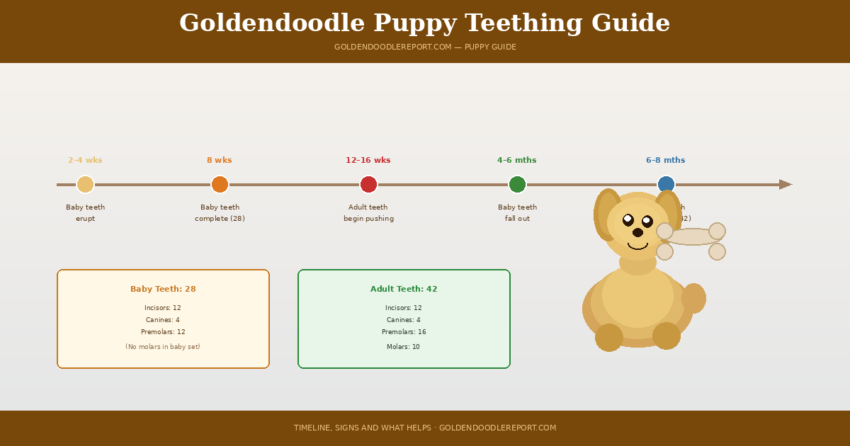
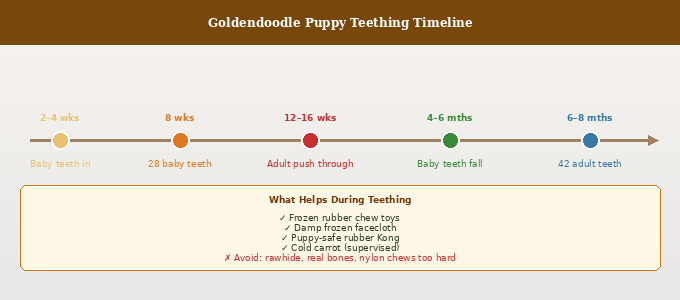
When do Goldendoodle puppies teethe? The process begins at 2–4 weeks when baby teeth erupt (you will not see this — it happens before pickup). Baby teeth are complete at 8 weeks — 28 teeth total. Adult teeth begin pushing through at 12 weeks, intensifying at 16 weeks, and the process completes when all 42 adult teeth are in place at 6–8 months. The most disruptive chewing period is 4 to 6 months when the molar area teeth come through.
The most important thing to know about the Goldendoodle puppy teething guide is the distinction between teething and the biting phase. These two things coincide and overlap but they are not the same. The biting phase is a behavioural issue — puppies bite because it is how they communicate and play, and it needs management through training. Teething is a physical process — puppies chew because their gums are uncomfortable, and it needs management through appropriate provision. Both are happening simultaneously between 3 and 6 months, which is why this period is frequently described as the hardest stage of puppyhood.
This guide covers:
- The complete teething timeline — month by month
- What is happening physically during teething
- Signs your puppy is teething
- What actually relieves teething discomfort
- What to avoid — products and approaches that make it worse
- When to check with the vet about retained baby teeth
In This Guide
Goldendoodle Puppy Teething Guide: The Complete Timeline
The teething process in dogs follows a consistent biological sequence. Understanding exactly what is happening at each stage helps owners interpret their puppy’s behaviour and respond appropriately rather than being caught off guard by changes that feel sudden but are predictable. For a broader overview of puppy dental development, the AKC’s guide to puppy teething covers the key milestones in useful detail.
Goldendoodle Puppy Teething Timeline
| Age | What Is Happening | Owner Experience | Action Required |
|---|---|---|---|
| 2–4 weeks | Baby (deciduous) teeth begin erupting through the gums | Puppy is still with breeder — you will not see this stage | None — breeder manages |
| 6–8 weeks | All 28 baby teeth in place — incisors, canines, premolars (no molars in baby set) | Puppy arrives home with sharp, complete baby teeth. Biting feels like needles. | Begin bite inhibition training immediately |
| 12–16 weeks | Adult incisors begin pushing through. Baby incisors start loosening and falling out. | Chewing begins to intensify. You may find small baby teeth in the house. | Introduce appropriate chew toys. Begin freezing rubber toys. |
| 4–5 months | Adult canines and premolars pushing through. Most intense discomfort phase begins. | Maximum chewing intensity. Everything is a chew target. Biting may intensify alongside teething discomfort. | Peak management period. Frozen chews, supervised chew sessions, consistent redirection. |
| 5–6 months | Molars erupting — the largest teeth and often the most uncomfortable stage. Remaining baby teeth falling out. | Some puppies show mild discomfort — reluctance to eat hard kibble, drooling, pawing at face. Others show no obvious signs. | Soften kibble briefly if eating seems painful. Continue frozen chew provision. |
| 6–8 months | All 42 adult teeth complete. Teething process ends. | Chewing typically reduces significantly. The dog that was destroying everything settles noticeably. | Check that all baby teeth have fallen out — retained baby teeth need veterinary attention. |
What Is Happening Physically During Teething
Understanding the physical process of teething explains why puppies chew with such apparent desperation during this phase — and why punishment for chewing is such an ineffective and counterproductive response.
Adult teeth form in the jaw below the baby teeth. As the adult tooth grows, it presses on the root of the baby tooth above it. The pressure dissolves the root of the baby tooth over time, eventually causing it to loosen and fall out — making way for the adult tooth to erupt through the gum. While this is happening, the gum tissue is inflamed, the baby tooth root is dissolving, and the adult tooth is pushing through tissue that was not previously open. This process produces real, measurable discomfort comparable to human teething — which is why human infants and puppies show strikingly similar responses to it.
Chewing provides counter-pressure against the gum that temporarily relieves the discomfort — in the same way that human teething babies chew on anything available. A puppy that is chewing intensively during the teething phase is doing exactly what its biology is telling it to do. The owner’s job is not to stop the chewing but to redirect it entirely toward appropriate items and away from furniture, shoes, and cables.
The baby teeth that fall out are tiny — many owners never find them because the puppy swallows them as they come loose during eating or chewing. This is harmless. Finding small, sharp, white teeth in the house or in the puppy’s bedding is completely normal between 12 and 24 weeks and requires no action beyond confirming that adult teeth are emerging in the same locations.
Signs Your Puppy Is Teething
Not all puppies show obvious teething signs — some move through the process with minimal apparent discomfort while others show more pronounced responses. The signs that indicate active teething include:
- Intensified chewing — the most universal sign. A puppy that was chewing at a manageable level suddenly escalates significantly, targeting new items it previously ignored
- Increased drooling — gum inflammation increases saliva production in some puppies
- Reluctance to eat hard kibble — a puppy that normally eats enthusiastically but hesitates or chews carefully may have sore gums. Softening the kibble briefly with warm water resolves this
- Pawing at the face or mouth — particularly during the molar stage when the discomfort is concentrated at the back of the jaw
- Bleeding gums — a small amount of blood on chew toys is normal during the period when baby teeth are loosening and falling out. Heavy bleeding or swollen, dark-red gums is not normal and warrants a vet check
- Finding baby teeth — in bedding, on the floor, or in the water bowl
- Increased biting — particularly mouthing and chewing on people’s hands, which provides the counter-pressure the puppy is seeking
What Actually Relieves Teething Discomfort
The options that genuinely help are those that provide safe chewing resistance and temperature-based gum relief — cold and pressure are the two mechanisms that actually work.
Frozen rubber chew toys are the most effective and safest option. A Kong or similar heavy rubber toy stuffed and frozen overnight provides both the cold temperature relief that soothes inflamed gum tissue and the chewing resistance that provides counter-pressure. Rotate three to four frozen chews so there is always one available and the rest are refreezing.
Damp frozen facecloth — a clean facecloth soaked in water, twisted into a rope shape, and frozen is an excellent low-cost teething relief option. The texture, resistance, and cold temperature all provide relief. Supervise use and discard when the cloth begins to unravel — loose fabric threads are an ingestion risk.
Cold carrot pieces — a large piece of carrot kept in the fridge or briefly in the freezer provides natural chewing resistance and cold relief. Use a piece large enough that the puppy cannot swallow it whole. Remove and discard when it becomes small enough to be a choking risk. This is supervised use only — do not leave the puppy unattended with food-based chews.
Puppy-safe rubber or nylon chews designed specifically for teething puppies — look for products marked as suitable for puppies, as adult dog chews are often too hard for developing teeth. The test: if you press your thumbnail into the chew and it does not indent at all, it is too hard for a teething puppy.
What to Avoid
Several commonly recommended or widely available products are not appropriate for teething Goldendoodle puppies and can cause more harm than the teething discomfort they are supposed to address.
Rawhide is one of the most common chew products given to puppies and one of the least appropriate. Rawhide softens with chewing and can break into large chunks that pose a significant choking and intestinal obstruction risk. It is also chemically processed in ways that have raised food safety concerns. Avoid entirely for puppies under 6 months.
Real bones — cooked or raw — from the kitchen are not appropriate teething chews. Cooked bones splinter into sharp fragments that can perforate the gut. Raw bones are less dangerous but still capable of fracturing teeth and causing blockages. Neither should be given to a teething puppy without specific veterinary guidance.
Chews that are too hard — the thumbnail test applies. Antlers, hard nylon chews, and very dense rubber toys designed for aggressive adult chewers are too hard for puppy teeth that are in the process of transitioning. Hard chews can fracture baby teeth or damage the emerging adult teeth below them.
Orajel or human teething gel — never use human dental pain relief products on dogs. Benzocaine, the active ingredient in most human oral anaesthetics, is toxic to dogs. Veterinary-specific dental gels exist — ask your vet if you want to explore this option.
Punishment for chewing — addressed last because it is the most important to avoid. A puppy that is physically corrected, shouted at, or scolded for chewing during the teething phase is being punished for a biological response to physical discomfort. The puppy cannot stop needing to chew any more than a teething human infant can stop needing to mouth things. Punishment creates anxiety without solving the underlying need. Redirection to appropriate chews — consistently, every time — is the only effective approach.
Retained Baby Teeth — When to See the Vet
Occasionally a baby tooth does not fall out when the adult tooth beneath it erupts — this is called a retained deciduous tooth. The most common retained teeth in dogs are the upper canines, where the baby tooth and adult tooth can exist side by side in the gum simultaneously.
A retained baby tooth is a problem for two reasons. First, it creates abnormal crowding and bite alignment, which can cause the adult teeth to come in at incorrect angles. Second, food debris accumulates in the tight space between the two teeth, leading to accelerated tartar build-up and gum disease.
Check the puppy’s mouth weekly from 16 weeks onward. If you see a baby tooth still in place alongside or behind an adult tooth — particularly in the canine positions — book a vet appointment. Retained baby teeth are typically removed under anaesthesia and this is ideally done at the neutering procedure to combine anaesthetic events. If your puppy is being spayed or neutered at 6 months, ask the vet to check for retained baby teeth at the same appointment and remove any found at that time.
⚠️ Watch Out
The most common Goldendoodle puppy teething mistake is giving inappropriate chew items to stop the chewing — rawhide, real bones, or very hard chews — because they provide immediate distraction. These items create risks (choking, fractured teeth, intestinal obstruction) that are significantly worse than the chewing behaviour they were given to address. Frozen rubber toys and supervised cold carrots are not as exciting as a bone, but they are safe, effective, and do not send you to the emergency vet.
Key Takeaways
- The Goldendoodle puppy teething guide covers a process that spans 2 weeks (baby teeth erupt) to 6–8 months (all 42 adult teeth complete) — not a brief phase
- The most intense discomfort and chewing period is 4 to 6 months when the canines, premolars, and molars are coming through
- Chewing is the puppy’s biological response to gum discomfort — it cannot be trained away during teething, only redirected to appropriate items
- Frozen rubber toys, damp frozen cloths, and cold carrots under supervision are the safest and most effective teething relief options
- Avoid rawhide, cooked bones, very hard chews, and human dental pain products — all are inappropriate for teething puppies
- Check for retained baby teeth weekly from 16 weeks — double teeth in the canine positions need veterinary removal
Related Goldendoodle Puppy Guides
- Goldendoodle Puppy Biting Phase Guide — Managing the biting behaviour that accompanies teething
- Best Chew Toys for Teething Goldendoodles — Safe options by stage and what to look for
- Goldendoodle Puppy Growth Stages — Month-by-month development including dental milestones
- Goldendoodle Puppy First Vet Visit — When to raise dental concerns with your vet
- Goldendoodle Puppy Care Guide — Complete first-year overview including the teething phase
Part of the Goldendoodle Puppy Guide resource hub:
→ Goldendoodle Puppy Guide — Browse all 40 puppy guides
Frequently Asked Questions
At what age do Goldendoodle puppies start teething?
The teething process technically begins at 2 to 4 weeks when baby teeth first erupt — but this happens before pickup and you will not observe it. The teething phase that owners experience begins at around 12 to 16 weeks when adult teeth start pushing through and the baby teeth start falling out. The most intense and disruptive period is 4 to 6 months. The process is complete by 6 to 8 months when all 42 adult teeth are in place.
Is it normal to find baby teeth in the house?
Yes — completely normal between 12 and 24 weeks. Baby teeth are tiny and often swallowed during eating or chewing, so many owners find few or none. Finding small, sharp, white teeth in bedding, on the floor, or in the water bowl requires no action other than confirming that adult teeth are erupting in the same positions. If you find a baby tooth and cannot see an adult tooth in that position, mention it at the next vet appointment.
My Goldendoodle puppy is chewing everything — is this just teething or is it a behaviour problem?
Between 3 and 6 months, intense chewing is almost always primarily teething-driven. The physical discomfort of adult teeth pushing through inflamed gum tissue produces a compulsive need to chew that goes beyond normal puppy mouthing. After 6 to 8 months, when teething is complete, chewing that continues at a high level is more likely to be boredom, under-exercise, or anxiety-driven and should be addressed through enrichment and training. Distinguishing the two is usually straightforward based on timing — if the puppy is between 3 and 6 months, start with teething management.
How can I soothe my Goldendoodle puppy’s teething pain?
The most effective options are frozen rubber toys (Kong stuffed and frozen overnight), damp frozen facecloths twisted into a rope shape, and large cold carrot pieces under supervision. Cold temperature and chewing pressure are the two mechanisms that provide genuine relief. Rotate between several options to maintain the puppy’s interest. Avoid human teething gels, rawhide, cooked bones, and very hard chews — these create risks that outweigh any benefit.
When should I be concerned about my puppy’s teething?
Contact your vet if you see heavy bleeding from the gums (a small amount is normal), swollen or very dark-red gum tissue, a baby tooth still in place alongside a fully erupted adult tooth at 6 months or older, the puppy is refusing to eat for more than 24 hours, or there are signs of facial swelling or pain beyond what would be expected from normal teething. Most teething progresses without complications — retained baby teeth and gum infections are the most common issues that require veterinary attention.
The information in this article is provided for general educational purposes only. King James Adjei is a researcher and enthusiast, not a veterinarian. For dental concerns including retained teeth or abnormal gum appearance, always consult a qualified veterinarian.