7-minute read | Last updated March 2026 | Reviewed for accuracy
By King James Adjei | GoldendoodleReport.com
Researcher, Goldendoodle enthusiast, and founder of GoldendoodleReport. Every guide on this site is written to give owners reliable, clearly organised information — researched carefully and updated regularly.
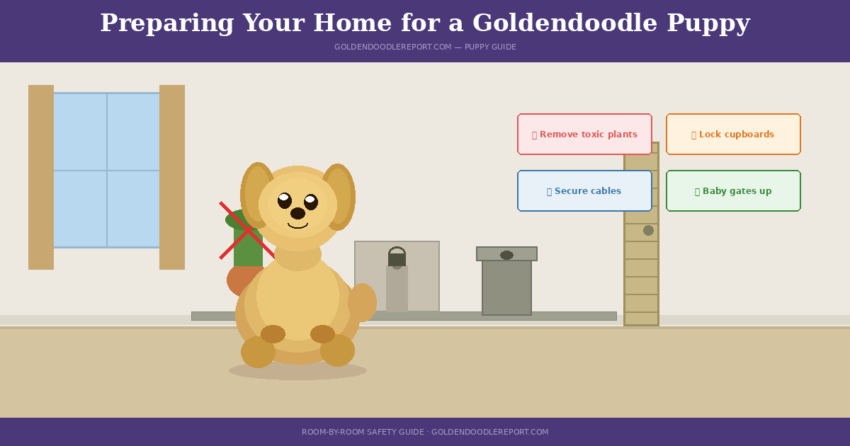
Preparing your home for a Goldendoodle puppy is one of the most overlooked parts of new puppy ownership — and one of the most consequential. A puppy that arrives to an unprepared home encounters hazards, has accidents in places that never get properly cleaned, and develops habits in its first hours that take weeks to undo. This guide goes room by room through every change to make before the puppy walks through the door.
Who This Guide Is For
This article is most useful if you:
- Are bringing a Goldendoodle puppy home within the next one to four weeks and want to work through every room
- Have brought a puppy home before but want to know what is specific to Goldendoodles
- Want to know which hazards are most commonly missed and most likely to cause harm
- Are renting and need low-damage solutions for puppy-proofing
For the complete supply list to buy before arrival, see the Goldendoodle Puppy Checklist.
Quick Summary
Preparing your home for a Goldendoodle puppy covers four categories: removing hazards (toxic plants, household chemicals, foods that are toxic to dogs), installing containment (baby gates, playpen, crate in position), managing access (restricting the puppy to two or three rooms initially rather than the full house), and eliminating accident re-attraction points (removing all traces of previous pet accidents with enzymatic cleaner before the puppy arrives). The most dangerous hazards in most homes are toxic plants, accessible bins containing food waste, and unsecured cables.
Quick Answer
What does preparing your home for a Goldendoodle puppy actually involve? Remove every toxic plant from rooms the puppy will access, secure all bins with locking lids or move them inside cupboards, store all household chemicals and medications in closed cupboards, fit baby gates at the bottom of stairs and across any rooms the puppy should not access, put the crate in position in the bedroom, cover or route all accessible cables, and walk each room at puppy height to see what you missed. The whole process takes two to three hours and prevents the majority of first-week emergencies.
The most useful way to approach home preparation is to get down to puppy height — literally crouch or kneel and look at each room from 30cm off the ground. What you see is what the puppy sees: the trailing cable behind the television stand, the gap under the kitchen units where a puppy can wedge itself, the houseplant at floor level whose soil is irresistible to dig in. Most hazards are invisible from standing height and obvious from puppy height.
This guide covers:
- The hazard categories that cause the most first-week emergencies
- Room-by-room preparation — what to change in each space
- Setting up the puppy’s core zone
- Garden and outdoor space preparation
- The most commonly missed hazards
In This Guide
Preparing Your Home for a Goldendoodle Puppy: The Four Hazard Categories
Before going room by room, it helps to understand the four categories of hazard that cause the most problems. Every home preparation decision falls into one of these categories.
Ingestion hazards — things the puppy will eat that will harm it. This covers toxic plants, human foods that are toxic to dogs, household chemicals, medications, batteries, small objects that can be swallowed, and certain types of fabric or stuffing material. Goldendoodle puppies are particularly at risk because they are highly food-motivated and will investigate anything with their mouth. For a comprehensive list of plants and foods toxic to dogs, the AKC’s guide to foods dogs cannot eat covers the most important items every owner needs to know.
Entrapment hazards — spaces the puppy can get into but not out of. Behind appliances, under furniture with narrow clearances, inside open washing machines or tumble dryers, and any enclosed space the puppy can enter at 8 weeks but will struggle to exit at 10 weeks as it grows. An 8-week Goldendoodle puppy is surprisingly small — check every gap wider than 8cm in rooms it will access.
Injury hazards — things that can cause physical harm. Unsecured heavy items that can be pulled down, stairs (which damage developing joints and from which puppies can fall), sharp edges at puppy height, and glass-fronted furniture or doors. Cables present both an ingestion risk (chewing through a live cable) and an injury risk (pulling a lamp or appliance from a height).
Access hazards — areas where the puppy should not go unsupervised. The full house during toilet training is an access hazard because you cannot monitor the whole house at once. Garages with vehicle chemicals and sharp tools. Utility rooms with cleaning products. Any room where the consequences of an accident or injury are difficult to manage.
Room-by-Room Preparation Guide
Room-by-Room Preparation Checklist
| Room | What to Do Before the Puppy Arrives |
|---|---|
| Kitchen | Move the bin inside a cupboard or fit a locking lid — food waste bins are irresistible and contain genuinely dangerous items (cooked bones, grape pips, onion skins, chocolate wrappers). Move onions, garlic, grapes, raisins, and any xylitol-containing products (sugar-free gum, some nut butters) to high shelves or closed cupboards. Fit child-proof latches to lower cupboards containing cleaning products. Check that the dishwasher is always closed when not in active use — the soap residue on dishes inside is toxic. Secure the space under the sink. |
| Living room | Remove or relocate every houseplant to a room the puppy will not access — identify each plant and check whether it is toxic to dogs before assuming it is safe. Common toxic living room plants include peace lily, pothos, dieffenbachia, and philodendron. Route all cables behind furniture or use cord covers secured to skirting boards. Move remote controls, glasses, books, children’s toys with small parts, and decorative objects from low surfaces and the floor. Block access behind sofas with rolled towels or furniture placement — the space behind sofas is where puppies have accidents that go undetected and attract repeat visits. |
| Bedroom | Move all shoes, socks, and clothing off the floor — these are high-priority chew targets and socks are a swallowing risk. Secure all medications in a closed drawer or cabinet — this is one of the most common causes of puppy poisoning because bedside medications are often left accessible. If the crate goes in the bedroom, clear floor space and position it where you can see it from the bed. Decide whether the puppy will ever have access to the bed — if not, block access from day one with a stool or side table placed at the foot. |
| Bathroom | Keep the bathroom door closed at all times — this is the simplest solution. If the puppy will have access, move all cleaning products, toilet cleaning tablets (highly toxic), and medications to height or a locked cabinet. The toilet lid should always be closed — a small puppy can fall in. Laundry left on the bathroom floor is a chew and ingestion risk, particularly socks. |
| Utility / laundry | Keep this room inaccessible with a baby gate or closed door. Utility rooms typically contain the highest concentration of hazardous chemicals in the home — washing powder, fabric softener, bleach, and other products that are acutely toxic if ingested. Always check the washing machine and tumble dryer drum before starting a cycle — puppies sometimes climb in. |
| Hallway and stairs | Fit a stair gate at the bottom of the stairs and keep it closed. Puppies under 12 weeks should not climb stairs — repeated stair climbing causes mechanical stress on growth plates that have not yet hardened. Even between 12 weeks and growth plate closure at 12–18 months, stair access should be managed rather than unrestricted. Fit a second gate at the top of the stairs for additional security once the puppy is larger and can push past a bottom gate. |
| Home office | Cable management is the priority — computers, monitors, and chargers create a significant cable tangle at floor level. Batteries left on desks are an ingestion hazard. Paper shredders should be unplugged when not in use. If working from home while the puppy is young, use a playpen rather than free access to the office. |
Setting Up the Puppy’s Core Zone
The puppy’s core zone is the two or three rooms it will have access to for the first weeks of toilet training. Restricting access to a manageable area is not unkind — it is the most effective way to toilet train quickly and keep the puppy safe during the period when it cannot be supervised constantly.
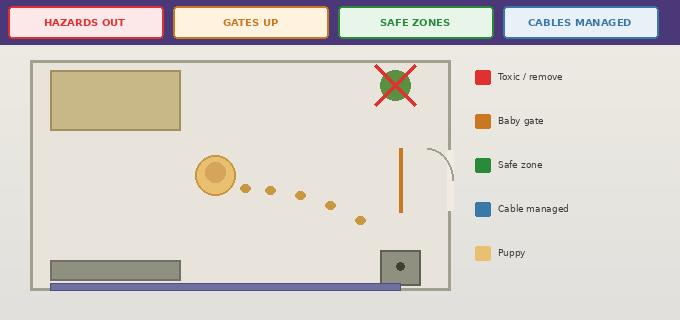
The ideal core zone for most homes is the kitchen and living room connected by an open doorway, with baby gates at every exit point. This gives the puppy enough space to explore and play, contains accidents to washable or easily cleaned floors (kitchen), and keeps the puppy visible from most positions in the room.
The crate should be positioned in the bedroom where the owner sleeps — not in the kitchen or a separate room. This is the single most effective arrangement for the first weeks. The puppy can hear and smell the owner, which significantly reduces night crying, and the owner can hear the puppy if it needs a toilet trip at 2 AM. Once the puppy is sleeping through reliably — typically by week four or five — the crate can be moved if preferred.
The toilet area should be a consistent, accessible patch of grass or gravel in the garden or a designated outdoor spot. Decide where it is before the puppy arrives and take the puppy to the same spot every time. The consistent location builds a strong toilet association. If you are in an apartment, decide whether the toilet location is the designated outdoor spot reached by stairs or lift, or a temporary indoor pad in a specific location — and commit to whichever from day one.
The playpen should be set up inside the core zone as a safe containment area for short periods when you cannot supervise — cooking, showering, answering the door. Place the crate inside the playpen with the door open, add water, and a couple of toys. This creates a self-contained safe space that is not punitive and that the puppy comes to associate with security rather than isolation.
Garden and Outdoor Space
The garden presents a different category of hazards to the indoor home. The most important step before the puppy arrives is a thorough perimeter check.
Fencing: Check every section of fencing for gaps a puppy can squeeze through. An 8-week Goldendoodle is surprisingly small — a gap that looks dog-proof may not be puppy-proof. Walk the full perimeter at ground level and check any point where the fence meets the ground, meets a gate post, or where the base is uneven. Block gaps with heavy stones, bricks, or a strip of landscape timber staked into the ground.
Gate latches: Check that every garden gate latches securely. A puppy that pushes against a gate and finds it opens will remember this permanently. Fit a second latch at a height the puppy cannot reach if the existing latch is accessible.
Toxic garden plants: Many common garden plants are toxic to dogs — foxglove, yew, rhododendron, azalea, hydrangea, daffodil bulbs, and bluebells are among the most commonly encountered. Identify every plant in the garden the puppy will access and check it against a comprehensive toxic plant list. Remove or block access to toxic plants before the puppy arrives — not after the first incident.
Garden chemicals: Move slug pellets, fertilisers, weed killers, and pesticides to a locked shed or sealed storage container completely inaccessible to the puppy. Slug pellets in particular are acutely toxic to dogs and are responsible for a significant number of preventable deaths every year.
Water features: A puppy can drown in surprisingly shallow water. Cover, fence off, or drain any pond, water feature, or pool before the puppy has garden access. Even a water feature with a pump or fountain that looks too small to be dangerous can trap a young puppy.
The Most Commonly Missed Hazards
These are the hazards that experienced owners report wishing they had caught before the puppy arrived rather than after the first incident.
The bin. Every owner knows not to leave food on the floor. Fewer think about the bin until the puppy tips it over. A standard kitchen bin with a foot pedal provides no meaningful barrier for a determined Goldendoodle. Move the bin inside a cupboard with a child-proof latch or buy a bin with a locking lid before the puppy arrives.
The dishwasher. The residue on plates and cutlery inside an open dishwasher is toxic — and the soap in the dispenser is extremely so. Goldendoodle puppies are tall enough at 8 weeks to reach the inside of a dishwasher door when it is open. Keep it closed when not actively loading or unloading.
Previous pet accident spots. If you have had other pets in the home, there are likely areas that carry residual urine odour that dogs can detect far more precisely than humans. These spots will immediately attract the new puppy as toilet locations. Before the puppy arrives, treat any suspected previous accident areas with an enzymatic cleaner, even if they appear visually clean and smell neutral to you.
The gap behind the washing machine or tumble dryer. These gaps are warm, dark, and sized exactly right for a puppy to squeeze into and then be unable to exit. Block them with cardboard, plywood, or a rolled towel before the puppy arrives.
Children’s bedrooms. Small toys, Lego, hair ties, earrings, and similar objects at floor level in children’s rooms are choking and obstruction hazards. Either keep the door closed or do a thorough floor-level sweep before allowing puppy access.
⚠️ Watch Out
Preparing your home for a Goldendoodle puppy is not a one-time exercise. A puppy that cannot reach the kitchen counter at 8 weeks will be able to at 6 months. A puppy that cannot open a cupboard at 10 weeks may learn to at 16 weeks. Revisit your home preparation at the 3-month and 6-month marks and reassess what the puppy can now access that it could not before. The hazards change as the puppy grows.
If Your Puppy Ingests Something Toxic
- Call your vet or an emergency animal poison line immediately — do not wait for symptoms to appear
- If possible, identify what was ingested and approximately how much — bring the packaging to the vet
- Do not induce vomiting unless specifically instructed to do so by a vet — for some substances, vomiting causes additional damage
- The ASPCA Animal Poison Control Center (US): 888-426-4435 — available 24 hours, consultation fee applies
Key Takeaways
- Preparing your home for a Goldendoodle puppy covers four hazard categories: ingestion, entrapment, injury, and access — address all four before pickup day
- The most dangerous and most commonly missed hazards are accessible bins, toxic houseplants, unsecured medications, and garden chemicals
- Walk every room at puppy height before the puppy arrives — most hazards are invisible from standing height
- Restrict the puppy to two or three rooms during toilet training — free access to the whole house is an access hazard that makes toilet training take twice as long
- The crate goes in the bedroom with you for the first weeks — this is the arrangement that reduces night crying fastest and allows you to hear toilet trip needs
- Revisit home preparation at 3 months and 6 months as the puppy grows into spaces and abilities it did not have at 8 weeks
Related Goldendoodle Puppy Guides
- Goldendoodle Puppy Checklist — Every item to buy before pickup day, organised by priority
- First Week With a Goldendoodle Puppy — Day-by-day guide for the first seven days
- Goldendoodle Puppy First Night at Home — Crate setup and what to expect on night one
- Best Crate for Goldendoodle Puppies — Size guide and setup for Mini to Standard puppies
- Best Puppy Playpen for Goldendoodles — Size, height, and setup for safe containment
Part of the Goldendoodle Puppy Guide resource hub:
→ Goldendoodle Puppy Guide — Browse all 40 puppy guides
Frequently Asked Questions
How long does it take to puppy-proof a house for a Goldendoodle?
A thorough preparation covering every room, the garden, and the installation of baby gates and containment equipment takes two to three hours for most homes. The time investment is front-loaded — once the initial preparation is done, ongoing adjustments as the puppy grows take far less time. The two to three hours spent before pickup prevents the majority of first-week emergencies and significantly reduces the stress of the early weeks.
Which houseplants are toxic to Goldendoodles?
The most commonly kept houseplants that are toxic to dogs include peace lily, pothos, philodendron, dieffenbachia, snake plant, aloe vera, and ZZ plant. Outdoor garden plants that are commonly toxic include foxglove, yew, rhododendron, azalea, hydrangea, and daffodil bulbs. The safest approach is to identify every plant in your home and garden and verify its toxicity status rather than assuming common plants are safe. The ASPCA maintains a comprehensive toxic plant database at aspca.org.
Do I need baby gates even if my Goldendoodle will eventually have full house access?
Yes — during toilet training specifically. A puppy with free access to the whole house will have accidents in rooms you are not in, which you do not find until the smell develops, which means the puppy has been returning to those spots and the toilet training clock resets every time. Restricting access to rooms you can monitor makes toilet training reliably faster. The gates come down gradually as toilet training becomes reliable — typically by 4 to 5 months with consistent training.
Is it safe to use the garden before the puppy is fully vaccinated?
Your own private garden is generally safe before full vaccination, provided no unknown dogs have access to it. Wild animals and foxes can carry parvovirus in their faeces, so check the garden for faeces and clear any found before the puppy uses the space. Public parks, communal garden areas, and pavements should be avoided until two weeks after the final primary vaccination at 16 weeks.
My puppy will be in an apartment — what changes instead of a garden?
Apartment preparation focuses on the indoor hazards above, plus designating a specific outdoor toilet spot reachable from the apartment. This is typically a patch of grass or a gutter strip nearby — the key is consistency of location. Some apartment owners use a balcony with artificial grass as an interim toilet location, which works well if the puppy can access it safely. Ensure balcony railings have no gaps a puppy can squeeze through or fall from.
The information in this article is provided for general educational purposes only. King James Adjei is a researcher and enthusiast, not a veterinarian. For concerns about toxic ingestion, contact your veterinarian or an animal poison control line immediately.