6-minute read | Last updated March 2026 | Reviewed for accuracy
By King James Adjei | GoldendoodleReport.com
Researcher, Goldendoodle enthusiast, and founder of GoldendoodleReport. Every guide on this site is written to give owners reliable, clearly organised information — researched carefully and updated regularly.
When can a Goldendoodle puppy go outside is one of the most urgently searched questions among new owners — and one where the two most common answers (keep the puppy inside until all vaccines are done, or it is fine outside from day one) are both wrong. The correct answer depends on the vaccination stage, the specific location, and whether the puppy is being carried or walking on the ground. This guide gives you a specific decision framework you can apply to any outdoor situation immediately.
Who This Guide Is For
This article is most useful if you:
- Have a new Goldendoodle puppy and want to know what outdoor access is safe right now
- Have been told to keep the puppy inside until all vaccinations are complete and want to understand whether that is really necessary
- Want to know the specific locations that carry real disease risk versus those that are safe before full vaccination
- Need to balance the vaccination window with the socialisation window and want a clear framework for doing both
For the full vaccination timeline and when full protection begins, see Goldendoodle Puppy Vaccination Timeline.
Quick Summary
When can a Goldendoodle puppy go outside? The puppy can access its own clean garden from day one. It can be carried into public spaces from day one. It can walk in low-risk locations after the second DHPP vaccination at 10 to 12 weeks. It has full outdoor access two weeks after the final DHPP at 14 to 16 weeks — approximately 16 to 18 weeks of age. The risk is not outdoor exposure itself — it is ground contact in areas where unvaccinated dogs have been, because parvovirus survives in soil for up to 12 months.
Quick Answer
A Goldendoodle puppy can go outside from day one — in its own garden and when carried in public. It cannot walk on public ground where unknown dogs have been until two weeks after the final DHPP vaccination at 14 to 16 weeks. Full outdoor freedom typically arrives at 16 to 18 weeks. Complete indoor isolation until all vaccines are done is unnecessary and causes socialisation damage. Controlled, location-assessed outdoor access from 8 weeks is the correct approach.
Quick Diagnosis — What Is Safe Right Now?
- If your puppy is 8 weeks with no vaccinations yet → own garden only, carry in all public spaces, no ground contact outside your property
- If your puppy has had the first DHPP (6–8 weeks, given by breeder) → own garden, vaccinated friends’ gardens, carry in quiet public areas, puppy classes with vaccination requirements
- If your puppy has had the second DHPP (10–12 weeks) → limited quiet street walks, continue carrying in busier areas, avoid all dog parks and pet shop floors
- If your puppy is 2 weeks past the final DHPP (16–18 weeks) → full outdoor access, all public spaces, dog parks, beaches, parks
Your vet tells you at the first visit to keep the puppy indoors until all vaccines are complete at 16 weeks. A friend who has had dogs for 20 years tells you that is ridiculous and you should just let the puppy outside from day one. Both are wrong in different ways. Your vet is protecting the puppy from disease. Your friend is protecting the puppy from socialisation failure. The answer that protects from both is in the middle — and it is specific.
The outdoor access question sits at the intersection of two genuine risks that point in opposite directions. Parvovirus is a real threat to unvaccinated puppies — it is present in soil, highly contagious, and has a mortality rate of up to 91 percent in untreated cases. But under-socialisation is an equally real threat with equally lasting consequences — a puppy kept in complete indoor isolation until 18 weeks emerges into the world with a fear response to novel stimuli that can take years to address and may never fully resolve. The solution is not to choose one risk over the other. It is to understand exactly where the disease risk is concentrated and work around it.
This guide covers:
- Why location matters more than age when assessing outdoor risk
- The carried vs walking distinction — why it changes everything
- The traffic-light framework for assessing any outdoor location
- Outdoor access by vaccination stage — specific permissions at each stage
- What full protection actually means and when it starts
In This Guide
When Can a Goldendoodle Puppy Go Outside: Why Location Matters More Than Age
The age-based rule — keep the puppy inside until vaccinations are complete — misses the key variable. The disease risk from outdoor access is not evenly distributed across all outdoor spaces. It is concentrated in locations where unvaccinated dogs have been, because the virus responsible for the most serious puppy disease — parvovirus — survives in soil and on surfaces for up to 12 months at normal environmental temperatures. A puppy walking through grass where a parvovirus-positive dog walked six months ago faces genuine risk. A puppy in its own back garden that has never had an unvaccinated dog in it faces essentially no risk from that specific pathogen.
This means the question to ask about any outdoor space is not “is my puppy old enough to be here?” but “could an unvaccinated dog have been on this ground?” That question produces very different answers for different locations. A friend’s private garden where only vaccinated adult dogs have ever been is as safe as your own. The grass verge outside a pet shop where unknown dogs relieve themselves daily is not safe regardless of the puppy’s age or vaccination status. For broader guidance on the disease risks relevant to this decision, the American Kennel Club’s puppy vaccination schedule guide explains the specific diseases the vaccination series protects against and why the timing matters.
Parvovirus is the primary concern for outdoor access decisions. It is highly contagious, shed in large quantities by infected dogs before symptoms appear, and resistant to most standard disinfectants. The 12-month soil survival figure means that an area that had a parvovirus case in the past year should be considered contaminated until at least one full winter has passed. Public parks, pavements near parks, dog exercise areas, and pet shop floors all fall into this category by default because their contamination history is unknown.
The Carried vs Walking Distinction
The single most useful concept for outdoor access decisions before full vaccination is the distinction between a carried puppy and a walking puppy. These two modes of outdoor exposure carry fundamentally different risk profiles, and understanding the difference unlocks a much larger range of safe socialisation opportunities than the indoor-until-vaccinated rule allows.
A puppy being carried has no ground contact with whatever surface it is above. It cannot ingest soil particles. It cannot contact faecal material. Its paws do not touch the ground where infected dogs have walked. The disease transmission routes for parvovirus — ingestion of contaminated material, direct contact with infected faeces, paw-to-mouth contact — are all eliminated by the simple act of being carried. A carried puppy in the middle of a busy market, observing people, traffic, sounds, and environments, is receiving high-value socialisation with essentially zero disease exposure.
A walking puppy, by contrast, contacts every surface with its paws, sniffs the ground, and mouths objects it finds. Even a quiet residential street has unknown contamination history. The risk of a walking puppy is substantially higher than a carried puppy in every environment outside the owner’s verified-clean property.
The practical implications of this distinction are significant. From day one, before any vaccination, a carried puppy can safely experience town centres, markets, car parks, busy streets, garden centres, and any other environment where the owner wants to provide novel stimulation. The puppy’s paws never touch the ground. The socialisation value is identical to what a fully vaccinated puppy would receive. The disease risk is negligible because the transmission routes do not apply.
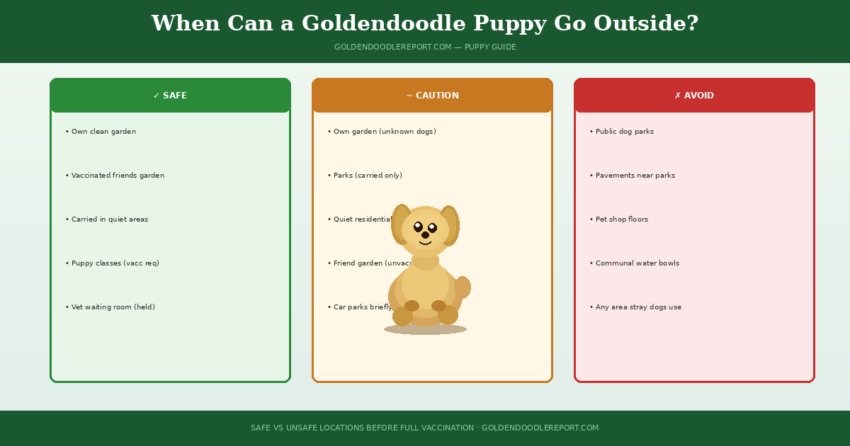
The Traffic-Light Location Framework
The following framework applies to any outdoor location before full vaccination. Assess the location against the single key question: could an unknown unvaccinated dog have had ground contact here? The answer determines the traffic light.
Outdoor Location Safety Framework — Before Full Vaccination
| Risk Level | Location Examples | Ground Contact Permitted? | Carried Access? |
|---|---|---|---|
| ✓ SAFE | Own garden (no unknown dogs ever), vaccinated friends’ private gardens, reputable puppy class with vaccination requirements and cleaned floors | Yes — walking permitted | Yes |
| ~ CAUTION | Own garden if unknown dogs have accessed it, quiet residential streets away from dog exercise areas, friend’s garden where dog vaccination status is unclear | After 2nd DHPP only — briefly | Yes — from day one |
| ✗ AVOID | Public dog parks, pavements near parks, pet shop floors, communal dog exercise areas, grass verges on busy streets, any area where dog faeces are commonly present | No — until 2 weeks post-final DHPP | Yes — carrying eliminates ground risk |
| ✗ ALWAYS AVOID | Known parvovirus-positive areas, areas with stray dog populations, communal water bowls, dog beach areas with unknown dog populations | No — even after full vaccination in high-risk periods | Caution even when carried — minimise time |
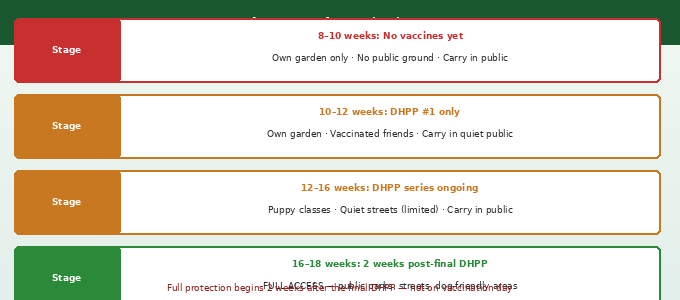
Outdoor Access by Vaccination Stage
Stage 1 — 8 to 10 weeks (no vaccinations yet or first DHPP only from breeder). The puppy has either no vaccination protection or only the first DHPP given by the breeder at 6 to 8 weeks. At this stage the vaccination series has not yet built meaningful protection. Access: own verified-clean garden for ground contact. Any public space when carried. No walking on public or unknown ground.
Stage 2 — 10 to 12 weeks (first or second DHPP received). Some immunity developing but not reliable protection against high-dose exposure. Access: own garden freely. Vaccinated friends’ private gardens. Puppy classes with vaccination requirements and cleaned surfaces. Carrying anywhere. Limited, brief walking on very quiet residential streets away from dog exercise areas as the second vaccination takes effect. Avoid all public dog areas, pet shops, and unknown ground.
Stage 3 — 12 to 16 weeks (vaccination series completing). Protection increasing but final DHPP not yet complete. Access: expands to include quiet street walks, continued carrying in all public environments, puppy socialisation classes. The critical rule: full protection does not begin on vaccination day — it begins two weeks after the final vaccination as the immune response consolidates.
Stage 4 — 16 to 18 weeks (two weeks after final DHPP). Full protection established. All outdoor access now safe. Public parks, dog beaches, pet-friendly shops, dog parks, busy streets — all accessible for walking. This is the moment the puppy’s outdoor world opens fully.
What Full Protection Means and When It Starts
The most common misconception in this area is that the puppy is protected from the day of vaccination. It is not. Vaccination primes the immune system to produce antibodies, but the antibody production process takes approximately two weeks to reach protective levels. A puppy vaccinated on Monday is not protected on Tuesday. It is protected approximately two weeks from Monday.
This means the final DHPP at 14 to 16 weeks produces full protection at approximately 16 to 18 weeks — not at 14 to 16 weeks. The precise timing depends on the specific vaccine, the puppy’s individual immune response, and whether the full series was administered correctly. When uncertain, two weeks after the date of the final injection is the conservative and correct guide.
Full protection from the DHPP series covers parvovirus, distemper, adenovirus, and parainfluenza. It does not cover Leptospirosis or Lyme disease, which are non-core vaccines recommended based on geographic risk. If your area has high Leptospirosis prevalence — standing water, wildlife, rural environments — discuss with your vet whether this vaccination affects outdoor access recommendations specifically.
Action Plan — Outdoor Access From Day One
- Start carried outdoor exposure immediately. From the day the puppy arrives home, begin carrying it into different environments — busy streets, markets, car parks, garden centres. The puppy’s paws never touch the ground. The socialisation value is full. The disease risk is negligible.
- Use your own garden freely for ground contact. If your garden has not had unknown or unvaccinated dogs in it, the puppy can walk, sniff, and play on the grass from day one. This is both safe and valuable for early sensory development.
- Identify two or three vaccinated-dog households for garden visits. Friends or family members with fully vaccinated adult dogs can offer their private garden for ground-contact socialisation before the puppy’s own series is complete. This provides dog interaction and novel ground environments safely.
- Book a reputable puppy class for the period after the second DHPP. Choose a class that requires proof of vaccination and cleans its floor surfaces. This provides the most valuable combination of safe dog-to-dog contact and novel environment exposure available before full vaccination.
- Begin short quiet street walks after the second DHPP at 10 to 12 weeks. Keep these away from dog parks, pet shop areas, and known dog exercise routes. Five to ten minutes on a quiet residential street is appropriate and low risk at this stage.
- Mark the date two weeks after the final DHPP in your calendar. This is full access day. From this date all outdoor environments are safe for walking ground contact.
What to Expect
Timeline: Full outdoor freedom at 16 to 18 weeks. Between 8 and 16 weeks, the carried access protocol delivers full socialisation value with minimal disease risk. The restriction period is 8 to 10 weeks — shorter than most owners expect.
Friction: Carrying a growing Goldendoodle puppy becomes physically demanding by 12 weeks, particularly for larger Standard Goldendoodles. A soft carrier bag or dog sling makes this practical for longer outings. The effort is worth the socialisation it enables.
Signs the approach is working: Puppy encounters novel environments calmly and with curiosity rather than fear. By the time full outdoor access arrives at 16 to 18 weeks, the puppy has already experienced dozens of environments, sounds, and people in the carried phase — which makes the transition to ground-level walking genuinely unremarkable.
Your Next Step
Today — carry your puppy into one new environment it has not experienced yet. A busy street, a car park, a garden centre. Bring treats. Let it observe from the safety of your arms. This is full-value socialisation with zero disease risk, available from day one. Do not wait for vaccinations to begin outdoor exposure.
What Most Owners Get Wrong
Mistake 1 — Treating their own garden as automatically safe without assessing its history. A garden that has had neighbourhood dogs in it, stray cats that defecate in it, or unknown animals accessing it via an unfenced boundary is not a guaranteed clean environment. Parvovirus can be brought in on shoes, wheels, or by animals other than dogs. If the garden’s history is genuinely unknown, treat it as a caution location rather than a safe one until the puppy has more vaccination protection.
Mistake 2 — Believing the puppy is protected from vaccination day. Protection builds over two weeks following vaccination. An owner who takes their puppy to the dog park the day after the final DHPP has made a risk assessment based on a false assumption. Two weeks post-vaccination is the protective threshold — not the injection date.
Mistake 3 — Keeping the puppy completely indoors until 16 to 18 weeks. This protects against parvovirus while guaranteeing socialisation failure. A puppy that has never been outside before 16 weeks has missed the most neurologically sensitive period for accepting novel environments as normal. The carried exposure protocol eliminates this trade-off entirely — it is not a compromise between safety and socialisation. It provides both.
Signs Your Approach Is Working
- Puppy encounters novel outdoor environments with curiosity rather than fear — even before full vaccination
- By 16 to 18 weeks, ground-level walks feel unremarkable to the puppy because the environments are already familiar from the carried phase
- No disease symptoms — no lethargy, vomiting, or bloody diarrhoea in the first months
- Puppy is comfortable being carried in public and observes stimuli calmly rather than struggling to escape
⚠️ Watch Out
The most dangerous single outdoor decision for an unvaccinated puppy is allowing ground contact in any public dog exercise area — dog park, park grass, pavement near a dog park entrance. These areas concentrate parvovirus risk because they concentrate dog traffic. A single exposure in a heavily contaminated area can be sufficient for transmission to an unvaccinated puppy. The carried protocol works precisely because it eliminates this specific risk while preserving all socialisation benefits.
Contact Your Vet Immediately If
- Your unvaccinated puppy has had ground contact in a public dog exercise area — contact your vet the same day for guidance
- You notice lethargy, vomiting, loss of appetite, or bloody diarrhoea within 3 to 10 days of any outdoor ground contact — these are parvovirus symptoms and require emergency veterinary attention
- Your puppy appears ill within 2 weeks of any outdoor exposure regardless of vaccination status
Key Takeaways — When Can a Goldendoodle Puppy Go Outside?
- Carried outdoor access is safe from day one — carrying eliminates the ground contact that is the primary disease transmission route
- Own clean garden is safe from day one for ground contact if no unknown or unvaccinated dogs have ever been in it
- The key risk question for any location: could an unknown unvaccinated dog have had ground contact here?
- Full protection begins two weeks after the final DHPP — not on vaccination day
- Complete indoor isolation until 16 to 18 weeks is unnecessary and causes socialisation damage — the carried access protocol provides both safety and socialisation simultaneously
- Parvovirus survives in soil for up to 12 months — location history matters, not just dog density on the day of the visit
Related Goldendoodle Puppy Guides
- Goldendoodle Puppy Vaccination Timeline — The complete vaccination schedule and when each stage of protection begins
- Goldendoodle Puppy Socialization Checklist — How to use the carried outdoor phase to complete the socialisation checklist
- Goldendoodle Exercise Needs by Age — Safe exercise limits once full outdoor access is established
- Goldendoodle Puppy First Vet Visit — When to discuss outdoor access with your vet and what to ask
- First Week With a Goldendoodle Puppy — The full first-week context including outdoor access decisions
Part of the Goldendoodle Puppy Guide resource hub:
→ Goldendoodle Puppy Guide — Browse all 40 puppy guides
Frequently Asked Questions
Can I carry my Goldendoodle puppy outside before vaccinations?
Yes — carrying the puppy outside before vaccinations is safe and strongly recommended for socialisation. When carried, the puppy has no ground contact, which eliminates the primary parvovirus transmission route. A carried puppy can safely experience any outdoor environment from day one. The disease risk from carrying is negligible. The socialisation benefit is identical to that of a fully vaccinated puppy walking in the same environment.
Is my own garden safe for my unvaccinated puppy?
Your own garden is safe for ground contact if no unknown or unvaccinated dogs have ever accessed it. If neighbourhood dogs, stray animals, or unknown dogs have been in the garden, treat it as a caution location — brief access is acceptable after the second DHPP but not guaranteed safe before. A securely fenced garden with a verified history of no unknown dog access is as safe as any indoor environment for an unvaccinated puppy.
When can my Goldendoodle puppy go to the dog park?
Dog parks are the highest-risk outdoor location for unvaccinated puppies and should be avoided entirely until full protection is established — two weeks after the final DHPP, which is approximately 16 to 18 weeks of age. Dog parks concentrate parvovirus risk because they concentrate dog traffic from unknown vaccination histories. Even after full vaccination, assess whether your specific dog park has a vaccination requirement for entry — those without requirements carry higher ongoing risk than those with.
My puppy had its second vaccination yesterday — can it walk outside now?
Protection from the second vaccination takes approximately two weeks to develop. The day after vaccination the puppy has the same protection level as the day before. After two weeks, limited quiet street walking is reasonable. Avoid all public dog exercise areas, pet shop floors, and communal dog spaces until two weeks after the final DHPP. The two-week window applies after every vaccination in the series, not just the last one.
How do I know if an outdoor area is safe for my puppy?
Apply the traffic-light question: could an unknown unvaccinated dog have had ground contact here in the past 12 months? If the answer is yes or unknown, treat it as a caution or avoid location. Private gardens where you know the vaccination status of all dogs that access them are safe. Public areas where unknown dogs have been are not safe for ground contact before full vaccination. Carrying eliminates this concern entirely for any location.
The information in this article is provided for general educational purposes only. King James Adjei is a researcher and enthusiast, not a veterinarian. For specific advice about your puppy’s vaccination status, outdoor access, and disease risk in your area, always consult a qualified veterinarian.