7-minute read | Last updated March 2026 | Reviewed for accuracy
By King James Adjei | GoldendoodleReport.com
Researcher, Goldendoodle enthusiast, and founder of GoldendoodleReport. Every guide on this site is written to give owners reliable, clearly organised information — researched carefully and updated regularly.
A Goldendoodle puppy routine by 8 weeks is not optional — it is the infrastructure that makes toilet training, sleep consolidation, and early training all work simultaneously. Without a consistent daily schedule from day one, owners spend the first month reacting to accidents, settling a puppy that will not sleep, and wondering why training is not sticking. With the right schedule running from the first morning home, most of those problems do not develop.
Who This Guide Is For
This article is most useful if you:
- Are bringing an 8-week Goldendoodle home and need a working daily schedule to start immediately
- Have an 8-week puppy at home with no routine in place and want to implement one today
- Want to understand why each element of the schedule is placed where it is, not just what to do
- Need a specific overnight protocol — what to do between the puppy’s bedtime and your morning wake time
For the routine at the next stage, see Goldendoodle Puppy Routine by 10 Weeks.
Quick Summary
The 8-week Goldendoodle puppy routine runs on a Feed → Toilet → Play → Sleep cycle repeated throughout the day. Feeding happens 4 to 5 times daily. Toilet trips happen immediately after every wake-up, every meal, and every play session — approximately every 45 to 60 minutes during waking hours. Naps happen in the crate every 60 to 90 minutes of awake time. Overnight requires two silent toilet trips — at approximately 11 PM and 2 AM. Consistency across all seven days matters more than perfection on any single day.
Quick Answer
The 8-week routine structure: wake at 6 AM, immediate toilet trip, then repeat Feed → Toilet → Play → Crate nap every 90 minutes throughout the day. Last meal at 6 to 7 PM, final toilet trip at 7:30 PM, crate for the night at 7:45 PM. Silent toilet trips at 11 PM and 2 AM. Morning wake at 6 AM. This structure repeats identically seven days per week until the puppy demonstrates it can hold longer — typically from 10 weeks onward.
Quick Diagnosis
- If the puppy is having accidents every hour → toilet trips are not frequent enough — add a trip after every play session and every wake regardless of how recently the last trip was
- If the puppy will not settle in the crate at nap time → awake window has been exceeded — enforce the nap earlier next time, do not wait for visible tiredness signals
- If the puppy is waking multiple times overnight → overnight toilet trips are being done with interaction — make them completely silent and return to crate immediately with no engagement
- If the puppy is not eating consistently at scheduled meal times → meal gaps are too long or too short — 4 to 5 meals every 3 to 4 hours is the correct 8-week frequency
Day three with your 8-week Goldendoodle. You have been responding to the puppy’s signals — feeding when it seems hungry, taking it outside when it sniffs around, letting it sleep on the sofa when it falls asleep there. By day five the puppy has no pattern, no predictability, and no progress on toilet training. The accidents are as frequent as day one. The problem is not the puppy. The problem is that you are following the puppy’s signals rather than leading with a structure the puppy’s biology can align to.
An 8-week Goldendoodle puppy has four biological systems that the daily routine must serve simultaneously: a bladder that holds for approximately 60 minutes when awake, a brain that requires 16 to 18 hours of sleep per day, a digestive system that processes meals in 20 to 30 minutes and produces elimination urgency shortly after, and a learning system that consolidates training inputs during sleep. A correctly structured routine serves all four at once — which is why the same schedule that produces toilet training progress also produces settled sleep, consistent training uptake, and reduced biting all at the same time.
This guide covers:
- The complete hour-by-hour daytime schedule for an 8-week Goldendoodle
- The biological rationale for each schedule element
- The overnight protocol — silent toilet trips and crate management
- How to adapt the schedule to your specific household
- What to do when the schedule breaks down
In This Guide
Goldendoodle Puppy Routine by 8 Weeks: The Complete Daytime Schedule
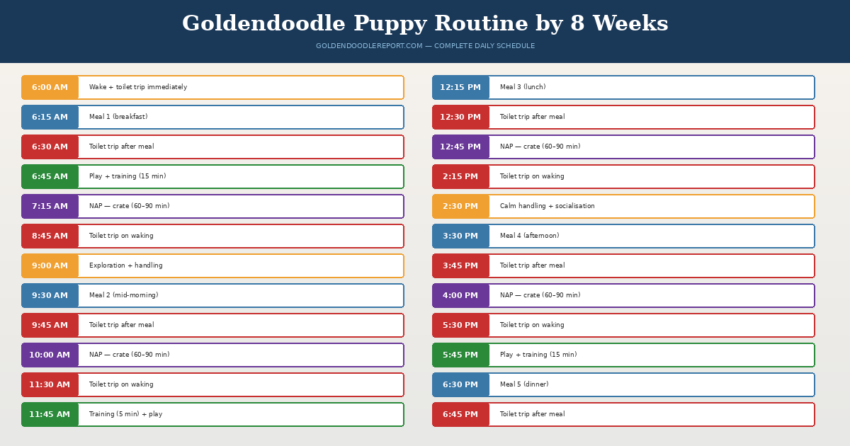
The following schedule runs from 6 AM to 7:45 PM. It is based on a five-meal-per-day feeding frequency, a 60 to 90 minute awake window, and toilet trips triggered by every wake-up, every meal, and every play session. Times are approximate — the cycle matters more than the clock. For the broader developmental context this schedule sits within, the American Kennel Club’s puppy schedule guide covers the foundational structure that applies across breeds.
Complete Daytime Schedule — 8-Week Goldendoodle Puppy
| Time | Activity | Detail |
|---|---|---|
| 6:00 AM | Wake + toilet | Carry or lead directly outside before any other interaction. No greetings until after the toilet trip. First thing every morning without exception. |
| 6:15 AM | Meal 1 | Breakfast — one fifth of daily food allowance. Feed in the same location every day. |
| 6:30 AM | Toilet trip | Immediately after meal — digestion triggers elimination within 10 to 20 minutes. Take outside and wait. |
| 6:45 AM | Play + training | 15 minutes of active play and one 3-minute training session. Name response and sit only at this age. |
| 7:15 AM | Nap — crate | 60 to 90 minutes. Stuffed Kong in the crate. Door closed. No interaction until natural wake. |
| 8:45 AM | Toilet trip | Immediately on waking from crate — before any play or interaction. |
| 9:00 AM | Handling + exploration | Calm handling practice — paws, ears, mouth. Allow garden or safe indoor exploration. |
| 9:30 AM | Meal 2 | Mid-morning meal — one fifth of daily allowance. |
| 9:45 AM | Toilet trip | Post-meal toilet trip. Wait outside until elimination occurs or 5 minutes have passed. |
| 10:00 AM | Nap — crate | 60 to 90 minutes. Brain consolidating the morning’s training and experiences. |
| 11:30 AM | Toilet trip | On waking. Immediate — before any engagement. |
| 11:45 AM | Training + play | Second training session of the day — 3 to 5 minutes. Reinforce morning behaviours before introducing anything new. |
| 12:15 PM | Meal 3 | Lunch — one fifth of daily allowance. |
| 12:30 PM | Toilet trip | Post-meal. Consistent timing trains the digestive reflex over two to three weeks. |
| 12:45 PM | Nap — crate | Longest nap of the day — often 90 minutes or more. This is the growth hormone release window. |
| 2:15 PM | Toilet trip | On waking. Do not skip this trip even if the crate was clean — the bladder has been filling during the nap. |
| 2:30 PM | Socialisation | Calm novel experience — visitor, sound, surface. The rested afternoon puppy processes new experiences better than a tired morning puppy. |
| 3:30 PM | Meal 4 | Afternoon meal — one fifth of daily allowance. |
| 3:45 PM | Toilet trip | Post-meal. Take the same route to the same spot every time — consistency reinforces the location association. |
| 4:00 PM | Nap — crate | 60 to 90 minutes. This nap prevents the overtired evening behaviour that peaks at 5 to 7 PM without it. |
| 5:30 PM | Toilet trip | On waking from afternoon nap. |
| 5:45 PM | Play + training | Third and final training session. 3 to 5 minutes. Tug play and bonding after training. Keep energy moderate — not high stimulation before the bedtime wind-down. |
| 6:30 PM | Meal 5 | Last meal of the day — given early enough that digestion completes before the overnight crating period. |
| 6:45 PM | Toilet trip | Post-dinner toilet trip. This is critical — incomplete emptying before bedtime increases overnight accident likelihood. |
| 7:00 PM | Wind-down | No active play or training. Calm physical contact only. Dim lights if possible. Prepare the crate with clean bedding and stuffed Kong. |
| 7:30 PM | Final toilet trip | Last trip before overnight crating. Stay outside for at least 5 minutes. Both urination and defecation if possible. |
Why Each Element Is Timed the Way It Is
Toilet trips immediately after every wake and every meal. The two most reliable elimination triggers in an 8-week puppy are waking from sleep (the bladder has been filling) and eating a meal (the gastrocolic reflex — digestive activity triggers elimination — is strongest in young animals). Timing toilet trips to follow these two triggers catches the majority of elimination events before they become accidents.
Naps every 60 to 90 minutes of awake time. At 8 weeks the puppy’s maximum useful awake window before neurological fatigue sets in is 60 to 90 minutes. Waiting for visible tiredness signals — slowing down, seeking dark corners, falling asleep mid-play — means the puppy has already reached overtiredness, which presents as escalating biting and inability to settle. Enforcing the nap 15 minutes before the end of the awake window catches the puppy before this threshold.
Training sessions placed after toilet trips and before meals. A puppy that has just eliminated is not distracted by bladder urgency. A puppy that is slightly hungry (before its next meal) is most food-motivated. Placing the training session in the window after the toilet trip and before the next meal combines maximum focus with maximum food motivation.
Last meal at 6:30 PM. Feeding the last meal early enough for digestion to be substantially complete before overnight crating reduces the likelihood of a defecation event overnight. At 8 weeks digestion takes 4 to 6 hours — a 6:30 PM meal is largely processed by 10:30 PM to 12:30 AM.
The Overnight Protocol
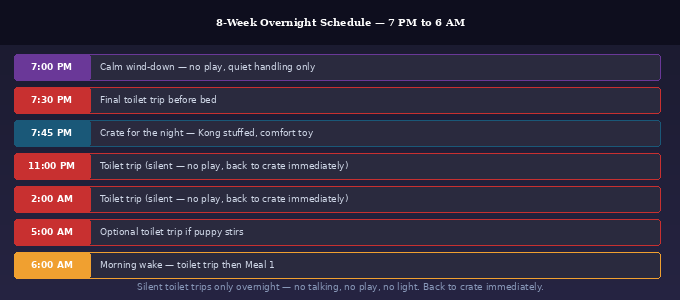
The overnight period is where toilet training is won or lost at 8 weeks. The puppy’s bladder at this age holds for approximately 3 to 4 hours at night — less than many owners expect. Two overnight toilet trips are required: one at approximately 11 PM and one at approximately 2 AM. By 10 weeks many puppies consolidate to one overnight trip. By 12 weeks many hold through the night entirely.
8-Week Overnight Schedule — 7:45 PM to 6:00 AM
| Time | Activity | Protocol |
|---|---|---|
| 7:45 PM | Crate for the night | Place puppy in crate with stuffed Kong and comfort toy. Door closed. Crate in the bedroom. No further interaction. |
| 11:00 PM | Silent toilet trip | No lights. No talking. No play. No greetings. Open the crate, carry to the toilet area, wait for elimination, return to crate. Total duration: 5 minutes maximum. This is not interaction time. |
| 2:00 AM | Silent toilet trip | Same protocol as 11 PM — silent, brief, no interaction. Return to crate immediately after elimination. |
| 5:00 AM | Optional trip | Only if the puppy stirs and appears distressed. If quiet — leave until 6 AM. Beginning to extend this gap trains the overnight hold capacity. |
| 6:00 AM | Morning wake | Greet warmly, immediate toilet trip, then Meal 1. The day restarts. Daytime schedule applies from this point. |
The silent overnight trip rule is the single most important discipline in the overnight protocol. Any interaction during an overnight trip — talking, play, greetings, lights — teaches the puppy that overnight waking produces rewarding human interaction. This creates the habit of waking at 2 AM not because of bladder urgency but because the 2 AM interaction is desirable. A puppy that receives a completely silent and unrewarding overnight trip learns that the trip serves only the biological need — not a social one.
Adapting the Schedule to Your Household
The schedule above assumes a 6 AM start. If your household wakes later, shift the entire schedule forward while maintaining the same intervals. A 7 AM start produces the same results as a 6 AM start — the biology that the schedule serves does not care about the clock time, only the intervals between elements.
If you work from home, the schedule runs as written. If you leave the house for periods, the playpen-crate combination covers the gap — the puppy stays in the playpen with the crate inside for up to 2 hours safely at this age. A puppy sitter or family member handling the toilet trips and feeding during your absence is strongly preferable for the first 4 weeks.
If there are multiple people in the household, assign the toilet trips, feeding, and training sessions consistently to the same person for the first 2 weeks. Multiple inconsistent approaches during the critical first fortnight produce slower toilet training progress than one consistent approach from one person. Consistency from multiple people is fine — inconsistency from multiple people is the problem to avoid.
Action Plan — Starting the Routine Today
- Print or save the daytime schedule table above. Put it somewhere visible — on the kitchen wall or as a phone screenshot. Refer to it every hour for the first week.
- Set phone alarms for every scheduled activity. For the first 5 days, set alarms for every toilet trip, every meal, and every nap start. The schedule must become habitual before it becomes intuitive.
- Prepare the overnight kit tonight. Stuffed Kong in the freezer. Clean crate bedding. Shoes by the crate for the 11 PM and 2 AM trips. Leash accessible. Remove all friction from the overnight trips so you can do them half-asleep without thinking.
- Take the toilet trip immediately on waking tomorrow. Before coffee. Before checking your phone. Before any greeting. The first morning sets the pattern for the following weeks.
- Run the schedule identically on weekends. The most common routine failure is weekend relaxation — sleeping in, skipping the structure because it is more relaxed. The puppy’s biology does not recognise weekends. Two inconsistent days reset 5 days of progress.
- Track accidents on a simple tally for the first week. Note the time of every accident. The pattern reveals where the toilet trip timing has a gap — which specific interval is too long for this puppy’s current bladder capacity.
What to Expect
Timeline: Days 1 to 3 will have accidents despite the schedule as the puppy adjusts. Days 4 to 7 the accident frequency should reduce noticeably. By week 2 the routine should feel established and the puppy will begin showing predictable elimination timing. Full daytime reliability at 8 weeks is not the goal — the goal is steady improvement week on week.
Friction: The overnight trips at 11 PM and 2 AM are the hardest part of the 8-week routine. They are also the most important — skipping them produces overnight accidents that set toilet training back more than the lost sleep costs. Two weeks of interrupted nights is the investment for a toilet-trained puppy by 12 weeks.
Signs the routine is working: Accident frequency reduces week on week. The puppy begins moving toward the door or whining before accidents — a sign it is learning to signal. Overnight duration between trips extends — the puppy goes from needing 11 PM and 2 AM trips to only needing one overnight trip by 10 weeks.
Your Next Step
Set your alarm for 6 AM tomorrow. Put shoes next to the crate tonight. Prepare the overnight Kong. The routine starts with the first morning trip — everything else follows from that anchor. Start tomorrow, not next week.
What to Do When the Schedule Breaks Down
The schedule will break on specific days — visitors arrive, you are unwell, an appointment runs late. A single day off the schedule does not undo a week of progress. Return to the schedule the following morning as if the break did not happen. Do not try to compensate for missed sessions — simply restart the cycle from the next natural anchor point (morning wake or next meal time) and continue.
If the schedule is breaking consistently — not occasionally — identify the specific point of failure. Is it the overnight trips? The nap enforcement? The post-meal toilet timing? Isolate the single element that is failing most often and fix only that element before addressing anything else. Trying to fix multiple schedule failures simultaneously produces confusion rather than progress.
What Most Owners Get Wrong
Mistake 1 — Waiting for the puppy to signal before taking a toilet trip. An 8-week puppy does not yet have the neurological capacity to reliably signal before eliminating. Waiting for a signal means waiting for an accident. The toilet trip schedule is pre-emptive — it takes the puppy out before the urgency reaches the point of an accident, not in response to it. This is the core distinction between reactive toilet management (cleaning up accidents) and proactive toilet training (preventing them).
Mistake 2 — Interacting during overnight toilet trips. Owners who talk to, greet, or play with the puppy during overnight trips create the overnight waking habit that then persists for weeks after the bladder capacity would otherwise allow full overnight holding. The silent trip is the correct protocol — not because it is unkind but because it keeps the overnight trip biologically functional rather than socially rewarding.
Mistake 3 — Relaxing the schedule on weekends. The two most common days for toilet training regression are Saturday and Sunday, when the 6 AM alarm is not set and the schedule is allowed to drift. The puppy’s biological systems do not take weekends. Two days of schedule inconsistency each week produces a puppy that progresses five steps on weekdays and loses two on weekends — halving the pace of toilet training progress over the first critical month.
Signs the Goldendoodle Puppy Routine by 8 Weeks Is Working
- Accident frequency reduces measurably week on week
- The puppy begins moving toward the door or showing a pre-elimination signal from week 2 to 3
- Overnight trips extend — from two trips nightly to one trip by 10 weeks in most puppies
- The puppy settles in the crate at nap time within 5 to 10 minutes without prolonged vocalisation by the end of week 2
⚠️ Watch Out
The most damaging single routine mistake at 8 weeks is allowing the puppy to free-roam the house unsupervised between toilet trips. An 8-week puppy with free access to every room will have accidents in multiple locations, making every room a potentially acceptable toilet site. Keep the puppy in one room under direct supervision when not in the playpen or crate — every accident in a new location extends toilet training by setting a new undesirable location association that must be overridden.
Contact Your Vet If
- The puppy is urinating extremely frequently — more than once every 20 to 30 minutes when awake — this may indicate a urinary tract infection rather than normal puppy frequency
- There is blood in the urine or stool
- The puppy appears uncomfortable, straining, or distressed when attempting to eliminate
Key Takeaways — Goldendoodle Puppy Routine by 8 Weeks: What to Remember
- The core cycle is Feed → Toilet → Play → Crate nap — repeated every 90 minutes throughout the day
- Toilet trips are pre-emptive — taken on a schedule, not in response to signals the puppy cannot yet reliably give
- Overnight requires two silent trips at 11 PM and 2 AM — completely without interaction, talking, or greetings
- Naps are enforced before the puppy shows tiredness — overtiredness produces escalating biting, not settling
- Weekend consistency is not optional — the two days of the week where the schedule most commonly breaks are the two days that most damage toilet training progress
- A single broken day does not undo a week of progress — return to the schedule the next morning and continue
Related Goldendoodle Puppy Guides
- Goldendoodle Puppy Routine by 10 Weeks — The schedule adjustments at 10 weeks as bladder capacity increases
- Goldendoodle Puppy Toilet Training Guide — The full toilet training protocol this schedule supports
- Best Crate for Goldendoodle Puppies — The crate setup that makes the nap schedule work
- How Much Sleep Does a Goldendoodle Puppy Need? — Why the 16 to 18 hour sleep requirement underpins the nap schedule
- Goldendoodle Puppy Care Guide — Complete first-year overview
Part of the Goldendoodle Puppy Guide resource hub:
→ Goldendoodle Puppy Guide — Browse all 40 puppy guides
Frequently Asked Questions
What should an 8-week Goldendoodle puppy’s daily schedule look like?
An 8-week Goldendoodle puppy schedule runs on the Feed → Toilet → Play → Sleep cycle repeated every 90 minutes throughout the day. Feeding happens 4 to 5 times between 6 AM and 6:30 PM. Toilet trips happen immediately after every wake and every meal — approximately every 45 to 60 minutes during waking hours. Naps happen in the crate for 60 to 90 minutes between each awake cycle. The overnight requires two silent toilet trips at 11 PM and 2 AM.
How often should an 8-week Goldendoodle puppy go to the toilet?
At 8 weeks, toilet trips should happen every 45 to 60 minutes during waking hours — triggered by every wake-up and every meal. The bladder at 8 weeks holds for approximately 60 minutes when awake. At night the capacity extends to 3 to 4 hours, which is why two overnight trips at 11 PM and 2 AM are required rather than a trip every hour through the night.
How many meals does an 8-week Goldendoodle puppy need per day?
Four to five meals per day at 8 weeks — spaced approximately 3 to 4 hours apart during the waking period. The daily food allocation from the packaging is divided into equal portions across these meals. At 10 to 12 weeks this transitions to three to four meals daily as the digestive system matures. Never feed one or two large meals at this age — the young digestive system processes small frequent meals more safely than large infrequent ones.
How long can an 8-week Goldendoodle puppy hold its bladder?
Approximately 60 minutes when awake and active. Up to 3 to 4 hours when asleep — which is why the overnight schedule requires two trips rather than continuous trips. This capacity increases gradually — at 10 weeks most puppies hold for 90 minutes when awake, at 12 weeks up to 2 hours, and at 16 weeks up to 2 to 3 hours. The daytime toilet trip schedule should be adjusted to reflect this growing capacity as the puppy develops.
When should an 8-week Goldendoodle puppy go to bed?
Between 7:30 and 8:00 PM — following the final toilet trip after the last meal. At 8 weeks the awake window closes relatively early because the total daily sleep requirement of 16 to 18 hours means the overnight sleep period extends from approximately 7:45 PM to 6:00 AM. This early bedtime is not permanent — by 12 to 16 weeks the sleep requirement reduces and the natural bedtime shifts later.
The information in this article is provided for general educational purposes only. King James Adjei is a researcher and enthusiast, not a veterinarian or certified trainer. For health concerns including unusually frequent urination, blood in urine, or signs of distress during elimination, always consult a qualified veterinarian.