7-minute read | Last updated March 2026 | Reviewed for accuracy
By King James Adjei | GoldendoodleReport.com
Researcher, Goldendoodle enthusiast, and founder of GoldendoodleReport. Every guide on this site is written to give owners reliable, clearly organised information — researched carefully and updated regularly.
Medical content notice: The vaccination schedule in this guide reflects general US veterinary guidelines as of 2026. Your veterinarian will tailor the specific timeline and vaccine choices to your puppy’s individual health, location, and risk profile. Always follow your vet’s guidance — this article is for general information only.
The Goldendoodle puppy vaccination timeline begins before you bring the puppy home and continues through the first year and beyond. Understanding when each vaccine is given, what it protects against, and what the puppy can and cannot safely do at each stage of the schedule is essential knowledge for every new owner — not just for health but for socialisation planning, which depends directly on vaccination status.
Who This Guide Is For
This article is most useful if you:
- Have a new Goldendoodle puppy and want to understand the full vaccination schedule ahead
- Want to know what is safe to do with your puppy before full vaccination is complete
- Are unsure what vaccines your puppy needs and when — especially if the breeder gave the first vaccine
- Want to understand the difference between core and non-core vaccines and which apply to your dog
For guidance on what to expect at the first appointment, see Goldendoodle Puppy First Vet Visit.
Quick Summary
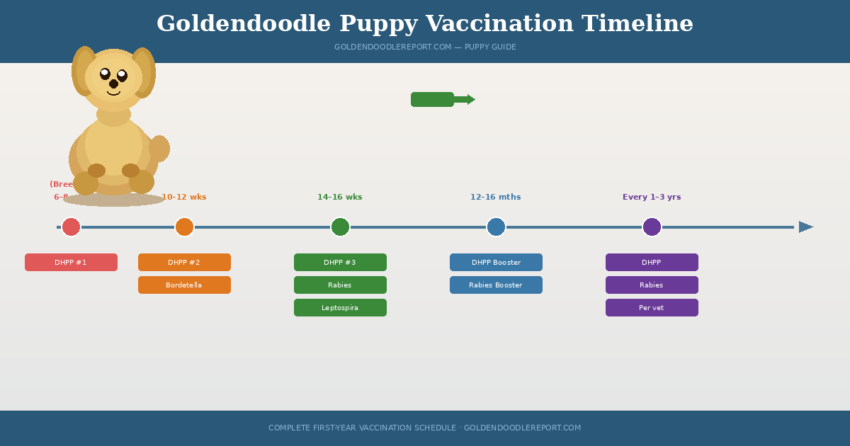
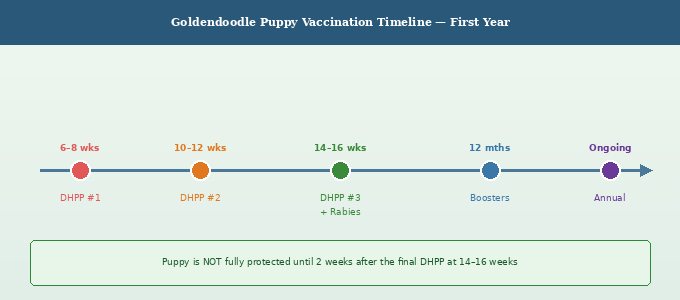
The Goldendoodle puppy vaccination timeline runs from 6–8 weeks (first DHPP given by the breeder) through 14–16 weeks (final primary DHPP and rabies), with a booster at 12–16 months and then ongoing adult vaccinations every 1–3 years. The puppy is not fully protected until two weeks after the final primary vaccine at 14–16 weeks. This window — from 8 weeks to approximately 18 weeks — requires careful management of outdoor exposure while maintaining the socialisation that is equally critical during this same period.
Quick Answer
What is the Goldendoodle puppy vaccination timeline? DHPP at 6–8 weeks (breeder), 10–12 weeks, and 14–16 weeks. Rabies at 12–16 weeks. Optional non-core vaccines including Bordetella, Leptospirosis, and Lyme based on location and lifestyle — discuss with your vet. Booster at 12–16 months. Adult vaccines every 1–3 years depending on the specific vaccine and your vet’s protocol. The entire primary series must complete before the puppy has full protection.
The tension at the heart of the vaccination period is that the most important socialisation window — 8 to 16 weeks — coincides exactly with the period when the puppy is not yet fully vaccinated. Managing this requires understanding which specific exposures are risky and which are safe, rather than simply keeping the puppy isolated until vaccination is complete. Isolation during this window produces a poorly socialised adult dog, which is a welfare problem. The answer is controlled, informed exposure — not isolation and not unrestricted access.
This guide covers:
- The complete Goldendoodle puppy vaccination timeline — every vaccine and timing
- What each core vaccine protects against
- Non-core vaccines — which ones apply to Goldendoodles and why
- What is safe and unsafe during the pre-vaccination window
- The first vet visit and what to bring
- Adult booster schedule
In This Guide
Goldendoodle Puppy Vaccination Timeline — Complete Schedule
The Goldendoodle puppy vaccination timeline below reflects the American Animal Hospital Association (AAHA) guidelines as applied by most US veterinarians. Your specific vet may adjust timing slightly based on your puppy’s individual health status, your geographic region, and local disease prevalence. For the most current vaccination guidelines, the AKC’s complete guide to puppy vaccinations provides a thorough overview of the standard schedule.
Goldendoodle Puppy Vaccination Timeline — First Year and Beyond
| Age | Vaccines Given | Who Administers | Notes |
|---|---|---|---|
| 6–8 weeks | DHPP #1 (Distemper, Hepatitis, Parvovirus, Parainfluenza) | Reputable breeder | Confirm this was given and get documentation at pickup |
| 10–12 weeks | DHPP #2, Bordetella (optional) | Your veterinarian | First appointment should happen at 48 hours — vet may give this vaccine then |
| 14–16 weeks | DHPP #3, Rabies (legally required in most US states), Leptospirosis (if risk area) | Your veterinarian | Full protection begins 2 weeks after this appointment |
| 6 months | Some vets recommend an additional DHPP at 6 months | Your veterinarian | Not universal — discuss with your vet based on risk level |
| 12–16 months | DHPP booster, Rabies booster (3-year vaccine often given here) | Your veterinarian | Annual wellness exam. Discuss adult vaccine protocol going forward. |
| Every 1–3 years | DHPP (every 3 years), Rabies (every 1 or 3 years per state law), non-core vaccines annually as needed | Your veterinarian | Titers testing can be used to assess immunity before re-vaccinating in some cases |
Core Vaccines — What Each One Does
Core vaccines are those recommended for every dog regardless of lifestyle or location because the diseases they prevent are serious, widespread, or transmissible to humans. Every Goldendoodle puppy should receive all core vaccines.
Distemper is a severe viral disease affecting the respiratory, gastrointestinal, and neurological systems. It is often fatal in unvaccinated puppies and has no cure — treatment is supportive only. The distemper virus is airborne and can survive in the environment for hours, making vaccination the only reliable protection.
Adenovirus (Hepatitis) causes infectious canine hepatitis, affecting the liver, kidneys, and eyes. It can be fatal in severe cases and is transmitted through contact with infected urine, faeces, and saliva. The vaccine is highly effective and part of every standard DHPP combination.
Parvovirus is one of the most serious threats to unvaccinated puppies. It causes severe haemorrhagic gastroenteritis — vomiting and bloody diarrhoea — with a mortality rate of up to 91% in untreated dogs. It is highly contagious, survives in soil for years, and is resistant to most common disinfectants. Parvovirus is the primary reason the pre-vaccination outdoor exposure restrictions exist — the disease can kill an unvaccinated puppy within days.
Parainfluenza is a component of kennel cough — a respiratory infection. Less severe than distemper or parvo but highly contagious in environments where dogs congregate. Included in the DHPP combination.
Rabies is legally required in most US states and many countries because it is transmissible to humans and fatal once symptomatic. The vaccine is given at 12–16 weeks, with a booster at 12–16 months and then either annually or every three years depending on the vaccine formulation and local law.
Non-Core Vaccines for Goldendoodles
Non-core vaccines are recommended based on individual risk assessment — your geographic location, your dog’s lifestyle, and local disease prevalence. Your vet will advise which are appropriate for your Goldendoodle specifically.
Non-Core Vaccines — Goldendoodle Risk Assessment
| Vaccine | What It Prevents | When Recommended for Goldendoodles |
|---|---|---|
| Bordetella | Kennel cough (Bordetella bronchiseptica) — the primary bacterial component | Recommended if the puppy will attend puppy classes, use doggy daycare, board, or visit dog parks. Many facilities require it. |
| Leptospirosis | Bacterial infection affecting kidneys and liver. Transmissible to humans. | Recommended in areas with wildlife exposure (raccoons, deer) or standing water. Discuss with your vet — prevalence varies significantly by location. |
| Lyme disease | Tick-borne bacterial infection. Can cause kidney disease in dogs. | Recommended in high-tick-burden areas — Northeast, Upper Midwest, Pacific Coast. If the dog hikes or spends time in wooded areas. |
| Canine Influenza | Dog flu — H3N2 and H3N8 strains | Recommended if the dog will board, attend daycare, or be around groups of dogs where outbreaks have been reported locally. |
What Is Safe Before Full Vaccination
The pre-vaccination window — from pickup at 8 weeks to full protection at approximately 18 weeks (two weeks after the 14–16 week DHPP) — requires a balanced approach. Full isolation is not the answer. Missing the socialisation window produces a fearful, under-socialised adult dog, which is itself a welfare problem. The goal is controlled, risk-assessed exposure.
Safe before full vaccination: Your own garden or yard if it has not had unvaccinated dogs on it. The homes and gardens of dogs whose vaccination status you know and trust. Being carried in outdoor public spaces rather than walking on ground frequented by unknown dogs. Puppy classes at reputable facilities with vaccination requirements and cleaned surfaces — the socialisation benefit outweighs the controlled, low-risk exposure. Car travel. Visits to friends’ homes.
Unsafe before full vaccination: Public parks, pavements, and areas where unknown dogs have access. Dog parks entirely. Pet shops that allow dogs inside. Any surface where a parvovirus-positive dog may have been — parvo survives in soil for up to a year. Communal water bowls. Contact with dogs of unknown vaccination history.
The practical rule is this: assess whether unknown unvaccinated dogs could have been on the surface or in the space. If yes, carry the puppy or avoid the area. If no — your own verified-clean garden, a vaccinated friend’s home — the exposure is safe and the socialisation benefit is real and valuable.
The First Vet Visit — What to Bring and Expect
The first vet visit should happen within 48 hours of bringing the puppy home. This is a health baseline check as much as a vaccination appointment. Bring the following:
- All paperwork from the breeder including vaccination records, deworming records, and any health certificates
- The puppy’s current food — the vet may want to note the brand and assess nutritional adequacy
- A list of questions — write them down before you go
- A stool sample if possible — many vets will check for intestinal parasites at the first visit
The vet will weigh the puppy, examine it from nose to tail for any congenital issues, confirm the breeder’s vaccination records, discuss the schedule going forward, recommend a deworming protocol, advise on flea and tick prevention appropriate for the puppy’s age and weight, and answer your questions. This appointment is also the right time to discuss the neutering/spaying decision and timing — increasingly important for Goldendoodles given the link between early neutering and joint health outcomes.
Adult Booster Schedule
After the primary series and the 12–16 month boosters, the adult Goldendoodle vaccination schedule depends on the specific vaccines and your vet’s protocol:
DHPP: Many vets now recommend every three years rather than annually following the booster at 12–16 months, based on evidence that immunity from the primary series lasts significantly longer than one year for most dogs. Titers testing — a blood test that measures existing antibody levels — can be used to determine whether re-vaccination is necessary before the three-year mark.
Rabies: Either annually or every three years depending on your state law and the vaccine formulation used. The 3-year rabies vaccine is widely available but not legal everywhere — your vet will advise on local requirements.
Non-core vaccines: Typically given annually if indicated — Bordetella, Leptospirosis, Lyme, and Canine Influenza are not covered by the extended intervals that apply to core vaccines.
⚠️ Watch Out
The most common mistake in managing the Goldendoodle puppy vaccination timeline is treating the completion of the primary series as the moment full protection begins. Full protection begins two weeks after the final primary DHPP at 14–16 weeks — not on the day of the injection. Factor this into any plans for puppy classes, park visits, or exposure to unknown dogs. The puppy is not fully protected until approximately week 18, not week 16.
Signs of a Vaccine Reaction — When to Call the Vet
Mild reactions (lethargy, mild soreness at injection site, reduced appetite for 24 hours) are normal after vaccination. Call your vet if you see:
- Facial swelling, hives, or severe itching within an hour of vaccination
- Vomiting or diarrhoea within 24 hours of vaccination
- Difficulty breathing or collapse — this is an emergency, call immediately
- Lethargy or loss of appetite lasting more than 48 hours
Key Takeaways
- The Goldendoodle puppy vaccination timeline runs from 6–8 weeks (breeder’s first DHPP) through 14–16 weeks (final primary DHPP and rabies), with boosters at 12–16 months and ongoing adult vaccines every 1–3 years
- Full protection begins two weeks after the final primary DHPP at 14–16 weeks — not on the day of the injection
- Core vaccines (DHPP and Rabies) are required for every Goldendoodle. Non-core vaccines (Bordetella, Leptospirosis, Lyme, Canine Influenza) are recommended based on location and lifestyle
- The pre-vaccination window overlaps with the critical socialisation window — controlled, risk-assessed exposure is the correct approach, not isolation
- The first vet visit should happen within 48 hours of bringing the puppy home — bring all breeder paperwork, a stool sample, and a list of questions
- Mild lethargy and soreness after vaccination is normal. Facial swelling, hives, vomiting, or breathing difficulty warrant an immediate call to the vet
Related Goldendoodle Puppy Guides
- Goldendoodle Puppy First Vet Visit — What to expect and what to bring to the first appointment
- Goldendoodle Puppy Deworming Guide — Deworming schedule and signs of infestation
- Goldendoodle Puppy Socialization Checklist — Safe socialisation within the vaccination window
- When Can a Goldendoodle Puppy Go Outside? — The safe outdoor timeline based on vaccination status
- Goldendoodle Puppy Care Guide — Complete first-year overview including health milestones
Part of the Goldendoodle Puppy Guide resource hub:
→ Goldendoodle Puppy Guide — Browse all 40 puppy guides
Frequently Asked Questions
At what age should a Goldendoodle puppy get its first vaccination?
The first DHPP vaccination is typically given by the breeder at 6 to 8 weeks of age, before the puppy goes to its new home. When you bring the puppy home at 8 weeks, your first task is to book a vet appointment within 48 hours to confirm the vaccination records and continue the schedule. If the breeder did not give the first vaccination — which should raise questions about the quality of the breeding operation — your vet will advise on how to begin the series.
Can my Goldendoodle puppy go outside before finishing vaccinations?
With appropriate precautions, yes. Your own garden, the homes of vaccinated dogs you trust, and carried in public spaces are all reasonable before full vaccination. What to avoid is ground where unknown unvaccinated dogs may have been — public parks, pavements, pet shops, and dog parks. Parvovirus in particular survives in soil for up to a year and can be lethal to unvaccinated puppies. The controlled outdoor socialisation that is safe before full vaccination is covered in detail in the When Can a Goldendoodle Puppy Go Outside guide.
What happens if my puppy misses a vaccination appointment?
Missing an appointment in the primary series means the series needs to be restarted or extended — your vet will advise based on how much time has passed. If the gap is two weeks or less, the series can typically continue without starting over. Longer gaps may require starting from the beginning. Call your vet as soon as you realise an appointment was missed rather than waiting until the next scheduled date — timing matters for the immune response the series is building.
Is the Rabies vaccine legally required for Goldendoodles?
Yes — in the vast majority of US states and many other countries, the Rabies vaccine is legally required for dogs. The specific timing, frequency, and proof requirements vary by state. Most states require the first Rabies vaccine between 12 and 16 weeks of age, followed by a booster at 12 months, and then either annually or every three years depending on the vaccine formulation used and state law. Your vet will know the specific requirements for your state.
What is a titers test and should I use it instead of re-vaccinating?
A titers test is a blood test that measures the level of antibodies against specific diseases — typically Distemper and Parvovirus — to determine whether an existing immune response is sufficient without re-vaccination. Some owners and vets prefer titers testing for adult dogs after the primary series and boosters are complete, as evidence suggests immunity lasts longer than annual re-vaccination schedules assume. Titers testing is not a replacement for the primary series or the 12–16 month boosters — it is a tool used to make informed adult vaccination decisions. Discuss with your vet whether it is appropriate for your Goldendoodle’s individual situation.
The information in this article is provided for general educational purposes only and does not constitute veterinary advice. King James Adjei is a researcher and enthusiast, not a veterinarian. Vaccination schedules should always be confirmed and managed by a qualified veterinarian who knows your puppy’s specific health status, location, and risk profile.