5-minute read | Last updated March 2026 | Reviewed for accuracy
By King James Adjei | GoldendoodleReport.com
Researcher, Goldendoodle enthusiast, and founder of GoldendoodleReport. Every guide on this site is written to give owners reliable, clearly organised information — researched carefully and updated regularly.
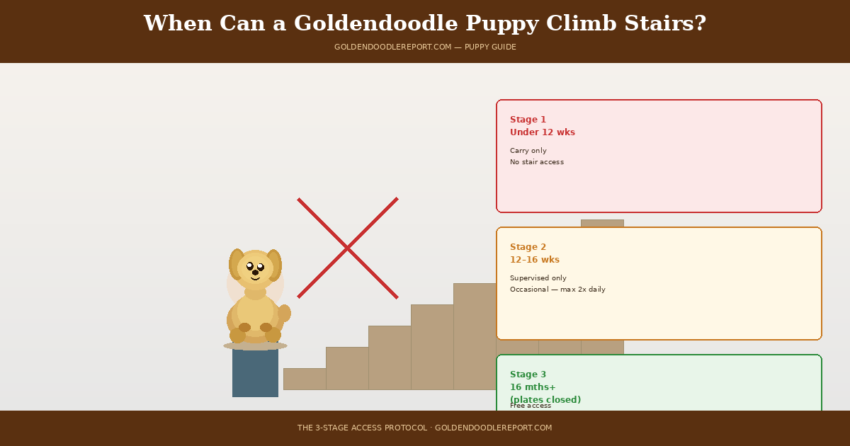
When can a Goldendoodle puppy climb stairs is a question that matters from the first day the puppy comes home — because most homes have stairs and the puppy will attempt them immediately. The answer is not simply an age but a three-stage protocol based on growth plate development, with specific rules for each stage and a clear distinction between going up and coming down.
Who This Guide Is For
This article is most useful if you:
- Have stairs at home and want to know what the rule is for your puppy’s current age
- Have been letting your puppy use the stairs already and want to know if damage has been done
- Want to understand specifically why stairs are harmful for puppies — not just that they are
- Need a practical management plan for a multi-storey home with a young puppy
For the broader exercise safety context, see Goldendoodle Puppy Exercise Mistakes.
Quick Summary
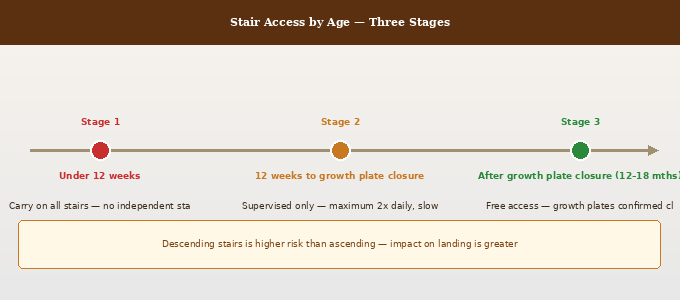
When can a Goldendoodle puppy climb stairs? Stage 1 — under 12 weeks: carry on all stairs, no independent access. Stage 2 — 12 weeks to growth plate closure: supervised occasional use only, maximum twice daily, never as exercise. Stage 3 — after growth plate closure at 12 to 18 months: free access. Descending stairs carries higher impact risk than ascending. A stair gate is the most practical management tool for any home with a puppy under 12 months.
Quick Answer
Carry your Goldendoodle puppy on stairs entirely until 12 weeks. From 12 weeks to growth plate closure allow supervised occasional use — maximum twice daily, slow pace, never as a repeated exercise. Free stair access is safe only after growth plates close at 12 to 18 months. Use a stair gate to enforce this without relying on vigilance alone.
Quick Diagnosis
- If your puppy is under 12 weeks → carry on all stairs, no exceptions, install stair gate today
- If your puppy is 12 weeks to 6 months → supervised only, twice daily maximum, no repetitive stair use, stair gate in place
- If your puppy is 6 to 12 months → supervised access, avoid using stairs as an exercise route, discuss growth plate status with vet at 12-month appointment
- If your puppy has been using stairs unsupervised already → stop, do not panic, monitor for stiffness or limping after activity and contact vet if observed
You live in a two-storey house. The bedroom is upstairs. The kitchen is downstairs. From the first week the puppy follows you everywhere — up the stairs in the morning, down again after breakfast, up for naps, down for dinner. By six months it has climbed those stairs hundreds of times. At 18 months your vet mentions hip changes on the X-ray. The stairs were never a single damaging event. They were cumulative loading on growth plates that were open the entire time.
The reason stair guidance feels overstated to many owners is that the consequences are invisible and delayed. A puppy that climbs stairs does not limp that afternoon. It continues to run and play with apparent normality. The structural changes accumulate silently in the growth plates — the soft cartilaginous areas at the ends of long bones that remain open until 12 to 18 months — and the results appear as joint disease in the young adult dog. By that point the connection to early stair use is not obvious, and the damage is not reversible.
This guide covers:
- Why stairs specifically stress growth plates — the biomechanical mechanism
- Why going down is more dangerous than going up
- The three-stage stair access protocol with specific age thresholds
- How to manage stairs practically in a multi-storey home
- What to do if the puppy has already been using stairs
In This Guide
When Can a Goldendoodle Puppy Climb Stairs: The Biomechanical Reason
Stairs impose a specific and problematic mechanical load on a puppy’s developing skeleton. To understand why, it helps to understand what makes stair climbing different from walking on flat ground. When a dog walks on a flat surface, the limb moves through a relatively consistent range of motion with moderate joint angles. The load on the hip, stifle, and elbow joints is distributed evenly across each stride. When a dog climbs stairs, each step requires a significantly greater hip and stifle extension angle to clear the riser height, concentrating load on the joint surfaces at the extremes of their range of motion.
For a fully mature dog with closed growth plates, this concentrated load is absorbed by hard cortical bone and dense cartilage. For a puppy with open growth plates, the load falls on soft, cartilaginous physeal tissue that has significantly lower resistance to compressive and shear forces. Repeated stair climbing in a puppy applies these concentrated forces to precisely the tissue least equipped to handle them, in a pattern — repeated multiple times daily — that accumulates over weeks and months. For a thorough overview of the growth plate anatomy underpinning these concerns, the American Kennel Club’s puppy development stages guide covers the key developmental context.
The growth plates at highest risk from stair climbing are the distal femur (knee area) and the femoral head (hip), because these joints bear the greatest load during the high-angle extension required for stair climbing. Goldendoodles — particularly Standard Goldendoodles — are already predisposed to hip dysplasia through their Golden Retriever heritage. Repetitive stair loading during the growth plate window compounds this predisposition in a way that controlled flat-surface exercise does not.
Why Descending Is More Dangerous Than Ascending
Most owners, if they think about stair safety at all, focus on the risk of the puppy ascending stairs. Descending is actually the higher-risk direction and the reason is straightforward biomechanics: gravity.
When a puppy descends stairs, each step forward requires the leading forelimbs to absorb the landing impact before the hindlimbs follow. The body weight plus forward momentum multiplied by the step height produces a landing force that is substantially greater than the simple body weight applied during ascent. The forelimb growth plates — the distal radius and ulna in the lower leg — absorb this landing impact repeatedly on every descending step. A staircase with twelve steps means twelve landing impact events per descent, multiplied by however many times the puppy uses the stairs daily.
Additionally, a puppy descending stairs that misjudges a step — a very common occurrence given the proportion of body length to step height in young puppies — will attempt a rescue movement involving sudden joint hyperextension to catch itself. These sudden hyperextension events are among the highest acute loading events a developing joint can experience and can cause growth plate micro-fractures that do not produce immediate obvious lameness but contribute to later joint degeneration.
The practical implication: if supervision resources are limited, prioritise controlling descent over ascent. A puppy ascending stairs at a careful pace applies lower forces than one descending the same stairs. Both should be managed, but if you can only block one direction, block the descent.
The Three-Stage Stair Access Protocol
Stair Access by Age — Three-Stage Protocol
| Stage | Age | Stair Access Rule | Management Method | Why This Threshold |
|---|---|---|---|---|
| Stage 1 | Under 12 weeks | Carry only — no independent stair use in either direction | Stair gate at top and bottom. Carry the puppy on all stair transitions. | Growth plates at most vulnerable stage — body weight to step-height ratio also makes falls likely |
| Stage 2 | 12 weeks to growth plate closure (12–18 months) | Supervised occasional use — maximum twice daily, slow pace, never as repeated exercise | Stair gate maintained. Remove supervision requirement by using carry as default, stairs as exception. | Growth plates still open but some structural resilience developing. Occasional use is low cumulative risk; daily repeated use is not. |
| Stage 3 | After growth plate closure — 12 to 18 months depending on size | Free access — normal stair use in both directions is safe | Stair gate can be removed. No restrictions on frequency or direction. | Growth plates calcified into hard bone — the compressive vulnerability that made stairs dangerous no longer exists. |
Size determines where in the 12 to 18 month range growth plates close. Mini Goldendoodles typically reach closure at 10 to 12 months. Medium Goldendoodles at 12 to 14 months. Standard Goldendoodles at 14 to 18 months. If uncertain, a veterinary X-ray at the 12 to 14 month appointment confirms closure status and allows a definitive transition from Stage 2 to Stage 3.
How to Manage Stairs Practically in a Multi-Storey Home
The gap between the theoretical rule and the practical reality of living with a puppy in a multi-storey home is where most owners struggle. Carrying a growing Standard Goldendoodle puppy up and down stairs multiple times daily is not realistic beyond the first few weeks. These are the practical management approaches that make the protocol workable.
Install stair gates immediately — before the puppy comes home. A stair gate at the bottom of the staircase is the single most effective management tool because it removes the decision from every interaction. The gate is closed. The puppy cannot access the stairs. No vigilance required. A second gate at the top provides complete protection. Stair gates for dogs should have a pressure-fit or wall-mounted design with an auto-close mechanism — step-over style child gates are insufficient for an energetic puppy.
Create a single-floor living space for the puppy during Stage 1. Feed, sleep, play, and toilet facilities all on one floor eliminates the stair transition requirement during the most critical growth plate period. The crate, bed, water, and play area are all ground floor. The puppy has no reason to need stairs. This is the most practical approach for the first 12 weeks.
Use the carry as the default in Stage 2, stairs as the exception. During Stage 2, treat all stair transitions as carry events by default. If the puppy needs to go upstairs — carry it. Reserve the two supervised daily stair uses for intentional training exposures where you are beside the puppy on the stairs to guide pace and catch any misstep. This approach keeps cumulative stair loading minimal while familiarising the puppy with the stairs it will eventually use freely.
Teach the wait cue at stair tops and bottoms. Training the puppy to sit and wait at the top and bottom of stairs before proceeding, rewarded with a treat, serves two purposes: it builds the habit of controlled stair use that persists into adulthood, and it provides a moment for the owner to assess the puppy’s readiness and position before movement begins.
What to Do If the Puppy Has Already Been Using Stairs
If the puppy has been using stairs unsupervised before you read this guide, stop the access now and monitor carefully over the following two to four weeks. Single past exposure to stairs — even many repetitions — does not guarantee joint damage. Growth plate injury from stair use is cumulative and probabilistic, not certain from any given exposure pattern. What matters now is stopping further accumulation.
Monitor for three specific signs that warrant veterinary contact: stiffness during the first few minutes of movement after rest (the puppy struggles to rise from lying but moves normally once warm), occasional subtle favouring of a forelimb or hindlimb during or after activity, and any reluctance to climb or descend stairs that was not previously present. None of these signs are emergency presentations, but all warrant a vet discussion — particularly in a puppy under 6 months where growth plate vulnerability is highest.
If no signs are present, focus on prevention from this point. Implement the stair gate protocol, transition to carrying as the default stair management, and schedule a growth plate discussion at the next routine vet appointment.
Action Plan — Stair Management Starting Today
- Install a stair gate before or immediately after the puppy arrives. Ground-floor gate as minimum. Top-of-stairs gate if the puppy has already accessed the upper floor. Choose a wall-mounted auto-close design.
- Carry the puppy on all stairs until 12 weeks — no exceptions. Every stair transition is a carry. This is non-negotiable during Stage 1 regardless of the puppy’s apparent ability to manage stairs independently.
- Identify which floor the puppy’s primary living space will be. Set up crate, water, feeding area, and toilet access all on the same floor. Eliminate the stair transition requirement entirely during the first 12 weeks.
- From 12 weeks, use the two-per-day supervised protocol. Two stair uses daily maximum, supervised, slow pace. Carry for all other transitions. This continues until growth plate closure is confirmed.
- Train the wait cue at stair tops and bottoms. From 12 weeks, teach sit-and-wait at each stair access point. This builds lifelong safe stair habits regardless of when free access begins.
- Book a growth plate discussion with your vet at 12 months. Confirm closure status by X-ray if uncertain. Do not transition to Stage 3 based on age assumption alone for Standard Goldendoodles.
What to Expect
Timeline: Stage 1 carry-only lasts 12 weeks. Stage 2 supervised access lasts until growth plate closure — 10 to 18 months depending on size. Stage 3 free access follows confirmed closure. The total restricted period is shorter than most owners expect once the Stage 2 supervised protocol is in place.
Friction: Carrying a Standard Goldendoodle that weighs 15 kg at 5 months is physically demanding. The stair gate removes most of the physical burden by eliminating the requirement — the puppy simply does not access the stairs. The carry is reserved for planned supervised exposures, not every transition.
Signs the protocol is working: No stiffness after activity, no limping, no reluctance to use stairs during supervised access. Puppy uses the stairs calmly and at a steady pace when permitted.
Your Next Step
If you do not have a stair gate installed, order one today. If your puppy is under 12 weeks, begin carrying on all stairs from this session onward. If the puppy is between 12 weeks and growth plate closure, implement the two-per-day supervised protocol and carry for all other transitions.
What Most Owners Get Wrong
Mistake 1 — Using physical ability as the safety indicator. A puppy that can physically climb the stairs is not a puppy that is safe to climb the stairs. Physical ability to perform a movement and biomechanical safety of that movement are different assessments. By 10 weeks most Goldendoodle puppies are physically capable of climbing a full staircase. Their growth plates will not be safe for that load for another year or more. Physical ability is not the signal — age and growth plate status are.
Mistake 2 — Treating occasional stair use as negligible. The framing of “just a few times a day” is not a low-risk framing when applied to a six-month developmental window. Two stair uses per day for 300 days is 600 loading events per growth plate before closure. The damage is cumulative. The Stage 2 supervised protocol exists precisely because occasional supervised use is genuinely lower risk than habitual unrestricted use — not because stair use below some frequency is harmless.
Mistake 3 — Not distinguishing between ascending and descending. Owners who manage ascending stairs carefully while allowing the puppy to run down freely are managing the lower-risk direction and leaving the higher-risk direction uncontrolled. Descending produces greater impact forces than ascending. If the puppy can access both directions, manage both directions with equal rigor — but if you can only manage one, manage the descent.
Signs Your Approach Is Working
- Puppy moves freely without stiffness after rest periods at any age
- No limping or subtle favouring of any limb during or after activity
- On supervised stair use, the puppy descends at a steady controlled pace — not rushing or sliding
- No reluctance to approach the stair gate or the staircase during supervised access
⚠️ Watch Out
The most dangerous stair pattern is not a single dramatic incident — it is the routine daily pattern that no one thinks to question. A puppy running up and down stairs freely as part of its normal daily movement, from 8 weeks to 12 months, applies cumulative growth plate loading that exceeds what any single supervised session would produce. Routine is the risk. The stair gate eliminates the routine before it is established.
Contact Your Vet If
- The puppy shows stiffness during the first minutes of movement after rest — particularly in the hips or hindlimbs
- Any limping during or after stair use, or after normal activity
- The puppy falls on stairs and shows any abnormal movement or vocalisation immediately after
- You notice muscle asymmetry — one hindlimb appears less developed than the other
Key Takeaways — When Can a Goldendoodle Puppy Climb Stairs?
- Stage 1 under 12 weeks: carry only — no independent stair access in either direction
- Stage 2 from 12 weeks to growth plate closure: supervised occasional use maximum twice daily, carry as default for all other transitions
- Stage 3 after growth plate closure (12 to 18 months depending on size): free access is safe
- Descending stairs produces greater landing impact than ascending — manage both directions but prioritise controlling descent
- Physical ability to climb stairs is not a safety indicator — growth plate status is
- A stair gate installed before the puppy arrives is the most effective management tool because it removes the daily vigilance requirement entirely
Related Goldendoodle Puppy Guides
- Goldendoodle Puppy Exercise Mistakes — The full context of exercise-related growth plate risks
- Goldendoodle Exercise Needs by Age — Safe exercise limits at each growth stage
- Goldendoodle Puppy Growth Stages — The full developmental timeline including growth plate closure ages
- Goldendoodle Puppy First Vet Visit — When to raise stairs and joint development with your vet
- Goldendoodle Puppy Care Guide — Complete first-year overview including all physical safety milestones
Part of the Goldendoodle Puppy Guide resource hub:
→ Goldendoodle Puppy Guide — Browse all 40 puppy guides
Frequently Asked Questions
At what age can a Goldendoodle puppy use stairs freely?
Free stair access is safe after growth plate closure, which occurs at 10 to 12 months for Mini Goldendoodles, 12 to 14 months for Mediums, and 14 to 18 months for Standards. Until that point the three-stage protocol applies. If uncertain about closure timing, a veterinary X-ray at 12 to 14 months confirms status. Do not assume closure has occurred based on age alone — particularly for Standard Goldendoodles whose skeletal maturity arrives later than smaller sizes.
My puppy fell down the stairs — what should I do?
Observe closely for the next 30 to 60 minutes. A puppy that falls but immediately gets up, moves normally, bears weight on all limbs, and shows no vocalisation of pain has likely not sustained a significant injury. Monitor over the following 24 hours for stiffness, limping, reluctance to move, or swelling around any joint. If any of these signs appear, contact your vet that day. If the puppy showed immediate abnormal movement, vocalisation, or non-weight-bearing after the fall, contact your vet immediately regardless of subsequent apparent recovery.
Is it safe to let my puppy watch me go up the stairs?
A puppy watching from behind a stair gate, not accessing the stairs, is completely safe. The concern is ground contact loading on growth plates — a puppy observing stairs from a seated position is experiencing none of that. The stair gate also serves a secondary purpose here: the puppy learns that the staircase is gated and that gate-scratching or gate-jumping does not produce access, which makes Stage 2 supervised introduction to the stairs easier because the puppy has not already established a frustrated barrier response.
Should I use a ramp instead of stairs for my puppy?
A dog ramp with a gentle gradient is a lower-impact alternative to stairs for getting a puppy onto elevated surfaces — a sofa, a car boot, a bed. The shallower the angle, the lower the hip and stifle extension required and the lower the impact loading. If your main concern is car boot access or furniture access, a ramp is a reasonable solution. For a home staircase, carrying remains the preferred option during Stage 1 because even a shallow ramp applied repeatedly multiple times daily accumulates loading over time.
Can my Goldendoodle puppy use an outdoor step — just one or two steps?
One or two low steps — for example, a doorstep or a single garden step — used occasionally at a walking pace are substantially lower risk than a full indoor staircase. The loading event is a single step rather than eight to fourteen repeated steps, and occasional use means low cumulative exposure. From 12 weeks onwards, occasional single-step use under supervision is reasonable. Under 12 weeks, carry even for single steps where possible, particularly for descent — a puppy jumping down from a single raised step lands with significant impact relative to its body size.
The information in this article is provided for general educational purposes only. King James Adjei is a researcher and enthusiast, not a veterinarian. For concerns about joint development or any signs of lameness after stair use, always consult a qualified veterinarian.