7-minute read | Last updated March 2026 | Reviewed for accuracy
By King James Adjei | GoldendoodleReport.com
Researcher, Goldendoodle enthusiast, and founder of GoldendoodleReport. Every guide on this site is written to give owners reliable, clearly organised information — researched carefully and updated regularly.
 Apartment living with a Goldendoodle is one of the most searched questions in the Goldendoodle owner community — and the honest answer is more nuanced than most breed guides admit. It is possible, but it depends almost entirely on the size of the dog, the commitment of the owner, and the quality of the exercise and enrichment routine. This guide covers what actually determines success, what makes it fail, and what apartment-dwelling Goldendoodle owners need to do differently to the owners with gardens.
Who This Guide Is For
This article is most useful if you:
- Live in an apartment and are considering getting a Goldendoodle
- Already have a Goldendoodle in an apartment and want to know if you are doing enough
- Are moving from a house to an apartment and want to prepare your Goldendoodle for the transition
- Want an honest assessment of which Goldendoodle sizes work in small spaces and which do not
For the structured daily routine that makes apartment life manageable, see the Goldendoodle Daily Routine guide.
Quick Summary
Apartment living with a Goldendoodle works best with a Mini or Medium Goldendoodle whose owner is genuinely committed to twice-daily outdoor exercise, daily mental enrichment, and a structured routine. It does not work well with a Standard Goldendoodle owner who expects the dog to self-manage its energy indoors, or with any size Goldendoodle whose owner works full time with no midday arrangement. The apartment is not the problem — the owner’s commitment to compensating for the lack of outdoor space is what determines success or failure.
Quick Answer
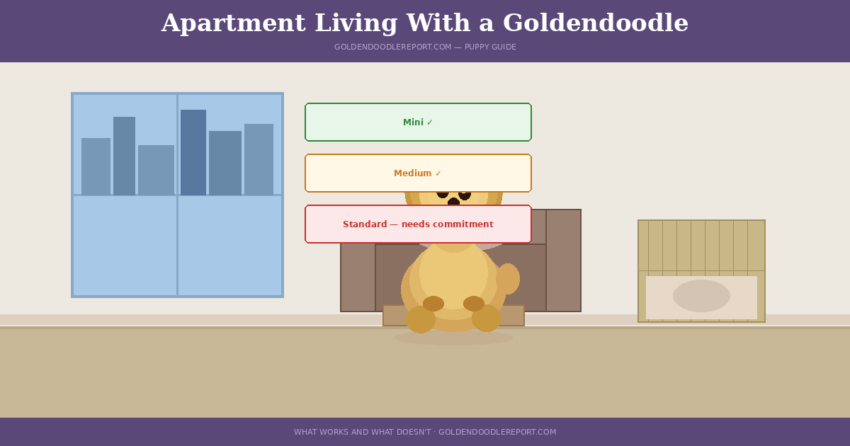
Can a Goldendoodle live in an apartment? Yes — with conditions. A Mini Goldendoodle adapts well to apartment life with 45–60 minutes of outdoor exercise daily. A Medium Goldendoodle can manage with 60–75 minutes and strong mental enrichment. A Standard Goldendoodle in an apartment requires 75–90 minutes of outdoor exercise daily plus structured enrichment — achievable but demanding. Any Goldendoodle in any apartment left alone all day without a midday break will develop separation anxiety and destructive behaviour regardless of size.
The most common failure point in apartment living with a Goldendoodle is not the size of the space — it is the gap between what the owner assumed the dog would need and what the dog actually needs. A Goldendoodle in a large house with a garden that gets one walk per day is less well-served than a Goldendoodle in a studio apartment whose owner walks it twice daily, does training sessions in the hallway, and uses food puzzles every morning. Space is secondary to commitment.
This guide covers:
- Which Goldendoodle sizes suit apartment life and which do not
- The exercise minimum that makes apartment living viable
- How to manage toilet needs without a garden
- Setting up a small apartment for a Goldendoodle
- Mental enrichment to compensate for reduced space
- The deal-breakers that make apartment life impossible for this breed
In This Guide
Apartment Living With a Goldendoodle: Which Size Works?
Size is the first and most important variable in apartment living with a Goldendoodle. The three size categories have genuinely different space and exercise requirements that translate directly into apartment suitability.
Goldendoodle Size Suitability for Apartment Living
| Size | Adult Weight | Apartment Verdict | What It Requires |
|---|---|---|---|
| Mini | 7–15 kg | Good fit | 45–60 min outdoor exercise daily. Mental enrichment 15–20 min daily. Midday toilet break if working. |
| Medium | 15–25 kg | Possible with commitment | 60–75 min outdoor exercise daily split into two sessions. Strong enrichment routine. No long solo days. |
| Standard | 25–40 kg | Demanding — owner must be fully committed | 75–90 min outdoor exercise daily. Daily enrichment. Dog walker or daycare on work days. Not suitable for owners with low availability. |
The honest position on Standard Goldendoodles in apartments is this: it can work, but it requires a level of daily commitment that many owners underestimate before bringing the dog home. A Standard Goldendoodle that receives insufficient exercise in an apartment does not quietly accept it — it expresses its frustration through barking, destructive behaviour, and anxiety that affects both the dog and the neighbours. If the lifestyle assessment is not honest before acquisition, the dog pays the price.
The Exercise Minimum That Makes It Viable
The fundamental principle of apartment living with a Goldendoodle is that exercise must compensate for space. A dog with a garden self-regulates to some extent — it goes outside, sniffs, potters, and burns low-level energy throughout the day. An apartment dog has none of those micro-activity opportunities. Every calorie of energy must be burned on dedicated outdoor exercise or structured indoor enrichment.
The minimum viable exercise for each size at full adult weight is two outdoor sessions per day, not one. A single long walk in the morning does not serve the same purpose as two moderate walks spread across the day. The morning walk burns overnight energy and sets the dog up for a settled morning. The afternoon or evening walk addresses the energy that has accumulated through the day. Skipping either session produces a dog that cannot settle in the evening, barks in response to apartment block sounds, and becomes increasingly difficult to manage.
Surface and route variety matters more for apartment dogs than for dogs with gardens. A dog that sniffs the same pavement route twice daily is receiving physical exercise but minimal mental stimulation — the two are not the same. Varying routes, taking the dog to different parks, allowing extensive sniff stops, and occasionally taking the dog to new environments provides the sensory variety that a garden naturally supplies.
For the specific exercise limits that apply during puppyhood, which are critical to follow even in an apartment context, see the Goldendoodle Exercise Needs by Age guide. The 5-minute rule applies in apartments exactly as it does elsewhere — being in a small space does not mean the puppy needs more exercise to compensate. It means it needs more mental enrichment.
Managing Toilet Needs Without a Garden
The toilet routine for an apartment Goldendoodle requires more planning than for a dog with direct garden access, but it is entirely manageable with the right approach established from day one.
Establish a consistent outdoor toilet spot — the same patch of grass, the same corner of the street, reached the same way every time. Consistency of location is what builds the toilet association quickly. A puppy taken to a different spot every time takes longer to toilet train than one that returns to the same familiar location.
Calculate realistic trip times before bringing the puppy home. If the nearest grass is a three-minute walk from your front door, every toilet trip takes at least ten minutes round trip. A puppy needs trips every two hours during waking time. Ensure this is genuinely feasible for your work and life schedule before committing.
For puppies in high-rise apartments, the time between the urge to go and the ability to get outside is too long for an 8–12 week puppy with almost no bladder control. A temporary indoor solution — a balcony with artificial grass, or a puppy pad in a fixed location — is practical for the first weeks while outdoor toilet training is simultaneously established. The indoor option is a bridge, not a permanent solution. For guidance on the outdoor-only approach and its timeline, the AKC’s guide to puppy toilet training covers the process that works for any living situation.
The night routine in an apartment requires the same discipline as in a house — a toilet trip immediately before bed and, for young puppies, a middle-of-the-night trip for the first four to six weeks. The only difference is the logistics of getting outside rather than into a garden. Keep the trip brief, low-stimulation, and immediate — this is a toilet job, not a walk.
Setting Up a Small Apartment for a Goldendoodle
The physical setup of an apartment for a Goldendoodle is about maximising the dog’s sense of having its own defined space, even within a small footprint.
The crate goes in a corner of the bedroom or living room — whichever room the owner spends the most time in. For puppies it should be in the bedroom. The crate gives the dog a clear personal territory in a space where everything else belongs to the owner. A Goldendoodle in an apartment without a crate has no defined “off-duty” space and tends to remain alert and watchful rather than relaxing fully.
A designated settle mat or dog bed in the living area — separate from the crate — gives the dog a daytime rest location that is not always inside the crate. This matters for apartments specifically because the dog and owner share the same relatively small space all day. The dog needs to know there is a place it can go that is its own, without being fully crated, that allows it to be present without being in the middle of everything.
Noise management is an apartment-specific consideration that house owners rarely face. Goldendoodles are sensitive to sound and alert barking in apartment buildings — responding to corridor footsteps, lift sounds, and neighbour noise — is a common complaint from apartment Goldendoodle owners. Desensitising the puppy to these sounds during the socialisation window (8–16 weeks) is the most effective prevention. White noise or low-level background music during the day reduces the dog’s alertness to intermittent building sounds.
Stair management in buildings without lifts requires the same approach as in any home — restrict stair climbing in puppies under 12 weeks entirely, and manage it carefully until growth plate closure. In buildings with lifts, use the lift for the puppy whenever possible and treat stair use as controlled, occasional exercise rather than routine transit.
Mental Enrichment to Compensate for Reduced Space
This is the most important differentiator between a happy apartment Goldendoodle and a miserable one. The absence of a garden means the absence of hours of low-level exploratory activity — sniffing, investigating, watching the world, digging — that keeps a dog mentally occupied throughout the day. This must be replaced deliberately.
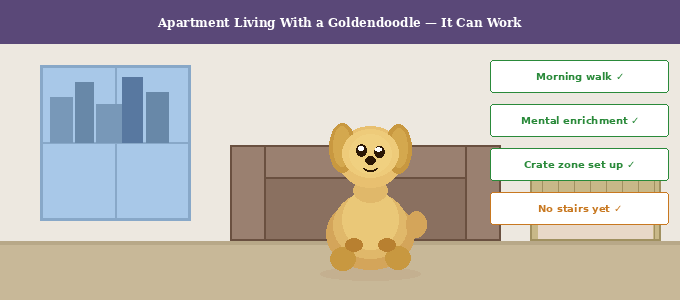
The most effective indoor enrichment options for apartment Goldendoodles are food puzzles and Kongs (a stuffed Kong frozen overnight provides 20–30 minutes of focused occupation), scatter feeding (the kibble meal thrown across the apartment floor rather than placed in a bowl — the dog spends 10–15 minutes hunting it), nose work games (hiding small food rewards in boxes or around furniture for the dog to find), and training sessions (10–15 minutes of obedience training or learning a new skill produces genuine mental tiredness that rivals physical exercise).
Two enrichment sessions per day — one morning, one afternoon — are the minimum for an apartment Goldendoodle. These do not need to be elaborate. A frozen Kong in the morning and a scatter feed at lunch, for example, adds meaningful mental occupation without significant effort from the owner.
The Deal-Breakers
These are the situations where apartment living with a Goldendoodle does not work, regardless of how much the owner wants it to. Being honest about these before acquiring the dog saves both the owner and the dog significant suffering.
Working full time with no midday arrangement. A Goldendoodle left alone in an apartment from 8 AM to 6 PM will develop separation anxiety. This is not a question of if — it is a question of how severe. No breed standard, no amount of crate training, and no amount of weekend exercise compensates for ten hours of daily isolation. If full-time working without a midday arrangement is the reality, this is a deal-breaker until that changes.
No outdoor space within reasonable walking distance. An apartment in a building surrounded entirely by hard standing, with the nearest grass patch a 15-minute walk away, makes the toilet training period extraordinarily difficult and reduces the dog’s daily outdoor variety to a point where quality of life suffers. This is not insurmountable but it is a significant additional challenge.
Noise-sensitive building or strict no-dog lease. Goldendoodles in apartments can bark — particularly during the adjustment period and when under-exercised. A building with noise complaints processes or a lease that does not permit dogs is the wrong environment. Confirm the building rules before acquiring the dog, not after.
A Standard Goldendoodle with an owner who cannot commit to 75–90 minutes of daily outdoor exercise. This is the most common failure pattern. The owner loves the breed, acquires a Standard because they prefer the look, manages the exercise commitment for six months, then finds it unsustainable as life circumstances change. The dog enters a cycle of under-exercise, frustrated behaviour, attempted correction, and escalating difficulty. If the exercise commitment for a Standard is not sustainable on the worst weeks of the year — when it is cold, dark, and raining — do not get a Standard in an apartment.
⚠️ Watch Out
The most common mistake in apartment living with a Goldendoodle is assuming the dog will adapt to the lifestyle rather than the lifestyle adapting to the dog. A Goldendoodle does not downgrade its exercise and social needs because it lives in a smaller space. It has the same needs regardless of the size of the home. The apartment owner who succeeds is not one who hopes the dog will be low-maintenance — it is one who commits to compensating for the lack of space with consistent exercise, enrichment, and structure from day one.
Signs the Apartment Arrangement Is Not Working
- Persistent barking when the owner is home and the dog is not being actively engaged
- Destructive behaviour — chewing furniture, scratching doors, destroying items when alone
- Inability to settle in the evenings despite exercise having been provided
- Neighbour complaints about noise when the owner is out
- Weight gain — a Goldendoodle in a small space with insufficient exercise gains weight noticeably
Key Takeaways
- Apartment living with a Goldendoodle works — but the apartment is not the variable, the owner’s commitment is
- Mini Goldendoodles are the best fit for apartment life; Standard Goldendoodles are possible but require the highest daily exercise commitment
- Two outdoor exercise sessions daily are the minimum — one long morning walk does not replace two moderate sessions
- The toilet routine in an apartment requires more logistical planning but follows exactly the same principles as in a house
- Mental enrichment — food puzzles, scatter feeding, training sessions — must compensate daily for the low-level activity a garden provides
- Full-time working with no midday arrangement is a deal-breaker for apartment Goldendoodle ownership regardless of size
Related Goldendoodle Puppy Guides
- Goldendoodle Daily Routine — The structured day that makes apartment living manageable
- Goldendoodle Exercise Needs by Age — Safe exercise limits at every life stage
- Goldendoodle Puppy Separation Anxiety — Prevention and early signs — critical for apartment owners
- Goldendoodle Puppy Care Guide — Complete first-year overview applicable to all living situations
- Best Puppy Playpen for Goldendoodles — Safe containment solution especially useful in small spaces
Part of the Goldendoodle Puppy Guide resource hub:
→ Goldendoodle Puppy Guide — Browse all 40 puppy guides
Frequently Asked Questions
What is the best Goldendoodle size for apartment living?
The Mini Goldendoodle — typically 7 to 15 kg as an adult — is the most practical size for apartment living. Its exercise needs are manageable for one person, it takes up less physical space in a small apartment, and it adapts more readily to the routine structure that apartment life requires. Medium Goldendoodles work well with committed owners. Standard Goldendoodles are possible but require the most exercise investment and the most stringent management of their energy and social needs.
Do Goldendoodles bark a lot in apartments?
Goldendoodles are not chronic barkers by nature — they are not a guard or alert breed in the traditional sense. However, an under-exercised or anxious Goldendoodle in an apartment will bark at corridor sounds, footsteps, lift doors, and passing noises in ways that a well-exercised dog with lower arousal will not. The barking is almost always a symptom of under-exercise or insufficient mental stimulation rather than a breed characteristic. Desensitisation to building sounds during the puppy socialisation window also reduces alert barking significantly.
Can I leave my apartment Goldendoodle alone all day?
No — not without a midday arrangement. Four to six hours is the maximum time an adult Goldendoodle should spend alone, and significantly less for puppies. A dog left alone in an apartment for eight to ten hours daily will develop separation anxiety and the destructive and vocal behaviour that accompanies it. This is not a training problem — it is a welfare problem. A dog walker, doggy daycare two to three days per week, a trusted neighbour, or a remote worker arrangement at home is necessary if full-time working is the reality.
How do I toilet train a Goldendoodle puppy in a high-rise apartment?
Use a temporary indoor toilet location — a balcony with artificial grass or a puppy pad in a fixed spot — for the earliest weeks when the puppy cannot hold its bladder long enough to get outside reliably. Simultaneously begin outdoor toilet training from day one by taking the puppy outside frequently. The indoor option is phased out as bladder control develops — typically by 12 to 14 weeks most puppies can manage the trip outside. Consistency of location for both indoor and outdoor toilet spots is the key to making the transition clean.
Do I need a garden to own a Goldendoodle?
No — but you need the time and commitment to compensate for not having one. A garden provides low-level activity, toilet access, and sensory variety that an apartment does not. All of these can be replaced through structured outdoor exercise, dedicated enrichment sessions, and frequent varied walks — but none of them replace themselves automatically. The question is not whether you have a garden. It is whether you are genuinely willing to do the work of replacing what a garden provides, every day, for the lifetime of the dog.
The information in this article is provided for general educational purposes only. King James Adjei is a researcher and enthusiast, not a veterinarian or certified behaviourist. For persistent behaviour problems or signs of anxiety, always consult a qualified veterinarian or certified dog behaviourist.