Affiliate Disclosure: Some links in this guide are affiliate links. If you purchase through them, we may earn a small commission at no extra cost to you. Read our full affiliate disclaimer here.
By King James Adjei — Researcher and Goldendoodle enthusiast, founder of GoldendoodleReport.com. Every guide on this site is carefully researched and written to give owners reliable, clearly organised information — updated regularly and honest about uncertainty. → About this site
📖 9-minute read | Last updated April 2026 | Reviewed for accuracy
A consistent goldendoodle daily routine is the single most effective tool available to a new owner — more effective than any training method, any product, or any advice about specific behaviours. The reason is not complicated: a puppy on a predictable daily schedule has lower baseline anxiety, sleeps better, toilet trains faster, bites less, and settles more readily than a puppy whose day is unstructured. The routine does not just make life easier for the owner. It provides the neurological scaffolding that a young puppy’s undeveloped brain cannot yet supply for itself. This guide gives you the framework, explains why each component works, and shows you how to adapt it as your puppy grows.
👤 Who This Guide Is For
- You are bringing a Goldendoodle puppy home soon and want to know exactly what a well-structured daily routine looks like before pickup day
- Your puppy’s days feel chaotic — the biting is unpredictable, settling is difficult, and nothing seems consistent
- You have a routine but it has started slipping and you want to understand why consistency matters before restoring it
- You want the principles behind the daily routine so you can adapt it to your household rather than follow a rigid timetable that does not fit your life
⚡ Quick Summary
A goldendoodle daily routine built around four repeating blocks — Feed, Toilet, Play/Train, Sleep — applied consistently from the first day home produces a measurably calmer, better-behaved puppy within two weeks. The specific times matter less than the sequence and consistency. A puppy who can predict what comes next has lower cortisol, better impulse control, and a more settled nervous system. The routine is not discipline — it is the external regulation system the puppy’s developing brain relies on.
✅ Quick Answer
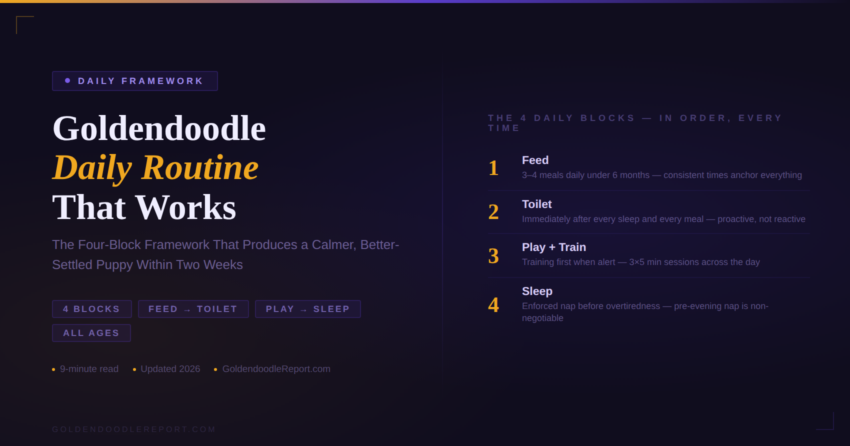
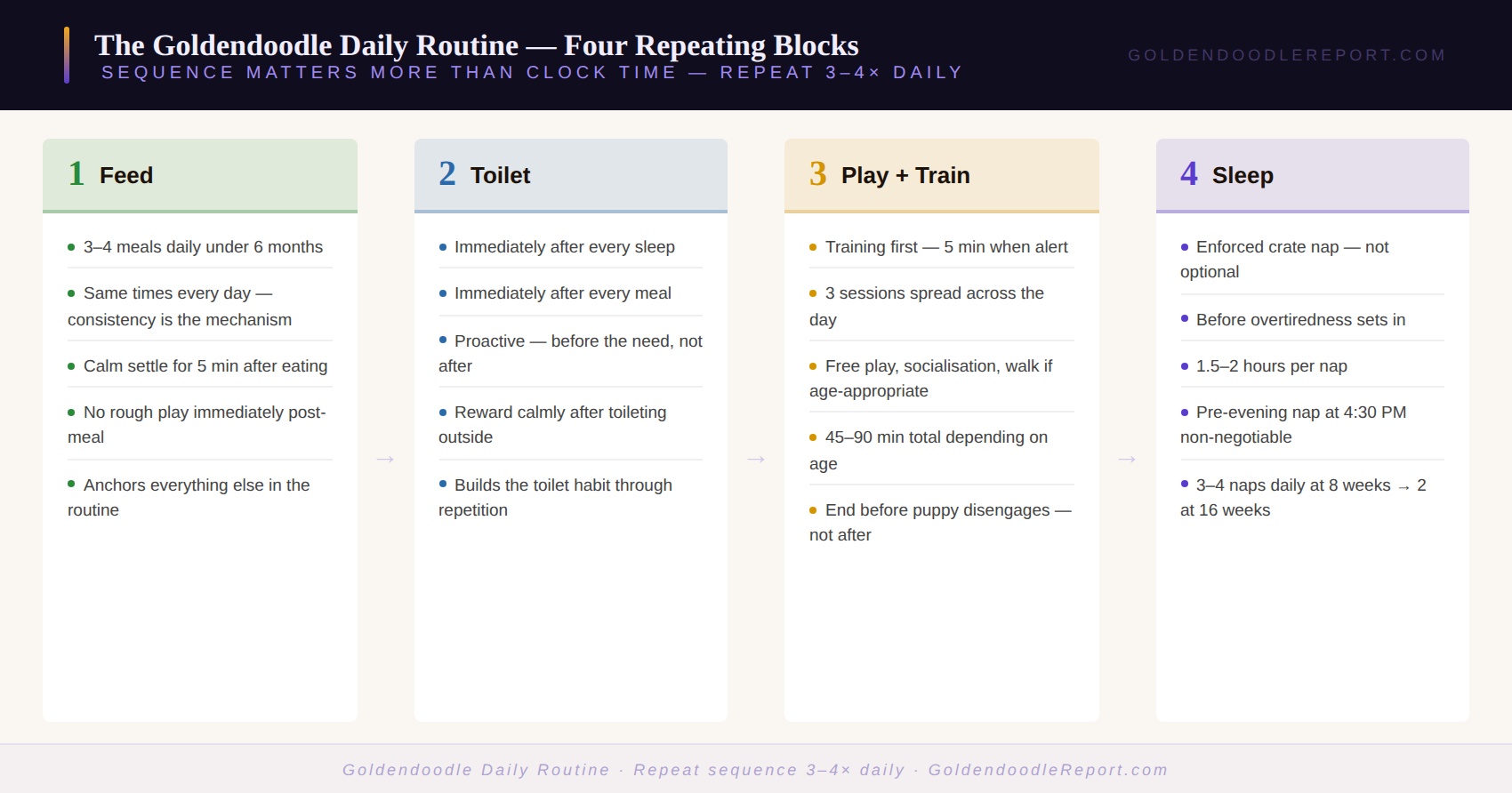
The goldendoodle daily routine that works follows four repeating blocks throughout the day: Feed → Toilet → Play and Train → Sleep. Each awake window lasts 60–120 minutes depending on age. Naps last 1–2 hours. Meals happen 3–4 times daily under 6 months. Toilet trips happen immediately after every sleep, every meal, and every play session. The routine repeats from morning to bedtime with the same sequence every day. Consistency of sequence matters more than consistency of clock time.
For age-specific hour-by-hour schedules see: Goldendoodle Puppy Routine by 8 Weeks, Goldendoodle Puppy Routine by 10 Weeks, Goldendoodle Puppy Routine by 12 Weeks, and Goldendoodle Puppy Routine by 16 Weeks. For the complete first-year guide see The Real Goldendoodle Puppy Guide.
🔍 Quick Diagnosis — What Is Going Wrong With Your Current Routine?
- Puppy bites hardest in the late afternoon and evening: The awake window is too long before the pre-evening nap. The puppy is overtired and the frantic biting is the symptom. Enforce an earlier nap — do not add exercise
- Toilet accidents happening despite frequent trips outside: Toilet trips are reactive rather than proactive. The routine should take the puppy out immediately after every sleep and every meal — not when accidents signal they need to go
- Puppy will not settle during the day: The sleep windows are inconsistent. A puppy who naps at different times each day cannot regulate their own energy — the routine provides the regulation that makes settling possible
- Puppy is hyperactive after meals: No calm settle time follows feeding. The routine should move from meal → toilet → short calm settle before play begins, not meal → immediate rough play
- Training is not sticking: Training sessions are too long or happening at the wrong point in the awake window. Short sessions at the beginning of an awake window — when the puppy is alert and before tiredness sets in — produce significantly better retention
📖 Real Scenario
Two owners bring home Goldendoodle puppies on the same day. Owner A follows a consistent daily routine from day one — four repeating blocks, meals at the same times, naps at the same times, toilet trips proactively after every sleep and meal. Owner B responds to the puppy’s cues — feeding when the puppy seems hungry, sleeping when the puppy crashes, taking outside when accidents suggest the need. By week four, Owner A reports the puppy settles reliably, has had no accidents in five days, and biting has reduced noticeably. Owner B reports the puppy is still unpredictable, accidents continue, and the biting if anything is worse. Same breed, same age, same week. The difference is the routine.
Why the Goldendoodle Daily Routine Works — The Developmental Reasoning
The reason a consistent goldendoodle daily routine produces such measurable results is not behavioural — it is neurological. A puppy’s prefrontal cortex, the brain region responsible for impulse control and emotional regulation, is not functionally mature until approximately 18 months. Until then, the puppy has limited ability to regulate their own energy, manage frustration, or settle independently without external structure.
A consistent daily routine provides the external regulation the puppy’s own brain cannot yet supply. When a puppy can predict what comes next — sleep follows play, food follows sleep, toilet follows food — their nervous system operates at a lower baseline stress level. This lower baseline produces better impulse control, faster learning, more reliable settling, and less reactivity. It is not a training effect — it is a neurological one. The routine creates the internal state that makes training and behaviour management significantly more effective.
The second mechanism is habit formation. Behaviours that happen at the same time in the same sequence every day become automatic for both the puppy and the owner. Toilet training works through this mechanism — a puppy taken outside after every sleep and every meal develops a toileting habit around those triggers, rather than toileting when the bladder demands it in whatever location is convenient. The routine creates the trigger. The habit forms around the trigger.
The Four Blocks of the Goldendoodle Daily Routine
Every effective goldendoodle daily routine — regardless of the specific times chosen or the age of the puppy — is built from four repeating blocks. Understanding what each block does and why it belongs in the sequence is what allows the routine to be adapted to any household without losing its effectiveness.
Block 1 — Feed
Meals anchor the daily routine. They happen at consistent times, they are predictable, and they trigger the physiological processes — digestion, bladder filling — that the toilet routine depends on. Puppies under 6 months need 3–4 meals per day spaced evenly through their waking hours. The consistency of meal timing is more important than the specific times chosen — a puppy fed at 7am, 12pm, 5pm, and 9pm learns to anticipate those times and the routine that follows them.
Meals should be calm, brief, and followed immediately by Block 2. Do not allow play or rough interaction immediately after feeding — the puppy needs 5–10 minutes of calm after a meal before the toilet trip and subsequent play. For the best feeding equipment see Best Puppy Food Bowls for Goldendoodles.
Block 2 — Toilet
The toilet block happens immediately after every sleep and every meal — without exception. Not when the puppy shows signals. Not when an accident suggests they need to go. Immediately after sleep and immediately after meals, every single time. This proactive approach is the foundation of reliable toilet training — the puppy is taken out before they need to go rather than after the urge has already produced an accident.
The toilet trip is not a play session. Go outside, wait for the puppy to toilet, reward immediately with calm praise and a treat, return inside. Keep it brief and purposeful. The play block follows — the puppy learns that toileting produces reward and then play, which is a powerful reinforcement of the toileting behaviour. See Goldendoodle Puppy Sleep Schedule for the sleep timing that determines toilet trip frequency.
Block 3 — Play and Train
The active block covers free play, structured play, training sessions, socialisation activities, and any outdoor walks within the age-appropriate exercise limit. This block lasts the majority of the awake window — 45–90 minutes depending on the puppy’s age and the total awake window length.
Training sessions belong at the beginning of this block — when the puppy is fresh and alert after sleeping and toileting, not at the end of the awake window when tiredness is setting in. Three short sessions of 3–5 minutes each distributed across the day produce significantly better results than one long session. Keep each session short enough to end while the puppy is still engaged — never push through disengagement. See Goldendoodle Puppy Socialisation Checklist for how socialisation activities fit into this block. For the right toys see Best Toys for Goldendoodle Puppies.
Block 4 — Sleep
The sleep block is not optional and it is not something the puppy self-selects when they feel like it. It is a scheduled, enforced rest period in the crate or designated sleep space. Puppies under 16 weeks need 16–18 hours of sleep per 24-hour period — far more than most owners expect, and far more than a puppy left to their own devices will take. An undertired puppy who has not had enough sleep is the source of most of the hard biting, frantic behaviour, and inability to settle that new owners report in the first months.
The crate is the most effective sleep location because it provides a consistent, low-stimulation environment that the puppy associates specifically with rest. A puppy who sleeps in a busy room on a dog bed, where household activity can interrupt the nap at any time, does not get the quality of rest that a crate nap provides. See Best Crate for Goldendoodle Puppies for crate sizing and setup. For sleep duration guidance by age see How Much Sleep Does a Goldendoodle Puppy Need?
The Adaptable Goldendoodle Daily Routine Framework
The framework below is the daily routine structure that works for Goldendoodle puppies from 8 weeks through to the end of the first year. The specific times shown are a starting point — they can be shifted earlier or later to fit your household schedule. What cannot be changed without losing effectiveness is the sequence and the proportions.
| Block | Example Time | Duration | What Happens | Why It Matters |
|---|---|---|---|---|
| Wake + Toilet | 6:30 AM | 5–10 min | Straight outside immediately on waking — before anything else | Bladder is full after night sleep — first trip of the day sets the toilet habit |
| Meal 1 + Toilet | 6:45 AM | 15 min | Feed calmly, 5 min calm settle, toilet trip | Meal triggers digestion — toilet trip catches the result |
| Play + Train | 7:05 AM | 45–75 min | Training session first (5 min), then free play, socialisation, walk if age-appropriate | Puppy is alert and fresh — best learning window of the morning |
| Toilet + Nap 1 | 8:00 AM | 1.5–2 hrs | Toilet trip, then into crate for nap before overtiredness sets in | Nap before the puppy becomes frantic — prevents the overtiredness biting cycle |
| Wake + Toilet | 10:00 AM | 5 min | Straight outside on waking from nap | Same trigger as morning — builds the toilet-after-sleep habit |
| Meal 2 + Play | 10:15 AM | 60–75 min | Feed, toilet, play + second training session mid-window | Second active window of the day — good for socialisation activities |
| Toilet + Nap 2 | 12:00 PM | 1.5–2 hrs | Toilet trip, then longest nap of the day | Midday nap — the longest and most important for young puppies |
| Wake + Meal 3 + Play | 2:00 PM | 60–90 min | Wake, toilet, feed, toilet again, afternoon play session and walk | Longest awake window of the day for older puppies |
| Pre-Evening Nap | 4:30 PM | 45–60 min | Short nap before evening family time | The most skipped and most important nap — prevents the classic evening biting frenzy |
| Evening + Meal 4 | 5:30 PM | 90–120 min | Family time, calm play, third training session, final meal, toilet | Calm engagement — not rough play — keeps arousal manageable before bedtime |
| Bedtime | 9:30 PM | Night | Final toilet trip, into crate, lights down, no interaction | Consistent bedtime routine signals that night is different from nap — builds night settling |
⚠️ The Most Skipped Part of the Goldendoodle Daily Routine
The pre-evening nap at around 4:30–5:00 PM is the block most owners skip and the one that most frequently causes the evening biting frenzy that new owners find most exhausting. By 4–5pm a puppy who has been awake and active since the afternoon nap is typically past their tiredness threshold. Without the pre-evening nap, they enter family evening time overtired, cortisol-elevated, and unable to regulate. The result is hard biting, inability to settle, and frantic behaviour that no amount of exercise or attention resolves. Enforce the pre-evening nap even when the puppy protests it. The evening will be measurably calmer.
The 5 Principles That Make the Goldendoodle Daily Routine Work
Principle 1 — Sequence matters more than clock time
The goldendoodle daily routine produces its results through the predictability of sequence — Feed follows Sleep, Play follows Toilet, Sleep follows Play — not through adherence to specific clock times. An owner who cannot maintain exact times but who maintains the sequence will see results. An owner who maintains exact times but regularly breaks the sequence will not. If your schedule means the routine runs an hour later on weekends, that is fine. If the sequence gets reversed — playing before the toilet trip, skipping a nap because the puppy seems fine — the predictability that produces the neurological benefit is lost.
Principle 2 — The nap must happen before overtiredness
The most common routine mistake is putting the puppy down for a nap after the frantic biting has already begun. By that point the puppy is overtired, cortisol-elevated, and will resist the crate strongly. The nap must happen before the overtiredness threshold — which means watching the awake window clock rather than waiting for behavioural signals. See Goldendoodle Puppy Sleep Schedule for the awake window lengths by age.
Principle 3 — Toilet trips are proactive, not reactive
Toilet training works through the routine, not through accident prevention. Every toilet trip is scheduled — after every sleep, after every meal, after every extended play session. The puppy is taken out before they need to go rather than when an accident signals they needed to go. Over 2–3 weeks of consistent proactive trips, the puppy develops a toileting habit anchored to the routine triggers. Reactive toilet training — responding to signals and accidents — produces slow, inconsistent results compared to the proactive routine approach.
Principle 4 — Consistency must be household-wide
The goldendoodle daily routine fails when only one person in the household follows it. A partner who skips naps, a child who triggers play during sleep windows, a family member who feeds outside the meal schedule — any inconsistency from any household member undermines the predictability that produces results. The routine needs to be understood and followed by everyone who interacts with the puppy. This is worth a brief household conversation before the puppy arrives home.
Principle 5 — The routine adapts as the puppy ages
The goldendoodle daily routine is not static. As the puppy grows, awake windows lengthen, nap frequency reduces, meal frequency reduces, and exercise duration increases. The sequence stays the same — the proportions change. An 8-week puppy needs 3–4 naps per day with 60-minute awake windows. A 16-week puppy needs 2 naps per day with 90–120 minute awake windows. A 6-month puppy may manage on one midday rest. The framework adapts — the principles do not change.
How the Goldendoodle Daily Routine Evolves From 8 Weeks to 12 Months
| Age | Awake Window | Daily Naps | Daily Meals | Max Walk |
|---|---|---|---|---|
| 8 weeks | 45–60 min | 3–4 naps | 4 meals | 10 min ×2 |
| 10 weeks | 60–75 min | 3 naps | 4 meals | 12 min ×2 |
| 12 weeks | 75–90 min | 2–3 naps | 3–4 meals | 15 min ×2 |
| 16 weeks | 90–120 min | 2 naps | 3 meals | 20 min ×2 |
| 6 months | 2–3 hours | 1–2 naps | 2–3 meals | 30 min ×2 |
| 12 months | 4–6 hours | 0–1 rest | 2 meals | 45–60 min ×2 |
For the detailed hour-by-hour schedule at each stage see the age-specific routine guides: 8 weeks, 10 weeks, 12 weeks, 16 weeks.
For authoritative guidance on puppy development and daily care requirements see the AVMA puppy care guidance.
Your Action Plan — Setting Up the Goldendoodle Daily Routine
- Choose your anchor times today. Decide when the first meal of the day will be. Everything else follows from this single decision — the rest of the routine builds around the first meal time. Write it down. Tell everyone in the household.
- Map out the four blocks from the first meal. Feed → Toilet → Play/Train → Sleep. Set approximate times for each. They do not need to be exact — they need to be consistent within 30 minutes each day.
- Identify the pre-evening nap time. Look at what time your puppy currently starts showing hard biting or frantic behaviour in the evening. The nap should begin 30 minutes before that point. This single addition resolves the most common evening behaviour problem immediately.
- Set up the crate for sleep. Every nap and night sleep happens in the same location. The crate is not a punishment — it is the sleep block location. Consistency of location reinforces the sleep association. See Goldendoodle Puppy First Night at Home for crate setup.
- Run the routine for 7 consecutive days without exception. The routine does not produce results on day two. It produces results by day seven, and noticeable results by day fourteen. One week of complete consistency is the minimum investment before assessing whether it is working.
- Adjust the times as the puppy grows. Every 3–4 weeks, review the awake window length. If the puppy is showing overtiredness signs before the scheduled nap, shorten the window. If the puppy is resisting the nap without overtiredness signs, extend the window. The table above gives the approximate ranges by age.
✅ Your Next Step
Choose your first meal time today and map the four blocks from it. Write them down. Share them with everyone in the household. Run the routine without exception for seven days. The goldendoodle daily routine is not a rigid timetable — it is a predictable sequence that your puppy’s developing brain can rely on. That predictability is what produces the calmer, more settled puppy that most new owners are not seeing yet because they are still responding to the puppy’s cues rather than leading with structure. For the full first-year guide see The Real Goldendoodle Puppy Guide.
🔑 Key Takeaways
- A consistent goldendoodle daily routine is the most effective tool available to a new owner — more effective than any training method because it creates the internal state that makes training work
- The routine is built from four repeating blocks: Feed → Toilet → Play and Train → Sleep. Sequence matters more than specific clock times
- The pre-evening nap is the most skipped and most important block — enforcing it at 4:30–5:00 PM resolves the classic evening biting frenzy that most new owners experience
- Toilet trips must be proactive — immediately after every sleep and every meal — not reactive. Proactive trips produce reliable toilet training. Reactive trips produce slow, inconsistent results
- The routine must be followed by every person in the household. One person skipping naps or feeding outside schedule times is enough to undermine the predictability that produces results
- The routine adapts as the puppy ages — awake windows lengthen, nap frequency reduces, meal frequency reduces. The sequence stays the same. The proportions change
📚 Continue Learning
- Goldendoodle Puppy Routine by 8 Weeks — exact hour-by-hour schedule for the first weeks home
- Goldendoodle Puppy Routine by 10 Weeks — the schedule as the awake windows begin to extend
- Goldendoodle Puppy Routine by 12 Weeks — transition to 2–3 naps per day
- Goldendoodle Puppy Routine by 16 Weeks — adolescence begins, 2 naps, 3 training sessions
- Goldendoodle Puppy Sleep Schedule — sleep duration and nap timing by age in full
- How Much Sleep Does a Goldendoodle Puppy Need? — why puppies need far more sleep than most owners expect
- Goldendoodle Puppy Exercise Mistakes — why exercise is not the answer to puppy energy
- Goldendoodle Puppy First Night at Home — the crate setup and first night routine
- New Goldendoodle Puppy Mistakes to Avoid — why abandoning the routine is the most common mistake
↑ Back to: The Real Goldendoodle Puppy Guide — From Pickup Day to the End of Year One | Goldendoodle Puppy Guide — All Articles
Frequently Asked Questions
What does a good goldendoodle daily routine look like?
A good goldendoodle daily routine is built from four repeating blocks throughout the day: Feed, Toilet, Play and Train, then Sleep. This sequence repeats 3–4 times per day depending on the puppy’s age. Each awake window lasts 60–120 minutes, followed by a nap of 1.5–2 hours in the crate. Meals happen 3–4 times daily for puppies under 6 months. Toilet trips happen immediately after every sleep and every meal without exception. The specific times can be adjusted to fit any household — the sequence and consistency are what matter.
How many times a day should a Goldendoodle puppy eat?
A Goldendoodle puppy under 6 months should eat 3–4 times per day, spaced evenly through their waking hours. Consistent meal times anchor the daily routine and trigger the toilet habits that make toilet training reliable. From 6 months most puppies transition to 3 meals per day, and from 12 months to 2 meals per day. Always check feeding quantities on the specific food packaging or with your vet — quantities vary significantly between food types and puppy sizes.
How often should I take my Goldendoodle puppy outside to toilet?
A Goldendoodle puppy should be taken outside to toilet immediately after every sleep, immediately after every meal, and after every extended play session. This proactive approach — taking the puppy out before they need to go rather than responding to signals or accidents — is the foundation of reliable toilet training. Young puppies under 12 weeks may also need an additional trip every 45–60 minutes during awake windows. See Goldendoodle Puppy Sleep Schedule for the sleep timing that determines toilet trip frequency.
Why is my Goldendoodle puppy so hyper in the evenings?
Evening hyperactivity and hard biting in Goldendoodle puppies is almost always caused by overtiredness rather than under-exercise. The most common cause is a missing pre-evening nap at around 4:30–5:00 PM. A puppy who has been awake since an afternoon nap and enters family evening time without rest is past their tiredness threshold — the result is cortisol-elevated frantic behaviour that exercise makes worse, not better. Enforce the pre-evening nap even when the puppy protests it. The evening will be measurably calmer within 2–3 days of consistent enforcement.
How long should a Goldendoodle puppy’s daily routine take to show results?
A consistent goldendoodle daily routine produces noticeable results within 7–14 days of complete, unbroken application. The first signs are typically faster toilet training progress and more predictable settling at nap times. By week two, most owners report measurably less hard biting and more reliable evening settling. The routine does not produce results when applied most of the time — it produces results when applied without exception by every person in the household, every day, for at least one full week before assessment.
What happens if I miss a nap in the goldendoodle daily routine?
Missing one nap occasionally has limited lasting impact if the routine is otherwise consistent. Missing naps regularly — or allowing the puppy to skip naps when they seem reluctant — produces an accumulated sleep debt that manifests as harder biting, more frantic behaviour, and more difficult settling over the following days. The puppy’s resistance to a nap is not a signal that they do not need it — it is often the opposite. Overtired puppies frequently resist sleep actively. Enforce the nap calmly and consistently regardless of the puppy’s protest.
Disclaimer: The information in this article is provided for general educational purposes only. King James Adjei is a researcher and enthusiast, not a veterinarian or certified behaviourist. For health concerns, symptoms, or behaviour issues that may indicate a medical or welfare problem, always consult a qualified veterinarian or certified professional.