5-minute read | Last updated March 2026 | Reviewed for accuracy
By King James Adjei | GoldendoodleReport.com
Researcher, Goldendoodle enthusiast, and founder of GoldendoodleReport. Every guide on this site is written to give owners reliable, clearly organised information — researched carefully and updated regularly.
The best harness for Goldendoodle puppies is not the same product at 8 weeks as it is at 6 months — and it is never a collar. Three harness types serve different developmental stages, the harness that suits a new puppy does not suit an adolescent puller, and Goldendoodles grow fast enough that the replacement schedule matters as much as the initial choice.
Who This Guide Is For
This article is most useful if you:
- Are buying a harness before the first walks and want the right type for your puppy’s age
- Have been using a collar and want to understand whether to switch to a harness
- Have a Goldendoodle starting to pull and want to know whether a different harness type is appropriate
- Want to know how often to check the harness fit as the puppy grows
For safe exercise limits at each age, see Goldendoodle Puppy Exercise Mistakes.
Quick Summary
The best harness for Goldendoodle puppies from 8 weeks to approximately 5 months is a back-clip harness — lightweight, simple to fit, and appropriate for a puppy still learning to walk on lead. From 5 to 6 months when adolescent pulling begins, a front-clip harness becomes the more effective choice. Never use a collar as the primary lead attachment for a puppy — the trachea and cervical vertebrae are not fully developed and collar pressure from pulling applies dangerous compressive force to both structures. A harness check every two weeks is appropriate during the rapid growth phase from 8 to 20 weeks.
Quick Answer
Buy a back-clip harness in XS for an 8-week puppy. Check the fit weekly for the first three months — Goldendoodle puppies grow fast enough to outgrow a harness in four to six weeks. Add the collar for ID tag only — never attach the lead to the collar. Transition to a front-clip harness at 5 to 6 months when pulling behaviour begins. Measure girth (chest circumference just behind the front legs) when buying and when checking fit.
Quick Diagnosis
- If the puppy is slipping out of the harness → harness is too large or the wrong design — check the two-finger rule and measure girth correctly
- If the puppy is coughing or gagging during walks → lead is attached to collar not harness — switch to harness attachment immediately
- If the puppy is pulling strongly and the back-clip harness is making it worse → transition to front-clip harness — back-clip can encourage forward pulling in strong dogs
- If the harness is leaving marks or rubbing on the armpits → harness is too tight or the wrong shape for the dog’s build — try a different brand or Y-front design
You put a collar on your 10-week Goldendoodle because that is what you had from a previous dog. On the third walk the puppy spots a squirrel and lunges hard on the lead. You feel the collar pull tight against its throat. The puppy coughs and continues. You think nothing of it. At the vet six weeks later you mention the occasional coughing on walks. The vet finds early tracheal irritation consistent with repeated collar pressure. The collar worked as an ID holder. It was never safe as a lead attachment for a puppy.
The collar and harness question is not a matter of preference — it is a safety question with a clear answer for puppies. After that is established, the harness type question is a developmental stage question with an equally clear answer. Both decisions are straightforward once the mechanism is understood.
This guide covers:
- Why collars are inappropriate for puppy lead work — the trachea and cervical spine mechanism
- The three harness types and which developmental stage each suits
- The Goldendoodle growth rate problem and how often to replace
- How to measure correctly and apply the two-finger fit rule
- Features that matter vs features that are marketing
In This Guide
- Best Harness for Goldendoodle Puppies: Why Not a Collar
- The Three Harness Types by Developmental Stage
- The Growth Rate Problem — How Often to Replace
- How to Measure Correctly and Apply the Two-Finger Rule
- Features That Matter vs Features That Are Marketing
- What Most Owners Get Wrong
- Frequently Asked Questions
Best Harness for Goldendoodle Puppies: Why Not a Collar
The trachea in a puppy is a cartilaginous tube — supported by rings of cartilage that provide structure but are significantly softer and more compressible than in an adult dog. The cervical vertebrae — the bones of the neck — are surrounded by muscles and ligaments that are still developing their full strength and density during the first year of life. When a lead is attached to a collar and the puppy pulls, lunges, or is suddenly restrained, the collar applies direct compressive and shear force to both structures simultaneously.
In an adult dog with mature cartilage and strong cervical musculature, this force is absorbed with minimal consequence. In a puppy, the same force applies to tissue that is not yet capable of absorbing it safely. For guidance on the anatomy involved and the specific risks of collar use in young dogs, the American Kennel Club’s guide on harnesses vs collars covers the relevant safety considerations.
The consequences are not always immediate or visible. A single lunge on a collar does not fracture a cervical vertebra. The damage is cumulative — repeated collar pressure produces tracheal irritation, which presents as a chronic cough that owners attribute to other causes, and cervical muscle strain that presents as occasional reluctance to lower the head, mild stiffness, or a head tilt that normalises between episodes. By the time these signs are assessed by a vet, the connection to collar use is rarely made because the incidents of collar pressure were minor and numerous rather than dramatic and singular.
The collar has one appropriate function for a puppy: holding the ID tag. It should remain on the puppy at all times for identification. The lead should never be attached to it.
The Three Harness Types by Developmental Stage
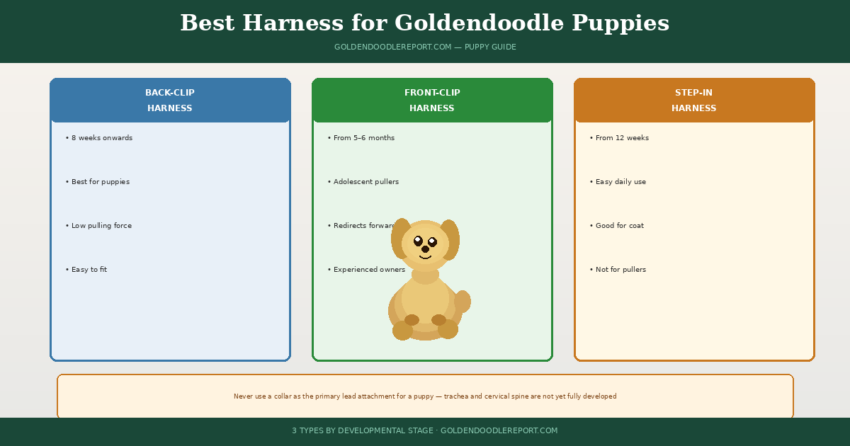
Best Harness for Goldendoodle Puppies — Three Types by Stage
| Type | Best Stage | How It Works | Advantages | Limitations |
|---|---|---|---|---|
| Back-clip | 8 weeks to 5 months — puppy learning to walk on lead | Lead attaches to a D-ring on the back between the shoulder blades. No pressure redirected toward the body when the dog pulls forward. | Simple to fit. Comfortable for puppies. Does not restrict natural gait. Easy on and off. | Can encourage forward pulling in dogs that learn to lean into the harness. Not effective for strong adolescent pullers. |
| Front-clip | 5 months onwards — adolescent pullers | Lead attaches to a ring on the chest. When the dog pulls forward the lead redirects the dog’s body toward the owner rather than allowing forward momentum. | Significantly reduces effective pulling force. Supports loose-lead walking training. No aversive pressure. | Lead can tangle under the legs if the dog changes direction quickly. Requires some owner experience to manage correctly. |
| Step-in | 12 weeks onwards — daily use where easy fitting is a priority | Dog steps both front feet into two loops, which are then clipped together at the back. Back-clip lead attachment. | Extremely quick to put on. Minimal coat snagging. Comfortable for curly-coated dogs. Good for dogs that resist overhead harness fitting. | Easier for dogs to back out of than over-the-head designs. Not appropriate as the sole harness for a strong puller. |
Many owners use two harnesses simultaneously — a step-in for daily easy fitting during the puppy stage, and a front-clip for training walks where loose-lead work is the priority. This is a practical approach that uses each harness type for its specific strength rather than expecting one product to serve both functions.
The Growth Rate Problem — How Often to Replace
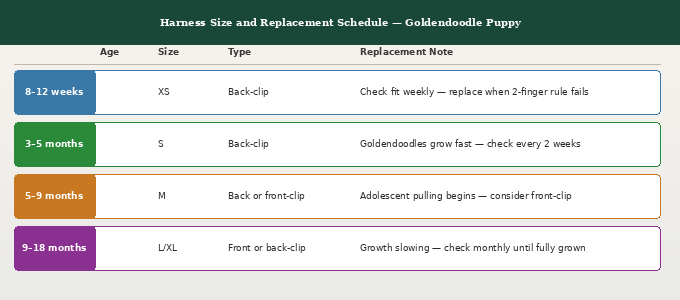
Goldendoodle puppies grow faster than most owners anticipate. A Standard Goldendoodle puppy at 8 weeks weighs approximately 4 to 5 kg. By 16 weeks it weighs 10 to 14 kg. By 6 months it weighs 18 to 25 kg. The chest girth — the measurement that determines harness fit — increases proportionally. A harness that fit correctly at 8 weeks is too small at 12 weeks in many cases. A harness bought at 10 weeks for a Standard Goldendoodle may be outgrown before it has been worn a dozen times.
The replacement schedule should be based on the two-finger fit rule rather than a fixed time interval — because individual growth rates vary significantly even within the same size category. Check the fit every two weeks from 8 to 20 weeks, and every four weeks from 20 weeks to 9 months. The two-finger rule: slide two fingers flat under the harness at any point on the body. If you cannot fit two fingers — too tight, replace immediately. If you can fit three fingers or more — too loose, adjust or replace.
The practical implication is a budget consideration. From 8 weeks to 6 months, budget for two to three harness replacements for a Standard Goldendoodle and one to two for a Mini. Buying inexpensive, functional harnesses during the rapid growth phase and investing in a higher quality harness once growth has slowed is the sensible approach — the same logic as the crate insert bed during the puppy stage.
How to Measure Correctly and Apply the Two-Finger Rule
The correct measurement for harness sizing is girth — chest circumference measured just behind the front legs. This is not the neck circumference or the widest chest width — it is the circumference of the body at the narrowest point of the chest just behind the armpits. Measure with a soft tape measure with the dog standing naturally, neither inhaling nor tense.
Harness size charts vary significantly between manufacturers. An XS in one brand may correspond to an S in another. Always buy based on the measured girth against the specific brand’s size chart rather than assuming a size label translates consistently between products.
Applying the two-finger rule at each harness point:
Check the girth strap (the band running behind the front legs), the chest strap (if present), and the back strap (running from chest to back). At each point, slide two fingers flat — not bunched together — under the strap. Two fingers flat should slide through with mild resistance. This is the correct fit. One finger or no fingers indicates too tight. Three fingers or more indicates too loose. Both conditions require adjustment or replacement — too tight restricts movement and causes chafing, too loose allows escape and provides inadequate control.
Features That Matter vs Features That Are Marketing
Features that genuinely matter: a padded chest panel (prevents chafing under the front legs — particularly important for curly-coated Goldendoodles where coat can bunch under harness straps), two points of adjustment minimum (girth and chest — one-point harnesses cannot be fine-tuned to individual body shapes), a secure buckle mechanism that requires deliberate pressure to release (puppies learn to manipulate simple buckles), and a handle on the back (useful for guidance near traffic and for lifting the puppy when needed).
Features that are primarily marketing: reflective stitching described as a safety feature (useful at night but irrelevant to harness function during daylight walks — not a reason to choose one harness over another), “anti-escape” claims on standard back-clip designs without specific structural evidence (genuine escape-proof harnesses have a specific design that prevents backing out — a claim alone is not confirmation), and machine washability described as premium (all fabric harnesses should be washable — this is a baseline expectation, not a selling point).
Action Plan — Buying and Fitting the Right Harness
- Measure girth before buying — do not estimate. Measure just behind the front legs with a soft tape measure. Find the measurement in the specific brand’s size chart. Do not carry over a size label from another brand.
- Buy a back-clip harness for 8 weeks to 5 months. Choose a padded chest panel design with two adjustment points. Budget for inexpensive options at this stage — it will be replaced in four to six weeks.
- Keep the collar on at all times for ID — never attach the lead to it. The collar is identification hardware only. The lead attaches to the harness D-ring exclusively.
- Check fit every two weeks from 8 to 20 weeks. Apply the two-finger rule at the girth strap, chest strap, and back strap. Replace as soon as two fingers no longer slide through with mild resistance.
- Transition to a front-clip harness at 5 to 6 months. When the puppy’s pulling force is strong enough to make back-clip walking a consistent challenge, the front-clip harness is the appropriate transition. Introduce it on a familiar walk — not a new environment where the puppy is already over-stimulated.
- Invest in a quality harness from 9 months when growth has slowed. By 9 months a Goldendoodle’s chest girth is approximately 80 to 90 percent of adult size. A quality harness bought at this stage with the maximum adjustment range will accommodate the remaining growth and last for years.
What to Expect
Timeline: A correctly fitted back-clip harness on a puppy produces immediate improvement over collar use. The front-clip transition at 5 to 6 months reduces effective pulling force within the first two to three walks as the puppy learns the redirection mechanism. Full loose-lead walking proficiency is a training outcome — the harness supports training but does not replace it.
Friction: Fitting a harness on a wriggly puppy for the first time is physically challenging. Practice at home before the first walk — put the harness on, take it off, put it on again — with treats throughout each fitting. A puppy that has had the harness put on twenty times at home is significantly easier to harness at the front door than one experiencing it for the first time under time pressure.
Signs the fit is correct: Two fingers slide under every strap with mild resistance. The harness does not shift sideways during movement. No rubbing marks or hair loss under the armpits after the first few walks.
Your Next Step
Measure girth today and order a back-clip harness in the correct size from the brand’s size chart. If the puppy is already wearing a collar on walks — switch to harness lead attachment from the very next walk. The collar stays on for ID. The lead moves to the harness.
What Most Owners Get Wrong
Mistake 1 — Using the collar as the lead attachment for puppy walks. The collar is appropriate for ID tags and for adult dogs that walk calmly with a loose lead. It is not appropriate as the lead attachment for a puppy that will inevitably lunge, pull, and test the lead. The tracheal and cervical consequences are cumulative and invisible until they are not — and by the time tracheal irritation is identified by a vet, the cumulative pressure history is months long.
Mistake 2 — Keeping the same harness too long because the buckle still closes. A harness that is too tight continues to buckle — the fit problem is at the strap tension, not the buckle mechanism. Owners who check fit by whether the harness goes on rather than by the two-finger rule are frequently using a harness that has been too tight for weeks. Check the strap tension at every wearing during the rapid growth phase, not just at purchase.
Mistake 3 — Introducing the front-clip harness too early. The front-clip harness requires the owner to manage lead direction more actively than the back-clip design, because the lead can travel under the dog’s legs when direction changes. On a young puppy still learning to walk on lead, this adds complexity to a process that should be kept as simple as possible. Start with back-clip and transition to front-clip when the developmental need — meaningful pulling force — actually exists, not before.
Signs Your Harness Setup Is Working
- No coughing, gagging, or throat-clearing during or after walks
- No rubbing marks or coat thinning under the armpits after repeated harness use
- Harness does not shift sideways during normal walking movement
- Puppy accepts harness fitting without prolonged resistance after the first week of practice
⚠️ Watch Out
A harness that fits correctly this week may be too small next week during the 8 to 20 week growth phase. The most common harness-related injury in young puppies is chafing from a harness that has become too tight between checks. Set a calendar reminder every two weeks during this period. The check takes thirty seconds and prevents weeks of skin irritation.
Contact Your Vet If
- The puppy is coughing consistently during or after walks — tracheal irritation from lead pressure warrants assessment
- Skin sores, raw patches, or significant hair loss appear under the armpits or at any harness contact point
- The puppy shows reluctance to lower its head, neck stiffness, or a persistent head tilt — these can indicate cervical strain from collar use
Key Takeaways — Best Harness for Goldendoodle Puppies
- Never attach a lead to a puppy’s collar — the trachea and cervical vertebrae are not yet developed enough to safely absorb collar pressure from pulling or lunging
- Start with a back-clip harness from 8 weeks — simple, comfortable, appropriate for a puppy learning to walk on lead
- Transition to a front-clip harness at 5 to 6 months when adolescent pulling force makes back-clip management difficult
- Check harness fit every two weeks from 8 to 20 weeks using the two-finger rule at every strap — not just by whether the buckle closes
- Goldendoodle puppies outgrow harnesses in four to six weeks during the rapid growth phase — budget for two to three replacements before 6 months
- Invest in a quality harness from 9 months when growth has slowed and the harness will last for years
Related Goldendoodle Puppy Guides
- Goldendoodle Puppy Exercise Mistakes — Safe exercise limits that the harness supports — not all exercise is appropriate at all ages
- Goldendoodle Exercise Needs by Age — How long to walk at each age once the harness is fitted
- When Can a Goldendoodle Puppy Go Outside? — Vaccination context for when harness walks on public ground begin
- Goldendoodle Puppy Care Guide — Complete first-year equipment overview
- Goldendoodle Daily Routine — How walk timing integrates with the daily routine
Part of the Goldendoodle Puppy Guide resource hub:
→ Goldendoodle Puppy Guide — Browse all 40 puppy guides
Frequently Asked Questions
Should a Goldendoodle puppy wear a collar or harness?
Both — but for different functions. The collar stays on at all times for ID tag purposes. The harness is used for all lead attachment during walks. Never attach a lead to the collar of a puppy — the trachea and cervical vertebrae are not yet developed enough to safely absorb the compressive force from pulling or sudden restraint. The harness distributes lead force across the chest and back rather than concentrating it at the throat.
What size harness does a Goldendoodle puppy need?
Measure girth — the chest circumference just behind the front legs — and match to the specific brand’s size chart. At 8 weeks most Goldendoodle puppies require XS. By 12 to 16 weeks many Minis are in S and Standards in S to M. Do not carry over size labels between brands — size charts vary significantly. Measure before each replacement during the rapid growth phase rather than estimating based on the previous harness size.
When should I switch from a back-clip to a front-clip harness?
When the puppy’s pulling force makes back-clip walking consistently difficult to manage — typically at 5 to 6 months as adolescent energy and forward drive increase. Do not introduce the front-clip harness on a young puppy still learning to walk on lead — the back-clip is simpler and more appropriate at that stage. The front-clip is a tool for managing existing pulling behaviour, not for preventing it from developing in the first place.
How do I stop my Goldendoodle puppy from slipping out of its harness?
A puppy that slips out of a harness is typically in one that is too large, the wrong design, or both. Check the two-finger rule at every strap — three fingers or more at any point indicates too loose. If the harness fits correctly and the puppy is still backing out, the design may not include a chest strap that prevents the rearward escape movement. Y-front harnesses with a chest strap that runs between the front legs are significantly harder to back out of than H-frame designs that have no front connection between the two shoulder straps.
Is a no-pull harness appropriate for a Goldendoodle puppy?
The term “no-pull harness” typically refers to a front-clip design that redirects forward momentum toward the owner. This is appropriate from 5 to 6 months when meaningful pulling behaviour begins. It is not appropriate from 8 weeks — the mechanical action of a front-clip harness during the loose-lead learning phase adds complexity without providing the corresponding benefit. The pulling force at 8 to 12 weeks is not significant enough to require a no-pull mechanism — the back-clip harness is the correct choice at that stage.
The information in this article is provided for general educational purposes only. King James Adjei is a researcher and enthusiast, not a veterinarian. For concerns about tracheal irritation, neck stiffness, or harness-related skin issues, always consult a qualified veterinarian.