5-minute read | Last updated March 2026 | Reviewed for accuracy
By King James Adjei | GoldendoodleReport.com
Researcher, Goldendoodle enthusiast, and founder of GoldendoodleReport. Every guide on this site is written to give owners reliable, clearly organised information — researched carefully and updated regularly.
The best puppy food bowls for Goldendoodles are not all-purpose bowl recommendations — they are breed-specific choices that address three problems the Goldendoodle’s anatomy and eating behaviour create. The wrong bowl actively contributes to bloat risk, ear infections, and chronic bacterial exposure. The right set of bowls eliminates all three with a total investment of under twenty pounds.
Who This Guide Is For
This article is most useful if you:
- Are buying bowls before the puppy arrives and want the right specification from day one
- Have noticed the puppy eating extremely fast and want to understand the risk this creates
- Have a Goldendoodle with recurring ear infections and suspect the bowl may be contributing
- Are currently using plastic bowls and want to know whether to switch
For the feeding schedule these bowls serve, see Goldendoodle Puppy Feeding Guide.
Quick Summary
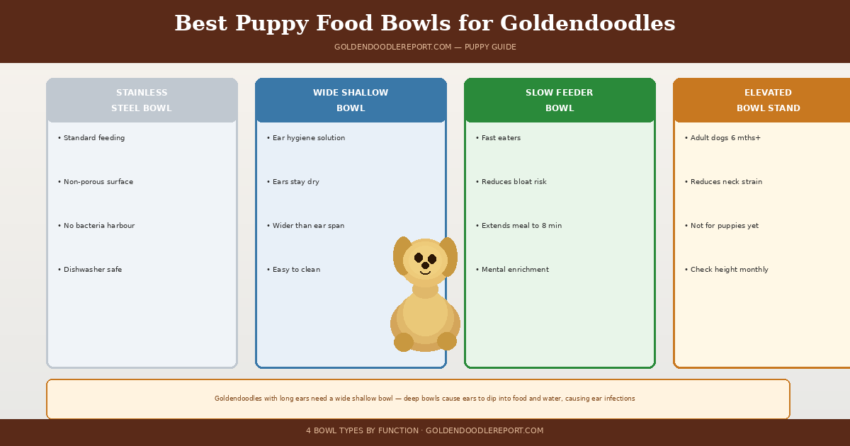
The best puppy food bowls for Goldendoodles are: a stainless steel wide-shallow bowl for daily feeding (addresses ear hygiene and bacterial exposure simultaneously), and a slow feeder bowl for any puppy eating a meal in under two minutes. Water bowls should also be wide and shallow. Plastic bowls harbour bacteria in microscopic surface scratches and are associated with canine acne — replace any plastic bowls currently in use. Elevated bowl stands are not appropriate for puppies and should not be introduced before 6 months.
Quick Answer
Buy two stainless steel wide-shallow bowls — one for food, one for water. If the puppy eats a full meal in under two minutes, add a slow feeder bowl and use it for every meal from that point. These three purchases cost under twenty pounds and address the three main bowl-related health risks for Goldendoodles. Do not buy elevated stands, plastic bowls, or ceramic bowls with glazed interiors.
Quick Diagnosis
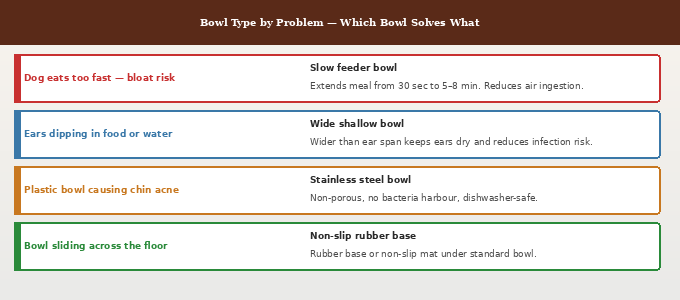
- If the puppy finishes a meal in under 60 seconds → fast eating, bloat risk elevated, introduce slow feeder immediately
- If the puppy has recurring ear infections despite regular cleaning → check bowl depth — ears may be dipping in water or food during every meal
- If pink or red spots appear on the chin or muzzle → canine acne from plastic bowl bacteria, switch to stainless steel immediately
- If the bowl slides across the floor during every meal → add a non-slip mat or replace with a bowl that has a rubber base
Your Goldendoodle has had three ear infections in five months. Your vet has treated each one and recommended regular ear cleaning, which you do. The infections keep returning. At the fifth appointment you mention that the dog eats and drinks from deep round bowls at floor level. The vet asks you to measure the bowl depth against the length of the dog’s ear. The ear hangs into the bowl at every meal. Every drink of water is coating the inner ear flap in moisture. The bowl is not the only cause — but it is the daily one nobody had flagged.
A food bowl for a Goldendoodle is not a neutral piece of equipment. The breed’s anatomy — long floppy ears, deep chest, high food motivation, and fast eating tendency — makes several standard bowl features active contributors to health problems that cost significantly more to treat than the correct bowl costs to buy. Understanding which problems the right bowl prevents is what makes the buying decision simple.
This guide covers:
- The bloat risk from fast eating and which bowl design addresses it
- The ear hygiene problem specific to Goldendoodles and long-eared breeds
- Why material matters — stainless steel as a health decision
- What to avoid and why
- The complete bowl set for a Goldendoodle puppy
In This Guide
- Best Puppy Food Bowls for Goldendoodles: The Bloat Risk and Fast Eating
- The Ear Hygiene Problem — Why Bowl Depth Matters for Goldendoodles
- Material Matters — Stainless Steel as a Health Decision
- What to Avoid and Why
- The Complete Bowl Set for a Goldendoodle Puppy
- What Most Owners Get Wrong
- Frequently Asked Questions
Best Puppy Food Bowls for Goldendoodles: The Bloat Risk and Fast Eating
Bloat — clinically known as Gastric Dilatation-Volvulus or GDV — is a life-threatening condition in which the stomach fills with gas and, in severe cases, twists on itself. It is the second most common cause of death in large and deep-chested dog breeds, and Goldendoodles — particularly Standards with their deep chest cavity — carry an elevated baseline risk.
Fast eating is one of the most consistently identified contributing factors: a dog that eats an entire meal in thirty to sixty seconds ingests large quantities of air simultaneously with food. That air, trapped in a stomach that has just received a full meal volume, is the initiating condition for bloat. For a thorough overview of bloat risk factors and prevention in large breeds, the American Kennel Club’s guide to dog bloat covers the mechanism and risk factors clearly.
The slow feeder bowl addresses this directly by making rapid eating physically impossible. The bowl’s internal ridges, spirals, or maze structures require the dog to work around obstacles to reach the food. A meal that takes thirty seconds to eat from a standard bowl takes five to eight minutes from a slow feeder. The air ingestion that occurs with rapid, unobstructed eating is eliminated when the dog must pause, adjust position, and navigate obstacles between each mouthful.
The test for whether a slow feeder is necessary is straightforward: time the puppy eating a full meal from a standard bowl. If the meal is finished in under two minutes — introduce a slow feeder immediately and use it for every subsequent meal. If the meal takes two minutes or more — the puppy’s natural eating pace is adequate and a slow feeder is optional enrichment rather than a health necessity. Most Goldendoodle puppies, with their Golden Retriever food motivation, finish meals in under sixty seconds. The slow feeder is standard rather than optional for this breed.
The Ear Hygiene Problem — Why Bowl Depth Matters for Goldendoodles
The Goldendoodle’s ear anatomy — long, floppy ear flaps that hang below the jaw line — means that any bowl deep enough for the ear tip to reach the bottom creates a repeated moisture exposure event at every meal and drink. The inner surface of a hanging ear flap is warm, poorly ventilated, and when repeatedly wetted with food or water becomes an ideal environment for the bacterial and yeast growth that causes otitis externa — outer ear infection.
This is not a theoretical risk. It is the mechanism behind a significant proportion of Goldendoodle ear infections that owners attribute to swimming, grooming, or genetics — while the daily bowl exposure continues unaddressed. The correction is a bowl wide enough and shallow enough that the ear tip does not reach the bowl surface when the dog’s nose is at the centre of the bowl during eating and drinking.
The practical measurement: measure from the dog’s nose tip to the point where the ear flap hangs when the head is lowered naturally. The bowl depth should be less than this measurement. For most adult Goldendoodles this means a bowl no deeper than 6 to 8 cm. Wide-shallow stainless steel bowls in the 22 to 28 cm diameter range achieve this — wide enough to hold adequate food volume, shallow enough to keep ears clear of the surface.
Material Matters — Stainless Steel as a Health Decision
Bowl Material Comparison — Goldendoodle Puppies
| Material | Suitable for Puppies? | Key Properties | Health Considerations |
|---|---|---|---|
| Stainless steel | ✓ Best choice | Non-porous surface — no microscopic scratches to harbour bacteria. Dishwasher safe. Durable. Does not leach chemicals. | No known health risks. Consistent surface integrity throughout the bowl’s lifespan. |
| Ceramic (food-grade glaze) | ~ Acceptable if undamaged | Heavy — stays in place. Easy to clean while glaze is intact. | Cracked or chipped glaze exposes porous ceramic underneath, which harbours bacteria. Replace immediately if damaged. |
| Plastic | ✗ Not recommended | Lightweight. Inexpensive. Available everywhere. | Develops microscopic surface scratches from normal use that harbour bacteria and biofilm. Associated with canine acne (chin folliculitis) in dogs with sensitive skin. |
| Melamine | ✗ Avoid | Looks like ceramic. Sold widely. | Can leach melamine compounds into food particularly with hot food or scratching. Not appropriate for animal feeding bowls. |
The stainless steel recommendation is not aesthetic preference — it is a surface integrity decision. Plastic bowls develop microscopic scratches within weeks of normal use that are invisible to the eye but create a surface area where bacteria and biofilm accumulate between washes. A plastic bowl washed and visually inspected as clean may carry bacterial contamination in those surface scratches that transfers to the dog’s muzzle and chin at every meal. Stainless steel does not develop equivalent surface degradation under normal use and remains genuinely clean after dishwasher washing throughout its lifespan.
What to Avoid and Why
Deep round bowls for Goldendoodles with long ears. Any bowl deeper than 6 to 8 cm for an adult Goldendoodle creates the ear-dipping condition described above. The depth that seems practical for holding water volume is the exact depth that causes the problem. Wide-shallow bowls hold equivalent volume with a larger surface area and a lower profile.
Elevated bowl stands for puppies under 6 months. Elevated bowls were recommended for large breeds for many years as a bloat prevention measure. More recent research has reversed this recommendation — elevated feeding has not been shown to reduce bloat risk and some studies suggest it may increase it. Elevated stands are appropriate from approximately 6 months for comfort reasons (reducing neck extension during eating) but are not appropriate as a bloat prevention tool and are not appropriate for young puppies whose posture during eating is naturally lower to the ground.
Plastic bowls in any format. This applies to food and water bowls equally. The bacterial accumulation issue is the same in water bowls — in fact, water bowls may be worse because they are in continuous use and the moisture environment accelerates biofilm formation. Replace plastic water bowls with stainless steel simultaneously with food bowls.
Self-filling water dispensers with large reservoir attachments. These are not inherently harmful but are difficult to clean thoroughly — the reservoir and the valve mechanism that fills the bowl both require regular disassembly and cleaning that most owners do not perform. Standard stainless steel water bowls that are emptied, washed, and refilled daily are significantly more hygienic in practice.
The Complete Bowl Set for a Goldendoodle Puppy
The practical bowl set that addresses all three Goldendoodle-specific health considerations is simple and inexpensive:
Bowl 1 — Stainless steel wide-shallow food bowl. 22 to 24 cm diameter, under 6 cm deep, for a puppy. Scale to 24 to 28 cm diameter for an adult Standard Goldendoodle. This serves as the primary food bowl and replaces the slow feeder on days when meal timing needs to be faster. Non-slip rubber base preferred.
Bowl 2 — Slow feeder insert or dedicated slow feeder. Used for every meal where the puppy eats in under two minutes from a standard bowl. The maze or ridge design extends meal duration to five to eight minutes. Clean after every meal — food particles trapped in ridges develop bacteria if left between meals.
Bowl 3 — Stainless steel wide-shallow water bowl. Same width and depth specifications as the food bowl. Emptied, washed, and refilled daily. Position on a non-slip mat to prevent sliding during drinking. For larger Goldendoodles, a slightly wider bowl reduces the frequency of refilling without increasing depth.
That is the complete set. Three bowls. The total cost is under twenty pounds for stainless steel options of appropriate quality. There is no functional benefit to spending more at the puppy stage — the specifications that matter are material, depth, and width, all of which are met by mid-range stainless steel options.
Action Plan — Setting Up the Right Bowl Set
- Replace any plastic bowls currently in use with stainless steel immediately. This applies to food and water bowls. The bacterial surface issue is not resolved by washing more frequently — it requires a material change.
- Select wide-shallow bowls for both food and water. Measure 22 to 28 cm diameter depending on Goldendoodle size, under 6 to 8 cm deep. Confirm these dimensions before purchasing.
- Time the puppy eating a full meal on the first day. If finished in under two minutes, order a slow feeder the same day. Use it for every meal from that point — not occasionally.
- Place both bowls on a non-slip mat or choose bowls with rubber bases. A bowl that slides three feet across the floor during every meal is not being used correctly and adds frustration to mealtimes.
- Wash all bowls after every meal. Not every other meal, not at the end of the day — after every use. The bacteria accumulation that causes chin acne and ear infections is a cumulative function of time between washes multiplied by meal frequency.
- Check slow feeder ridges weekly for trapped food particles. Food trapped in maze ridges between washes is a bacterial growth site. Clean with a bottle brush or firm bristle brush to reach into the channels after each use.
What to Expect
Timeline: Switching to stainless steel produces improvement in chin acne within two to four weeks in puppies where plastic bowl bacteria was the contributing factor. Switching to a wide-shallow bowl reduces ear moisture exposure immediately — the impact on recurring ear infections is visible across the subsequent one to two ear check cycles.
Friction: Slow feeders frustrate some puppies initially — the first two or three meals may produce paw-swatting at the bowl or attempts to flip it. This is normal and resolves as the puppy learns the feeding mechanism. Use a non-slip mat under the slow feeder to prevent the flipping behaviour from being rewarded by moving the bowl to an easier angle.
Signs the setup is working: Meals take five or more minutes with the slow feeder. No ear dipping visible during mealtimes. Chin and muzzle remain clear of spots or redness after switching to stainless steel.
Your Next Step
If you are currently using plastic bowls — replace them today. If the puppy is eating in under two minutes — order a slow feeder today. These are the two changes that produce the greatest health impact for the lowest cost in Goldendoodle bowl management.
What Most Owners Get Wrong
Mistake 1 — Treating the food bowl as a neutral container. The bowl is in contact with the dog’s face at every meal and every drink. The material, depth, and cleanliness of that surface are not trivial decisions for a breed predisposed to ear infections, food-motivated fast eating, and plastic sensitivity. The bowl is the daily delivery mechanism for the three most common preventable health problems in Goldendoodles — treating it as an afterthought produces those outcomes at veterinary cost.
Mistake 2 — Using the slow feeder only when the puppy is particularly fast. Fast eating is not a variable behaviour that occasionally needs managing — it is a consistent tendency in food-motivated breeds that requires consistent management. A slow feeder used three days a week while a standard bowl is used the other four produces the air ingestion risk on the four standard-bowl days. Use the slow feeder for every meal, every time, or the bloat-risk reduction it provides is intermittent.
Mistake 3 — Buying an elevated stand because it looks appropriate for a large breed. The elevated stand is a comfort feature for adult dogs — reducing neck extension during meals once the dog is at full height. It is not a bloat prevention tool, it is not appropriate for puppies whose natural eating posture is low to the ground, and the evidence on its bloat impact is negative. Defer elevated stands until the dog is fully grown and use them for comfort only, not health benefit.
Signs Your Bowl Setup Is Working
- Meals take 5 or more minutes with the slow feeder in consistent use
- No ear dipping during mealtimes — ears remain clear of food and water surface
- Chin and muzzle clear of spots, redness, or folliculitis
- Ear infection frequency has reduced since switching to wide-shallow bowls
⚠️ Watch Out
Bloat can develop in Goldendoodles regardless of bowl type — fast eating is one risk factor among several including exercise immediately after meals, genetics, and meal size. Never exercise a Goldendoodle for at least one hour after a full meal. Feed two smaller meals rather than one large meal daily. These two habits combined with the slow feeder bowl address the three most controllable bloat risk factors available to owners.
Contact Your Vet Immediately If
- The dog’s abdomen appears visibly distended or drum-like after eating
- Unproductive retching — attempting to vomit without producing anything — is a bloat emergency requiring immediate veterinary attention
- The dog is restless, drooling excessively, or adopts a hunched posture after a meal — these are bloat warning signs that require same-day veterinary contact
Key Takeaways — Best Puppy Food Bowls for Goldendoodles
- Stainless steel wide-shallow bowls address two Goldendoodle-specific health concerns simultaneously — bacterial surface hygiene and ear dipping during meals
- A slow feeder is standard for Goldendoodles, not optional — most Goldendoodle puppies eat fast enough to create meaningful bloat risk from air ingestion
- The correct test for slow feeder necessity: time a meal — if finished in under two minutes, introduce the slow feeder immediately
- Plastic bowls develop microscopic bacteria-harbouring scratches through normal use — replace with stainless steel, including water bowls
- Elevated bowl stands are not appropriate for puppies and have not been shown to reduce bloat risk — defer until adulthood for comfort only
- Wash all bowls after every meal — not at the end of the day — to prevent bacterial accumulation between uses
Related Goldendoodle Puppy Guides
- Goldendoodle Puppy Feeding Guide — The feeding schedule and portions these bowls serve
- Best Puppy Treats for Goldendoodles — Treats that complement the feeding programme
- Goldendoodle Puppy Care Guide — Complete first-year equipment overview
- Goldendoodle Daily Routine — How meal timing integrates with the daily routine
- Goldendoodle Puppy Exercise Mistakes — Why exercise timing around meals matters for bloat prevention
Part of the Goldendoodle Puppy Guide resource hub:
→ Goldendoodle Puppy Guide — Browse all 40 puppy guides
Frequently Asked Questions
What size food bowl does a Goldendoodle puppy need?
At 8 to 16 weeks, a 22 cm diameter stainless steel bowl that is under 6 cm deep is appropriate. By 6 months a Medium Goldendoodle needs 24 to 26 cm and a Standard needs 26 to 28 cm. The depth should remain under 6 to 8 cm throughout — this is the ear hygiene requirement that applies from puppyhood through adulthood. Bowl volume is determined by diameter, not depth, so a wide-shallow bowl holds the same volume as a deep narrow bowl of the same diameter at a lower profile.
Do Goldendoodle puppies need a slow feeder bowl?
Most do. Goldendoodles inherit Golden Retriever food motivation, which typically produces fast eating from the first meal. Time your puppy eating a standard meal — if finished in under two minutes, introduce a slow feeder immediately and use it consistently for every meal. The slow feeder extends meal duration and eliminates the rapid air ingestion that contributes to bloat risk in deep-chested breeds. It is also a source of daily mental enrichment — the puppy must problem-solve to access the food.
Are plastic dog bowls safe for Goldendoodle puppies?
Plastic bowls are not recommended for Goldendoodles or any dog. Normal use creates microscopic surface scratches that harbour bacteria and biofilm between washes — even bowls that appear visually clean after washing may retain bacterial contamination in these scratches. This bacterial load transfers to the dog’s muzzle and chin at every meal and is associated with canine acne (chin folliculitis) in sensitive individuals. Stainless steel does not develop equivalent surface degradation and remains genuinely clean after dishwasher washing.
Should I use an elevated bowl stand for my Goldendoodle puppy?
No — not for puppies and not as a bloat prevention measure at any age. The elevated stand was historically recommended for large deep-chested breeds as a bloat prevention tool. Subsequent research has not supported this — some studies suggest elevation may increase rather than decrease bloat risk. Elevated stands are appropriate from approximately 6 months for comfort reasons — reducing neck extension during meals once the dog is at standing height — but not before, and not as a health intervention.
How often should I wash my Goldendoodle’s food and water bowls?
After every use — every meal for the food bowl, and daily for the water bowl. Bacteria in residual food material multiply rapidly at room temperature. A bowl washed at the end of the day has had bacteria accumulating for up to eight hours after the last meal. For stainless steel bowls, dishwasher washing at the hottest cycle available is the most effective cleaning method. Slow feeders require a bottle brush or firm bristle brush to clean the ridges and channels where food particles accumulate.
The information in this article is provided for general educational purposes only. King James Adjei is a researcher and enthusiast, not a veterinarian. For concerns about bloat symptoms, recurring ear infections, or canine acne, always consult a qualified veterinarian promptly.