5-minute read | Last updated March 2026 | Reviewed for accuracy
By King James Adjei | GoldendoodleReport.com
Researcher, Goldendoodle enthusiast, and founder of GoldendoodleReport. Every guide on this site is written to give owners reliable, clearly organised information — researched carefully and updated regularly.
The best puppy playpen for Goldendoodles is not just a size question — it is a configuration question. Most owners buy a playpen and set it up incorrectly, treating it as a replacement for the crate rather than as a complementary safe zone that works alongside it. The result is a puppy that either escapes or fails to develop the crate association that toilet training depends on.
Who This Guide Is For
This article is most useful if you:
- Are buying a playpen before the puppy arrives and want the right size and height for your Goldendoodle type
- Have a playpen the puppy has already escaped from and want to understand why and how to fix it
- Are unsure whether to use a playpen or a crate and want to understand how they work together
- Want to know exactly what to put inside the playpen for safe unsupervised periods
For the crate that goes inside the playpen, see Best Crate for Goldendoodle Puppies.
Quick Summary
The best puppy playpen for Goldendoodles requires a minimum of 8 panels, with height of at least 90 cm for Medium and 100 cm for Standard Goldendoodles. The playpen is not a crate replacement — the correct setup places the crate inside the playpen with the crate door open, giving the puppy access to its den space plus a larger safe zone during unsupervised periods. Standard Goldendoodles are strong enough to push over or climb an undersized playpen by 4 to 5 months — height and structural weight matter as much as panel count.
Quick Answer
Buy an 8-panel metal playpen — 60 cm high for Mini Goldendoodles, 90 cm for Medium, 100 cm for Standard. Place the crate inside the playpen with the door open. Add a water bowl and two or three appropriate chew toys. Do not add puppy pads — they undermine toilet training. Do not use the playpen without the crate inside — the crate is the toilet training anchor, the playpen is the safe zone extension.
Quick Diagnosis
- If the puppy is escaping the playpen → height is too low for the puppy’s current size and athleticism — increase panel height immediately
- If the puppy is toileting all over the playpen → puppy pads are present (remove them) or crate is not inside the playpen (add it with door open)
- If the playpen is tipping when the puppy pushes it → panel construction is too lightweight for a Goldendoodle — replace with heavy-duty metal panels
- If the puppy is distressed when left in the playpen → playpen is being used without the crate inside — add the crate with door open so the puppy has its den space available
You set up the playpen in the kitchen as a safe zone while you work. It is a generous size — 8 panels in a circle. You put puppy pads in one corner, a water bowl, some toys, and leave the puppy there for two hours. You come back to find the puppy has used the pads, played with the toys, and is completely comfortable. Week three — toilet training has stalled. The puppy is going to the pad in the playpen reliably and going anywhere in the rest of the house. The pad taught it that one area is the toilet. The playpen should never have had a pad in it.
The puppy playpen and the puppy crate solve different problems — and understanding that distinction is the key to using both correctly. The crate manages overnight sleep, nap times, and toilet training. The playpen provides a supervised-but-contained safe zone during periods when the owner cannot directly observe the puppy but does not want it crated. Used correctly together, they eliminate both the accidents of free-roaming and the confinement stress of continuous crating. Used incorrectly — playpen without crate, or playpen with puppy pads — they undermine toilet training while appearing to be working.
This guide covers:
- The crate-playpen relationship — why they work together and not instead of each other
- Panel count, height, and area by Goldendoodle size
- The escape risk by size and age — what determines whether a puppy can get out
- The correct safe zone configuration — what goes inside and what does not
- What to look for in a playpen and what to avoid
In This Guide
Best Puppy Playpen for Goldendoodles: Crate vs Playpen — Two Tools, One System
The playpen is not a larger, more comfortable crate. It is a different tool that serves a different purpose — and using it as a crate replacement produces specific, predictable failures. Understanding what each tool does makes the buying decision and the configuration decision both straightforward. For broader guidance on puppy containment approaches during the first months, the American Kennel Club’s guide to using a puppy playpen covers the functional distinctions clearly.
Crate vs Playpen — What Each Tool Does
| Feature | Crate | Playpen |
|---|---|---|
| Primary function | Sleep, nap, toilet training anchor. The den space the puppy identifies as its own. | Safe zone for supervised-but-not-watched periods. Extends safe space beyond the crate without giving free access to the house. |
| Toilet training role | Critical — the instinct to avoid toileting in the sleep space is the mechanism that makes toilet training work. | Neutral to negative if used incorrectly — adding puppy pads to the playpen actively undermines the toilet training the crate supports. |
| Duration of use | Time-limited — never exceeds 4 to 5 hours during the day. The dog is not warehoused in the crate. | Bridges the gap — gives the puppy more space during periods when the crate alone would be too long but free roaming is unsafe. |
| Correct combined use | Crate is placed inside the playpen with the door open. Puppy can move between den space and play area freely. | Playpen surrounds the crate. The crate remains the sleep anchor. The playpen adds play and movement space. |
The correct mental model: the crate is a bedroom, the playpen is the bedroom plus a small sitting room. The puppy moves between the two freely during playpen time, retreating to the crate to sleep and emerging to the larger play space when awake. This setup gives the puppy appropriate space without the toilet training risks of free-roaming, and without the confinement stress of continuous crating during waking hours.
Panel Count, Height, and Area by Goldendoodle Size
Best Puppy Playpen for Goldendoodles — Size by Type
| Type | Adult Weight | Min Panels | Min Height | Approx Area | Construction |
|---|---|---|---|---|---|
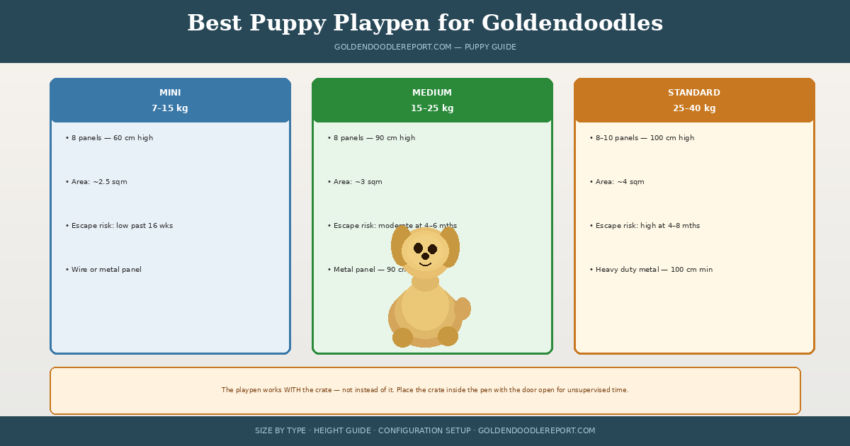
| Mini | 7–15 kg | 8 panels | 60 cm | ~2.5 sqm | Wire or light metal |
| Medium | 15–25 kg | 8 panels | 90 cm minimum | ~3 sqm | Heavy-duty metal panels |
| Standard | 25–40 kg | 8–10 panels | 100 cm minimum | ~4 sqm | Heavy-duty metal — weighted base preferred |
These specifications apply from the point of purchase — not the puppy’s current size. A Standard Goldendoodle puppy at 8 weeks cannot climb a 60 cm playpen, but by 4 months it will. Buying the correct height from day one means the playpen is still appropriate when the puppy has the strength and motivation to escape it.
Escape Risk by Size and Age
Goldendoodle playpen escapes follow a predictable pattern. Young puppies at 8 to 12 weeks lack the strength, coordination, and motivation to escape most playpens — they settle quickly and the playpen appears to be working perfectly. The risk increases sharply at two points: when the puppy develops the upper body strength to place its front legs on the top rail (approximately 12 to 16 weeks for Standard Goldendoodles), and again when adolescent energy and curiosity peak at 4 to 6 months.
The specific escape mechanisms by Goldendoodle size:
Mini Goldendoodles: Lower escape risk throughout the puppy phase due to smaller body weight and shorter leg length. A 60 cm playpen remains secure for most Minis until 6 months. The primary risk is not climbing but pushing — lightweight playpens tip over when pushed by a determined Mini at 4 to 5 months. The playpen must be heavy enough or properly secured to resist this.
Medium Goldendoodles: Moderate escape risk from 14 to 16 weeks. At this point the Medium puppy can place its front legs on a 60 cm rail and begin climbing. The 90 cm height specification addresses this — a Medium Goldendoodle puppy cannot reliably scale a 90 cm panel until 6 to 8 months, by which time the playpen need is typically reducing.
Standard Goldendoodles: High escape risk from 12 to 14 weeks. Standard puppies grow rapidly in both height and strength and are motivated escape artists during adolescence. The 100 cm height specification is the minimum — some Standard owners report needing to add a second panel layer or weight the base to prevent escape at peak adolescence. The panel construction weight matters — flimsy panels that flex under pressure are easier to manipulate than rigid heavy-duty metal.
The Correct Safe Zone Configuration
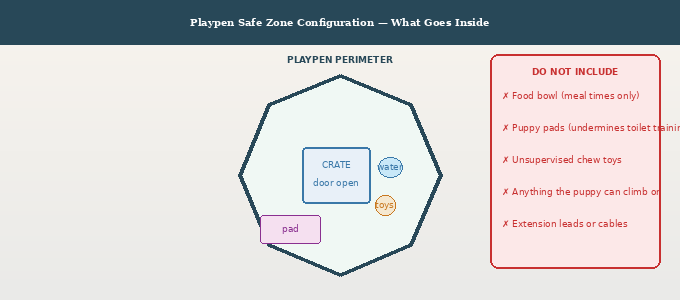
The playpen configuration determines whether it supports toilet training or undermines it. The following setup is the correct functional configuration:
What goes inside the playpen:
The crate, with the crate door open or removed entirely. This is the non-negotiable element. The crate inside the playpen gives the puppy access to its sleep space, maintains the crate association that toilet training requires, and gives the puppy a retreat option during playpen time. A puppy in a playpen without a crate has no den space, no sleep anchor, and no functional toilet training input from the playpen setup.
A water bowl — not a food bowl. Meals happen outside the playpen on the toilet training schedule. Water is available inside at all times. Use a stainless steel bowl with a weighted or non-slip base — plastic water bowls tip over on the playpen floor constantly.
Two to three appropriate toys — one stuffable rubber toy (Kong), one chew option, and one comfort toy. No more than three. Enough for engagement, not enough to create chaos.
What does not go inside the playpen:
Puppy pads — never. Adding a puppy pad to the playpen teaches the puppy that the playpen is a place where elimination is acceptable. This directly conflicts with every other toilet training input the crate is providing. If the puppy cannot hold long enough to remain clean in the playpen, the playpen period is too long for the puppy’s current bladder capacity — reduce the time rather than adding a pad.
Furniture, boxes, or any object the puppy can climb onto to reach the playpen rail. A Standard Goldendoodle puppy that cannot scale a 100 cm panel from the floor can frequently scale it from a 20 cm raised surface. Audit the interior for climbable objects.
Food — meals happen at the scheduled toilet training times, outside the playpen, followed by an outdoor toilet trip. Feeding inside the playpen decouples the feeding-toilet routine that is the core structure of toilet training.
Action Plan — Buying and Setting Up the Playpen
- Select the correct size for your Goldendoodle type using the table above. Do not buy for the current puppy size — buy for the 5-month size when escape risk peaks.
- Buy heavy-duty metal panels for Medium and Standard Goldendoodles. Lightweight wire panels flex and tip under the push force a Goldendoodle generates at adolescence. The panel weight is a structural requirement, not an aesthetic preference.
- Place the crate inside the playpen before the puppy arrives. Set up both together as a single system. The crate door stays open during playpen time — the puppy moves between den and play space freely.
- Add a stainless steel water bowl with a weighted base. Position it away from the crate entrance so the crate interior remains dry.
- Add two to three toys — Kong, chew, comfort toy. Rotate the toys weekly using the same rotation system as the main toy programme.
- Set a maximum playpen duration appropriate for the puppy’s age. At 8 weeks — 60 to 90 minutes maximum before a toilet trip. At 12 weeks — up to 2 hours. At 4 months — up to 3 hours. Extend only when the puppy is consistently clean within the current limit.
What to Expect
Timeline: A correctly configured playpen produces clean, settled behaviour within the first two weeks. The puppy learns that the playpen is a comfortable, safe space with access to its den. Escape attempts reduce once the puppy has habituated to the space — typically within 5 to 10 days of consistent use.
Friction: Standard Goldendoodle puppies test playpen boundaries actively from 12 to 20 weeks. This is the highest-friction period — the puppy has more energy than the playpen expects and escape attempts are frequent and creative. Heavy-duty panels anchored to a wall bracket or doorway significantly reduce success rate during this period.
Signs the setup is working: Puppy enters the playpen willingly when directed. Puppy is clean at the end of appropriate playpen intervals. Puppy retreats to the crate inside the playpen voluntarily to sleep — demonstrating that the crate-inside-playpen configuration is maintaining the den association correctly.
Your Next Step
Confirm your Goldendoodle type and select the panel count and height from the table above. Set up the playpen with the crate inside before the puppy arrives — do not improvise the configuration on day one. The combined crate-playpen system needs to be functional from the first night to support toilet training from the start.
What to Look For and What to Avoid
Look for: metal panel construction with a gauge heavy enough to resist flexing under push force, a door panel with a latch that requires deliberate manipulation (not a simple push), panels that connect securely without gaps at the joins (Goldendoodle puppies identify and exploit gaps), and a configuration option that allows the playpen to be shaped as a rectangle rather than only as a circle or octagon — a rectangle fits against walls and into corners more efficiently than a circle of the same area.
Avoid: plastic-framed playpens for any Goldendoodle size (insufficient structural resistance), fabric or mesh play yards (a Goldendoodle puppy chews through these), playpens described as “suitable for puppies to 6 months” without specifying breed size (meaningless without weight and height specifications), and any playpen without a door panel — a playpen you must step over or disassemble to enter is one you stop using consistently.
What Most Owners Get Wrong
Mistake 1 — Using the playpen instead of the crate, not alongside it. The most common playpen mistake is buying a large playpen and removing the crate from the setup — reasoning that the playpen provides more space and is therefore better. The crate is the toilet training mechanism. The playpen without a crate inside is a large unsupervised area where accidents are inevitable and the toilet training structure is absent. Keep the crate. Put it inside the playpen. Use both.
Mistake 2 — Adding puppy pads to prevent accidents during playpen time. The puppy pad in the playpen is a toilet training catastrophe disguised as a hygiene solution. It teaches the puppy that elimination inside a contained space is acceptable — exactly the opposite of what toilet training requires. If the puppy is having accidents in the playpen, reduce the playpen duration to match the puppy’s current bladder capacity rather than accommodating the accident with a pad.
Mistake 3 — Buying a playpen sized for the puppy today rather than the puppy at 5 months. A 60 cm playpen for a Standard Goldendoodle puppy at 8 weeks appears adequate. At 14 weeks it is not. Buying a replacement playpen three months after the first purchase costs more than buying the correct size from day one and produces a gap in the management system while the replacement arrives.
Signs Your Playpen Setup Is Working
- Puppy enters the playpen willingly and settles without prolonged vocalisation
- Puppy is consistently clean at the end of appropriately timed playpen intervals
- Puppy uses the crate inside the playpen voluntarily to sleep during playpen time
- No escape attempts by 10 days of consistent use at the correct height and panel count
⚠️ Watch Out
A Standard Goldendoodle puppy that has successfully escaped the playpen once will attempt to escape it again immediately. A single successful escape teaches the puppy that escape is possible and motivates repeated attempts. If an escape occurs — increase panel height or add a top panel before the next playpen session. Do not return the puppy to the same configuration it already escaped. Success reinforces the behaviour.
When to Reassess the Playpen Setup
- Consistent escape attempts despite correct height — add a top panel or reposition the playpen against walls on two sides
- Consistent accidents inside the playpen despite removing pads — reduce the duration to match current bladder capacity and reassess weekly
- Puppy is refusing to enter the playpen — check whether the playpen is being used punitively and ensure it remains a positive, enriched space
Key Takeaways — Best Puppy Playpen for Goldendoodles
- The playpen works alongside the crate — not instead of it. Place the crate inside the playpen with the door open for all playpen sessions.
- Minimum 8 panels — 60 cm high for Mini, 90 cm for Medium, 100 cm for Standard Goldendoodles
- Buy for the puppy’s 5-month size, not the current size — Standard Goldendoodles outgrow a 60 cm playpen by 14 weeks
- Never add puppy pads to the playpen — they undermine the toilet training the crate supports
- Heavy-duty metal panels only for Medium and Standard Goldendoodles — lightweight panels tip and flex under the push force these breeds generate
- The correct playpen contents: crate (door open) + water bowl + two to three toys. Nothing else.
Related Goldendoodle Puppy Guides
- Best Crate for Goldendoodle Puppies — The crate that goes inside the playpen — size and type guide
- Goldendoodle Puppy Toilet Training Guide — How the playpen-crate system supports the toilet training programme
- Best Toys for Goldendoodle Puppies — What toys to rotate into the playpen
- Goldendoodle Daily Routine — How playpen sessions fit into the daily structure
- Goldendoodle Puppy Care Guide — Complete first-year equipment and setup overview
Part of the Goldendoodle Puppy Guide resource hub:
→ Goldendoodle Puppy Guide — Browse all 40 puppy guides
Frequently Asked Questions
What size playpen does a Goldendoodle puppy need?
A minimum of 8 panels with height matched to the adult Goldendoodle size — 60 cm for Mini, 90 cm for Medium, and 100 cm for Standard. Buy based on the adult size category, not the current puppy size, because Goldendoodle puppies grow rapidly and the escape risk peaks at 12 to 20 weeks when the puppy has the strength to test the boundaries. A playpen bought at the correct height from day one remains appropriate through the entire puppy phase.
Should I use a playpen or a crate for my Goldendoodle puppy?
Both — together. The crate manages overnight sleep, nap times, and provides the toilet training mechanism. The playpen provides a larger supervised-but-contained safe zone during periods when continuous crating would be too long but free-roaming is unsafe. The correct setup places the crate inside the playpen with the door open, giving the puppy access to its den space and the larger play area simultaneously. Choosing between them is a false choice — they serve different functions and work as a system.
Can I put puppy pads in the playpen?
No — never. Adding a puppy pad to the playpen teaches the puppy that elimination inside a contained space is acceptable. This directly undermines the toilet training mechanism the crate provides. If the puppy is having accidents during playpen time, reduce the playpen duration to match the puppy’s current bladder capacity rather than accommodating the accident with a pad. The duration limit, not the pad, is the correct solution.
My Goldendoodle puppy keeps escaping the playpen — what do I do?
Increase the panel height immediately — before the next playpen session. A single successful escape teaches the puppy that escape is possible and motivates repeated attempts. For Standard Goldendoodles that are escaping a 100 cm panel, add a top panel that covers the opening, or reposition the playpen so two sides are against walls — reducing the angles from which the puppy can approach the panels with climbing momentum. Do not return the puppy to the same configuration it already escaped successfully.
How long can a Goldendoodle puppy stay in the playpen?
At 8 weeks — 60 to 90 minutes. At 12 weeks — up to 2 hours. At 4 months — up to 3 hours. These limits reflect bladder capacity rather than behaviour — the puppy may appear comfortable for longer but the toilet training integrity depends on taking the puppy to the toilet before accidents occur rather than after. Extend the playpen duration gradually as reliable cleanliness at the current limit is demonstrated over at least 5 consecutive clean sessions.
The information in this article is provided for general educational purposes only. King James Adjei is a researcher and enthusiast, not a veterinarian or certified trainer. For specific advice about containment, toilet training, or behaviour, consult a qualified certified trainer or behaviourist.