5-minute read | Last updated March 2026 | Reviewed for accuracy
By King James Adjei | GoldendoodleReport.com
Researcher, Goldendoodle enthusiast, and founder of GoldendoodleReport. Every guide on this site is written to give owners reliable, clearly organised information — researched carefully and updated regularly.
The best puppy treats for Goldendoodles are not chosen primarily by ingredient quality — they are chosen by size, calorie density, and whether they serve training or reward purposes. An excellent treat in the wrong size slows every training session. An excellent treat used without a calorie budget disrupts the feeding plan. Getting both of these right is more impactful on training outcomes than the brand on the packet.
Who This Guide Is For
This article is most useful if you:
- Are starting training and need to buy treats before the first session
- Have been using treats but the puppy loses focus quickly or fills up during sessions
- Want to know how many treats per day are appropriate without disrupting the feeding plan
- Are not sure whether to use commercial treats, kibble, or human food as training rewards
For the training sessions these treats support, see How to Bond With a Goldendoodle Puppy.
Quick Summary
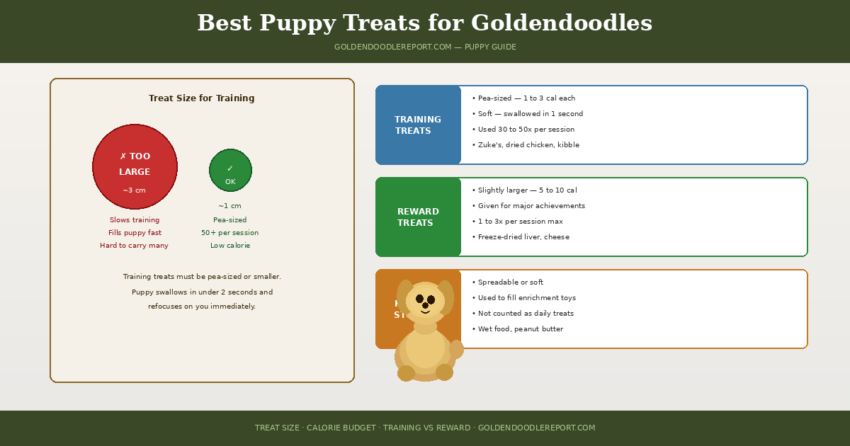
The best puppy treats for Goldendoodles training are pea-sized (approximately 1 cm), soft enough to swallow in under 2 seconds, and contain 1 to 3 calories each. The daily treat budget is 10 percent of the puppy’s daily calorie allowance — a Mini Goldendoodle at 8 weeks has approximately 25 calories available for treats, a Standard at 4 months has approximately 90 calories. Kibble from the daily meal allowance is a valid and free training treat. Treats should be deducted from the daily meal allocation — not added on top of it.
Quick Answer
Best training treats: Zuke’s Mini Naturals (3 calories each), dried chicken breast broken into pea-sized pieces (1 to 2 calories each), or the puppy’s own kibble (2 to 4 calories each). Break any commercial treat to pea-sized before using regardless of the packet size. Calculate 10 percent of daily calorie allowance, divide by treat calorie count, and that is the maximum daily treat number. Deduct treats from meal portions on heavy training days.
Quick Diagnosis
- If the puppy loses focus after 10 repetitions in a training session → treats are too large — the puppy is full, not uninterested. Break them to pea-sized.
- If the puppy refuses treats during training outside → treats are insufficiently motivating for the distraction level — upgrade to high-value treats (freeze-dried liver, cheese) for outdoor sessions only
- If the puppy is gaining weight unexpectedly → treat calories are not being deducted from meal portions — calculate the treat budget and adjust meal size accordingly
- If the puppy spits the treat out and sniffs the floor → treat is too hard or too large to swallow quickly — switch to soft treats or smaller pieces
You are using the training treats that came recommended from a friend — small round treats from a well-known brand. Training sessions start well but the puppy loses interest after about eight repetitions. You assume it is not motivated. The actual issue: each treat is 8 calories and thumbnail-sized. At 10 repetitions the puppy has consumed 80 calories from treats alone — nearly a third of its daily allowance from an 8-week Mini Goldendoodle. It is not unmotivated. It is not hungry anymore. The session could have run 40 repetitions with the same treat broken to pea-sized pieces at 2 calories each.
Treats in Goldendoodle puppy training serve one primary mechanical function: they create the positive association between performing a behaviour and a pleasant outcome. The speed of that association formation is determined by two variables — the frequency of repetitions in a session and the desirability of the treat. Treat size determines repetition frequency. Treat quality determines desirability. Both matter, but owners almost universally over-invest in desirability (buying the best treat available) while under-attending to size (using whatever size comes out of the packet).
This guide covers:
- The 10 percent calorie rule and how to calculate the daily treat budget for your Goldendoodle
- Why treat size determines training effectiveness — the mechanism
- Training treats vs reward treats — different purposes, different specifications
- The best treat options by category and when to use each
- Human foods that are safe treat options and which to avoid
In This Guide
Best Puppy Treats for Goldendoodles: The 10 Percent Calorie Rule
The 10 percent rule is the nutritional framework that governs treat use in puppy feeding: treats should not exceed 10 percent of the puppy’s total daily calorie intake. This is not an arbitrary guideline — it reflects the energy balance required for a growing puppy to receive complete nutrition from its main meals rather than from the incomplete nutritional profile of treats.
A puppy consuming 25 percent of its daily calories from treats is receiving 25 percent of its energy from a food source that does not contain the balanced vitamins, minerals, and amino acids required for healthy development. For the nutritional framework underlying this principle, the American Kennel Club’s guide on how many treats to feed dogs covers the 10 percent rule and its application clearly.
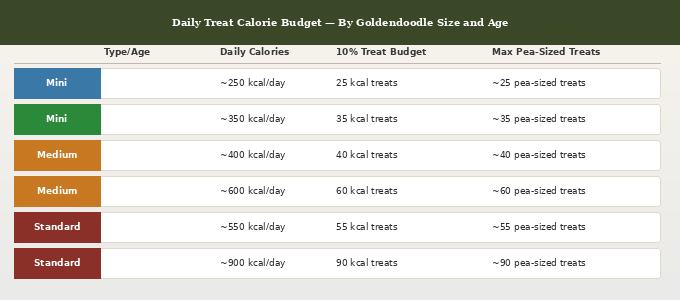
Daily Treat Budget by Goldendoodle Size and Age
| Type and Age | Approx Daily Calories | 10% Treat Budget | Max Pea-Sized Treats | Meal Deduction |
|---|---|---|---|---|
| Mini — 8–12 weeks | ~250 kcal | ~25 kcal | ~25 treats (at 1 kcal each) | Reduce meal by 25 kcal on training days |
| Mini — 4–6 months | ~350 kcal | ~35 kcal | ~35 treats | Reduce meal by 35 kcal on training days |
| Medium — 8–12 weeks | ~400 kcal | ~40 kcal | ~40 treats | Reduce meal by 40 kcal on training days |
| Medium — 4–6 months | ~600 kcal | ~60 kcal | ~60 treats | Reduce meal by 60 kcal on training days |
| Standard — 8–12 weeks | ~550 kcal | ~55 kcal | ~55 treats | Reduce meal by 55 kcal on training days |
| Standard — 4–6 months | ~900 kcal | ~90 kcal | ~90 treats | Reduce meal by 90 kcal on training days |
These calorie figures are approximate averages — check the calorie count on your specific food packaging for a precise calculation. The treat count assumes pea-sized treats at approximately 1 calorie each. Treats with 3 calories each (such as Zuke’s Mini Naturals) reduce the maximum count by two-thirds — approximately 8 to 30 treats daily depending on size and age. Using kibble from the daily meal allocation as treats is the simplest approach to calorie management — the treats come directly from the measured daily portion, making overfeeding structurally impossible.
Why Treat Size Determines Training Speed
The relationship between treat size and training speed is mechanical, not motivational. It operates through two pathways that both limit the number of training repetitions achievable in a session.
Pathway 1 — Satiety. A puppy that consumes 50 calories in treats during a 10-minute training session has consumed 20 percent of a Mini Goldendoodle’s daily budget in one session. As calorie consumption from treats rises during a session, the puppy’s hunger motivation falls. The treat that was highly motivating at repetition 1 is significantly less motivating at repetition 30 because the hunger drive that made it valuable has been partially satisfied. A pea-sized treat at 1 calorie each means the puppy can complete 50 repetitions before reaching the same satiety level that 5 repetitions with a 10-calorie treat would produce.
Pathway 2 — Processing time. A treat that requires chewing takes the puppy’s attention away from the handler for 3 to 5 seconds while it chews. Across 20 repetitions this is 60 to 100 seconds of lost handler-focus — time when the training loop is broken and the puppy is attending to the food rather than the next cue. A pea-sized soft treat is swallowed in under 2 seconds. The puppy’s attention returns to the handler immediately. The training loop remains intact across every repetition.
The practical rule: a training treat must be swallowable in under 2 seconds. If the puppy is still chewing when the next cue is given, the treat is too large. Break any commercial treat to pea-sized before using it in training regardless of what size it comes out of the packet. A 10-calorie treat broken into 10 pieces is 10 treats at 1 calorie each — the product cost is identical, the training effectiveness multiplies by ten.
Training Treats vs Reward Treats
Training Treats vs Reward Treats — Specifications
| Specification | Training Treats | Reward Treats |
|---|---|---|
| Purpose | Reinforce known behaviours during training sessions — sit, recall, eye contact. Used 20 to 50 times per session. | Celebrate a major achievement, first-time success at a new behaviour, or jackpot after exceptional performance. Used 1 to 3 times per session maximum. |
| Size | Pea-sized — swallowed in under 2 seconds. No exceptions. | Slightly larger — 3 to 5 pea-sized treats given rapidly as a “jackpot” sequence. |
| Calories | 1 to 3 calories each maximum. | 5 to 15 calories total for the jackpot sequence. |
| Value level | Low to medium — kibble or standard soft treats. Reserve high-value treats for outdoor or distracted environments where motivation must overcome competing stimuli. | High-value — freeze-dried liver, real cheese, cooked chicken. Used sparingly to maintain their motivational power. |
| Examples | Puppy kibble, Zuke’s Mini Naturals (broken), dried chicken pieces, soft commercial training treats | Freeze-dried liver pieces, small cubes of plain cooked chicken, small cubes of hard cheese |
Best Treat Options by Category
Kibble from the daily meal allowance. The simplest, cheapest, and most nutritionally sound training treat available. The calorie management is automatic — every piece of kibble used in training is deducted from the measured daily portion. The motivation level is sufficient for indoor training sessions where competing stimuli are low. Not sufficient for outdoor or highly distracted training — upgrade to soft treats for those sessions.
Commercial soft training treats — small size. Products specifically designed for training, containing 1 to 3 calories per treat in pea-sized format. These are the most convenient option for owners who prefer a purpose-made product. Key requirements: soft enough to swallow in under 2 seconds, no artificial preservatives, no added sugar or xylitol. Break any treat larger than a pea even if the packet describes it as a training treat — manufacturers do not always match the pea-sized standard.
Dried chicken or turkey strips. Single-ingredient, high-protein, low-calorie options that most Goldendoodles find highly motivating. Break into pea-sized pieces before the session. Check that the product contains no seasoning, garlic, or onion — plain dried chicken only. Store in an airtight container to maintain freshness across multiple sessions.
Freeze-dried liver or meat. High-value reward treats — used as jackpots for exceptional performance or for outdoor sessions where motivation must compete with environmental distractions. Higher calorie density than training treats — use sparingly and deduct from the daily budget. The strong smell maintains motivational value even in high-distraction environments.
Safe Human Food Treats and What to Avoid
Safe human food options in pea-sized amounts:
Plain cooked chicken or turkey (no seasoning), plain cooked salmon (boneless, no seasoning), hard cheese in tiny cubes (cheddar, mozzarella — plain only), carrot pieces (low calorie, most puppies enjoy the texture), blueberries (one or two at a time — high in antioxidants, appropriate as occasional reward treats), and plain cooked sweet potato in small pieces.
Human foods to avoid entirely:
Grapes and raisins — toxic to dogs, cause kidney failure even in small amounts. Onions and garlic — toxic in all forms including powder, cause red blood cell destruction. Macadamia nuts — toxic to dogs. Xylitol — found in sugar-free products, peanut butter alternatives, and some chewing gum — highly toxic. Chocolate — toxic at any dose. Avocado — toxic, particularly the skin and pit. Cooked bones — splinter and cause intestinal perforation. Salt — avoid highly salted human foods.
When in doubt about any human food — do not give it. The safe list above covers the most common and reliably safe options. Anything outside this list requires individual verification before use as a treat.
Action Plan — Setting Up the Treat Programme
- Calculate the daily treat budget today. Find your puppy’s daily calorie allowance on the food packaging. Multiply by 10 percent. This is the maximum daily treat budget in calories.
- Buy one bag of pea-sized soft training treats. Check the calorie count per treat on the back. Divide the daily budget by the calorie count per treat to get the maximum daily number.
- Break every treat to pea-size before training sessions. Regardless of packet size. Set aside pre-broken treats in a small pot before every session so you are not breaking treats during the session.
- Reduce meal portions on heavy training days. On days with three or more training sessions, reduce the daily meal allocation by the treat calories consumed. This prevents cumulative overfeeding across high-frequency training weeks.
- Keep two treat types on hand. Standard soft training treats for indoor sessions and a high-value option (freeze-dried liver or cooked chicken) for outdoor or high-distraction sessions. Never use high-value treats for indoor sessions — preserve their motivational power for when it is genuinely needed.
- Use kibble from the daily portion for at least one session daily. This maintains food motivation by ensuring the puppy earns part of its meal through training rather than receiving all of it from the bowl. A puppy that must work for some of its food is more motivated in training than one that receives its full meal before any training occurs.
What to Expect
Timeline: Switching to correctly sized pea-sized treats produces visible improvement in training session length and engagement within the first session. The puppy that previously lost focus after 8 repetitions will sustain engagement for 30 to 50 repetitions with the same treat in the correct size.
Friction: Pre-breaking treats before sessions adds 2 to 3 minutes of preparation. Owners who skip this step because it feels unnecessary then break treats during sessions — which interrupts the training flow more significantly than the pre-session preparation would have. Build the pre-break habit from the first session.
Signs the treat programme is working: The puppy sustains focus for 20 or more repetitions in a training session. Session engagement does not decrease noticeably after the first 5 minutes. The puppy arrives at training sessions with visible anticipation rather than disinterest.
Your Next Step
Calculate your puppy’s daily treat budget right now — find the calorie count on the food packaging, multiply by 10 percent. Then check the calorie count on any treats you are currently using. If they are over 3 calories each — break them to pea-size before the next session and observe the difference in session length.
What Most Owners Get Wrong
Mistake 1 — Using treats that are too large because they came out of the packet that size. Commercial treat manufacturers size treats for appeal on the shelf and ease of manufacture — not for training session mechanics. The “training treat” label on a packet means the product is intended for training use, not that it is automatically the correct size. Break every treat to pea-size regardless of what the packet says. This single change produces more improvement in training outcomes than any treat brand change.
Mistake 2 — Adding treats on top of the daily meal rather than deducting from it. A puppy receiving its full three daily meals plus 30 training treats is receiving more calories than its daily allowance. The immediate consequence is reduced food motivation — a puppy that is slightly over-fed is less motivated by food rewards than one receiving exactly its required calories, some of which come from training treats. The long-term consequence is weight gain. Treats are part of the daily calorie budget, not additions to it.
Mistake 3 — Using the same treat for all training contexts. A treat that motivates a puppy reliably in the kitchen may not motivate it reliably in the park where squirrels, dogs, and smells compete for attention. The treat value required to overcome distraction is higher than the treat value required to maintain focus in a familiar, low-stimulus environment. Keep a high-value treat option specifically for outdoor and novel-environment sessions. Reserve it for those contexts to maintain its motivational power.
Signs Your Treat Programme Is Working
- Training sessions run for 20 or more repetitions before the puppy loses focus
- The puppy approaches the training area with visible anticipation when the treat container appears
- Food motivation is maintained across sessions — the puppy is not visibly full or disinterested by mid-session
- Bodyweight is tracking normally — no unexpected weight gain on the monthly weight check
⚠️ Watch Out
Check peanut butter labels every time before using as a Kong stuffing or training treat. Several major peanut butter brands have added xylitol to reduced-sugar or “natural” varieties in recent years and formulations change without prominent labelling changes. Xylitol causes rapid, severe hypoglycaemia in dogs and is life-threatening. The label must show no xylitol and no sugar alcohols. Regular full-fat versions of standard brands are generally safe but always confirm the current label before use.
Contact Your Vet If
- The puppy ingests xylitol — this is an emergency requiring immediate veterinary attention, do not wait for symptoms
- The puppy ingests grapes, raisins, onion, garlic, chocolate, or macadamia nuts in any amount — same-day veterinary contact
- Unexpected weight gain persists despite reducing meal portions on training days — discuss calorie management with your vet
Key Takeaways — Best Puppy Treats for Goldendoodles
- Treats must be pea-sized — swallowed in under 2 seconds — for effective training sessions that run 20 to 50 repetitions
- The 10 percent rule: treats must not exceed 10 percent of daily calorie intake. Calculate this for your specific puppy from the food packaging.
- Treats are deducted from the daily meal allocation — not added on top of it
- Two treat types: low-value standard treats for indoor sessions, high-value treats reserved for outdoor and high-distraction environments
- Kibble from the daily portion is a valid, free, and nutritionally sound training treat — use it for at least one session daily
- Never give grapes, raisins, onion, garlic, chocolate, macadamia nuts, or xylitol-containing products — all are toxic to dogs
Related Goldendoodle Puppy Guides
- How to Bond With a Goldendoodle Puppy — How treat-based training sessions build the bond alongside the trained behaviours
- Best Chew Toys for Teething Goldendoodles — Kong stuffing options that use the same treat ingredients
- Goldendoodle Puppy Feeding Guide — The daily calorie baseline these treat budgets are calculated from
- Goldendoodle Daily Routine — How training sessions and treat use fit into the daily schedule
- Goldendoodle Puppy Care Guide — Complete first-year overview including nutrition and training
Part of the Goldendoodle Puppy Guide resource hub:
→ Goldendoodle Puppy Guide — Browse all 40 puppy guides
Frequently Asked Questions
How many treats can I give my Goldendoodle puppy per day?
Treats should not exceed 10 percent of the puppy’s total daily calorie intake. A Mini Goldendoodle at 8 weeks eating 250 calories daily has a treat budget of approximately 25 calories — roughly 25 pea-sized treats at 1 calorie each, or 8 to 10 treats at 3 calories each. Calculate from the calorie count on your specific food packaging for a precise figure. Deduct treat calories from meal portions on training-heavy days to stay within the daily budget.
Can I use kibble as training treats for my Goldendoodle puppy?
Yes — kibble is an excellent training treat. It is nutritionally balanced, low calorie, and when taken from the measured daily portion makes overfeeding structurally impossible. Most puppies find kibble sufficiently motivating for indoor training sessions. For outdoor or high-distraction training where motivation must overcome competing stimuli, upgrade to a higher-value soft treat. Using kibble for at least one training session daily maintains food motivation by ensuring the puppy earns part of its meal through engagement rather than receiving all of it from the bowl.
What is the best training treat for a Goldendoodle puppy?
For indoor sessions: pea-sized pieces of dried chicken, puppy kibble, or a commercial soft training treat at 1 to 3 calories each. For outdoor or high-distraction sessions: small pieces of freeze-dried liver, plain cooked chicken, or hard cheese in tiny cubes. The indoor treat should be reserved for low-distraction contexts — using high-value treats for every session reduces their motivational power by eliminating the contrast between routine rewards and exceptional ones.
Are Zuke’s Mini Naturals good for Goldendoodle puppies?
Yes — Zuke’s Mini Naturals are a well-regarded training treat with 3 calories per treat, a soft texture that enables quick swallowing, and no artificial preservatives. At 3 calories each they are appropriate for training sessions as long as the daily quantity stays within the 10 percent calorie budget. For a Mini Goldendoodle at 8 weeks with a 25-calorie treat budget this means approximately 8 treats per day maximum. For a Standard at 4 months with a 90-calorie budget this means approximately 30 treats per day.
Can my Goldendoodle puppy have cheese as a treat?
Yes — plain hard cheese (cheddar, mozzarella, Edam) in small cubes is safe for most puppies and is a high-value reward treat that most Goldendoodles find extremely motivating. Use it sparingly — as a jackpot reward for exceptional performance or for outdoor sessions where environmental competition is high — rather than as a routine training treat. Reserve its motivational power by limiting frequency. Avoid processed cheese, cream cheese, and any cheese product with added herbs, garlic, or onion.
The information in this article is provided for general educational purposes only. King James Adjei is a researcher and enthusiast, not a veterinarian. For specific dietary advice about your puppy’s calorie requirements or concerns about treat-related health issues, always consult a qualified veterinarian.