7-minute read | Last updated March 2026 | Reviewed for accuracy
By King James Adjei | GoldendoodleReport.com
Researcher, Goldendoodle enthusiast, and founder of GoldendoodleReport. Every guide on this site is written to give owners reliable, clearly organised information — researched carefully and updated regularly.
Goldendoodle puppy fear stages are among the most important developmental events in the first year of a dog’s life — and among the least understood by owners who encounter them without warning. There are two distinct fear periods in puppy development. Both have specific timing, specific characteristics, and a specific correct response. Handled well, fear periods pass with minimal lasting impact. Handled poorly — most commonly by forcing the puppy through the feared thing — they produce fear associations that can persist for years or permanently.
Who This Guide Is For
This article is most useful if you:
- Have noticed your puppy is suddenly frightened of things it was fine with previously
- Are in the 8–11 week window and want to understand the heightened fear sensitivity of this period
- Have a puppy between 6 and 14 months who has developed new fears without apparent cause
- Want to understand what the correct response to a fear period is — and what to avoid
For the broader developmental context including the socialisation window, see the Goldendoodle Puppy Growth Stages guide.
Quick Summary
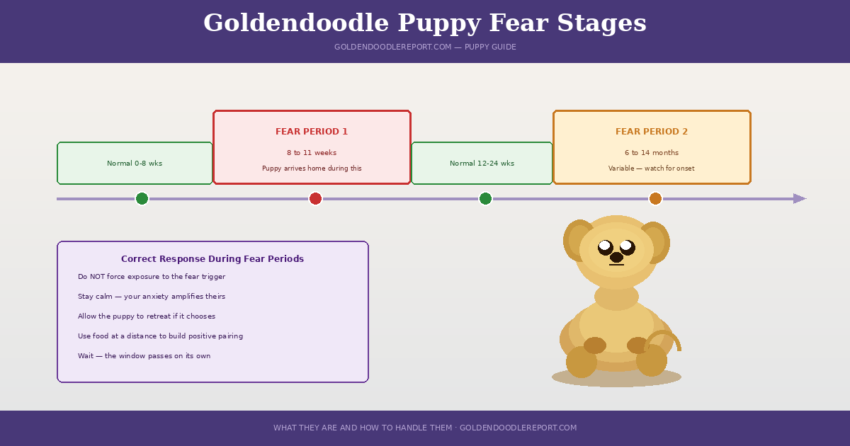
Goldendoodle puppy fear stages occur in two distinct windows. Fear Period 1 is at 8 to 11 weeks — the period during which most puppies arrive home — when the brain is in a heightened fear-imprinting state where negative experiences are recorded more durably than at almost any other developmental point. Fear Period 2 occurs between approximately 6 and 14 months, is more variable in timing and intensity, and often surprises owners because the dog was previously confident. Both periods share the same correct response: do not force exposure to the feared thing, do not flood with reassurance, and allow the puppy to regulate at its own pace using food as a positive bridge.
Quick Answer
What are the Goldendoodle puppy fear stages? Fear Period 1 at 8–11 weeks: the puppy’s brain is in a heightened fear-imprinting state. A single frightening experience during this window can create a lasting fear association. Fear Period 2 at 6–14 months: part of adolescent brain development. The dog may suddenly show fear toward previously neutral or familiar things. Both periods typically last 2 to 3 weeks and pass on their own. The correct response to both is the same: reduce exposure to the feared trigger, use food to build positive associations at a comfortable distance, and wait.
The most damaging mistake owners make during Goldendoodle puppy fear stages is the intuitive one — pushing the puppy through the fear, reasoning that “getting it used to it” will solve the problem. This approach, called flooding in behavioural science, can work in very specific professional settings with very careful application. In the hands of well-meaning but untrained owners, it almost always makes the fear worse. A puppy that is prevented from retreating from a fear trigger while in a heightened neurological fear state is not learning that the thing is safe. It is learning that the thing is inescapable — which is a significantly more alarming association than the original fear.
This guide covers:
- What the two Goldendoodle puppy fear stages are and why they exist
- Fear Period 1 — timing, signs, and correct response
- Fear Period 2 — timing, signs, and correct response
- What to do and what to avoid during a fear period
- How long fear periods last
- When fear responses require professional help
In This Guide
Goldendoodle Puppy Fear Stages: Why They Exist
Fear periods are not random or unique to Goldendoodles — they are a universal feature of canine development and exist across all dog breeds. They represent windows in neurological development when the brain is actively adjusting its model of what is dangerous in the environment. From an evolutionary perspective, this makes sense: at certain developmental stages, it is adaptive for a young animal to become more sensitised to potential threats, consolidating the danger model that will protect it through adulthood.
What this means for domestic puppies is that during these windows, fearful experiences are recorded more durably than at other developmental points. A puppy that encounters something frightening during a fear period and receives no positive counter-experience may retain a fear of that thing for years — sometimes permanently. The flip side is that positive exposures during these same windows are equally powerful. A puppy that encounters something mildly novel during a fear period and has a genuinely good experience with it builds a positive association of unusual durability.
For Goldendoodles specifically, the breed’s emotional sensitivity — inherited from both Golden Retrievers and Poodles, which are highly attuned to their owners and environments — makes them more susceptible to the lasting effects of both positive and negative fear period experiences than many other breeds. For broader context on how fear periods fit into puppy development, the AKC’s guide to puppy fear periods covers the developmental science clearly.
Fear Period 1 — 8 to 11 Weeks
The first fear period is the one most owners do not know about until they are in the middle of it — because it begins at almost exactly the age when puppies arrive in their new homes.
The first fear imprint period in dogs is widely recognised to begin around 8 weeks of age and typically persists through week 11. Some research extends the sensitive period slightly earlier or later, and individual variation is real, but the core window of 8 to 11 weeks represents the highest-risk period. This is the window during which a single frightening experience — a loud unexpected noise, being dropped, an aggressive greeting from a strange dog, being restrained painfully during a veterinary procedure — can create a lasting fear association with minimal counter-conditioning required.
The coincidence of this fear period with the standard rehoming age of 8 weeks is significant. A puppy is being removed from everything familiar — its litter, its mother, its environment, its smells — and placed into a completely new context, all during the most neurologically sensitive fear window of its development. This is not an argument against the 8-week rehoming convention, which exists for sound socialisation reasons, but it is an argument for deliberate management of the first three weeks at home.
Signs of Fear Period 1:
- The puppy freezes or trembles in response to something it did not respond fearfully to before
- Sudden reluctance to approach something previously neutral — a bin, a staircase, a person wearing a hat
- Tail tucking, crouching, or trying to move away from new stimuli
- Refusal to eat in a new environment that previously presented no difficulty
- Clinging to the owner and reluctance to explore independently in familiar spaces
All of these are normal expressions of the heightened fear state of this developmental window. They do not indicate damage or a predisposition to anxiety — they indicate that the brain is doing exactly what it is supposed to be doing at this age.
Fear Period 2 — 6 to 14 Months
The second fear period is the one that most surprises owners because it arrives after the puppy appeared to have settled. A dog that was bold, friendly, and confident at 5 months may suddenly become hesitant about approaching strangers, startle at sounds it previously ignored, or refuse to enter a room or cross a threshold it walked through without hesitation the week before.
Fear Period 2 is less precisely timed than Fear Period 1 and varies more between individual dogs. The window generally sits within the 6-to-14-month range, but some dogs show clear fear period signs as early as 5 months and others not until 12 months. It is also typically less intense than Fear Period 1 for dogs that were well socialised during the first window — the brain is revisiting and refining its threat model rather than establishing it from scratch.
The second fear period is closely linked to adolescent neurological development — it often arrives alongside or just before the other adolescent changes described in the Goldendoodle puppy growth stages guide. The brain undergoing its most significant prefrontal cortex remodelling is also temporarily more sensitive to potential threats during this period.
Signs of Fear Period 2:
- A dog that was previously confident with strangers suddenly hesitates or backs away from new people
- Objects that were previously unremarkable — rubbish bins, postboxes, statues, unusual vehicles — suddenly trigger alarm or avoidance
- Recall that was reliable deteriorates, possibly because environmental stimuli are triggering more arousal
- Increased vigilance on walks — scanning the environment more, startling more easily
- A dog that was fine with other dogs at the dog park suddenly shows hesitance or reactive behaviour
What to Do and What to Avoid
The correct response to both Goldendoodle puppy fear stages is the same regardless of which period is active. The principles do not change based on the age of the puppy or the specific trigger.
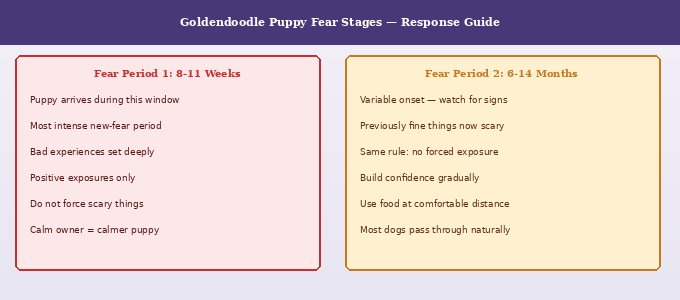
Fear Period Response — Do This vs Avoid This
| Do This | Avoid This |
|---|---|
| Allow the puppy to retreat to a comfortable distance from the trigger | Force the puppy closer to the thing it is afraid of |
| Use high-value food at the distance where the puppy is comfortable — create a positive association at that distance | Flood the puppy with reassurance — “it’s okay, it’s okay” in an anxious tone communicates that there is indeed something to worry about |
| Stay calm and behave normally — your emotional state is the puppy’s most powerful environmental cue | Pick the puppy up and hold it near the trigger to “let it see it’s safe” |
| Gradually decrease distance to the trigger over multiple sessions as the puppy demonstrates comfort at the current distance | Rush the desensitisation — moving too fast increases the fear rather than resolving it |
| Walk past triggers without stopping — continuing movement is often more effective than stopping to investigate | Punish the fear response — a puppy cannot choose not to be afraid |
| Reduce the intensity of the feared stimulus if possible — play thunder sounds at low volume rather than at realistic volume | Repeatedly expose the puppy to the trigger without food or positive association |
A note on reassurance: The instinct to comfort a frightened puppy with “it’s okay, it’s okay” in a soft, concerned voice is completely understandable. The problem is that this response — calm, prolonged, directed at the puppy specifically in response to its fear — functions as reinforcement. The puppy’s fearful behaviour has produced a specific and desirable response from the owner. This is not the association that helps. The more effective approach is to remain matter-of-fact, use food to pair the stimulus with something good, and behave as though the trigger is unremarkable — because that is the model of reality you want to build for the puppy.
How Long Fear Periods Last
Both Goldendoodle puppy fear stages are time-limited. Fear Period 1 at 8 to 11 weeks typically lasts 2 to 3 weeks. Fear Period 2 is more variable — it can be as brief as 2 weeks or extend for 4 to 6 weeks in some dogs. Neither is permanent, and both typically pass without lasting effects in dogs that are handled correctly during them.
The single most important factor in determining whether a fear period passes cleanly or leaves lasting associations is whether the owner forces the puppy through its fears during the period. Dogs that are allowed to regulate their own distance from fear triggers, whose owners use food positively at comfortable distances, and whose owners remain calm and matter-of-fact during the period almost always emerge from the fear window with the same or better confidence than before it began.
Dogs that are repeatedly flooded — forced into close proximity with fear triggers without the ability to retreat — during fear periods commonly develop lasting phobias or reactivity toward the specific triggers that were involved. This is not inevitable or genetic. It is the product of how the fear period was managed.
When to Seek Professional Help
Most Goldendoodle puppy fear stages resolve without professional intervention when managed correctly. Seek the guidance of a certified veterinary behaviourist or accredited dog behaviourist if:
- Fear responses are intensifying rather than reducing over 4 to 6 weeks despite consistent correct handling
- The puppy is showing fear toward its owner or household family members — this goes beyond normal fear period behaviour and warrants professional assessment
- The fear is accompanied by aggression — snapping, lunging, or biting when the fear trigger cannot be avoided
- The puppy is showing generalised anxiety rather than specific fear triggers — unable to settle in familiar environments, showing persistent stress signals throughout the day
- Fear responses are so severe that they are affecting the puppy’s quality of life — refusing to eat, unable to walk outside, panicking in normal household situations
In some cases, a veterinary consultation about anxiety support alongside behaviour work is appropriate. This is not a failure — it is recognising that the neurological component of severe anxiety sometimes requires medical support alongside behavioural management. Your regular vet is the right first contact for any concern that goes beyond typical fear period behaviour.
⚠️ Watch Out
The most damaging thing owners do during Goldendoodle puppy fear stages is force exposure with good intentions. “He has to get used to it” is not a method — it is flooding, and in the hands of an untrained owner during a fear-sensitive developmental window it reliably makes fears more intense and more persistent. The only exposure that helps during a fear period is exposure the puppy chooses voluntarily, at a distance where it can eat food, while the owner remains calm. Any other approach is likely to make things worse.
Signs That Need Immediate Veterinary Assessment
- The puppy shows sudden, extreme fear with no apparent trigger — this can occasionally indicate a medical cause including pain or neurological change
- Fear is accompanied by physical symptoms — trembling that does not resolve, vomiting, loss of bladder or bowel control from fear
- The puppy bites when approached during a fear response — this requires professional assessment before the behaviour becomes established
Key Takeaways
- Goldendoodle puppy fear stages occur in two windows — Fear Period 1 at 8–11 weeks and Fear Period 2 at 6–14 months — both are normal and time-limited
- Fear Period 1 coincides with when most puppies arrive home — a single frightening experience during this window can create a lasting fear association
- Fear Period 2 arrives during adolescence and often surprises owners because the dog was previously confident
- The correct response to both periods is the same: allow retreat, use food at a comfortable distance, stay calm, do not force exposure
- Reassurance in an anxious tone reinforces the fear response — matter-of-fact calm is more effective
- Both fear periods pass on their own in 2 to 6 weeks with correct handling — they do not require intervention, only management
Related Goldendoodle Puppy Guides
- Goldendoodle Puppy Growth Stages — The full developmental timeline that fear stages fit within
- Goldendoodle Puppy Socialization Checklist — Building positive associations before and after the first fear period
- First Week With a Goldendoodle Puppy — Managing the arrival period during Fear Period 1
- When Do Goldendoodle Puppies Calm Down? — How fear periods relate to the adolescent behaviour timeline
- Goldendoodle Puppy Care Guide — Complete first-year overview including all developmental windows
Part of the Goldendoodle Puppy Guide resource hub:
→ Goldendoodle Puppy Guide — Browse all 40 puppy guides
Frequently Asked Questions
How do I know if my Goldendoodle is in a fear period?
The clearest sign is sudden fearfulness toward something the puppy was previously neutral or positive about — without any obvious traumatic event having occurred. If your puppy was happily approaching the wheelie bin last week and is now freezing and backing away from it, and the puppy is between 8 and 11 weeks or between 6 and 14 months, this is almost certainly a fear period response. If the sudden fear is accompanied by other signs of illness or pain, veterinary assessment is appropriate to rule out a physical cause.
Should I comfort my Goldendoodle puppy when it is scared?
You cannot reinforce fear itself — fear is an emotional state, not a behaviour. What you can inadvertently reinforce is the behavioural expression of fear, including fleeing, freezing, vocalising, or clinging. The most helpful response is calm, matter-of-fact presence — being near the puppy without making anxious sounds or focused comforting directed specifically at the fearful behaviour. Use food if the puppy will take it, maintain normal behaviour, and allow the puppy to regulate at its own pace. This models that the situation is manageable, which is the message that actually helps.
My puppy was fine last month and is now scared of everything — what happened?
This is the classic presentation of Fear Period 2 — the onset is often sudden and it typically affects a dog that was previously confident and settled. The neurological shifts of adolescence include a temporary increase in threat sensitivity that drives this behaviour. It is not a permanent change and it is not a reflection of poor socialisation in the first weeks. With correct management — no forced exposure, food-based positive pairing at comfortable distances, consistent calm owner behaviour — the second fear period typically resolves within 2 to 6 weeks.
Is it safe to take my puppy to puppy classes during a fear period?
With care, yes. A good puppy class with a qualified trainer who understands fear periods can actually be beneficial — the controlled positive social environment, the food, and the structured low-pressure interactions are exactly the conditions that support fear period management. A class that forces interactions, allows overwhelming rough play, or applies pressure on a visibly fearful puppy is not appropriate during a fear period. Discuss the fear period with the trainer before the class and let them guide you on management within the session.
Can I do anything to prevent the fear periods?
Fear periods are a universal feature of canine neurological development — they cannot be prevented. What can be reduced is the lasting impact of fear periods. Thorough positive socialisation before the first fear period (in the litter, before 8 weeks) and in the weeks between the two fear periods significantly reduces the intensity of fear period responses. A puppy with a rich bank of positive experiences has more resilience during the fear windows than one with limited prior exposure. Socialisation does not prevent fear periods — it makes them easier to navigate.
The information in this article is provided for general educational purposes only. King James Adjei is a researcher and enthusiast, not a veterinarian or certified behaviourist. For fear responses that are intensifying, involve aggression, or significantly affect quality of life, always consult a qualified veterinarian or certified dog behaviourist.