Affiliate Disclosure: Some links in this guide are affiliate links. If you purchase through them, we may earn a small commission at no extra cost to you. This does not influence our recommendations. Read our full affiliate disclaimer here.
By King James Adjei — Researcher and Goldendoodle enthusiast, founder of GoldendoodleReport.com. Every guide on this site is carefully researched and written to give owners reliable, clearly organised information. → About this site
⚠️ Health note: Fear that comes on suddenly with no obvious trigger, or with signs of pain or illness, needs a vet visit before you assume it is a normal stage. If your puppy growls, snaps or bites, contact a qualified behaviourist.
📖 9-minute read | Last updated November 2026 | Reviewed for accuracy
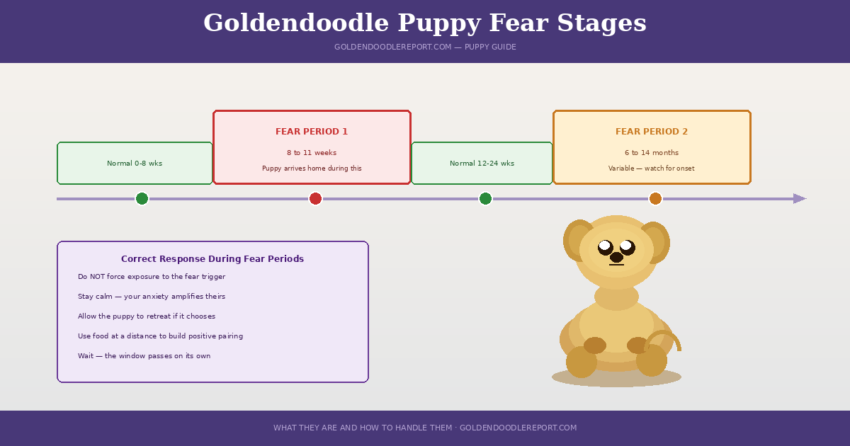
Goldendoodle puppy fear stages are the two phases, one around the first weeks at home and one in adolescence, when a puppy that was happy yesterday suddenly freezes, backs away or barks at something ordinary. It is one of the most unsettling things new owners meet, because it can feel as if you did something wrong. Trainers say you almost certainly didn’t.
This guide is the overview: what the two stages are, how to recognise them, what to do and what to avoid, and when to call a vet. I have also been careful about what is known and what is not. The advice trainers agree on is consistent, but the age windows and durations are described without studies, and the sources disagree on how long a stage lasts. When you are ready for step-by-step plans for specific triggers, see our Goldendoodle fear periods guide. For the wider timeline, see Goldendoodle puppy growth stages.
✅ Quick Answer
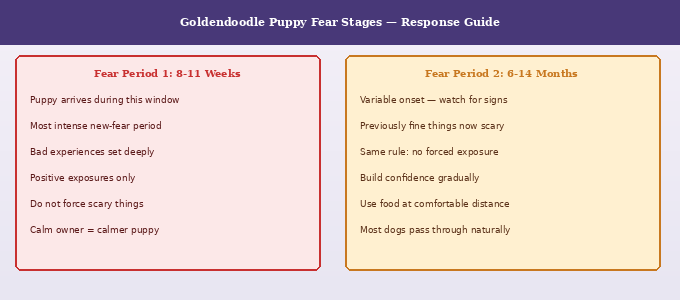
Goldendoodle puppy fear stages are usually described as a first window at about 8 to 11 weeks and a second at roughly 6 to 14 months. Trainers give the same advice for both: let your puppy keep a comfortable distance, stay calm, reward calm or curious behaviour, and never force your puppy toward what scares it. Sources disagree on how long a stage lasts, and the evidence for the second one is thin. See a vet if the fear is sudden, severe or comes with physical signs.
👤 Who This Guide Is For
- Your puppy is 8 to 12 weeks old and seems more nervous in the new home
- Your dog is 6 to 14 months old and has suddenly become wary of familiar things
- You want to know what is normal and what needs a vet
- You want to respond kindly without making things worse
📊 Quick Facts — Puppy Fear Stages
- The AKC and PetsRadar both describe a first period at about 8 to 11 weeks and a second at roughly 6 to 14 months
- The AKC says smaller breeds may reach the second period sooner than large ones, and that the length varies among puppies
- The AKC says “no amount of socialization can prevent them”
- Wikipedia says the early critical period for socialisation closes between 4 and 8 weeks, when puppies begin avoiding novel objects instead of approaching them
- PetsRadar’s behaviourist says fear periods are not breed-specific and not every puppy goes through them
- Purdue University’s Canine Welfare Science Group says the fear stage starts at about 8 weeks, “but breeds and individuals may differ”
🔍 Quick Diagnosis — What Sounds Like You?
- “My puppy just came home and seems scared” → The first window
- “He’s 6 to 14 months and was fine last week” → The second window
- “It started suddenly, with no trigger” → Is it a fear stage or something else?
- “I don’t know what to do” → What to do and avoid
- “It isn’t getting better” → When to get help
📋 In This Guide
What Fear Stages Are, and What the Evidence Says
Trainers use “fear period” or “fear stage” for a phase when a puppy becomes more wary of new or unusual things. Behaviourist Jan Barley, quoted by PetsRadar, says these are normal developmental phases and not a sign of a deeper problem. Wikipedia says the early critical period for socialisation closes between 4 and 8 weeks, when puppies begin avoiding novel objects instead of approaching them, which fits with the idea that puppies become more cautious of the new around this time.
What is well supported and what is not. Early sensitivity to novelty in puppies is described in the research. A 2022 Austrian study of 83 puppies from 12 litters (Stolzlechner, Bonorand and Riemer) discusses startle reactions at about 3 to 6 weeks, initial fear responses at about 6 to 8 weeks and fear of novelty increasing until about 12 to 14 weeks.
Purdue University’s Canine Welfare Science Group also says the fear stage starts at about 8 weeks, that breeds and individuals may differ, and cites a published study on breed differences in when fear-related avoidance begins in puppies (Morrow and colleagues, 2015). The adolescent window is less clear. Whole Dog Journal trainer Pat Miller says one or more fear periods may occur between 6 and 24 months, each typically two to three weeks, but gives no study details.
Dog trainer Suzanne Clothier argues it is not well documented in the literature, and the AKC page on fear periods cites no studies for its age ranges. That doesn’t mean your dog isn’t scared. It means the age windows are a useful rule of thumb, not exact dates, and no source I read shows that Goldendoodles are more or less affected than other breeds.
For the broader picture of how this fits into the first year, see Goldendoodle puppy growth stages. The AKC also explains the two windows in its guide to puppy fear periods.
The First Window: About 8 to 11 Weeks
This window is described as starting at about 8 weeks and running to about 11, which is often when a puppy leaves its litter. It is a big change at the same time: new smells, new people, a new routine. Many owners notice more clinginess, hesitation or startling in this period. We can’t say how much of that is a “fear stage” and how much is simply the stress of a new home, and that is fine, because the response is the same.
Signs owners describe include freezing or trembling at something new, a sudden reluctance to approach a bin or staircase, tail tucking or crouching, not eating in a new place, and sticking close to you. Barley’s list adds startling at household objects like the vacuum, hiding and shaking.
Your first days at home matter here. Keep things calm and predictable, and keep experiences small and positive. See the first week with a Goldendoodle puppy and the Goldendoodle puppy socialization checklist for gentle introductions that don’t overwhelm.
📖 Real Scenario
An owner of a 9-month-old Miniature Poodle wrote on a UK forum that on a walk his dog’s “tail was between his legs the whole way” and that at home he hesitated at the wheelie bin for 5 to 10 minutes. The owner worried that “the way I react to this could shape his future temperament.” Replies said it was common in adolescence, one saying her dog went through it and was only “just started trusting people and dogs again” at 16 months, and one suggesting an eyesight check at the vet. No one confirmed a method that worked. The thread shows both the worry and the range of timings owners report.
The Second Window: About 6 to 14 Months
This window arrives after your puppy has seemed settled, which is why it catches owners off guard. The AKC says smaller breeds may hit it sooner than large and giant breeds. An owner of an 11-month-old large-breed puppy described a change from “utterly friendly and outgoing” to “jumpy,” “reactive and suspicious,” with alarm barking at a child bouncing a ball, and wrote “This wasn’t supposed to happen!”
Signs include hesitating around people who were fine before, avoiding or barking at ordinary objects, startling more on walks and, in the owner’s report above, wariness around other dogs. Barley warns against labelling fear-driven behaviour as aggression, which she says is a common mistake in this period. Many owners also see listening slip in these months; see when do Goldendoodle puppies calm down and why won’t my Goldendoodle listen.
🗣️ What Goldendoodle Owners Describe
These patterns come from owner posts summarised in a Google AI Overview of Reddit threads. I could not open Reddit directly, so treat them as owner reports, not research.
- Sudden spookiness around ordinary things: a new rock by the sidewalk, trash cans, canopies, a particular street, sounds
- A puppy happy on a walk who refuses to go beyond the end of the driveway
- A pup who picks “one new thing to spook at each day” and is confident one day and not the next
- In a separate owner thread (not about Goldendoodles), some owners said rest and avoiding overtiredness helped, and one said some wariness lingered for months
Is It a Fear Stage or Something Else?
“It’s a stage” is a comforting explanation, but it is not always the right one. Ask these four questions:
- Did it start suddenly with no trigger? A San Diego Humane Society resource warns that a sudden fear of familiar things may signal a medical problem. See a vet.
- Are there physical signs? Trembling that doesn’t settle, vomiting, loss of control of bladder or bowels, pain or not eating warrant a vet visit, not a wait.
- Is it spreading or getting worse? A stage is usually described as fear of new or odd things. Fear that grows, or turns to growling or snapping, needs a professional.
- How long has it lasted? If it is worsening after several weeks, get it checked.
- Could something else explain it? Owners in Reddit threads, as shown in a Google AI Overview (I could not open Reddit directly), point to teething pain, adjusting to a new environment or a startling event. The same summary says most replies agreed that barking at people or dogs, or growling or snapping when picked up, in a 5-month-old Goldendoodle was more than a routine fear phase and a reason for prompt training or professional help.
💡 What This Guide Adds That Most Others Don’t
Most pages state the age windows and durations as fact. This one tells you where the evidence is thin, shows where the sources disagree and gives you a four-question check so you don’t assume a medical problem is “just a phase.”
What to Do and What to Avoid
Trainers give consistent advice for both windows. It is practitioners’ experience, not tested data, but it is gentle and low-risk.
| Do this | Avoid this |
|---|---|
| Let your puppy keep a comfortable distance from the scary thing | Forcing your puppy closer (flooding); both AKC and PetsRadar advise against it |
| Reward calm or curious behaviour at that distance with small treats | Luring with treats toward the fear source, which the AKC trainer says can overwhelm a puppy |
| Stay calm and matter-of-fact | Panicking, or heavy anxious fussing, which trainers say can make things more unsettling |
| Keep training short and easy, and lower your expectations | Crowded, overstimulating outings while the fear is fresh |
| Manage exposure to the biggest triggers while it passes | Punishing fear; a puppy can’t choose not to be afraid |
On comforting. Trainers disagree here. The AKC trainer says it’s okay for your puppy to be afraid and that panicking makes things worse, and Barley says too much cuddling can reinforce fear. Others say a calm, cheerful tone is fine. Nothing I read tested this, so the safe middle is calm, matter-of-fact company and treats for calm behaviour. As my own suggestion, if a trigger can be made smaller, such as a recorded noise at very low volume, start there.
Puppy classes. The AKC trainer says a class can help if the instructor understands fear periods. Tell the instructor before you attend, and leave if your puppy is overwhelmed. See socializing a Goldendoodle puppy.
Next level. For step-by-step plans for people and dogs, noises and objects, and places, use our Goldendoodle fear periods guide. If your dog barks and lunges on walks, see the Goldendoodle reactivity guide.
How Long Do Fear Stages Last?
Nobody knows exactly, and the sources don’t agree. The AKC’s training page says each period usually lasts no more than about two weeks, PetsRadar says a few weeks, and another AKC page says the length varies among puppies, with some fears fading in days and others taking longer.
Whole Dog Journal’s Pat Miller says two to three weeks is typical for each period, but that there may be more than one between 6 and 24 months. One forum owner reported trust returning only at 16 months. Treat all of these as examples, not promises. What matters is the direction: slowly better is reassuring; worsening or spreading is a reason to get help.
⏱️ What to Expect
Many owners see goldendoodle puppy fear stages settle with patience, but I can’t give you a reliable timeline. Expect good days and bad days, keep experiences small, and note whether things are improving week to week.
When to Get Help
Call your vet first if the fear is sudden, extreme or comes with physical signs. Then see a qualified, reward-based behaviourist or trainer if:
- The fear is intensifying or spreading after several weeks
- Your puppy is afraid of you or your family
- There is growling, snapping, lunging or biting
- Your puppy can’t settle at home, or fear is affecting eating or walking outside
The AKC trainer recommends a fear-focused professional and your vet if fearfulness continues beyond a normal fear period. Asking for help is not failing. For a vet visit that doesn’t add to the fear, see the first vet visit guide.
✅ Your Next Step
Note the one thing your puppy is scared of right now. Move far enough away that your puppy is relaxed, give a treat for calm looking and end the session. Then read the fear periods guide for the next steps.
🔑 Key Takeaways
- Goldendoodle puppy fear stages are usually described as about 8 to 11 weeks and 6 to 14 months
- The age windows are a rule of thumb; the second has thin evidence
- Rule out medical causes if the fear is sudden or severe
- Give distance, stay calm, reward calm looks and never force it
- Sources disagree on length, so watch the direction, not the calendar
- You didn’t cause it, and socialisation helps but can’t prevent it
📚 Related Goldendoodle Puppy Guides
- Goldendoodle Puppy Growth Stages — the full developmental timeline that fear stages fit within
- Goldendoodle Puppy Socialization Checklist — building positive associations before and after the first fear stage
- First Week With a Goldendoodle Puppy — managing the arrival period
- When Do Goldendoodle Puppies Calm Down? — how fear stages relate to the adolescent timeline
- Goldendoodle Puppy Care Guide — complete first-year overview
- Goldendoodle Fear Periods Guide — step-by-step plans for specific triggers
Part of the Goldendoodle Puppy Guide resource hub: → Goldendoodle Puppy Guide — Browse all Goldendoodle puppy guides
Frequently Asked Questions
How do I know if my Goldendoodle is in a fear stage?
The clearest sign is sudden fearfulness toward something your puppy was fine with, in the age windows above, with no illness or injury. If it is sudden, severe or comes with physical signs, see a vet first.
Should I comfort my Goldendoodle puppy when it is scared?
Trainers disagree. Stay calm and matter-of-fact, offer treats for calm behaviour and let your puppy keep its distance. Avoid panicking or heavy, anxious fussing.
My puppy was fine last month and is now scared of everything. What happened?
This is the classic description of the second window, at about 6 to 14 months. It can also be a medical problem, so check the four questions above, and see a vet if the fear is sudden or severe.
Is it safe to take my puppy to puppy classes during a fear stage?
The AKC trainer says classes can help if the instructor understands fear periods. Tell the instructor, keep it low-pressure and leave if your puppy is overwhelmed.
Can I prevent fear stages?
The AKC says no amount of socialisation can prevent them. Careful, positive socialisation still helps your puppy cope; see the socialization checklist.
Are Goldendoodles more prone to fear stages?
I found no source showing that. PetsRadar’s behaviourist says fear periods are not breed-specific, though nervous dogs may be more predisposed.
Sources
Disclaimer: The information in this article is provided for general educational purposes only. King James Adjei is a researcher and enthusiast, not a veterinarian or certified behaviourist. For fear that is sudden, intensifying, involves aggression or affects quality of life, always consult a qualified veterinarian or certified dog behaviourist.