6-minute read | Last updated March 2026 | Reviewed for accuracy
By King James Adjei | GoldendoodleReport.com
Researcher, Goldendoodle enthusiast, and founder of GoldendoodleReport. Every guide on this site is written to give owners reliable, clearly organised information — researched carefully and updated regularly.
The Goldendoodle puppy first night at home is almost universally described as the hardest night of puppy ownership — and almost universally handled in ways that make subsequent nights harder. This guide covers exactly what to expect, why the crying happens, what the correct response is, and the single decision that determines whether night two is better or worse than night one. Nothing about this night needs to be as difficult as most owners find it, provided the setup is right and the response protocol is clear before the puppy arrives.
Who This Guide Is For
This article is most useful if you:
- Are bringing a Goldendoodle puppy home and want to know what night one will actually be like
- Want to set up the crate correctly before the puppy arrives
- Are dreading the crying and want to know the right way to respond to it
- Had a bad first night and want to understand what went wrong and how to reset
For the broader first-week context, see First Week With a Goldendoodle Puppy.
Quick Summary
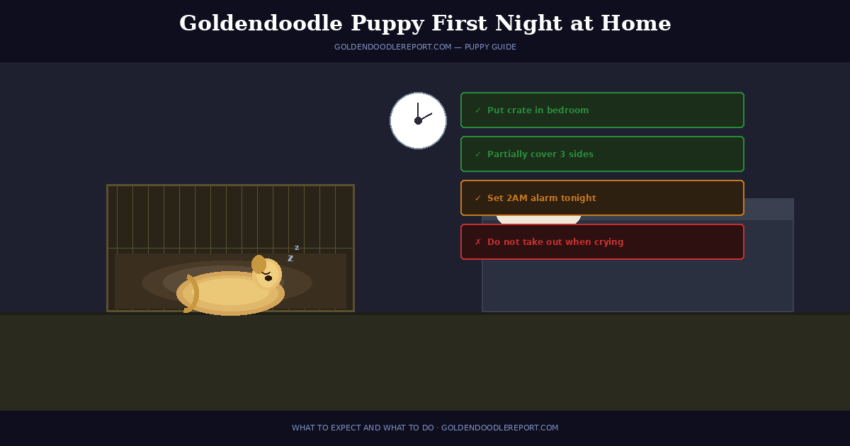
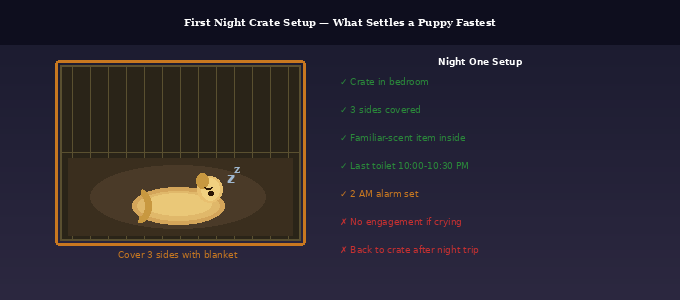
The Goldendoodle puppy first night at home involves crying — this is normal, expected, and not a sign that anything is wrong. The crying is grief and disorientation, not manipulation. The crate goes in the bedroom with you. Three sides are partially covered with a blanket. The last toilet trip is at 10 to 10:30 PM. You set an alarm for 2 AM. You do not take the puppy out of the crate in response to crying. You take it out briefly and silently at 2 AM for a toilet trip, then return it to the crate immediately. Night two will be shorter. Night three shorter still. By night five most puppies are settling within 10 to 15 minutes.
Quick Answer
What should I do on my Goldendoodle puppy’s first night at home? Set up the crate in your bedroom before pickup. Place familiar-scent bedding inside. Give the last meal no later than 5 PM. Take the last toilet trip at 10 to 10:30 PM. Place the puppy calmly in the crate, partially covered, with no fuss. Do not respond to crying. Set an alarm for 2 AM — take the puppy out briefly and silently for a toilet trip, then straight back to the crate. This is the protocol that produces the fastest improvement across subsequent nights.
The most important thing to understand before the Goldendoodle puppy first night at home is that the choices you make on night one set the behavioural precedent for weeks to come. A puppy that cries and is taken out of the crate has learned that crying opens the door. A puppy that cries and is not taken out — except at the pre-scheduled 2 AM toilet trip — has learned that the crate is safe and that crying does not produce a result. These two patterns diverge dramatically over the following nights. Choosing the right response on night one is the most powerful thing you can do for crate training success.
This guide covers:
- Setting up the crate before the puppy arrives
- The evening routine on night one
- What happens during the night and why
- The correct response to crying
- The 2 AM toilet trip — how to do it right
- What night two looks like and when things improve
In This Guide
Goldendoodle Puppy First Night at Home: Setting Up the Crate
The crate setup should be complete before the puppy arrives — not assembled on the first evening while the puppy is running around the house. A crate that is set up, comfortable, and familiar-smelling before the puppy first sees it makes the transition to sleeping inside it significantly easier. For a helpful overview of crate training principles, the AKC’s crate training guide covers the foundational approach that underpins everything in this article.
Location: The crate goes in your bedroom — specifically, next to or near your bed so you can hear the puppy and the puppy can hear and smell you. The most common mistake is placing the crate in the kitchen or a separate room to “avoid the noise.” This approach produces more noise, not less, because the puppy in complete social isolation cries with significantly more intensity and duration than one that can smell its new primary caregiver nearby.
Sizing: The crate should be large enough for the puppy to stand up, turn around, and lie down with its legs extended. No larger — excess space allows the puppy to use one end as a sleeping area and the other as a toilet, which undermines toilet training. Use a divider if the crate is sized for the adult dog rather than the current puppy.
Bedding: Line the crate floor with a washable fleece blanket or veterinary bedding. If the breeder provided a cloth with the litter’s scent, place it inside — the familiar smell is genuinely calming and reduces first-night crying duration in many puppies.
Covering: Cover three sides of the crate — back, left, right — with a blanket or towel, leaving the front open. This reduces visual stimulation and creates a den-like environment that reduces arousal. Do not cover the top if the crate is wire and requires airflow, but three sides covered is highly effective.
Water: Attach a small water bottle to the crate bars rather than placing a bowl inside — a water bowl in the crate gets tipped and produces wet, cold bedding which makes the puppy uncomfortable and more likely to cry. A water bottle provides hydration without spillage.
The Evening Routine on Night One
The evening leading up to the first night sets up the conditions for the night itself. A few specific timing choices make a measurable difference to how the night goes.
Last meal no later than 5 PM. A meal at 5 PM means the digestion cycle that drives the need to defecate is largely complete before the 10 PM last toilet trip. A meal at 8 PM means the puppy is more likely to need to defecate at 1 AM rather than holding until morning.
Wind down from 8 PM. Avoid high-arousal play in the two hours before the crate. A puppy that is still zooming at 9:30 PM takes significantly longer to settle in the crate than one that has had a calm evening of gentle interaction and settle practice.
Last toilet trip at 10 to 10:30 PM. This is the most important single timing decision of the night. Take the puppy outside to the toilet area — or, for apartment owners, to the designated toilet spot — and wait until it urinates and defecates before coming back inside. Do not rush this trip. The longer the puppy holds after this trip, the longer it sleeps before needing the 2 AM trip.
Crate entry: Place the puppy in the crate calmly after the last toilet trip. No extended goodnight rituals, no prolonged petting through the bars. Place the puppy in, close the door, and either get into bed or leave the room. The less fuss around crate entry, the faster the puppy settles.
What Happens During the Night
On night one, most Goldendoodle puppies will cry. This is completely normal and expected — understanding why it happens makes the correct response easier to hold.
The puppy has spent its entire life until this evening in a warm pile of littermates with its mother’s presence as a constant. In the space of one day, all of that is gone. The crate is unfamiliar. The smells are unfamiliar. The sounds are unfamiliar. The absence of littermate body warmth is immediate and physical. The crying is a distress call — it is what young social mammals do when separated from their group.
This is not manipulation. An 8-week-old puppy does not have the neurological capacity for strategic manipulation. The crying is grief and disorientation, and it is entirely genuine. Understanding this does not require you to respond to it — but it does make the correct response feel less like cruelty and more like what it is: allowing the puppy to adjust to a new reality that is, objectively, safe.
The typical pattern on night one: crying on crate entry, lasting 20 to 45 minutes before the puppy exhausts itself and sleeps. A period of quiet. Often a second crying bout at 1 to 2 AM when the bladder wakes the puppy. The 2 AM toilet trip. Return to crate and usually faster settling for the remainder of the night.
The Correct Response to Crying
The correct response to crying in the crate at night is no response. Not a verbal soothing. Not a hand through the bars. Not taking the puppy out. No response.
This is the hardest instruction in this guide to follow — and the most important. Here is why it matters so much.
Every time a puppy cries and receives a response — any response — it learns that crying produces a result. The result might be the owner’s voice, a hand through the bars, or being taken out of the crate. All of these are rewarding to a puppy that is lonely and distressed. The puppy’s brain records: this behaviour (crying) produced this outcome (contact with owner). It will repeat and potentially intensify the behaviour that worked.
A puppy that cries and receives no response, night after night, learns something different: this behaviour does not produce a result. It is not worth doing. The crying extinguishes. This process takes longer than one night, but it begins on night one — and it only begins correctly if the response protocol is followed from the start.
The exception is the 2 AM scheduled toilet trip, which is not a response to crying — it is a scheduled action the owner takes at a predetermined time regardless of whether the puppy is crying or quiet. The distinction matters: a toilet trip at 2 AM that happens at a fixed time is a management action. A toilet trip at 2 AM because the puppy is crying at 2 AM is a response to crying that rewards the behaviour.
Night One Response Protocol
| Situation | Correct Response | Why |
|---|---|---|
| Puppy cries on entering crate | No response — get into bed, turn off the light | Any response rewards crying and extends the behaviour |
| Puppy cries in the night (not 2AM) | No response unless signs of distress are extreme | Random responses are the worst reinforcement pattern — inconsistency makes crying more persistent |
| 2 AM alarm goes off | Get up quietly, take puppy outside, toilet trip, back to crate | Scheduled action — not a response to crying. Prevents accidents and bladder stress. |
| Puppy is quiet during the night | Do not disturb — let it sleep | Sleep is developmental — do not interrupt quiet periods |
The 2 AM Toilet Trip — How to Do It Right
The 2 AM toilet trip is essential for the first four to six weeks and needs to be done in a specific way to avoid inadvertently training the puppy to expect an exciting night-time interaction.
Keep lights low. Do not turn on bright lights — use a small lamp or torch. Bright light signals daytime to the puppy’s circadian system and makes it harder to resettle after the trip.
Say nothing. No greeting, no “good boy,” no conversation. Complete silence from the moment you open the crate to the moment you close it again after the return. Any vocal interaction rewards the night-time waking and makes the puppy more likely to be awake and alert at 2 AM in subsequent nights expecting that interaction.
Go directly outside. Straight from crate to toilet area and back. Not via the kitchen for water. Not a short play session because the puppy seems awake. A toilet trip and nothing else.
Reward quietly if the puppy toilets. A single calm “good” is sufficient — no excited praise. Return immediately to the crate and close the door.
If the puppy does not toilet within 5 minutes — return it to the crate anyway. Some nights the puppy wakes from disorientation rather than genuine bladder pressure. Returning it to the crate without a successful toilet trip is fine.
When Things Improve
The trajectory of the Goldendoodle puppy first night at home and the nights that follow is predictable when the protocol is applied consistently.
Night 1: Crying on entry — typically 20 to 45 minutes. One or two night wakings. 2 AM toilet trip. Overall a difficult night for most owners.
Night 2: Crying on entry is usually shorter — 10 to 20 minutes for most puppies. Still 2 AM trip needed. Slight improvement.
Nights 3 to 5: Entry settling time typically under 10 minutes. Night wakings reducing. Most puppies begin showing the first signs of reliable overnight settling during this window.
Week 2: Most Goldendoodle puppies with consistent crate training are settling within 5 to 10 minutes of entry and having one reliable night waking at around 2 AM rather than multiple.
10 to 16 weeks: The 2 AM trip typically becomes unnecessary as bladder capacity increases. Most puppies can hold from 10 PM to 5 to 6 AM by 12 to 14 weeks.
The rate of improvement is almost entirely determined by consistency. A puppy that has been taken out when crying on some nights will not progress as quickly as one whose response protocol has been applied without exception. Inconsistency — taking the puppy out on especially difficult nights, giving vocal reassurance on others — resets the learning and extends the process significantly.
⚠️ Watch Out
The most damaging thing owners do on the Goldendoodle puppy first night at home is respond to crying out of kindness. Taking the puppy out of the crate when it cries, allowing it to sleep in the bed, or providing sustained vocal reassurance feel compassionate in the moment — and genuinely are born from compassion. But they teach the puppy that crying produces exactly what it wants: owner contact and freedom from the crate. Night two is worse. Night three is worse still. The kindest thing for the puppy’s long-term wellbeing — its ability to be comfortable in its own space and to settle independently — is following the protocol even when it is hard to do.
Key Takeaways
- The Goldendoodle puppy first night at home will involve crying — this is normal, expected, and represents grief and disorientation, not manipulation
- The crate goes in the bedroom next to the owner’s bed — not in a separate room — for fastest settling
- Cover three sides of the crate with a blanket to create a den-like environment
- Last toilet trip at 10 to 10:30 PM — wait until both urination and defecation are complete
- Do not respond to crying in the night — any response trains the puppy that crying works
- Take the 2 AM scheduled toilet trip in complete silence and return the puppy to the crate immediately after
Related Goldendoodle Puppy Guides
- First Week With a Goldendoodle Puppy — The full first week context that the first night is part of
- Goldendoodle Puppy Sleep Schedule — How much sleep is normal and when the 2 AM trip stops being needed
- Goldendoodle Puppy Care Guide — Complete first-year overview including crate training
- Goldendoodle Daily Routine — The structure that makes nights progressively easier
- Best Crate for Goldendoodle Puppies — Choosing the right size and type of crate
Part of the Goldendoodle Puppy Guide resource hub:
→ Goldendoodle Puppy Guide — Browse all 40 puppy guides
Frequently Asked Questions
How long will my Goldendoodle puppy cry on the first night?
Most puppies cry for 20 to 45 minutes on the first night before exhausting themselves and sleeping. The duration decreases meaningfully each subsequent night with consistent protocol — by night three to five, most Goldendoodle puppies are settling within 10 to 15 minutes. The total duration of night one crying is almost entirely influenced by one factor: whether previous attempts at settling the puppy have included any owner responses to crying, which teach the puppy that crying eventually produces a result worth waiting for.
Should I put anything in the crate with my Goldendoodle puppy on the first night?
A washable fleece blanket or veterinary bedding for warmth and comfort. If the breeder provided a cloth or item with the litter’s scent, include it — familiar smell significantly reduces first-night distress. A water bottle attached to the bars rather than a bowl. Do not include food, as this increases overnight elimination frequency. Avoid toys with small parts that could be chewed off and swallowed during the night when you are not supervising.
My puppy is crying so intensely it sounds like it is in pain — should I check on it?
Assess briefly and non-engagingly: look at the puppy through the bars or from a distance to confirm it is not caught in the crate, vomiting, or injured. If it is physically fine and crying is vocal distress rather than an injury response — which is almost always the case — return to bed without engaging. The intensity of the crying is not a guide to whether a response is appropriate. Many puppies cry intensely on night one. It is distressing to hear. It is not an emergency in a healthy puppy who has been recently fed and toileted.
Can I let my puppy sleep in my bed on the first night just for tonight?
This is the most consequential decision of night one. A puppy that sleeps in the bed on night one will expect to sleep in the bed on night two. Removing a comfort that has been granted is significantly harder than never granting it. If your plan is for the adult dog to sleep in your bed, allowing this from night one is a reasonable choice and the puppy will learn to settle there. If your plan is for the adult dog to sleep in its own space, crate training from night one is the kindest approach — because removing the privilege after two or three weeks of bed sleeping is genuinely distressing for the puppy in ways that a consistent crate routine from night one never is.
The puppy woke up crying at midnight — do I take it out for a toilet trip?
Not unless it is close to the 2 AM scheduled trip or the puppy is showing clear physical urgency signals — circling, squatting — rather than vocal distress. A midnight waking in most 8 to 10 week puppies is more likely disorientation than genuine bladder urgency. Responding to it with a toilet trip rewards the midnight waking and teaches the puppy that waking at midnight produces an interesting result. If the puppy is past 10 weeks and the last trip was at 10:30 PM, midnight is probably too soon for genuine bladder urgency. Hold to the 2 AM scheduled trip unless there are clear signs of physical distress.
The information in this article is provided for general educational purposes only. King James Adjei is a researcher and enthusiast, not a veterinarian or certified behaviourist. For persistent, extreme distress or physical signs during the night, consult a qualified veterinarian.