6-minute read | Last updated March 2026 | Reviewed for accuracy
By King James Adjei | GoldendoodleReport.com
Researcher, Goldendoodle enthusiast, and founder of GoldendoodleReport. Every guide on this site is written to give owners reliable, clearly organised information — researched carefully and updated regularly.
A Goldendoodle puppy sleep schedule is one of the most misunderstood aspects of early puppy care. New owners frequently worry that their puppy is sleeping too much, try to keep it awake for interaction, or skip naps to fit the puppy around the household schedule. All of these responses are counterproductive. This guide covers exactly how much sleep is normal at each age, why enforcing that sleep is one of the most important things an owner can do, and the signs that indicate a genuine problem rather than normal puppy rest.
Who This Guide Is For
This article is most useful if you:
- Have a new Goldendoodle puppy and want to know how much sleep is normal at their current age
- Are concerned your puppy is sleeping too much and want to know whether this warrants a vet visit
- Have been allowing the puppy to skip naps and want to understand why enforcing them matters
- Want to structure sleep into a consistent daily routine that makes everything else easier
For the complete daily routine that the sleep schedule fits into, see the Goldendoodle Daily Routine guide.
Quick Summary
A Goldendoodle puppy sleep schedule at 8 weeks requires 16 to 20 hours of sleep per day — distributed across multiple naps throughout the day and night, not just overnight. This is not laziness and it is not a sign of illness. Sleep is when puppy brains consolidate training, when physical growth occurs, and when the immune system develops. Skipping naps produces an overtired, overstimulated puppy that bites harder, settles worse, and learns more slowly. The most common sign of an overtired puppy is frantic evening behaviour — not tiredness.
Quick Answer
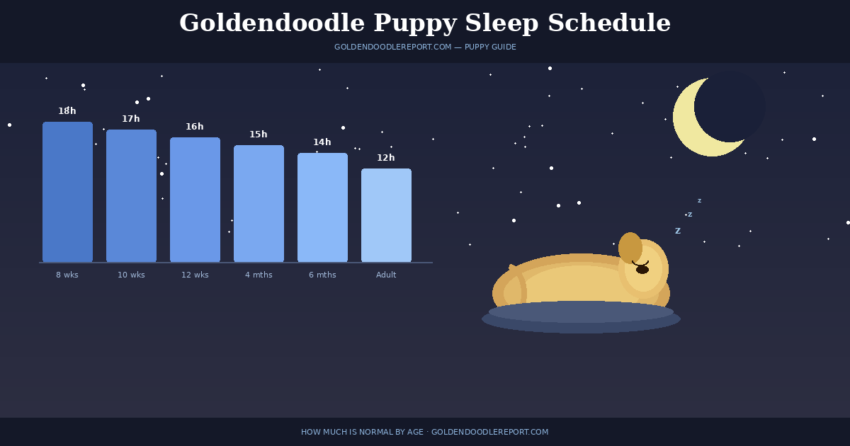
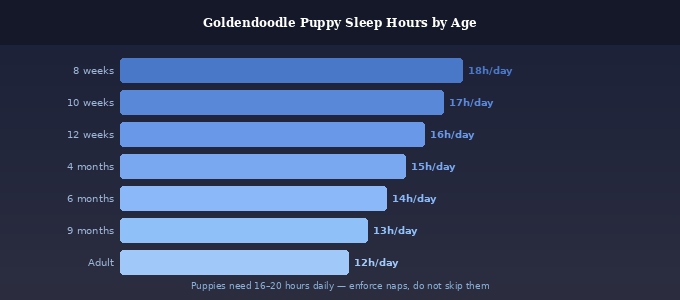
How much should a Goldendoodle puppy sleep? At 8 weeks: 16–20 hours daily. At 12 weeks: 15–18 hours. At 4 months: 14–16 hours. At 6 months: 13–15 hours. Adult: 12–14 hours. Sleep decreases gradually as the puppy matures — but even adult Goldendoodles sleep significantly more than humans. Puppies need far more than most owners expect, and enforcing that sleep is part of responsible early puppy care.
The most common sign that a Goldendoodle puppy is being kept awake past the point its developing brain can manage is escalating biting, inability to settle, and increasingly frantic behaviour in the evenings — what owners often call the “witching hour.” This is almost always an overtired puppy that needs sleep, not a stimulation or exercise problem. Recognising this pattern is the first step toward a smoother experience for both puppy and owner.
This guide covers:
- The Goldendoodle puppy sleep schedule by age — hours and nap frequency
- Why puppies need so much sleep and what happens during it
- How to enforce naps using the crate
- The difference between an overtired puppy and a sick one
- Night sleep — what is normal and when it improves
- The most common sleep schedule mistakes
In This Guide
Goldendoodle Puppy Sleep Schedule by Age
The Goldendoodle puppy sleep schedule changes significantly across the first year. The figures below represent total daily sleep including all naps — not just overnight sleep.
Goldendoodle Puppy Sleep Schedule — Hours by Age
| Age | Total Daily Sleep | Naps Per Day | Nap Duration | Max Awake Window |
|---|---|---|---|---|
| 8 weeks | 16–20 hours | 4–6 naps | 30 min–2 hours | 1–2 hours |
| 10 weeks | 16–18 hours | 4–5 naps | 45 min–2 hours | 1–2 hours |
| 12 weeks | 15–18 hours | 3–4 naps | 1–2.5 hours | 2 hours |
| 4 months | 14–16 hours | 2–3 naps | 1–3 hours | 2–3 hours |
| 6 months | 13–15 hours | 1–2 naps | 1–2 hours | 3–4 hours |
| 9–12 months | 12–14 hours | 1 nap | 1–2 hours | 4–6 hours |
| Adult (2+ yrs) | 12–14 hours | 1 or more | Variable | Self-regulating |
The maximum awake window is the most practical figure in this table. It tells you when to put the puppy in the crate for a nap regardless of whether it appears tired. At 8 weeks a puppy that has been awake for two hours needs to sleep even if it is still active — the brain is at its developmental limit whether the behaviour shows it or not.
Why Puppies Need So Much Sleep
The volume of sleep a Goldendoodle puppy requires is not incidental — it is biologically essential. For the science behind why dogs sleep so much, the AKC’s guide to dog sleep covers the neurological basis in detail. Sleep serves four critical functions that cannot be substituted by rest while awake.
Brain development and training consolidation. The experiences, exposures, and training inputs of each waking period are processed into long-term memory during sleep. A puppy taught to sit and then kept awake learns the command less effectively than one given a nap after the session. Sleep is part of the learning process, not a break from it — this is why a consistent Goldendoodle puppy sleep schedule directly supports training progress.
Physical growth. Growth hormone is released primarily during sleep in puppies, just as in human infants. Bone, cartilage, and muscle develop during sleep. Given that Goldendoodles are already predisposed to joint issues if over-exercised, protecting the sleep that supports proper physical development is particularly relevant for this breed.
Immune system development. The period from 8 to 16 weeks is when maternally derived immune protection wanes and the puppy’s own immune system develops. Sleep is critical to immune function at every age but especially so during this window when the primary vaccination series is underway.
Emotional regulation. Sleep deprivation in puppies produces the same effects as in young children — escalating irritability, reduced impulse control, and lowered frustration thresholds including harder biting. Most of what owners experience as difficult evening puppy behaviour is overtiredness rather than a behaviour problem.
How to Enforce Naps
Enforcing naps is the most important and least intuitive part of managing a Goldendoodle puppy sleep schedule. An overtired puppy does not look tired — it often looks more energetic and frantic than a rested one, because the stress hormones released by fatigue produce hyperactivity rather than drowsiness.
The crate is the tool that makes enforced naps work. When the awake window closes, place the puppy in the crate in a quiet, low-stimulation environment. The crate prevents the puppy from continuing to receive stimulation that keeps it awake despite neurological exhaustion. Most puppies settle and sleep within 5 to 15 minutes once environmental stimulation is removed.
The key elements of successful enforced naps are reduced light, low noise, a familiar-scented blanket in the crate, and the owner not hovering or engaging through the bars. A crate partially covered with a blanket on three sides reduces visual stimulation significantly and helps puppies settle faster.
Do not wait for the puppy to fall asleep on the sofa or in your arms and then transfer it to the crate. The nap then becomes associated with that location, not the crate — and the puppy often wakes during transfer. Place the puppy in the crate while still awake and let it settle there. This is the association that makes every future nap easier.
Overtired Versus Sick — How to Tell the Difference
Because puppies sleep so much, new owners struggle to distinguish between appropriate sleepiness and illness-related lethargy. The distinction matters because the correct responses are opposite.
Overtired Puppy vs Sick Puppy — Key Differences
| Overtired Puppy — Needs Sleep | Sick Puppy — Needs Vet Attention |
|---|---|
| Frantic, hyper, biting harder than usual | Slow, unresponsive, difficult to rouse |
| Occurs after a long awake window | Occurs even after adequate sleep |
| Settles and sleeps quickly in crate | Limp, uninterested in surroundings when awake |
| Normal appetite when awake | Refusing food and water |
| Wakes alert and engaged after nap | Gums pale, white, or bluish |
| Normal temperature, no vomiting | Vomiting, diarrhoea, or both present |
The single most useful distinguishing factor is what happens after sleep. An overtired puppy wakes from a nap refreshed, alert, and engaged. A sick puppy remains dull and uninterested after waking. If in doubt in the first two weeks at home — when rehoming stress already suppresses the immune system — contact your vet rather than waiting.
Night Sleep — What Is Normal and When It Improves
Night sleep is the part of the Goldendoodle puppy sleep schedule that most directly affects new owners because it determines how much sleep the owner gets.
Weeks 1–2 at home (8–10 weeks): One overnight toilet trip is necessary — most puppies cannot hold their bladder through 8 hours at this age. Expect waking once overnight, typically around 2 AM with a 10 PM last trip. This is bladder physiology, not a crate training failure.
10–14 weeks: Most puppies begin extending overnight holds to 5–6 hours. A 10 PM last trip and 4–5 AM first trip becomes the normal pattern. Some puppies in this window begin holding through entirely — this is individual variation.
14–16 weeks: The majority of Goldendoodle puppies hold through a full 7–8 hour night by this age with a consistently late last toilet trip at 10–10:30 PM.
4–6 months: Reliable overnight holding is established for most puppies. If consistent night waking persists at 5 months, assess whether the last trip is early enough, whether waking has been rewarded with owner attention, or whether a urinary tract infection — common and easily treated — is worth ruling out with your vet.
Common Sleep Schedule Mistakes
Keeping the puppy awake for visitors. A puppy past its awake window needs a nap, not an audience. An overtired puppy meeting visitors is overstimulated and bites harder — a rested puppy meeting visitors is calm and makes a better impression. Enforce the nap first.
Allowing unstructured napping around the house. A puppy that naps freely on laps, sofas, and floors has an unpredictable schedule that makes toilet training harder. Crate naps build the crate association and create predictable elimination timing. Both matter.
Responding to frantic evening behaviour with more play. The most common sleep schedule mistake. The puppy appears to need more activity — so the owner plays more, raising arousal further and deepening overtiredness. The correct response is to remove stimulation and crate the puppy. Most witching-hour behaviour resolves within 10 minutes of crate entry.
Waking the puppy early from naps. Sleep is doing active developmental work. Unless you have a specific reason — toilet trip, medical — let the nap run its full course.
⚠️ Watch Out
The most common Goldendoodle puppy sleep schedule mistake is skipping enforced naps because the puppy does not seem tired. An overtired puppy does not look tired — it looks frantic, bitey, and hyperactive. By the time the puppy is showing these signs, it is already past where it should have been in the crate. The maximum awake window in the table above is your guide — when it closes, the nap happens regardless of what the puppy’s behaviour suggests.
Key Takeaways
- A Goldendoodle puppy sleep schedule at 8 weeks requires 16–20 hours of daily sleep — this is biologically essential, covering brain development, physical growth, and immune function
- The maximum awake window — 1 to 2 hours at 8 weeks — is the most practical figure; when it closes, enforce the nap regardless of what the puppy’s behaviour suggests
- Frantic, bitey evening behaviour is almost always an overtired puppy, not one that needs more stimulation — remove the stimulation and crate the puppy
- Sleep consolidates training into memory — a nap after a training session improves retention more than continuing the session
- Most Goldendoodle puppies hold through the night reliably by 14–16 weeks with consistent late last toilet trips
- An overtired puppy wakes refreshed; a sick puppy remains dull after sleep — when in doubt, contact your vet
Related Goldendoodle Puppy Guides
- How Much Sleep Does a Goldendoodle Puppy Need? — The full breakdown of sleep requirements by age
- Goldendoodle Daily Routine — How to structure the full day including all nap windows
- Goldendoodle Puppy Routine at 8 Weeks — Hour-by-hour schedule with all nap windows marked
- Goldendoodle Puppy First Night at Home — What to expect on night one and how to handle it
- Goldendoodle Puppy Biting Phase Guide — Why overtiredness makes biting worse and what to do
Part of the Goldendoodle Puppy Guide resource hub:
→ Goldendoodle Puppy Guide — Browse all 40 puppy guides
Frequently Asked Questions
Is it normal for a Goldendoodle puppy to sleep 20 hours a day?
Yes — at 8 weeks, 18 to 20 hours of total daily sleep is within the normal range. This includes all naps throughout the day combined with overnight sleep. If the puppy wakes alert, feeds normally, and engages actively during awake windows, this is normal puppy development. If the puppy is difficult to rouse, uninterested in food, or remains dull after waking, those signs warrant a vet visit.
Should I wake my Goldendoodle puppy to feed it?
Generally no — for healthy puppies over 8 weeks brought home at normal weight. If the puppy is sleeping through a scheduled meal time, let it sleep and feed when it wakes naturally. The exception is very small or underweight puppies at risk of hypoglycaemia — if your vet has flagged this specifically, follow their guidance on feeding frequency over sleep.
My Goldendoodle puppy wakes at 3 AM every night — is this normal?
At 8 to 10 weeks yes — one overnight toilet trip is normal and expected. By 12 to 14 weeks this should be reducing. If consistent 3 AM waking persists past 14 weeks, assess whether the puppy is being inadvertently rewarded for waking with attention, play, or engagement. If so, the waking has been trained. Reduce the reward by keeping trips silent, brief, and immediately returning the puppy to the crate.
How do I stop my Goldendoodle puppy from fighting naps?
Fighting nap entry is normal — it does not mean the puppy does not need sleep. It means the puppy does not want to leave the interesting environment. Use the crate, reduce light and noise, cover three sides of the crate, and leave the area after crating rather than staying near it. Most puppies that fight entry settle within 5 to 15 minutes once stimulation is removed.
At what age do Goldendoodle puppies start sleeping through the night?
Most Goldendoodle puppies sleep reliably through a 7 to 8 hour night by 14 to 16 weeks, provided the last toilet trip is at 10 to 10:30 PM and overnight waking has not been reinforced with attention. Some achieve this earlier, some later. If consistent night waking continues at 5 months, a veterinary check for urinary tract issues and an honest assessment of whether waking has been rewarded are both appropriate next steps.
The information in this article is provided for general educational purposes only. King James Adjei is a researcher and enthusiast, not a veterinarian. For concerns about lethargy, abnormal sleep, or persistent night waking in an older puppy, always consult a qualified veterinarian.