6-minute read | Last updated March 2026 | Reviewed for accuracy
By King James Adjei | GoldendoodleReport.com
Researcher, Goldendoodle enthusiast, and founder of GoldendoodleReport. Every guide on this site is written to give owners reliable, clearly organised information — researched carefully and updated regularly.
How much sleep does a Goldendoodle puppy need is one of the first questions new owners search — usually because their puppy appears to be sleeping far more than they expected and they want to know whether something is wrong. The answer is specific, biological, and reassuring: puppies at 8 weeks need 16 to 20 hours of sleep daily, and that quantity is not incidental — it is the result of four simultaneous biological processes that only happen during sleep.
Who This Guide Is For
This article is most useful if you:
- Have a puppy that is sleeping a lot and want to know whether this is normal for their age
- Have been waking your puppy for interaction or socialisation and want to know if this is harmful
- Want to understand the difference between a puppy sleeping normally and one that is lethargic from illness
- Are following a daily routine and want to know how many naps are appropriate
For the full nap schedule and awake windows by age, see Goldendoodle Puppy Sleep Schedule.
Quick Summary
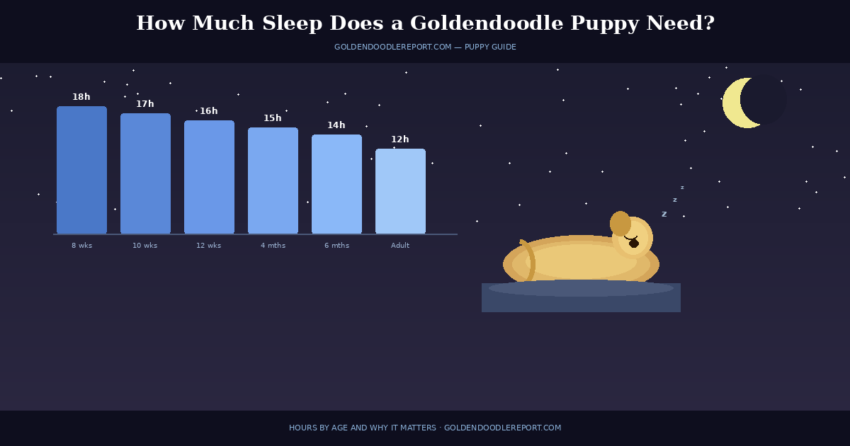
How much sleep does a Goldendoodle puppy need? At 8 weeks: 16 to 20 hours daily. At 12 weeks: 15 to 18 hours. At 4 months: 14 to 16 hours. At 6 months: 13 to 15 hours. These are not approximate suggestions — they reflect the biological reality of what is happening in the puppy’s brain, bones, immune system, and nervous system during sleep. The requirement decreases gradually as development progresses. An 8-week puppy sleeping 18 hours a day is healthy. An 8-week puppy sleeping only 10 hours a day is not.
Quick Answer
A Goldendoodle puppy at 8 weeks needs 16 to 20 hours of sleep per day, distributed across multiple naps. At 6 months the requirement is 13 to 15 hours. Adult Goldendoodles sleep 12 to 14 hours daily. Never wake a sleeping puppy except for a scheduled toilet trip. Sleep deprivation in puppies impairs brain development, immune function, and growth hormone release — all of which only occur during sleep.
Quick Diagnosis
- If your puppy sleeps 16 to 20 hours at 8 weeks and wakes alert and active → completely normal, do not restrict sleep
- If your puppy sleeps and is difficult to rouse, limp when held, or uninterested in food when awake → not normal tiredness, contact vet
- If your puppy falls asleep mid-play → normal at 8 to 12 weeks, the brain has reached its developmental limit for that session
- If your puppy sleeps much less than 14 hours and seems wired and bitey in the evenings → overtired, enforce naps using the crate
Your 10-week Goldendoodle has been home for two weeks. You read that the socialisation window closes at 16 weeks and you are determined to maximise every day of it. You start waking the puppy after 45-minute naps to fit in more exposure sessions. By week three the puppy is biting harder in the evenings, struggling to settle, and making slower progress in training than the week before. The socialisation effort is undermining itself — an overtired puppy cannot consolidate new experiences during the sleep it is not getting.
The universal concern among new Goldendoodle owners is that something must be wrong when a puppy sleeps this much. This concern is understandable — adult dogs sleep 12 to 14 hours, which already seems like a lot to most people. The idea that a healthy puppy needs 16 to 20 hours feels excessive. But the comparison is misleading: adult dogs are maintaining a mature system, while puppies are building one from scratch. The demands on a puppy’s biology during the first months of life are categorically different, and sleep is where the majority of that biological work happens.
This guide covers:
- Why puppies need so much sleep — the four biological functions
- Sleep hours by age — specific figures from 8 weeks to adulthood
- Normal sleep signs versus signs that require veterinary attention
- Whether to wake a sleeping puppy — specific rules and exceptions
- How overtiredness presents and why it looks like hyperactivity
In This Guide
- How Much Sleep Does a Goldendoodle Puppy Need: The Four Biological Reasons
- Sleep Hours by Age — Specific Figures
- Normal Sleep vs Signs That Need Veterinary Attention
- Should You Wake a Sleeping Puppy?
- Overtiredness — Why It Looks Like Hyperactivity
- What Most Owners Get Wrong
- Frequently Asked Questions
How Much Sleep Does a Goldendoodle Puppy Need: The Four Biological Reasons
The question of how much sleep a Goldendoodle puppy needs cannot be answered meaningfully without understanding what sleep is doing during the first months of life. Sleep in young puppies is not passive rest — it is the period during which the most critical developmental work occurs. Four biological processes run simultaneously during sleep, none of which can be substituted by rest while awake. For a broader overview of canine sleep science, the American Kennel Club’s guide to how much dogs sleep covers the foundational research clearly.
1. Brain development and memory consolidation. Every training session, socialisation exposure, and new experience the puppy has during its waking hours is processed and transferred into long-term memory during sleep — specifically during the slow-wave and REM sleep stages. A puppy that does not sleep enough after a training session retains the learning less effectively than one that sleeps promptly after. This is the direct neurological basis for the rule that naps should follow training: the sleep is part of the learning process, not a break from it.
2. Physical growth and bone development. Growth hormone in puppies — as in human infants — is released primarily during deep sleep rather than during waking hours. The skeletal and muscular development that produces a healthy adult Goldendoodle is driven by growth hormone pulses that occur during sleep. Restricting sleep during the growth period does not just make the puppy tired — it directly interferes with the physiological process producing the adult body.
3. Immune system development. The period from 8 to 16 weeks coincides with the waning of maternally derived immune protection and the development of the puppy’s own immune response. Sleep is critical to immune function at every life stage, but the demand is highest when the immune system is actively developing. A sleep-deprived puppy during the primary vaccination period has a compromised immune response at the precise time when immune development is most active.
4. Nervous system and emotional regulation. Sleep deprivation in puppies, exactly as in young children, produces a degraded capacity for emotional self-regulation. The result is a puppy with a lower threshold for frustration, reduced impulse control, heightened reactivity to stimuli, and a harder bite. Owners who describe their puppy’s behaviour escalating in the evenings are almost always observing overtiredness rather than a genuine behaviour problem. The solution is sleep, not more stimulation or correction.
Sleep Hours by Age — Specific Figures
How Much Sleep Does a Goldendoodle Puppy Need — By Age
| Age | Total Daily Sleep | Naps Per Day | Max Awake Window | Primary Driver |
|---|---|---|---|---|
| 8 weeks | 16–20 hours | 4–6 naps | 1–2 hours | Brain + immune development |
| 10 weeks | 16–18 hours | 4–5 naps | 1–2 hours | Memory consolidation + growth |
| 12 weeks | 15–18 hours | 3–4 naps | 2 hours | Socialisation processing |
| 4 months | 14–16 hours | 2–3 naps | 2–3 hours | Teething recovery + training retention |
| 6 months | 13–15 hours | 1–2 naps | 3–4 hours | Adolescent neurological development |
| 9–12 months | 12–14 hours | 1 nap | 4–6 hours | Transitioning to adult pattern |
| Adult (2+ yrs) | 12–14 hours | Self-regulating | Self-regulating | Maintenance and recovery |
These figures represent total daily sleep including all naps — not overnight sleep alone. An 8-week puppy sleeping 18 hours in a 24-hour period, distributed across overnight sleep and 4 to 6 daytime naps, is perfectly normal. A puppy sleeping only 10 hours total in 24 hours is sleep-deprived regardless of how active it appears.
Normal Sleep vs Signs That Need Veterinary Attention
The most frequent source of owner anxiety around puppy sleep is the inability to distinguish between a puppy sleeping normally and one that is lethargic from illness. The two can superficially appear similar — both involve a puppy that is unresponsive and horizontal. The differences are consistent and observable.
Normal Sleep vs Abnormal Lethargy — How to Tell the Difference
| Normal — Let the Puppy Sleep | Abnormal — Contact Vet |
|---|---|
| Sleeping 16–20 hours at 8 weeks — this is the expected amount | Sleeping far beyond age-appropriate amounts and difficult to rouse even briefly |
| Wakes alert, energetic, and hungry after each nap | Wakes dull, unresponsive, or immediately falls back asleep without eating |
| Falls asleep mid-play — especially at 8 to 12 weeks | Limp and unresponsive when picked up rather than simply sleepy |
| Breathing is slow and even during sleep — occasional twitching is normal REM | Laboured, irregular, or very rapid breathing during sleep |
| Normal pink gums when checked while asleep | Pale, white, blue, or grey gums — urgent veterinary attention required |
| Eats normally and toilets normally during wake periods | Refuses food when awake, vomiting, or diarrhoea accompanying the lethargy |
The single most reliable distinguishing factor is what happens when the puppy wakes. A normally sleeping puppy emerges from a nap alert, engaged, and ready to eat and interact. A puppy that is lethargic from illness remains dull and disinterested after waking. If you are uncertain in the first two weeks at home — when rehoming stress suppresses immune function — contact your vet rather than waiting.
Should You Wake a Sleeping Puppy?
The general rule is unambiguous: do not wake a sleeping puppy. Sleep is doing active developmental work — interrupting it is not neutral. The reasons given for waking sleeping puppies — to fit in more socialisation, to maintain a schedule, to stop the puppy sleeping too much — are almost always counterproductive. A puppy woken from a nap before it has completed its sleep cycle is a tired, irritable, less receptive puppy that will learn less, socialise less effectively, and bite harder than one allowed to complete its rest.
There are three specific exceptions where waking is appropriate:
Exception 1 — Scheduled overnight toilet trip. At 8 to 12 weeks, a pre-set toilet trip at approximately 2 AM prevents accidents and is appropriate. This should be done silently, briefly, and with immediate return to the crate — not as an interactive session.
Exception 2 — Missed meal time in a very young puppy. Puppies under 10 weeks from small or underweight litters may be at risk of hypoglycaemia if they sleep through a meal. If your vet has flagged this risk specifically, follow their guidance over the general rule. For healthy, normal-weight puppies this exception does not apply.
Exception 3 — Veterinary instruction. If your vet has given specific instructions about waking frequency for a medical reason, follow that guidance above all else.
Outside of these three exceptions, the puppy sleeps until it wakes. If visitors want to see the puppy and it is napping — they wait. If a socialisation session was planned and the puppy has fallen asleep — it waits. Sleep is the priority.
Overtiredness — Why It Looks Like Hyperactivity
The most counterintuitive fact about puppy sleep is that a sleep-deprived puppy does not look tired. It looks frantic, bitey, and incapable of settling. This is because sleep deprivation in mammals triggers the release of cortisol and adrenaline — stress hormones that produce hyperarousal rather than drowsiness. The biological drive to stay awake despite exhaustion manifests as escalating activity, not reduced activity.
The practical consequence is that owners who interpret their puppy’s frantic evening behaviour as needing more stimulation and exercise make the problem worse by providing exactly that. The correct response to a frantic, bitey, hyper puppy in the early evening is to place it in the crate and remove all stimulation. In most cases the puppy is asleep within 5 to 10 minutes. The behaviour was not an energy problem — it was an overtiredness problem wearing the mask of hyperactivity.
Signs the puppy is overtired rather than energetic: biting harder than usual, inability to disengage from stimulation, frantic movement with no apparent goal, inability to focus during training, and escalating rather than reducing arousal when given more interaction. All of these are crate signals, not exercise signals.
What Most Owners Get Wrong
Mistake 1 — Restricting naps to keep the puppy awake for socialisation or interaction. Socialisation cannot happen effectively in a sleep-deprived puppy. The experiences a tired puppy has during socialisation are processed less completely and retained less durably than those of a rested puppy. A puppy that has its nap, then meets a new person, then has another nap consolidates that meeting into long-term memory. A puppy kept awake through exhaustion to squeeze in more exposures retains less and reacts more fearfully to novel stimuli. Sleep the puppy, then socialise it.
Mistake 2 — Interpreting heavy daytime sleeping as a sign of illness. A puppy sleeping 18 hours in a 24-hour period at 8 weeks is not sick. It is doing exactly what its biology requires. The concern about excessive sleep is almost never warranted in a puppy that wakes alert, eats normally, and is energetic during awake windows. The question to ask is not “is my puppy sleeping too much?” but “does my puppy wake up right, eat right, and behave normally when it is awake?”
Mistake 3 — Waking the puppy to enforce a human-schedule routine. Owners who wake their puppy at a specific time every morning to maintain a schedule are disrupting sleep cycles that serve developmental purposes. The puppy’s sleep schedule should be led by its biology in the first 12 weeks — consistent nap timing emerges naturally when the crate is used consistently and the awake windows are respected. Enforcing human clock-based schedules on an 8-week puppy produces an overtired, schedule-resistant dog rather than the structured routine the owner was hoping to create.
⚠️ Watch Out
The most damaging sleep mistake for a Goldendoodle puppy is not restricting total hours but restricting individual naps. A puppy woken after 30 minutes because “it has slept enough” is being denied the deep sleep stages where growth hormone is released and memory consolidates. This happens most commonly when owners want to show the puppy off to visitors or squeeze in a training session. Let naps run their natural course — a nap that ends naturally produces a rested puppy. A nap interrupted at the 30-minute mark produces a groggy, irritable one.
When to Contact Your Vet
- Puppy is difficult to rouse and remains dull or unresponsive after waking
- Gums are pale, white, blue, or grey when checked — this is an emergency
- Lethargy is accompanied by vomiting, diarrhoea, or refusal to eat
- Breathing during sleep is laboured, irregular, or very rapid
- A previously energetic puppy becomes suddenly lethargic without explanation
Action Plan — Managing Your Puppy’s Sleep Correctly
- Check the awake window for your puppy’s current age. Use the table above. When the window closes, enforce the nap in the crate — do not wait for visible tiredness signals.
- Stop waking the puppy for visitors, socialisation, or schedule convenience. If the puppy is asleep, it sleeps. Visitors wait. Sessions reschedule. Sleep does not.
- Place the puppy in the crate for naps — do not allow free napping on the sofa or floor. Crate naps build the association that makes every future nap easier and protect the puppy from interruption.
- If the puppy shows frantic evening behaviour — crate it, do not exercise it more. Escalating biting and inability to settle in the evening is an overtiredness signal. Remove stimulation, enforce the nap.
- Check gums once weekly during the first month. Press a finger to the gum — it should be pink and moist. Pale or white gums at any time are an emergency.
What to Expect
Timeline: Sleep requirements decrease gradually — you will not notice a dramatic shift week to week but will see clear reduction comparing 8 weeks to 4 months. The biggest observable change is the evening settling time: by 14 to 16 weeks most puppies hold through the night reliably with a late last toilet trip.
Friction: Enforcing naps for a puppy that does not appear tired — particularly when visitors want to interact or socialisation sessions are planned — requires deliberate discipline. The puppy’s apparent energy at the end of an awake window is not a signal that it does not need sleep.
Signs the approach is working: Puppy wakes from naps alert and hungry. Evening behaviour is calm rather than frantic. Training sessions produce focused, willing responses. Biting intensity is not escalating in the evenings.
Your Next Step
Check the awake window for your puppy’s current age in the table above. When the next window closes — enforce the nap in the crate regardless of whether the puppy appears tired. Do not wait for visible fatigue signals. The awake window is the guide, not the puppy’s behaviour.
Signs Your Approach Is Working
- Puppy wakes from every nap alert, energetic, and ready to eat
- Evening behaviour is settled rather than frantic and bitey
- Training sessions produce focused attention — the puppy is not too tired to engage
- Night-time settling is improving week on week
Key Takeaways — How Much Sleep Does a Goldendoodle Puppy Need?
- At 8 weeks: 16 to 20 hours of total daily sleep is normal and necessary — not a sign of illness
- Sleep serves four biological functions that cannot be substituted by rest while awake: brain development, growth hormone release, immune development, and emotional regulation
- Do not wake a sleeping puppy except for a scheduled overnight toilet trip, a vet-specific medical reason, or hypoglycaemia risk in underweight puppies
- Overtired puppies look hyperactive, not tired — frantic evening behaviour is a nap signal, not an exercise signal
- The question to ask is not whether the puppy is sleeping too much but whether it wakes alert, eats normally, and behaves appropriately during awake windows
- Sleep deprivation impairs training retention, socialisation consolidation, and immune function — it is not a neutral outcome of busy schedules
Related Goldendoodle Puppy Guides
- Goldendoodle Puppy Sleep Schedule — The full nap schedule, awake windows, and crate enforcement by age
- Goldendoodle Daily Routine — How to structure the full day around sleep requirements
- Goldendoodle Puppy Biting Phase Guide — Why overtiredness intensifies biting and how to separate the two issues
- Goldendoodle Puppy Growth Stages — How sleep requirements fit into the full developmental timeline
- Goldendoodle Puppy Care Guide — Complete first-year overview including all health and development milestones
Part of the Goldendoodle Puppy Guide resource hub:
→ Goldendoodle Puppy Guide — Browse all 40 puppy guides
Frequently Asked Questions
Is it normal for a Goldendoodle puppy to sleep 20 hours a day?
Yes — at 8 weeks, 18 to 20 hours of total daily sleep is within the normal range and reflects the biological demands of rapid development. The puppy waking alert, eating normally, and being energetic during its 1 to 2 hour awake windows is the key confirmation of health. A puppy sleeping 20 hours that wakes lethargic and uninterested in food is a different situation entirely — that pattern warrants veterinary contact regardless of total sleep hours.
My puppy falls asleep during play — is this normal?
Completely normal at 8 to 14 weeks. The awake window at this age is genuinely short — 1 to 2 hours — and the brain reaches its developmental limit quickly regardless of how engaging the activity is. A puppy that falls asleep mid-game has not lost interest in you — it has run out of neurological capacity for that session. Place it gently in the crate to complete its sleep rather than on the sofa or floor where it may be disturbed.
Should I wake my Goldendoodle puppy if it sleeps through a meal time?
For healthy, normal-weight puppies over 10 weeks — generally no. Allowing the puppy to sleep and feeding it when it wakes naturally is appropriate. The exception is puppies under 10 weeks, very small puppies, or puppies your vet has flagged as being at hypoglycaemia risk. For those puppies, follow veterinary guidance specifically regarding feeding frequency. For a healthy 12-week Goldendoodle that misses one meal time because it is asleep — let it sleep.
Why is my Goldendoodle puppy suddenly sleeping more than usual?
A sudden increase in sleep beyond the age-appropriate amount can occur after a particularly active or stimulating day — the extra sleep is the brain processing and consolidating the increased input. This is normal and temporary. A sudden increase in sleep accompanied by any of the abnormal signs in the table above — difficulty rousing, dull waking, pale gums, laboured breathing, refusal to eat, vomiting, or diarrhoea — is not normal and requires veterinary contact that day.
Does a Goldendoodle puppy need more sleep than other breeds?
The sleep requirements at each developmental stage are broadly consistent across all dog breeds — all puppies at 8 weeks need 16 to 20 hours regardless of breed. What may vary is the intensity of the waking period — Goldendoodles, as a high-energy, high-intelligence breed, tend to be more intensely engaged during their awake windows, which means they genuinely require the full sleep allocation to recover and consolidate. The sleep requirement does not differ from other breeds but the cost of shortchanging it may be more visible in a breed this active and intelligent.
The information in this article is provided for general educational purposes only. King James Adjei is a researcher and enthusiast, not a veterinarian. For concerns about lethargy, abnormal sleep patterns, or any of the warning signs listed above, always consult a qualified veterinarian.