How to bond with a Goldendoodle puppy is one of the most searched questions new owners ask — and one of the most incompletely answered. Most guides list activities like “spend time together” and “play games” without explaining what actually happens neurologically when a deep bond forms, why some activities build genuine trust while others build dependency, or what to do when the puppy seems more attached to someone else in the household. This guide covers the mechanism, the four pillars, and the week-by-week approach that produces a dog genuinely bonded to you rather than simply comfortable around you.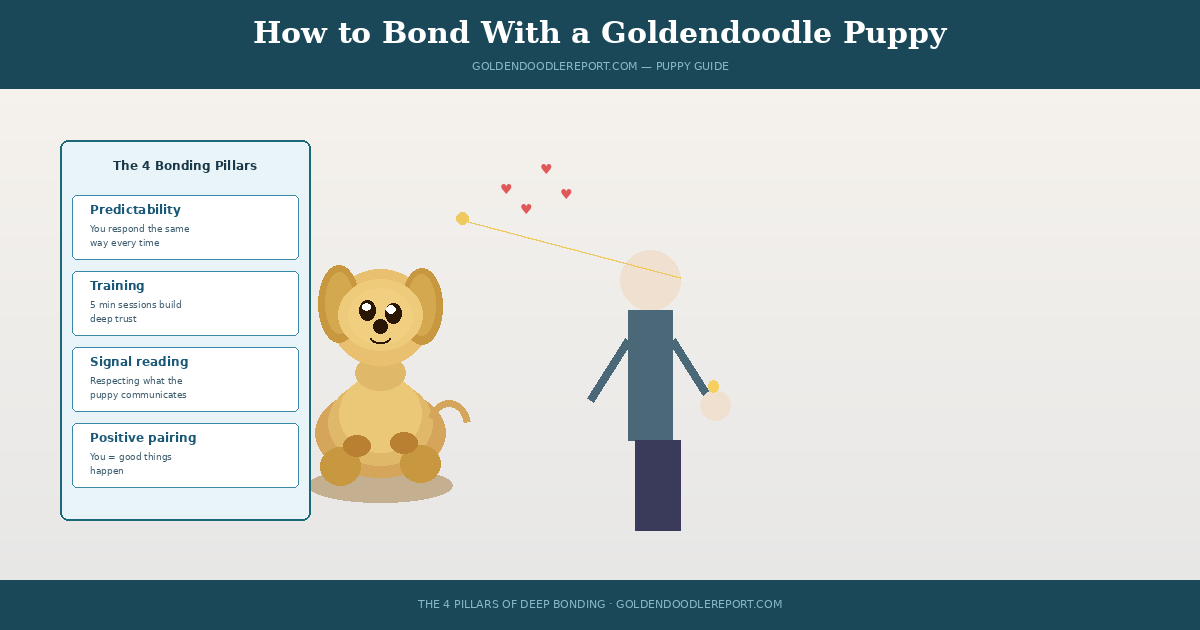
Who This Guide Is For
This article is most useful if you:
- Have just brought a Goldendoodle puppy home and want to start building the bond correctly from day one
- Feel your puppy does not seem particularly attached to you yet and want to understand why and what to change
- Have noticed the puppy prefers another family member and want practical guidance on shifting that dynamic
- Want to understand the difference between a dog that is genuinely bonded to you and one that is simply dependent on you
For the first-week context that bonding sits within, see First Week With a Goldendoodle Puppy.
Quick Summary
Deep bonding with a Goldendoodle puppy is built through four specific behaviours: predictability (the puppy learns you respond consistently), positive association (you reliably signal good things), training (short daily sessions produce the deepest trust of any activity), and accurate signal reading (respecting what the puppy communicates rather than overriding it). These four pillars, applied consistently across the first month, produce genuine attachment. Physical closeness alone — cuddles, carrying the puppy — produces comfort but not the deep trust that defines a real bond.
Quick Answer
How to bond with a Goldendoodle puppy: run three to five short training sessions per day (3 minutes each), use the puppy’s name positively and consistently, respond to stress signals by reducing pressure rather than pushing through, and make every interaction predictable. Training — not physical affection — is the single most powerful bonding tool available. A dog that has learned through you becomes genuinely bonded to you.
Quick Diagnosis
- If your puppy follows you room to room and makes eye contact voluntarily → bonding is progressing well. Reinforce with training sessions.
- If your puppy is friendly but shows no specific preference for you over strangers → the bond is surface-level. Begin structured daily training sessions immediately.
- If your puppy consistently chooses another household member over you → that person is doing more of the four bonding behaviours. Begin training sessions yourself and take over feeding duties.
- If your puppy avoids physical contact or retreats when approached → trust is damaged or underdeveloped. Stop forcing interaction. Use treat-scatter approach only until the puppy initiates contact.
You bring the puppy home, hold it constantly, let it sleep on your lap, and carry it everywhere for the first two weeks. It seems comfortable and happy. But at week three you notice it runs to your partner when they come home, sits beside them at the sofa, and will not settle unless they are in the room. Your partner has been doing the evening training sessions because you felt awkward with the commands. The puppy is not confused — it has bonded to the person who trained it.
The Goldendoodle’s reputation for warmth, emotional sensitivity, and human orientation is well-earned. Both parent breeds — Golden Retrievers and Poodles — are among the most handler-responsive dogs in existence, meaning the bond a Goldendoodle forms with its primary person is unusually deep and unusually lasting.
But that same emotional sensitivity means Goldendoodles are particularly accurate readers of their owners’ behaviour. They notice who is calm and who is anxious. Who is consistent and who is erratic. Who communicates clearly through training and who tries to communicate through physical contact alone. The bond they form reflects what they observe — not simply who spends the most time near them.
This guide covers:
- How bonding actually works — the neurological mechanism most guides never explain
- The four pillars of deep bonding and why each one matters
- Why training is more powerful for bonding than physical affection
- The difference between a bonded dog and a dependent dog
- What to do when the puppy prefers someone else
- A week-by-week bonding plan for the first month
In This Guide
- How to Bond With a Goldendoodle Puppy: The Mechanism
- The Four Pillars of Deep Bonding
- Why Training Bonds More Than Cuddling
- Bonded vs Dependent — The Critical Difference
- What to Do When the Puppy Prefers Someone Else
- Week-by-Week Bonding Plan — First Month
- What Most Owners Get Wrong
- Frequently Asked Questions
How to Bond With a Goldendoodle Puppy: The Mechanism
Bonding between a dog and a human is not a vague emotional phenomenon — it has a specific neurological basis. When a dog and a human make eye contact, engage in cooperative activity, or have a positive shared experience, both parties release oxytocin — the same neurochemical involved in human parent-child bonding.
Research published in the journal Science demonstrated that mutual gaze between dogs and their owners produces an oxytocin feedback loop: the dog’s gaze raises the owner’s oxytocin, the owner’s warm response raises the dog’s oxytocin, and this loop progressively deepens the attachment response. For a broader overview of the human-dog attachment research, the American Kennel Club’s guide to how dogs bond with people covers the key findings accessibly.
What this means practically is that bonding is not a passive process that happens from proximity alone. It is an active process driven by specific behaviours — primarily mutual attention, predictable positive responses, and cooperative learning. A puppy that sits beside you on the sofa while you watch television is receiving proximity but not bonding inputs. A puppy that learns to sit on cue from you, receives a treat, and makes eye contact with you in that moment is receiving all three bonding inputs simultaneously.
This mechanism also explains why the person who does the training becomes the primary bonded person — and why physical affection alone rarely produces the depth of bond that training does. Training is the most concentrated form of mutual attention, predictable positive response, and cooperative communication available to a dog and owner. It is not supplementary to bonding. It is the primary vehicle for it.
The Four Pillars of Deep Bonding
Deep bonding with a Goldendoodle puppy rests on four specific behavioural pillars. Each pillar addresses a different component of what the puppy’s brain requires to classify a person as its primary trusted individual.
The Four Pillars of Goldendoodle Puppy Bonding
| Pillar | What It Looks Like | Why It Works | What Undermines It |
|---|---|---|---|
| Predictability | Same feeding time. Same greeting tone. Same response to the same behaviour — every time. | Predictability signals safety. A puppy that can predict your behaviour feels secure in your presence. | Inconsistency — laughing at jumping one day, correcting it the next. Erratic emotional tone. |
| Positive Association | You are reliably the source of meals, treats, play, and calm handling. Your presence predicts good outcomes. | The puppy’s brain pairs your presence with reward — the foundation of approach behaviour and attention-seeking. | Only interacting when the puppy needs something from you. Others giving the treats while you give corrections. |
| Training | 3–5 minute daily sessions: sit, name recall, eye contact on cue. The puppy learns that engaging with you produces good outcomes. | Mutual gaze + reward + cooperative success produces the strongest oxytocin response of any interaction type. | Delegating training to another family member. Skipping sessions. Making training frustrating or too long. |
| Signal Reading | Recognising when the puppy is overwhelmed and removing pressure. Not forcing interaction when the puppy signals it needs space. Responding to communication. | When you respond correctly to the puppy’s signals, you demonstrate that communication works — this builds the loop of mutual communication that is the core of a genuine bond. | Overriding stress signals to continue petting or interaction. “He has to get used to it.” Forcing proximity. |
Why Training Bonds More Than Cuddling
This is the piece of information most new Goldendoodle owners are missing — and the one that, once understood, changes everything about how they approach the first weeks at home.
Physical affection — cuddling, carrying, stroking — provides comfort and warmth. It signals physical safety. It produces a positive association with your presence. All of this is real and valuable. But it does not require the puppy’s active engagement. The puppy is passive during physical affection. You are doing something to it. The oxytocin exchange is limited because mutual attention — the primary driver of the bonding neurochemical loop — is absent.
Training is structurally different. During a training session, the puppy must pay attention to you. It must read your signals. It must attempt a behaviour, receive feedback, and adjust. You must read whether the puppy understood, adjust your communication, and reward the outcome. Both parties are fully engaged with each other. Eye contact occurs repeatedly. The puppy experiences a sequence of attempt → success → reward that it associates entirely with you. This is mutual communication at its most concentrated, and it is precisely the input the bonding mechanism requires.
The practical implication: three 3-minute training sessions daily from day one produces a stronger bond by week four than three hours of cuddling on the sofa. This does not mean cuddling is wrong — it means training should be non-negotiable, not optional, and should be done by the person who most wants to be the primary bonded figure.
Start with the simplest possible behaviours: the puppy’s name (say it once, treat when the puppy looks at you), sit (lure with a treat, mark and reward), and focus (reward any voluntary eye contact). These are not obedience exercises. They are bonding sessions that happen to produce trained behaviours as a side effect.
Bonded vs Dependent — The Critical Difference
Two puppies can display identical clingy behaviour toward their owners, but one is genuinely bonded and one is anxiously dependent. The distinction matters enormously because the long-term outcomes are entirely different — and because many of the behaviours owners interpret as deep bonding are actually signs of dependency being cultivated accidentally.
Bonded vs Dependent — How to Tell the Difference
| Genuinely Bonded | Anxiously Dependent |
|---|---|
| Checks in with you during play and exploration — then returns to exploring confidently | Will not explore independently at all — stays pressed against you even in safe environments |
| Settles calmly in the crate when you leave the room | Distressed when you leave the visual field — crying, destructive behaviour, inability to settle |
| Responds quickly and willingly to cues — learned through training with you | Responds inconsistently — compliance depends on whether you are holding treats |
| Greets you warmly after absence, then settles back to normal activity | Over-the-top greeting after even brief absence — prolonged inability to calm down on return |
| Comfortable in your absence if given appropriate crate time and enrichment | Shows signs of separation anxiety — destructive behaviour, vocalisation, inappropriate elimination when alone |
Dependency is created by owners who respond to every distress signal, never practice crate separation, carry the puppy rather than allowing it to navigate the world, and confuse the puppy’s need for constant proximity with evidence of a strong bond. The irony is that the actions taken to build the bond — constant physical contact, never leaving the puppy alone — are precisely the actions that create an anxious, dependent dog rather than a confident, bonded one.
The four bonding pillars build genuine attachment. Independent crate time, brief planned separations, and allowing the puppy to explore away from you build the confidence that makes genuine attachment possible.
What to Do When the Puppy Prefers Someone Else
This is one of the most emotionally difficult situations for new puppy owners — you chose the dog, you wanted the bond, and the puppy has clearly decided to prefer your partner, your teenager, or seemingly anyone else in the household. Understanding why this happens removes the emotional sting and makes the correction straightforward.
The puppy has not made a personality judgement about you. It has made a behavioural observation. It has noticed that one person in the household is more predictable, runs more training sessions, delivers more treats, responds more accurately to its signals, or simply sits at floor level more often. The puppy’s attachment follows that observation precisely, because that is exactly how bonding works.
The correction requires three specific changes:
Take over feeding entirely. Feeding is a strong positive association anchor. The person who consistently delivers meals becomes associated with the most fundamental resource the puppy needs. If someone else feeds the puppy, switch this today. Feed every meal yourself for a minimum of two weeks.
Take ownership of all training sessions. For the next four weeks, you are the only person who runs formal training sessions. Three sessions of 3 minutes each, daily, without exception. The other family member can interact with the puppy normally but does not run training sessions. Within two to three weeks the puppy’s attention orientation will shift measurably.
Sit at puppy level daily. Sit on the floor in the puppy’s space for 10 minutes once a day without reaching for the puppy, calling it, or producing treats. Simply be present at its level. Scatter a few treats around you if it helps. Allow the puppy to approach in its own time. This builds the confident approach behaviour that is the foundation of voluntary bonding rather than treats-driven compliance.
Week-by-Week Bonding Plan — First Month
First Month Bonding Plan — Week by Week
| Week | Focus | Daily Actions | What You Are Building |
|---|---|---|---|
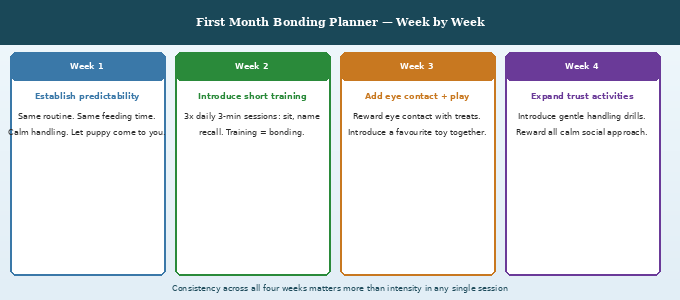
| Week 1 | Establish predictability and positive association | Feed all meals yourself. Same routine each day. Sit at floor level 10 min daily. Scatter treats around you. Do not force interaction. | Safety association — you predict good things. Puppy begins approaching voluntarily. |
| Week 2 | Introduce training sessions | 3× daily 3-min sessions: name response, sit, and voluntary eye contact. End every session on a success. Continue floor-level sitting. | Mutual communication loop — the puppy learns that engaging with you produces reliable rewards. |
| Week 3 | Add play and cued eye contact | Introduce a favourite toy — play brief tug or fetch games initiated by you. Add “look at me” cue — reward every eye contact. Increase training to 4× daily. | Play partnership — you become the source of fun as well as food and safety. |
| Week 4 | Expand trust — handling and novelty | Gentle daily handling (paws, ears, mouth) with treats throughout. Introduce one new low-stress experience per day. Continue training sessions — add recall from short distances. | Secure attachment — the puppy approaches new experiences with you as its anchor rather than avoiding them. |
What Most Owners Get Wrong
Mistake 1 — Delegating training to whoever is most comfortable doing it. The person who runs the training sessions becomes the bonded person. This is not a soft principle — it is the direct consequence of the oxytocin mechanism. Owners who feel awkward with dog training commands and ask their partner to handle it are unknowingly transferring the primary bond to their partner. If you want to be the primary bonded figure, you must be the primary trainer. Discomfort with training commands is not a reason to delegate — it is a reason to practise until the discomfort resolves.
Mistake 2 — Confusing proximity with bonding. A puppy that is physically close to you at all times is not necessarily bonded to you. It may be dependent on you. It may simply be seeking warmth, comfort, and proximity to any available person. Genuine bonding produces a dog that shows voluntary preference for you — seeks your attention specifically, checks in with you during exploration, and orients toward you in novel situations. Physical closeness that you create by carrying, crating near you, and preventing independent movement does not produce voluntary preference. It produces a dog that cannot function independently.
Mistake 3 — Responding to stress signals by increasing pressure rather than reducing it. When a puppy moves away from being touched, freezes during handling, or shows other withdrawal signals, the instinctive response from a well-intentioned owner is to continue — “he needs to get used to it.” This is exactly backwards. Continuing when the puppy signals discomfort communicates that its communication does not work, which is the opposite of what bonding requires. Reduce the pressure, reward any calm moment, and allow the puppy to disengage. A puppy whose signals are consistently respected voluntarily seeks interaction. A puppy whose signals are consistently overridden learns to shut down or avoid.
Action Plan — Starting Today
- Take over all feeding immediately. Every meal, every time. Do this regardless of convenience or schedule conflicts. The feeding association is the fastest positive association anchor available.
- Start training sessions today — not when you feel ready. Begin with one simple behaviour: the puppy’s name. Say it once in a warm tone. The moment the puppy looks at you, mark with “yes” and deliver a treat. Do this 10 times. This is your first session. Do three sessions today.
- Sit on the floor in the puppy’s space for 10 minutes daily. No reaching, no calling, no producing treats on demand. Scatter a few around yourself and simply be present. Allow the puppy to approach in its own time. Do not end the session by reaching for the puppy.
- Stop forcing physical contact. Every time you reach for the puppy when it is moving away, or hold it when it wants to leave, you register as unpredictable and unresponsive. Stop. Let the puppy come to you.
- Add one play session per day initiated by you. Keep it short — 3 to 5 minutes — and end it while the puppy still wants more. You ending the game while it is still fun creates anticipation for the next session with you.
- Apply the week-by-week plan above from day one. Consistency across all four weeks matters more than intensity in any single session.
What to Expect
Timeline: Voluntary approach behaviour (puppy seeking your attention unprompted) typically appears within 7 to 14 days of consistent training sessions. Clear preference for you over other household members typically establishes within 3 to 4 weeks of taking ownership of training and feeding. Full deep bonding — the dog orienting toward you in novel situations and showing specific distress at your absence rather than anyone’s absence — develops over 3 to 6 months of consistent four-pillar behaviour.
Friction: The first week of sitting on the floor without reaching for the puppy feels unnatural and produces some anxiety in owners who interpret the puppy’s exploratory independence as disinterest. It is not disinterest. It is the puppy building the confidence from which genuine bonding can grow.
Signs the bond is developing: Puppy seeks you out voluntarily when you enter the room. Makes eye contact with you without being prompted. Brings toys to you during play rather than carrying them away. Checks in with you during exploration rather than ignoring your presence.
Your Next Step
Start your first 3-minute training session today using the puppy’s name and a handful of small treats. Do not wait until you feel confident with commands — the session itself builds your confidence and the bond simultaneously. Run three sessions today. Run three tomorrow. The bond is built in those minutes, not in the hours on the sofa.
Signs Your Approach Is Working
- The puppy seeks you out voluntarily when you enter a room — not only when you are holding food
- The puppy makes eye contact with you during play and exploration without being cued
- The puppy settles calmly after your return rather than remaining in an extended arousal state
- Training sessions produce quick, willing responses — the puppy engages rather than looking away
⚠️ Watch Out
The most common bonding mistake is creating dependency in the belief that you are creating attachment. Carrying the puppy everywhere, sleeping with it every night, and never practising planned separation produces a dog that cannot cope with your absence — not a dog that is securely bonded to you. Secure bonding requires the puppy to have confidence in its own ability to exist without you in close proximity. Build that confidence through crate training, brief planned separations, and allowing independent exploration. The puppy’s willingness to explore away from you while checking in periodically is a sign of secure bonding — not lack of interest.
When to Seek Professional Help
- The puppy actively avoids all household members after 4 weeks at home — not just one person but everyone
- Severe separation anxiety signs at 4 to 5 months despite consistent crate training from the start — destructive behaviour, prolonged vocalisation, self-harm attempts
- The puppy shows fear or aggression toward the primary owner specifically, which may indicate a trust-damaging incident that requires professional counter-conditioning
Key Takeaways — How to Bond With a Goldendoodle Puppy
- Bonding works through a specific neurological mechanism — mutual attention, predictable positive response, and cooperative communication produce oxytocin exchange that deepens attachment
- Training is the most powerful bonding tool available — three 3-minute daily sessions produce a stronger bond by week four than hours of physical affection alone
- The person who trains the puppy becomes the primary bonded person — delegating training is delegating the bond
- Genuine bonding produces a confident, secure dog that explores independently and checks in. Dependency produces a dog that cannot function without constant proximity.
- If the puppy prefers someone else — take over feeding and all training sessions immediately. The shift in bond orientation follows within 2 to 3 weeks.
- Respecting withdrawal signals — not forcing interaction when the puppy signals discomfort — builds trust faster than any amount of continued handling
Related Goldendoodle Puppy Guides
- First Week With a Goldendoodle Puppy — The full first-week context including the bonding foundations
- Goldendoodle Puppy Socialization Checklist — How socialisation sessions build on the bonding work
- Goldendoodle Puppy Fear Stages — How fear periods affect the bond and how to protect it through them
- Goldendoodle Puppy Biting Phase Guide — Why consistent training during the biting phase deepens the bond
- Goldendoodle Daily Routine — How to structure the daily schedule so bonding activities happen consistently
Part of the Goldendoodle Puppy Guide resource hub:
→ Goldendoodle Puppy Guide — Browse all 40 puppy guides
Frequently Asked Questions
How long does it take for a Goldendoodle puppy to bond with you?
Initial safety association — the puppy feeling comfortable and secure in your presence — typically develops within the first week for most puppies. Voluntary preference — the puppy actively seeking you out over others — develops within 2 to 4 weeks of consistent training and feeding by the same person. Deep bonding — orientation toward you in novel situations, specific distress at your absence rather than anyone’s absence — develops over 3 to 6 months of consistent four-pillar behaviour. The timeline is shortened significantly by daily training sessions and lengthened by inconsistency or delegation of training to others.
My Goldendoodle puppy follows my partner everywhere but not me — what should I do?
Take over all feeding immediately — every meal, every day. Simultaneously take ownership of all formal training sessions for a minimum of four weeks. Your partner can continue normal interactions but does not run training sessions. The puppy’s bond orientation follows whoever provides the most consistent combination of food, training engagement, and predictable behaviour. Within 2 to 3 weeks of this shift, the puppy’s preference will move measurably toward you. This is not permanent damage — it is a behavioural pattern responding to a behavioural correction.
Is it possible to bond too strongly with a Goldendoodle puppy and create separation anxiety?
Yes — but the cause is not the strength of the bond. It is how the bond was built. A bond created through constant physical proximity, never practising separation, and responding to every distress signal creates anxious dependency regardless of how loving the relationship is. A bond built through training, positive association, signal respect, and planned independence practice creates secure attachment that tolerates separation well. The four-pillar approach builds the latter. The key distinction: allow the puppy independence and practise crate separation from week one, regardless of how much you want constant closeness.
Does the Goldendoodle typically bond to one person or the whole family?
Goldendoodles typically form a strong primary bond with one person and warm secondary bonds with others in the household. The primary bond goes to the person who does the most training, feeding, and consistent positive interaction. Secondary bonds form naturally with other family members through normal interaction. This is healthy and normal — the primary bonded person becomes the anchor the dog orients toward in novel or stressful situations, while enjoying the company of others freely. Attempting to make the bond perfectly equal across multiple family members typically produces weaker attachment to everyone rather than strong attachment to a primary figure with warm secondary relationships.
My puppy is friendly with everyone but doesn’t seem particularly attached to anyone — is this a problem?
At 8 to 12 weeks, general friendliness without strong specific attachment is normal — the puppy is still in the early stages of building bonds. If this pattern persists past 8 to 10 weeks at home with no specific preference emerging, it usually indicates that no one in the household is running consistent training sessions or serving as the primary feeder. Begin daily training sessions immediately with one designated primary person. The specific attachment that follows training-based bonding is distinctly different from generalised friendliness and should become visible within 2 to 3 weeks.
The information in this article is provided for general educational purposes only. King James Adjei is a researcher and enthusiast, not a veterinarian or certified behaviourist. For puppies showing significant fear, avoidance, or aggression, always consult a qualified certified behaviourist.