6-minute read | Last updated March 2026 | Reviewed for accuracy
By King James Adjei | GoldendoodleReport.com
Researcher, Goldendoodle enthusiast, and founder of GoldendoodleReport. Every guide on this site is written to give owners reliable, clearly organised information — researched carefully and updated regularly.
When do Goldendoodle puppies calm down is one of the most searched questions among owners of adolescent dogs — usually typed at the end of a long day with a frustrated tone. The honest answer is later than most owners expect, for a neurological reason most guides never explain, and with a timeline that varies meaningfully by size. Understanding why the energy and impulsivity persist makes the phase significantly more manageable than simply waiting it out with gritted teeth.
Who This Guide Is For
This article is most useful if you:
- Have a Goldendoodle between 6 months and 2 years that still behaves like a puppy and you want to know when this ends
- Have been told the dog will calm down at 12 months and are now at 14 months wondering what went wrong
- Are doing more and more exercise trying to tire the dog out and it does not seem to be working
- Want to understand the difference between normal adolescent energy and a genuinely hyperactive dog
For the developmental context this fits within, see Goldendoodle Puppy Growth Stages.
Quick Summary
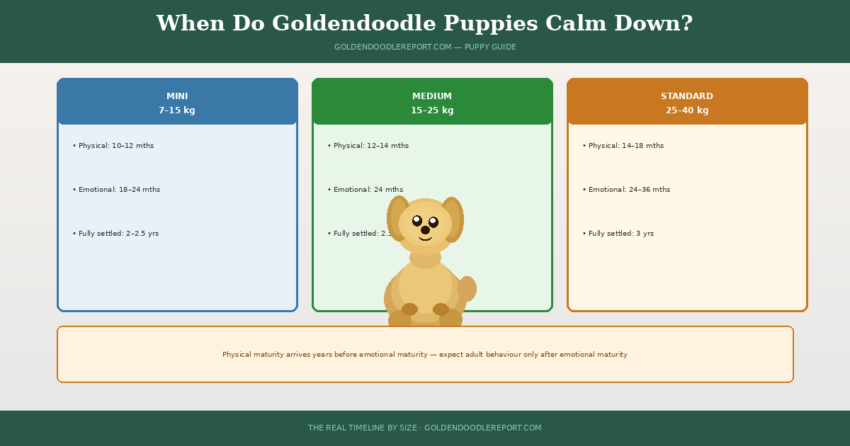
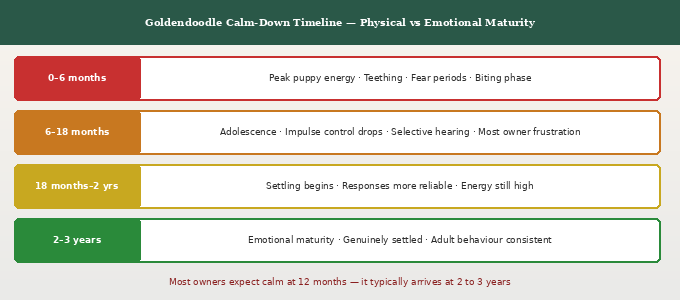
When do Goldendoodle puppies calm down? Physical maturity arrives at 10 to 18 months depending on size. Emotional maturity — the neurological settling that produces genuinely calm, reliable adult behaviour — arrives at 2 to 3 years. The gap between these two milestones is the period most owners find hardest. The dog looks adult but behaves like a teenager. This is not a training failure. It is a biological timeline.
Quick Answer
Goldendoodle puppies show noticeable settling from 18 months and genuine emotional maturity at 2 to 3 years. Mini Goldendoodles settle earlier — often by 18 to 24 months. Standard Goldendoodles may not fully settle until 3 years. The 12-month milestone that owners are often told to wait for is physical maturity, not emotional maturity. Expecting adult behaviour at 12 months is the single most common source of owner frustration with this breed.
Quick Diagnosis
- If your Goldendoodle is 6 to 12 months and acting erratic → peak adolescence, normal, will not resolve by training alone
- If your Goldendoodle is 12 to 18 months and still impulsive → still within the normal emotional maturity timeline, continue structure and training
- If your Goldendoodle is 18 months and showing early signs of settling → on track, full emotional maturity follows at 2 to 3 years
- If your Goldendoodle is 3+ years and genuinely cannot settle or focus → consult your vet to rule out underlying anxiety or health causes
Your Standard Goldendoodle is 14 months old. It is physically enormous — 30 kg, fully grown in every visible way. You were told it would calm down at 12 months. It has not. You are walking it for 90 minutes daily. It is still bouncing off the walls when you come home, demolishing cushions at 9 PM, and has seemingly forgotten that it knew how to sit reliably at 5 months. You are exhausted and starting to wonder if you made a mistake. You did not. The dog’s brain is 14 months old. The prefrontal cortex that produces the calm, reliable behaviour you are waiting for will not finish maturing for another 12 to 18 months.
The frustration most owners feel during this phase is not caused by a bad dog or failed training. It is caused by a mismatch between expectation and biology. The expectation — that dogs calm down at 12 months — is based on physical maturity. The biology — that dogs calm down when the prefrontal cortex finishes developing — operates on a different and longer timeline. Closing the gap between these two timelines means understanding what the brain is actually doing during this period.
This guide covers:
- Why Goldendoodle puppies stay energetic and impulsive — the prefrontal cortex mechanism
- The calm-down timeline by size — Mini, Medium, and Standard
- The exercise trap — why more exercise produces more endurance, not less energy
- The three management strategies that actually work during adolescence
- The signs that genuine settling has begun
In This Guide
When Do Goldendoodle Puppies Calm Down: The Prefrontal Cortex Explanation
The prefrontal cortex is the region of the brain responsible for impulse control, emotional regulation, and the ability to override immediate urges in favour of learned behaviour. In dogs — as in humans — this is the last brain region to reach full maturity. It undergoes its most significant development and remodelling during adolescence, and during the peak of that remodelling it temporarily becomes less effective at its primary function.
This is not a metaphor. During active prefrontal cortex remodelling, the neural pathways that produce impulse control are being rebuilt. The result is a dog that knows the sit command but cannot execute it reliably when distracted — not because it has forgotten the command, but because the circuit that overrides the distraction to access the command is temporarily under reconstruction. The adolescent dog that ignores a known recall command while running toward another dog is not being disobedient. It is neurologically incapable, in that moment, of overriding the limbic drive with the learned behaviour.
This resolves when the remodelling completes — which happens at 2 to 3 years in most Goldendoodles. The dog that could not reliably recall at 14 months will recall reliably at 30 months, with no additional training required, because the circuit that makes the recall possible has finished being built. For the broader context of how adolescent brain development affects canine behaviour, the American Kennel Club’s guide to dog adolescence covers the research on this period clearly.
The practical implication for owners is significant: continued, consistent training during adolescence is not wasted effort even when results seem to have regressed. The training is being deposited into the system that will emerge at full maturity. The dog that was trained consistently through adolescence produces a significantly more reliable adult than the one whose training was abandoned in frustration during the difficult phase.
The Calm-Down Timeline by Size
When Do Goldendoodle Puppies Calm Down — By Size
| Size | Physical Maturity | Adolescence Peak | Emotional Maturity | Fully Settled |
|---|---|---|---|---|
| Mini 7–15 kg |
10–12 months | 6–14 months | 18–24 months | 2–2.5 years |
| Medium 15–25 kg |
12–14 months | 6–16 months | 20–26 months | 2–2.5 years |
| Standard 25–40 kg |
14–18 months | 6–18 months | 24–36 months | 2.5–3 years |
These timelines represent the point at which most owners describe a noticeable, consistent shift in their dog’s behaviour — not the point at which all impulsivity disappears overnight. Settling is a gradual process with visible improvement markers rather than a single transformation. The Standard Goldendoodle’s longer timeline is a direct consequence of the larger brain mass requiring longer prefrontal cortex development — the same pattern seen across mammalian species where larger animals mature more slowly.
The Exercise Trap
The most common owner response to an adolescent Goldendoodle’s energy is to increase exercise — walk longer, play harder, run more often. The logic is intuitive: a tired dog is a calm dog. The problem is that this logic, consistently applied, produces the opposite of its intended effect.
Cardiovascular fitness in dogs develops on a similar timeline to cardiovascular fitness in athletes. A dog that is exercised at high intensity daily for 6 months builds the endurance to sustain high-intensity activity for longer. The exercise required to tire this dog increases as fitness improves. The owner who started with 45-minute walks at 6 months and has progressed to 90-minute runs at 12 months has trained a high-endurance athlete — not a calmer dog. The underlying neurological energy source has not been addressed; only the physical capacity to express it has grown.
This does not mean exercise is wrong. It means exercise alone cannot solve an adolescent energy problem rooted in prefrontal cortex development. The effective approach combines appropriate physical exercise — not excess — with two other activity types that address the underlying neurological need more directly: mental stimulation and structured training.
A 30-minute training session exhausts the prefrontal cortex more effectively than a 90-minute walk, because training demands the active deployment of exactly the brain circuit that is under development. A puzzle feeder that takes 20 minutes to empty produces more genuine tiredness in an adolescent Goldendoodle than an additional 20 minutes of walking, because it engages the problem-solving circuits rather than only the cardiovascular system. The owners who successfully navigate adolescence are those who replace escalating physical exercise with a balanced programme that includes physical exercise, structured training, and mental enrichment in roughly equal proportion.
Three Management Strategies That Actually Work
Strategy 1 — Maintain consistent, short training sessions throughout adolescence. Three to five minutes, three to five times daily. Do not abandon training because it feels like the dog has regressed — the training is being deposited into the maturing system regardless of whether the results are currently consistent. Keep sessions short enough that they end on a success. Reward generously. The adolescent dog needs more reward density than the young puppy to maintain engagement because its impulse control is lower.
Strategy 2 — Prioritise mental enrichment alongside physical exercise. Scatter feeding rather than bowl feeding, Kong-stuffing, puzzle feeders, sniff walks where the dog leads the pace and follows its nose — these activities engage problem-solving circuits and produce genuine tiredness at lower physical cost than extended runs. A sniff walk of 20 minutes is more cognitively demanding for the dog than a fast walk of 40 minutes. Build mental enrichment into every day as a non-negotiable element of the exercise programme rather than a supplement.
Strategy 3 — Maintain crate and settle practice rather than abandoning it. Owners commonly relax crate training once the dog appears past the puppy phase, giving it free access to the house and removing the structure that crate time provides. During adolescence — when self-regulation is at its lowest — maintaining crate time preserves the capacity to settle that the young puppy learned. A dog that has two daily crate periods as a normal part of its routine throughout adolescence emerges with that settled behaviour intact. A dog whose crate training was abandoned at 6 months may require reintroduction at 18 months when the consequences of unstructured access become clear.
Action Plan — Managing the Adolescent Phase
- Recalibrate your expectation to the correct timeline. Find your dog’s size in the table above. Write down the emotional maturity date. This is when consistent adult behaviour arrives — not 12 months. Stop measuring the current behaviour against adult standards.
- Audit your exercise programme and reduce if above age-appropriate limits. Check the exercise needs by age guide and confirm you are not in the escalation trap. More exercise than the guidelines suggest is building fitness, not solving the energy problem.
- Add 15 minutes of mental enrichment daily in place of 15 minutes of physical exercise. Scatter feeding, puzzle feeders, sniff-led walks. Run this parallel for two weeks and note the difference in evening settling behaviour.
- Restart or maintain three training sessions daily — 3 to 5 minutes each. Focus on known behaviours rather than introducing complex new ones during peak adolescence. Reliability on sit, down, stay, and recall is more valuable than variety.
- Preserve crate time if you have relaxed it. One to two hours in the crate daily during adolescence maintains the settle behaviour that underpins everything else. Reintroduce gently if it has lapsed — treat-stuffed Kong in the crate, calm entry, normal exit.
- Track improvement in 4-week blocks rather than daily. Adolescent improvement is not linear. A bad week is not evidence that nothing is working. Progress is visible across months, not days.
What to Expect
Timeline: Noticeable settling typically begins at 18 months and consolidates between 2 and 3 years depending on size. The improvement is gradual — owners typically notice it retrospectively rather than as a clear event.
Friction: Maintaining training consistency and exercise discipline during the phase when the dog appears to be ignoring everything requires deliberate effort. The temptation to give up structured training because “it isn’t working” is highest exactly when consistency matters most.
Signs it is working: Evening settling time reduces week on week. The dog disengages from distractions more readily than it did three months ago. Training sessions produce quicker, more reliable responses than they did at peak adolescence.
Your Next Step
Find your dog’s size in the calm-down table. Set a realistic expectation date for emotional maturity. Replace 15 minutes of daily physical exercise with a mental enrichment activity today — scatter feeding, a puzzle feeder, or a sniff walk. Note the evening behaviour difference within one week.
Signs That Genuine Settling Has Begun
- The dog disengages from distractions — other dogs, squirrels, interesting smells — when called, where it previously could not
- Evening behaviour becomes calmer without any change in the exercise programme
- The dog chooses to lie down and rest during the day without being crated — self-regulated rest was not present during peak adolescence
- Training responses become more consistent across different environments — the dog that only sat reliably in the kitchen now sits reliably in the park
- The dog greets visitors with enthusiasm that reduces to calm within 2 to 3 minutes, rather than sustaining high arousal for extended periods
What Most Owners Get Wrong
Mistake 1 — Expecting adult behaviour at 12 months. The 12-month milestone is physical maturity — fully grown body, adult teeth, closed growth plates. It has no relationship to the emotional maturity timeline that produces reliably calm, impulse-controlled behaviour. Expecting adult behaviour at 12 months from a Goldendoodle is equivalent to expecting adult decision-making from a 13-year-old human. The body is there. The brain is not done yet.
Mistake 2 — Escalating physical exercise in response to energy. Building fitness in an adolescent dog builds the capacity for more energy expression, not less. The more you run a young, fit Goldendoodle, the fitter it becomes, and the more exercise it takes to reach the tiredness threshold. The solution is not less exercise — it is exchanging some physical exercise for mental exercise, which engages the prefrontal cortex directly rather than bypassing it.
Mistake 3 — Abandoning training because progress seems to have reversed. Adolescent training regression is neurological, not instructional. The dog has not forgotten the training. The circuit that executes the trained behaviour is under active reconstruction and temporarily less reliable. Continuing training during this period deposits the behaviour into the system that will emerge at maturity. Owners who stop training during the difficult phase produce dogs that genuinely have incomplete training at emotional maturity, rather than dogs that have the training but temporarily cannot access it.
⚠️ Watch Out
The most common time owners consider rehoming or returning a Goldendoodle is between 8 and 18 months — precisely the peak of the adolescent phase. The dog is large, energetic, and apparently ignoring training that seemed to be working at 5 months. This phase ends. The dog that is difficult at 14 months and receives consistent management will be the settled, reliable, deeply bonded companion at 3 years that the owner imagined when they chose the breed. Decisions made at the peak of adolescence based on the dog’s current behaviour are made at the worst possible moment for accurate assessment.
When to Consult Your Vet or a Behaviourist
- Genuine aggression — not excitable nipping or jumping but directed biting with intent — at any age warrants professional assessment
- A dog past 3 years with no improvement in impulse control despite consistent management may have an underlying anxiety or thyroid issue worth investigating
- Destructive behaviour that is escalating rather than plateauing past 18 months benefits from behaviourist assessment of environmental and anxiety factors
Key Takeaways — When Do Goldendoodle Puppies Calm Down?
- Physical maturity at 10 to 18 months and emotional maturity at 2 to 3 years are different milestones — expect adult behaviour only after emotional maturity arrives
- The prefrontal cortex — responsible for impulse control and reliable trained behaviour — is the last brain region to mature and is under active reconstruction during adolescence
- More exercise does not solve adolescent energy — it builds fitness. Replace some physical exercise with mental enrichment and training to address the neurological source directly
- Training during adolescence is not wasted even when results appear inconsistent — it is being deposited into the system that emerges at full maturity
- Standards take longest to calm down — up to 3 years. Minis settle first — typically by 18 to 24 months
- The peak of adolescent difficulty at 8 to 18 months is the worst possible time to make permanent decisions about the dog based on current behaviour
Related Goldendoodle Puppy Guides
- Goldendoodle Puppy Growth Stages — The full developmental timeline including the adolescent phase
- Goldendoodle Exercise Needs by Age — The appropriate exercise levels that avoid the fitness escalation trap
- How to Bond With a Goldendoodle Puppy — Why training during adolescence deepens the bond even when results feel inconsistent
- Goldendoodle Puppy Biting Phase Guide — Managing the biting that often intensifies during early adolescence
- Goldendoodle Daily Routine — How to structure the day to support adolescent management
Part of the Goldendoodle Puppy Guide resource hub:
→ Goldendoodle Puppy Guide — Browse all 40 puppy guides
Frequently Asked Questions
At what age do Goldendoodle puppies calm down?
Goldendoodle puppies show noticeable settling from around 18 months and reach full emotional maturity at 2 to 3 years depending on size. Minis calm down earliest — typically 18 to 24 months. Standards take longest — sometimes not fully settled until 3 years. The 12-month milestone that is commonly cited refers to physical maturity, not the emotional and neurological maturity that produces reliably calm adult behaviour.
Is my Goldendoodle hyperactive or is this normal adolescent behaviour?
For dogs between 6 and 18 months, high energy, impulsivity, and inconsistent training responses are almost always normal adolescent behaviour rather than a hyperactivity problem. Normal adolescent behaviour reduces progressively between 18 months and 3 years with consistent management. A dog past 3 years with no improvement despite consistent structure may warrant veterinary assessment for anxiety, thyroid issues, or other underlying causes — but this is rare. If the dog’s behaviour is within the adolescent window, trust the timeline.
Will more exercise make my Goldendoodle calmer?
Not if taken beyond age-appropriate limits. Appropriate daily exercise is essential and contributes to a well-balanced dog. Exercise beyond those limits builds fitness rather than reducing energy — a highly fit adolescent Goldendoodle has more capacity for activity, not less. The effective approach is balancing physical exercise with mental enrichment (puzzle feeders, scatter feeding, sniff walks) and structured training, which engages the prefrontal cortex directly rather than building cardiovascular endurance around it.
My Goldendoodle seemed to get better at training then got worse — what happened?
This is peak adolescent regression and it is entirely normal. Between approximately 6 and 14 months the prefrontal cortex undergoes active remodelling that temporarily reduces reliable access to trained behaviours. The dog has not forgotten the training — the circuit that executes it under distraction is being rebuilt. Continue training consistently at slightly lower difficulty and higher reward density during this window. The reliable responses will return as remodelling completes.
When do Standard Goldendoodles calm down compared to Minis?
Standard Goldendoodles typically reach full emotional maturity at 2.5 to 3 years. Mini Goldendoodles typically settle at 18 to 24 months. The difference is a direct consequence of brain size and the longer development timeline required for larger animals. Standard Goldendoodles also have a longer adolescent peak — from approximately 6 to 18 months versus 6 to 14 months for Minis. Owners of Standard Goldendoodles should set their expectation at 3 years rather than 2 to avoid prolonged disappointment.
The information in this article is provided for general educational purposes only. King James Adjei is a researcher and enthusiast, not a veterinarian or certified behaviourist. For dogs showing aggression or extreme behavioural concerns, always consult a qualified veterinarian or certified behaviourist.