Affiliate Disclosure: Some links in this guide are affiliate links. If you purchase through them, we may earn a small commission at no extra cost to you. Read our full affiliate disclaimer here.
By King James Adjei — Researcher and Goldendoodle enthusiast, founder of GoldendoodleReport.com. Every guide on this site is carefully researched and written to give owners reliable, clearly organised information — updated regularly and honest about uncertainty. → About this site
📖 9-minute read | Last updated April 2026 | Reviewed for accuracy
The goldendoodle puppy routine by 12 weeks arrives at a moment when owners typically feel two things at once — relief that the hardest early weeks are behind them, and frustration that the schedule they finally got working has stopped fitting again. The 12-week mark brings three changes that matter: awake windows extend further, teething begins in earnest, and for most puppies this is the first week outdoor access properly opens up. Each of these changes affects how the daily routine should be structured — and getting this transition right sets the foundation for the next two months.
👤 Who This Guide Is For
- Your Goldendoodle puppy has just turned 12 weeks and the 10-week schedule has started feeling slightly off
- Your puppy is staying awake longer than before and fighting crate naps more than they were two weeks ago
- Your vet has confirmed the vaccination course is complete and you want to know how to integrate outdoor time into the daily routine
- The biting seems to be intensifying again and you want to understand whether that is teething or something else
⚡ Quick Summary
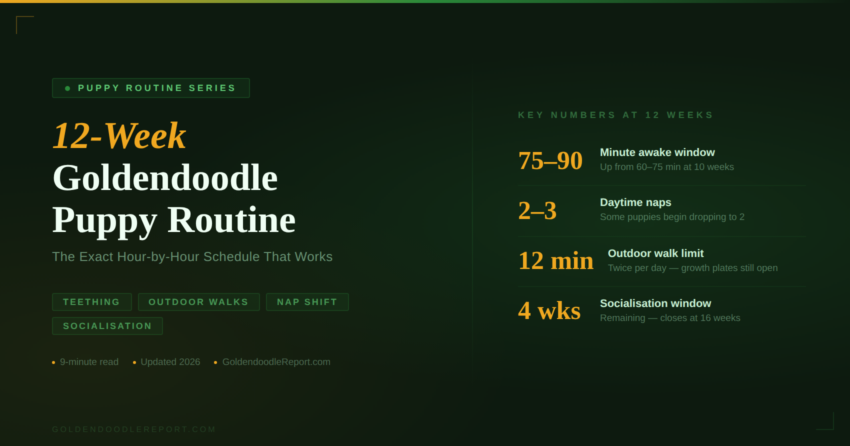
At 12 weeks, a Goldendoodle puppy’s awake window extends to 75–90 minutes, teething typically begins and intensifies biting behaviour, and outdoor access opens up post-vaccination. The routine shifts from 3 structured daytime naps to 2–3 depending on the individual puppy. Meals remain at 3 per day. Training sessions can extend slightly to 5 minutes. The socialisation window has 4 weeks remaining — this is the time to use it deliberately.
✅ Quick Answer
A goldendoodle puppy routine by 12 weeks follows the same feed-toilet-play-train-toilet-nap cycle but with longer awake windows of 75–90 minutes, 2–3 daytime naps instead of 3, and a short outdoor walk integrated into one awake window per day once vaccination is confirmed complete. Biting during this period is often driven by teething discomfort, not just overtiredness — frozen chew toys become essential tools in the routine.
For the complete first-year overview, see The Real Goldendoodle Puppy Guide — From Pickup Day to the End of Year One.
🔍 Quick Diagnosis — What Is Your Puppy Telling You?
- Puppy is fighting naps that used to work perfectly: The awake window has extended to 75–90 minutes — push the nap 15 minutes later and watch the resistance disappear
- Biting has intensified despite consistent management: Teething has likely begun. The biting is driven by gum discomfort, not just overtiredness — frozen chew toys address the cause directly
- Puppy is dropping one of the three daytime naps naturally: Normal at this age — some 12-week puppies need 2 naps, some still need 3. Let the puppy lead rather than forcing a third nap
- Puppy seems desperate to get outside and explore: Vaccination should be complete by 12–14 weeks — confirm with your vet and integrate a short outdoor walk once cleared
- Puppy is chewing everything in sight: Teething is active. Every chewable item in reach is a target. Puppy-proof at floor level again and rotate chew toys to maintain interest
📖 Real Scenario
It is day two of week 12. The owner puts the puppy in the crate for the usual 10am nap — the same nap that has been working reliably for two weeks. The puppy protests loudly, does not settle, and within 10 minutes is whining continuously. The owner, assuming something is wrong, takes them out. The puppy immediately chews the sofa leg. Twenty minutes later the puppy crashes mid-play and sleeps on the floor. What happened: the awake window extended by 15 minutes without warning, the nap arrived too early, and the puppy was not actually ready. The fix is not removing the nap — it is shifting it 15 minutes later and watching the puppy settle within 5 minutes instead of 30.
What Changes at 12 Weeks — and Why the 10-Week Routine No Longer Fits
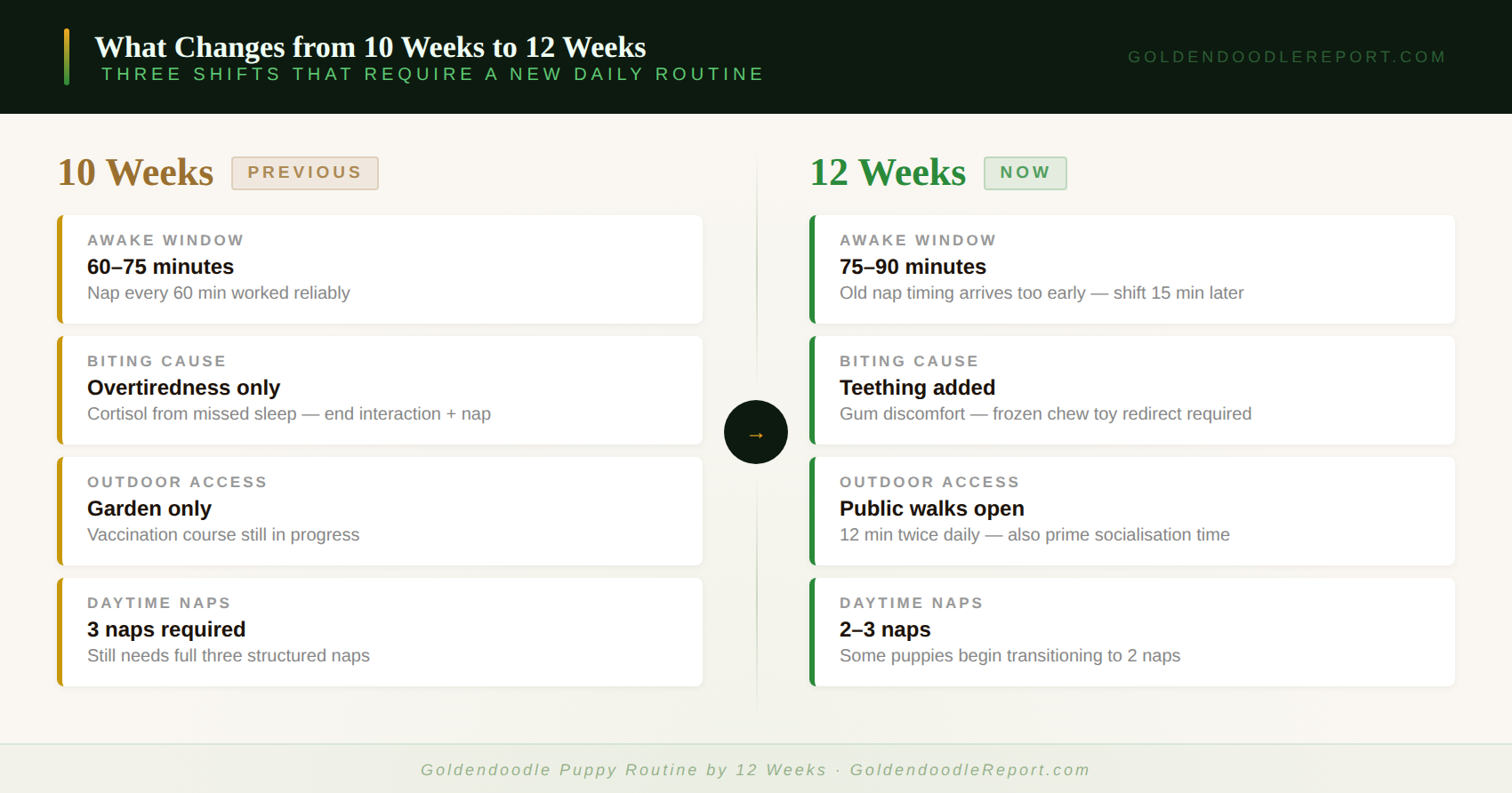
Between 10 and 12 weeks, three meaningful changes occur that the daily routine must account for. Understanding why each happens makes it significantly easier to adapt when the puppy deviates from the schedule.
The first change is the awake window. At 10 weeks the window ran 60–75 minutes. By 12 weeks it typically extends to 75–90 minutes. The same nap timing that worked two weeks ago now arrives 15 minutes too early, producing nap resistance that looks like a behaviour problem but is simply a mismatch between the schedule and where the puppy actually is developmentally.
The second change is teething. Baby teeth begin loosening at around 12 weeks, with adult teeth starting to push through between 12 and 16 weeks. This creates gum discomfort that drives increased chewing and biting — separate from the overtiredness-driven biting of the earlier weeks. An owner who managed the biting successfully at 10 weeks may find it intensifying again at 12 weeks despite doing everything correctly. The cause is different, which means the response needs to be different: frozen chew toys address the physical discomfort that training alone cannot.
The third change is outdoor access. For most puppies whose vaccination course completes around 12–14 weeks, this is the first week they can access public outdoor spaces safely. Integrating a short outdoor walk into the daily routine at this stage serves two purposes simultaneously — physical exercise within the safe guideline of 12 minutes twice per day, and the socialisation exposure that the closing window still needs.
The Complete Goldendoodle Puppy Routine by 12 Weeks
The schedule below is built around a puppy who wakes at 6:30am. Adjust all times proportionally if your puppy wakes earlier or later. The intervals between blocks matter more than the clock times. This schedule reflects a puppy on the 3-nap version of the 12-week routine — if your puppy is naturally dropping to 2 naps, see the Sleep section for the adjusted pattern.
| Time | Block | Duration | Notes |
|---|---|---|---|
| 6:30 AM | Wake + Toilet | 5 min | Immediate toilet trip — do not delay |
| 6:35 AM | Meal 1 | 10 min | Remove bowl after 10 minutes regardless |
| 6:45 AM | Play + Toilet | 50 min | Calm play. Toilet every 20–30 min. Frozen chew toy available |
| 7:20 AM | Training Session 1 | 5 min | Name recall, sit, down. Pea-sized treats. End on a success |
| 7:45 AM | Toilet + Nap 1 | 1.5–2 hrs | Crate nap. Puppy awake ~75 min. Door closed. Cover crate |
| 9:30 AM | Wake + Toilet | 5 min | Immediate toilet trip on waking |
| 9:35 AM | Outdoor Walk + Socialisation | 12 min | Best window for outdoor exposure. 12 min max structured exercise |
| 9:50 AM | Play + Toilet | 30 min | Calm indoor play after walk. Chew toy available |
| 10:20 AM | Meal 2 | 10 min | Second meal. Remove bowl after 10 minutes |
| 10:35 AM | Toilet + Nap 2 | 1.5–2 hrs | Crate nap. ~80 min awake. Crate door closed |
| 12:20 PM | Wake + Toilet | 5 min | Immediate toilet trip |
| 12:25 PM | Play + Training Session 2 | 50 min | 5 min training mid-session. Toilet mid-play |
| 1:20 PM | Toilet + Nap 3 | 1.5–2 hrs | Longest nap of the day. Crate door closed |
| 3:00 PM | Wake + Toilet | 5 min | Immediate toilet trip |
| 3:05 PM | Meal 3 | 10 min | Final meal of the day |
| 3:15 PM | Play + Handling + Outdoor Walk 2 | 55 min | Second walk of 12 min. Handling practice — paws, ears, mouth |
| 4:15 PM | Short Rest | 45–60 min | Quiet crate rest. Not necessarily full sleep. Door closed |
| 5:15 PM | Wake + Toilet | 5 min | Toilet trip |
| 5:20 PM | Calm Play | 40 min | Wind-down begins. No high-energy games. Chew toy available |
| 6:00 PM | Toilet + Pre-Evening Rest | 45–60 min | Critical — prevents overtiredness during family evening time |
| 7:00 PM | Wake + Toilet | 5 min | Toilet trip |
| 7:05 PM | Family Time / Calm Play | 75 min | Low stimulus. Chew toy. Settles with family. No rough play |
| 8:20 PM | Toilet + Short Rest | 40 min | Crate rest before final session |
| 9:00 PM | Last Play + Toilet | 25 min | Final calm play and last toilet trip before bed |
| 9:30 PM | Bedtime Crate | All night | Crate in bedroom. Overnight toilet trip expected — typically 2–4am |
Colour key: 🟡 Nap/Rest | 🟢 Training | 🔵 Night sleep
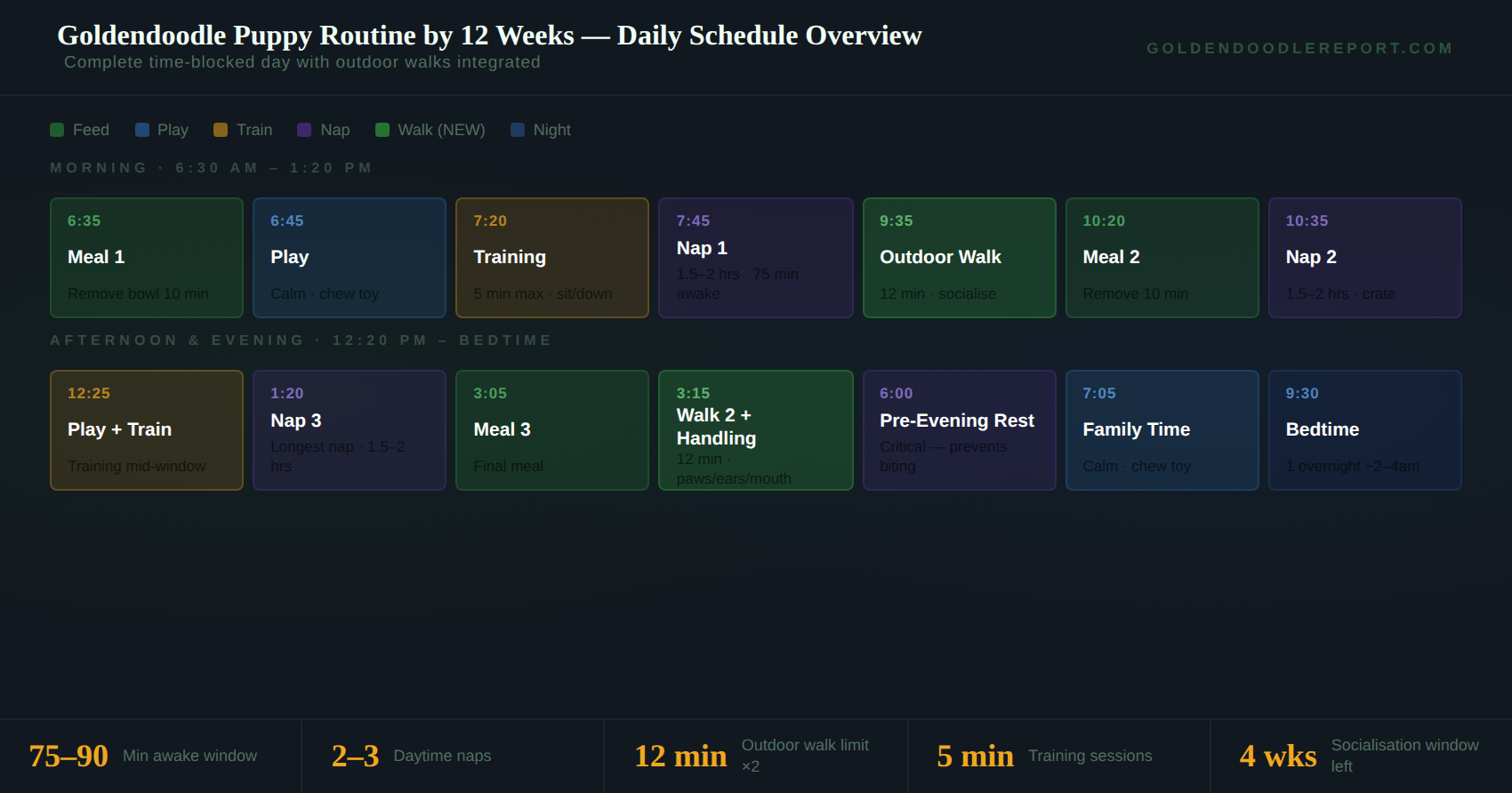
The overnight toilet trip remains expected at 12 weeks for most puppies. Many begin sleeping through occasionally from 12–14 weeks but this is not consistent yet. Keep setting the alarm for around 2–3am rather than waiting for crying.
Feeding at 12 Weeks
Meals remain at 3 per day at 12 weeks for most Goldendoodles. The main feeding change at this stage is in how the meals interact with the new outdoor exercise blocks. Avoid feeding immediately before or after a walk — digestion and physical exertion in quick succession can cause stomach upset in puppies. The schedule above places meals either before play sessions or after walks with a buffer built in.
Some puppies begin showing slightly reduced appetite at 12 weeks during peak teething discomfort. This is not a cause for concern unless appetite loss lasts more than 48 hours or is accompanied by lethargy. Softer treats and room-temperature meals are sometimes better tolerated during active teething. For guidance on choosing treats that work during training and teething simultaneously, see Best Puppy Treats for Goldendoodles and Best Chew Toys for Teething Goldendoodles.
For authoritative puppy nutrition guidance by life stage, see the puppy feeding fundamentals guide at the American Kennel Club.
Sleep and Nap Windows at 12 Weeks
Total daily sleep at 12 weeks is typically 15–17 hours — slightly less than at 10 weeks but still significantly more than owners expect. The change that catches most people off guard is not the total sleep reduction but the awake window extension. Where 60–75 minutes worked at 10 weeks, 75–90 minutes is the correct window now. Attempting naps at 60 minutes will increasingly produce resistance.
The nap reduction question — 2 naps or 3?
Some 12-week puppies begin transitioning from 3 structured daytime naps to 2. The signal is consistent: the puppy stays awake past the usual nap time without showing overtiredness signs, settles only reluctantly when crated, and then sleeps longer than usual for the remaining 2 naps as compensation. If this pattern appears for 3 or more consecutive days, try dropping to 2 longer naps of 2 hours each rather than forcing a third. Do not make the change based on a single day — puppies vary.
If the puppy is still showing overtiredness signs — hard biting, inability to settle, frantic energy — at the end of awake windows, keep 3 naps. The puppy not the schedule dictates the transition. For full sleep guidance see Goldendoodle Puppy Sleep Schedule and How Much Sleep Does a Goldendoodle Puppy Need?
Teething — What It Means for the Goldendoodle Puppy Routine by 12 Weeks
Teething in Goldendoodle puppies typically begins between 12 and 16 weeks as adult teeth start pushing through. This is distinct from the biting behaviour of the earlier weeks in one important way: teething biting is driven by physical discomfort, not overtiredness or lack of impulse control. A puppy who has been improving in their biting management may seem to regress at 12 weeks — this is usually teething, not a training failure.
The practical difference for the routine is this: the correct response to overtiredness biting is ending the interaction and enforcing a nap. The correct response to teething biting is providing an appropriate outlet for the chewing impulse — a frozen chew toy works particularly well because the cold reduces gum inflammation. The routine should have a frozen chew toy available in every awake session from 12 weeks onwards, not just when biting occurs.
Signs that biting is teething-driven rather than overtiredness-driven: it occurs throughout the awake window rather than intensifying only at the end, the puppy chews objects as well as hands, they drool more than before, and they show interest in frozen items specifically. For the complete teething guide see Goldendoodle Puppy Teething Guide.
⚠️ Watch Out
Teething puppies will chew anything at floor level — cables, furniture legs, shoes, plants. Re-do your puppy-proofing sweep at 12 weeks. Items that were safe at 8 weeks when the puppy was less mobile and less motivated to chew are now targets. See Preparing Your Home for a Goldendoodle Puppy for the full room-by-room checklist.
Going Outside — Integrating Outdoor Time Into the Routine
For most puppies whose vaccination course completes around 12–14 weeks, this is the first week proper outdoor access opens. The temptation is to take the puppy out as much as possible after weeks of garden-only access. The exercise guideline says otherwise: 12 minutes of structured exercise twice per day — 2 minutes per month of age, twice daily. This is not a suggestion. Growth plates remain open and repetitive impact loading on hard outdoor surfaces before closure may contribute to joint problems in adulthood.
Where to place outdoor walks in the routine
The schedule places the first outdoor walk in the second awake window of the morning — after the first nap, when the puppy is fully alert, cortisol is cleared, and they are most receptive to new experiences. This timing serves two purposes at once: exercise and the final weeks of the socialisation window. The second walk sits in the afternoon awake window as a lower-key physical session.
What outdoor time adds to socialisation
The socialisation window closes at approximately 16 weeks. At 12 weeks you have roughly 4 weeks remaining. Outdoor walks during this window are among the highest-value socialisation activities available — traffic sounds, unfamiliar people, different surfaces, other animals at a distance. Every calm outdoor experience during this window builds associations that are significantly harder to create after it closes. Use the time deliberately. See Goldendoodle Puppy Socialisation Checklist for a structured exposure list.
For full exercise guidance see Goldendoodle Exercise Needs by Age, When Can a Goldendoodle Puppy Go Outside? and When Can a Goldendoodle Puppy Climb Stairs?
Play and Training Sessions at 12 Weeks
Training sessions extend to a firm 5-minute maximum at 12 weeks. The puppy’s working memory and associative learning are now strong enough to begin chaining simple commands — asking for a sit before placing the food bowl, asking for eye contact before opening the door. These micro-demands build impulse control naturally into the routine rather than requiring separate training blocks.
Commands to introduce or consolidate at 12 weeks: name recall, sit, down, wait (before meals and doors), and the beginning of leave it. Keep sessions reward-dense. If the puppy’s interest drops before 5 minutes, end it — a 3-minute session that ends on enthusiasm is more valuable than a 5-minute session that ends on indifference.
What Most Owners Get Wrong at 12 Weeks
Mistake 1 — Treating teething biting the same as overtiredness biting
Ending the interaction and enforcing a nap is the correct response to overtiredness biting. Applied to teething biting, it removes the interaction but does not address the underlying gum discomfort — which means the puppy returns to biting as soon as they are back in an awake session. The correct addition is a frozen chew toy redirect, not just interaction withdrawal. Both responses working together address both causes simultaneously.
Mistake 2 — Overexercising now that outdoor access is open
After weeks of garden-only access, many owners compensate with long outdoor sessions in the first week of freedom. Twelve minutes of structured exercise twice per day is the ceiling at 12 weeks — not a baseline. An overtired, overstimulated puppy who has had too much outdoor exercise will return home and bite harder, sleep less effectively, and show more frantic behaviour than one who was exercised within the correct limit.
Mistake 3 — Assuming the socialisation window has closed
The socialisation window closes at approximately 16 weeks — not 12. Four weeks of active, deliberate socialisation remain. Owners who ease off at 12 weeks because they believe the critical period has passed are missing some of the highest-value weeks. The outdoor walks now available make this the easiest time in the puppy’s development to accumulate new positive experiences. Use every walk intentionally.
Mistake 4 — Removing the pre-evening rest because the puppy seems fine
The pre-evening rest remains essential at 12 weeks despite the extended awake window. A puppy who has been awake and active since the afternoon rest at 4pm will be overtired by 7pm regardless of how well they seem to be managing. The pre-evening rest prevents the frantic biting that most owners experience during family evening time. When it is removed for even one day the effect is immediate — and owners often mistake it for the puppy having a bad day rather than a structural routine problem.
Why the Goldendoodle Puppy Routine by 12 Weeks Works — The Developmental Reasoning
💡 Information Gain — Why This Timing Works at 12 Weeks
Every interval in the goldendoodle puppy routine by 12 weeks is placed where it is for a specific developmental reason.
- Outdoor walk in the second awake window: Post-first-nap is when cortisol is fully cleared and the puppy is most neurologically receptive — both to physical exercise and to new socialisation experiences. First awake window is too groggy; later windows carry accumulated fatigue
- Frozen chew toy in every awake session: Teething discomfort is continuous, not episodic. Having the chew toy available proactively redirects before biting escalates rather than reacting after it starts
- Training in the middle of awake windows: The middle of a 75–90 minute awake window is when working memory and focus peak — not at the start (still activating) and not at the end (cortisol rising)
- Pre-evening rest retained despite longer awake windows: A longer awake window at 12 weeks does not mean the puppy needs less total rest — it means rest can be spread differently across longer gaps. The pre-evening rest prevents the cortisol accumulation that ruins evening family time
- Exercise guideline strictly applied even outdoors: Growth plates are still completely open at 12 weeks. The exercise guideline of 12 minutes twice per day applies to outdoor hard surfaces specifically — garden play on grass at the puppy’s own pace is self-regulated and does not count toward the limit
Your Action Plan — Implementing the Goldendoodle Puppy Routine by 12 Weeks
- Today: Push each scheduled nap 15 minutes later than it currently sits. If nap resistance has been a problem, this single change will resolve most of it within 2 days.
- Before the first outdoor walk: Confirm with your vet that the vaccination course is complete. Do not assume — timing varies. Once confirmed, plan the first walk for the second awake window of the morning and keep it to 10–12 minutes maximum.
- Teething response: Prepare 2–3 frozen chew toys and rotate them. Put them in the freezer the night before. Place one in the puppy’s space at the start of every awake session — proactively, not reactively. When teeth touch skin, the chew toy goes in, the interaction ends.
- Training upgrade: Extend sessions to a maximum of 5 minutes. Begin chaining — ask for sit before the food bowl goes down every single meal. This takes 5 seconds and builds impulse control three times a day without an extra training session.
- Socialisation urgency: Mark 4 weeks on the calendar from today. That is when the socialisation window closes. Use every outdoor walk as a deliberate exposure session — not just exercise. New surface, new sound, new person, new animal at a distance. One new experience per walk.
- Pre-evening rest: Keep it. Even if the puppy seems fine without it for one evening, the habit is worth protecting. One week of consistent pre-evening rests produces a measurably calmer family evening experience.
⏱ What to Expect This Week
- Days 1–2: Shifting nap timing later reduces resistance immediately for most puppies. Some continued adjustment needed as the new window settles
- Days 3–4: First outdoor walks produce heightened arousal — expect the puppy to return home more stimulated than from indoor play. A toilet trip and a calm indoor session before the next nap manages this
- Days 5–7: Teething chew toy rotation begins showing results — biting during awake sessions decreases as the physical outlet becomes established
- Friction point: Accepting that biting has increased again at 12 weeks is not a failure — it is teething. Owners who understand this respond more calmly and redirect more effectively than those who interpret it as regression
✅ Your Next Step
Now that you have the complete goldendoodle puppy routine by 12 weeks, the most useful companion guides are Goldendoodle Puppy Teething Guide for managing the teething phase in full, and Goldendoodle Puppy Socialisation Checklist to make the most of the remaining 4 weeks of the window. When your puppy reaches 16 weeks, the next routine update covers the final shift of the puppy stage.
✅ Signs the 12-Week Routine Is Working
- Nap resistance has reduced — puppy settles within 5–10 minutes after the adjusted longer awake window
- Teething biting is redirected to chew toys within 2–3 seconds of offering them — the association between gum discomfort and the chew toy is forming
- First outdoor walks are taken calmly — puppy is curious but not overwhelmed, recovers quickly from startles
- Training sessions show chained behaviour — puppy offers a sit at mealtimes without being asked, demonstrating impulse control building
- Evening family time is noticeably calmer than the weeks before the pre-evening rest was introduced
🩺 When to Contact Your Vet
- Complete loss of appetite lasting more than 48 hours — normal teething may reduce appetite slightly but should not eliminate it
- Excessive drooling with swollen or bleeding gums — some drooling is normal during teething, significant swelling or bleeding is not
- Retained baby teeth — if adult teeth are coming through alongside baby teeth that have not fallen out, your vet needs to assess
- Limping or favouring a limb after walks — stop outdoor exercise and contact your vet before continuing
- Diarrhoea or vomiting following the first outdoor walks — puppies sometimes ingest things outside; monitor and contact your vet if it persists beyond 24 hours
See Goldendoodle Puppy First Vet Visit for full guidance on what to bring up at your 12-week check-up.
🔑 Key Takeaways
- The goldendoodle puppy routine by 12 weeks requires a longer awake window of 75–90 minutes — the single most common cause of nap resistance at this age is using the 10-week timing unchanged
- Teething typically begins at 12 weeks and drives a second wave of biting that is distinct from overtiredness biting — frozen chew toys address the physical cause that training alone cannot resolve
- Outdoor access opens for most puppies at 12 weeks — the exercise guideline of 12 minutes twice per day applies strictly, and every walk is also a high-value socialisation opportunity with 4 weeks of the window remaining
- The socialisation window does not close at 12 weeks — it closes at approximately 16 weeks. Four deliberate weeks remain and outdoor walks make this the most accessible socialisation period of the puppy’s development
- The pre-evening rest remains non-negotiable at 12 weeks despite the longer awake window — removing it produces predictable overtiredness and biting during family evening time
📚 Continue Learning
- Goldendoodle Puppy Routine by 8 Weeks — the full routine series from the start
- Goldendoodle Puppy Routine by 10 Weeks — the previous stage schedule for comparison
- Goldendoodle Puppy Teething Guide — the complete teething phase explained
- Goldendoodle Puppy Socialisation Checklist — how to use the final 4 weeks of the window
- Goldendoodle Puppy Biting Phase Guide — managing both overtiredness and teething biting
- Goldendoodle Exercise Needs by Age — safe exercise limits at every stage
↑ Back to: The Real Goldendoodle Puppy Guide — From Pickup Day to the End of Year One | Goldendoodle Puppy Guide — All Articles
Frequently Asked Questions
What should a goldendoodle puppy routine by 12 weeks look like?
A goldendoodle puppy routine by 12 weeks follows the same feed-toilet-play-train-toilet-nap cycle as earlier weeks, but with awake windows of 75–90 minutes instead of 60–75, 2–3 daytime naps depending on the individual puppy, and a short outdoor walk of 12 minutes twice per day integrated into two of the awake windows. Frozen chew toys should be available in every awake session to manage teething discomfort.
How many naps does a 12-week Goldendoodle need?
Most 12-week Goldendoodles still need 3 daytime naps, though some begin transitioning to 2. The signal for the transition is the puppy staying awake past the usual nap time without overtiredness signs, then sleeping longer for the remaining naps to compensate. If this happens consistently for 3 or more days, try dropping to 2 naps of 2 hours each. If overtiredness signs remain — hard biting, frantic energy — keep 3 naps.
Why is my 12-week Goldendoodle biting more again?
Increased biting at 12 weeks is most commonly teething — adult teeth are beginning to push through and gum discomfort drives the chewing impulse regardless of how well biting management has been working. The response is different from overtiredness biting: offer a frozen chew toy as the primary redirect rather than just ending the interaction. Both approaches working together address both causes. See Goldendoodle Puppy Teething Guide for the full method.
Can I start taking my 12-week Goldendoodle on walks?
Yes — once your vet confirms the vaccination course is complete, which is typically around 12–14 weeks. The exercise guideline at 12 weeks is 12 minutes of structured exercise twice per day — this is a ceiling, not a target. Start with shorter walks of 8–10 minutes and build gradually. Use every walk as a deliberate socialisation session with 4 weeks of the critical window remaining. See When Can a Goldendoodle Puppy Go Outside?
How long can a 12-week Goldendoodle stay awake?
The awake window at 12 weeks is typically 75–90 minutes. Going past 90 minutes without a rest opportunity produces overtiredness — cortisol rises, biting intensifies, and the puppy becomes harder to settle. The awake window will extend further at 16 weeks, but at 12 weeks 75–90 minutes is the correct range for most puppies.
Is the socialisation window still open at 12 weeks?
Yes — the socialisation window closes at approximately 16 weeks, not 12. At 12 weeks you have roughly 4 weeks of the most neurologically receptive developmental period remaining. Outdoor walks now available make this the most practical time to accumulate positive new experiences. Each walk should include at least one deliberate new exposure — a new surface, sound, person, or environment. See Goldendoodle Puppy Socialisation Checklist.
Disclaimer: The information in this article is provided for general educational purposes only. King James Adjei is a researcher and enthusiast, not a veterinarian or certified behaviourist. For health concerns, symptoms, or behaviour issues that may indicate a medical or welfare problem, always consult a qualified veterinarian or certified professional.