Affiliate Disclosure: Some links in this guide are affiliate links. If you purchase through them, we may earn a small commission at no extra cost to you. Read our full affiliate disclaimer here.
By King James Adjei — Researcher and Goldendoodle enthusiast, founder of GoldendoodleReport.com. Every guide on this site is carefully researched and written to give owners reliable, clearly organised information — updated regularly and honest about uncertainty. → About this site
📖 9-minute read | Last updated April 2026 | Reviewed for accuracy
The goldendoodle puppy routine by 10 weeks is not a small update to what you were doing at 8 weeks — it is a genuinely different schedule, built around a puppy whose sleep cycles are lengthening, whose awake windows are widening, and who is now entering the second half of the most critical socialisation window of their life. If your 8-week routine has started feeling slightly off — the puppy resisting sleep at the usual times, staying awake longer, or biting more at the end of play sessions — that is the puppy telling you the schedule needs to shift.
👤 Who This Guide Is For
- You have a Goldendoodle puppy who has just turned 10 weeks and you want to know exactly what their daily routine should look like now
- Your 8-week schedule has started feeling slightly wrong — nap resistance, longer awake windows, or increased biting at the end of play
- You want a time-blocked daily schedule you can follow from tomorrow, not a generic guide
- You want to understand the reasoning behind each timing decision so you can adapt the schedule intelligently when your puppy deviates from it
⚡ Quick Summary
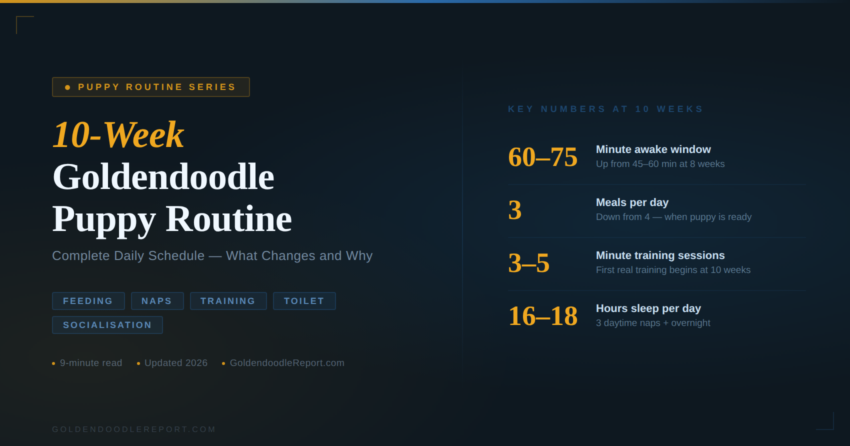
At 10 weeks, a Goldendoodle puppy typically moves from 4 meals per day to 3, awake windows extend from around 45 minutes to 60–75 minutes, and the first short training sessions can begin. Nap windows remain essential — 3 naps of 1.5–2 hours during the day. The socialisation window is still open and should be used daily. The fear period that began at 8 weeks is likely still active — exposures must remain positive and controlled.
✅ Quick Answer
A Goldendoodle puppy routine by 10 weeks should follow a cycle of feed, toilet, play, train, toilet, nap — repeated 3 times across the day with a final wind-down before bed. Awake windows run 60–75 minutes. Three daytime naps of 1.5–2 hours each. Three meals per day. Toilet trip every 45–60 minutes while awake.
For the complete overview of the first year of Goldendoodle puppy ownership, see the Real Goldendoodle Puppy Guide.
🔍 Quick Diagnosis — What Is Your Puppy Telling You?
- Puppy is resisting sleep at the usual nap time: The awake window has likely lengthened — extend play by 10–15 minutes before the next nap attempt
- Biting is intensifying at the end of play sessions: Overtiredness — the puppy has gone past their awake window. End play immediately and enforce a crate nap
- Puppy is waking earlier from naps than before: Normal at this age — sleep cycles are shifting. Do not rush to extend naps artificially; let the puppy lead
- Puppy is not finishing their meals: Check portion size — moving from 4 to 3 meals means each meal is slightly larger. Adjust downward if needed
- Puppy seems frightened of something they were fine with at 8 weeks: The fear period is likely still active. Do not push through it — back off and re-expose positively later
📖 Real Scenario
It is day three of week 10. The owner has been using the same schedule since the puppy arrived at 8 weeks — feeding four times a day, napping every 45 minutes, toilet trips every 30 minutes while awake. The puppy is now fighting sleep at the usual nap time, staying awake for what feels like forever, and then biting hard and frantically about 20 minutes later. The owner assumes the puppy has too much energy and starts adding more play. The biting gets worse. The problem is not energy — the awake window has shifted, the puppy has gone past it, and the overtiredness is presenting as hyperactivity. The fix is not more stimulation. It is adjusting the schedule to match where the puppy actually is developmentally at 10 weeks.
📋 Table of Contents
What Changes at 10 Weeks — and Why the 8-Week Routine No Longer Fits
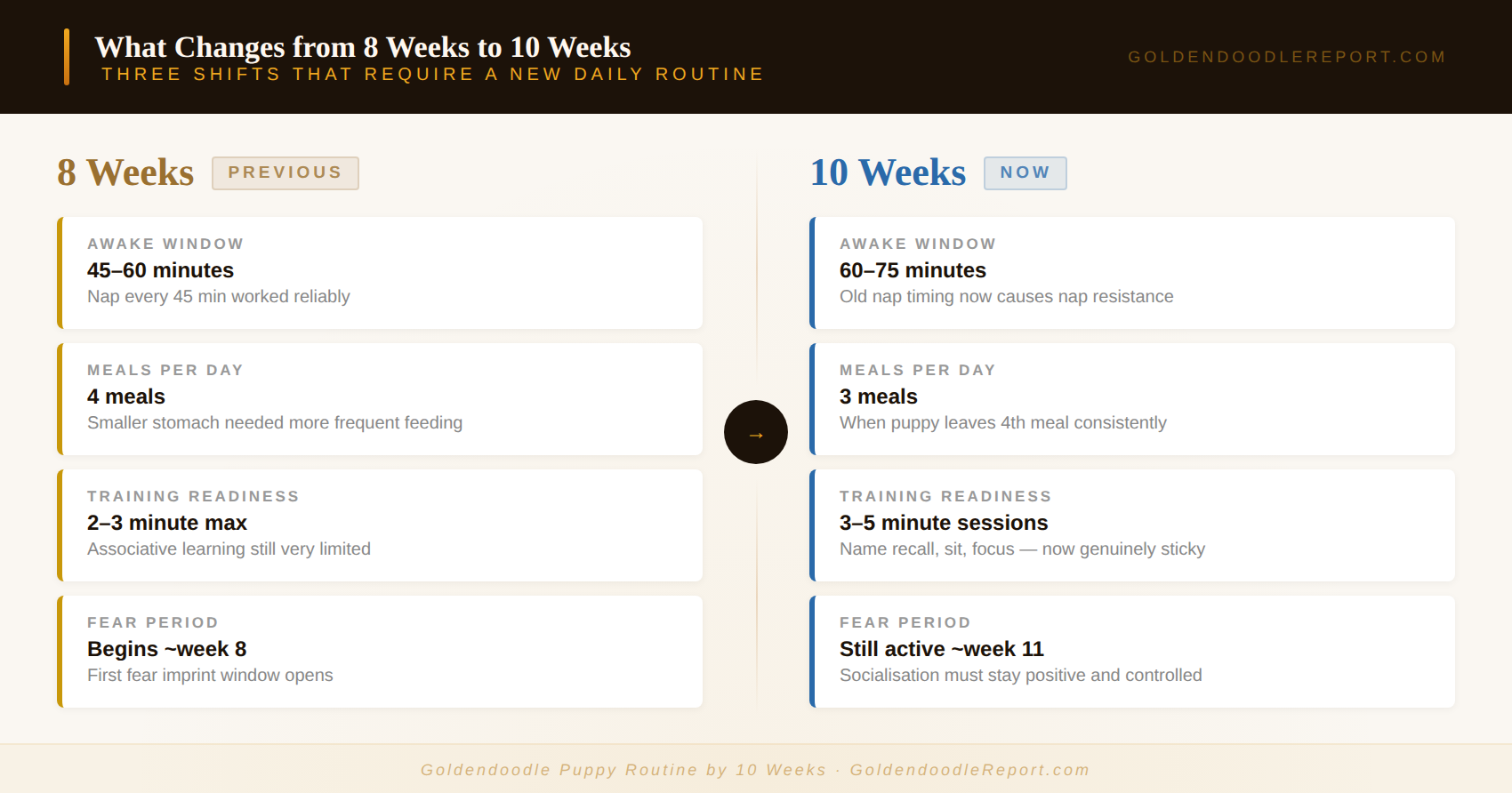
Between 8 and 10 weeks, three things shift in a Goldendoodle puppy’s biology that directly affect how the daily routine should be structured.
First, the awake window lengthens. At 8 weeks, most Goldendoodle puppies manage 45–60 minutes of wakeful activity before needing to sleep. By 10 weeks, that window has typically extended to 60–75 minutes. This sounds like a small change but it means the old nap timing is now slightly off — nap attempts that land 45 minutes after waking will increasingly be met with resistance, because the puppy is not yet ready.
Second, meal frequency typically drops from four to three. The puppy’s stomach capacity has grown enough to handle slightly larger meals spread across the day. Continuing with four meals at this stage is not harmful, but many puppies begin showing less interest in the fourth meal naturally — which is the puppy’s signal that three meals is the right structure now.
Third, the puppy’s capacity for short, focused learning begins to emerge. At 8 weeks, training sessions of more than 2–3 minutes are largely ineffective. At 10 weeks, the window extends to 3–5 minutes, and simple commands — name recognition, sit, focus — can begin producing consistent results when training is structured correctly.
None of these changes mean the puppy is suddenly grown up. Growth plates are still fully vulnerable, the socialisation window is still open, and the fear period that began around 8 weeks is likely still active. What changes is the rhythm of the day, not the fragility of the developmental stage.
The Complete Goldendoodle Puppy Routine by 10 Weeks
The schedule below is built around a puppy who wakes at 6:30am and goes down for the night at 9:00pm. If your puppy wakes earlier or later, shift all times proportionally — the intervals between each block are what matters, not the clock times themselves.
| Time | Block | Duration | Notes |
|---|---|---|---|
| 6:30 AM | Wake + Toilet | 5 min | Immediate toilet trip — do not delay |
| 6:35 AM | Meal 1 | 10 min | First meal of 3. Remove bowl after 10 minutes |
| 6:45 AM | Play + Toilet | 45 min | Calm play. Toilet trip every 20–30 min during play |
| 7:15 AM | Training Session 1 | 3–5 min | Name recall, sit, focus. Use pea-sized treats. Stop before puppy loses interest |
| 7:30 AM | Toilet + Nap 1 | 1.5–2 hrs | Crate nap. Puppy has been awake ~60 min. Close crate door |
| 9:15 AM | Wake + Toilet | 5 min | Immediate toilet trip on waking |
| 9:20 AM | Play + Socialisation | 45 min | Socialisation exposure during this window — sounds, surfaces, handling. Toilet mid-play |
| 10:05 AM | Meal 2 | 10 min | Second meal. Remove bowl after 10 minutes |
| 10:20 AM | Toilet + Nap 2 | 1.5–2 hrs | Crate nap. ~60–65 min awake. Crate door closed |
| 12:00 PM | Wake + Toilet | 5 min | Immediate toilet trip |
| 12:05 PM | Play + Training Session 2 | 45 min | 3–5 min training mid-play. Keep play calm — not overstimulating |
| 12:55 PM | Toilet + Nap 3 | 1.5–2 hrs | Third and longest nap of the day. Crate door closed |
| 2:45 PM | Wake + Toilet | 5 min | Immediate toilet trip |
| 2:50 PM | Meal 3 | 10 min | Third and final meal. Remove bowl after 10 minutes |
| 3:00 PM | Calm Play + Handling | 45 min | Gentle handling practice — paws, ears, mouth. Toilet mid-play |
| 3:50 PM | Short Rest | 45–60 min | Quiet crate rest — not necessarily a full sleep. Crate door closed |
| 4:50 PM | Wake + Toilet | 5 min | Toilet trip |
| 4:55 PM | Evening Play | 45 min | Calmer play. Avoid high-energy games — wind-down period begins |
| 5:45 PM | Toilet + Short Nap | 45–60 min | Pre-evening rest. Prevents overtiredness before the long evening awake window |
| 6:45 PM | Wake + Toilet | 5 min | Toilet trip |
| 6:50 PM | Family Time / Calm Play | 60 min | Low-stimulus interaction. Chew toy. Settles with family. No rough play |
| 7:50 PM | Toilet + Short Rest | 45 min | Crate rest before final evening session |
| 8:35 PM | Last Play + Toilet | 30 min | Final calm play and last toilet trip before bed |
| 9:00 PM | Bedtime Crate | All night | Crate in bedroom or nearby. One overnight toilet trip expected at 10 weeks — typically 1–3am |
Colour key: 🟡 Nap/Rest | 🟢 Training | 🔵 Night sleep
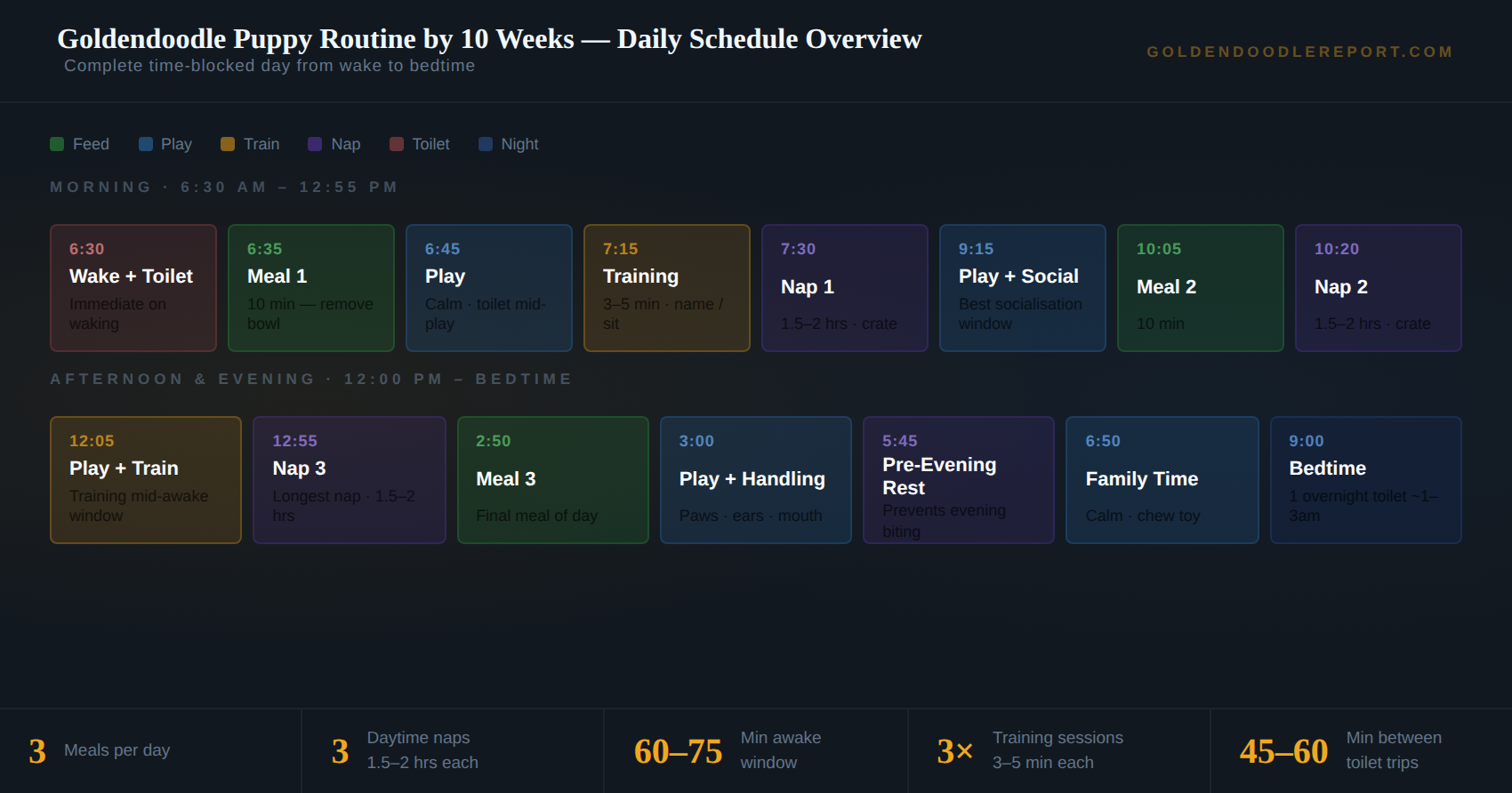
The overnight toilet trip is still expected at 10 weeks. Most puppies are not reliably dry through the night until 12–16 weeks. Set an alarm for around 1–2am rather than waiting for the puppy to cry — this prevents the crying from becoming a habit.
Feeding a Goldendoodle Puppy at 10 Weeks
At 10 weeks, most Goldendoodle puppies transition naturally from 4 meals to 3 meals per day. The signal is simple — if your puppy is consistently leaving food in the bowl at the fourth meal, they are ready for 3. If they are still eating all 4 meals enthusiastically, keep 4 for another week and reassess.
How much to feed
Portion size depends on the food brand, the puppy’s current weight, and projected adult size. Always start with the manufacturer’s puppy feeding guide as your baseline and adjust based on body condition — you should be able to feel the puppy’s ribs easily but not see them prominently. A Goldendoodle at 10 weeks who is growing normally will typically look slightly rounded in the belly after meals and leaner between them.
Treats and training portions
At 10 weeks you are starting short training sessions. Training treats must be pea-sized and counted within the daily food allowance. Many owners do not account for training treats and then wonder why their puppy is losing interest in meals — the calorie intake from treats across 2–3 training sessions per day adds up quickly. Use small pieces of the puppy’s kibble as training rewards where possible to keep the balance right.
For detailed guidance on treat selection see Best Puppy Treats for Goldendoodles.
For authoritative guidance on puppy nutrition by life stage, see the puppy feeding fundamentals guide at the American Kennel Club.
Sleep and Nap Windows at 10 Weeks
A 10-week Goldendoodle puppy typically sleeps 16–18 hours per day across overnight sleep and daytime naps. The most common mistake at this age is mistaking nap resistance for the puppy not being tired — in almost every case, a puppy who fights sleep at 10 weeks has been kept awake too long and is now overtired rather than not tired enough.
The awake window — what it is and why it matters
The awake window is the maximum time a 10-week puppy can stay alert and engaged before the nervous system needs to reset through sleep. At 10 weeks this window is typically 60–75 minutes. Going past it does not produce a calmer puppy — it produces a cortisol spike that presents as hyperactivity and intensified biting. The moment you see your puppy starting to bite harder, lose focus, or move erratically, check the clock. If they have been awake for more than 60 minutes, you have likely gone past the window.
Crate naps — why the crate door must stay closed
Naps in the crate with the door closed are not optional. A puppy left to nap in an open playpen or on the sofa will typically not achieve the depth of sleep needed for neurological recovery. The crate provides the low-stimulus enclosed environment that allows deeper sleep cycles. Close the door, cover the crate lightly with a blanket to reduce visual stimulation, and walk away. Most puppies at 10 weeks will settle within 5–10 minutes.
For the full sleep guide see How Much Sleep Does a Goldendoodle Puppy Need? and Goldendoodle Puppy Sleep Schedule.
Toilet Training Within the Goldendoodle Puppy Routine by 10 Weeks
At 10 weeks, a Goldendoodle puppy does not yet have full bladder control. They can hold their bladder for approximately 1–1.5 hours while awake — slightly longer than at 8 weeks, but still not reliably longer. The toilet training rule at this age is simple: take the puppy out every 45–60 minutes while awake, immediately after every meal, and immediately on waking from every nap.
The most reliable toilet accidents at 10 weeks happen in two situations. First, directly after a meal when the owner waits too long before taking the puppy outside. Second, in the middle of an exciting play session when the puppy is distracted and misses their own physical signals. Building toilet trips into the routine at regular intervals — not waiting for the puppy to signal — prevents the majority of accidents at this stage.
⚠️ Watch Out
Do not take your 10-week Goldendoodle puppy to public pavements, parks, or areas used by unknown dogs. Your puppy’s vaccination course is not yet complete at 10 weeks. The second vaccination appointment is typically at 10–12 weeks — until your vet confirms the course is complete, limit outdoor access to your own garden or the gardens of households with fully vaccinated dogs. See When Can a Goldendoodle Puppy Go Outside?
Play and First Training Sessions at 10 Weeks
Ten weeks is the right age to begin short, structured training sessions. The puppy’s attention span and short-term associative learning are sufficiently developed to make 3–5 minute sessions genuinely productive. Start with three things only: name recognition, sit, and eye contact. Introduce one at a time — do not attempt all three in the same session.
Training session structure
Keep sessions to 3–5 minutes maximum. End every session on a success — if the puppy completes the behaviour once correctly, end there rather than repeating until failure. Use the puppy’s name at the start of every session to build the name-recall association. If the puppy loses focus before the session ends, end it immediately rather than trying to re-engage — a distracted puppy is not learning.
Exercise limits at 10 weeks
The safe exercise guideline at 10 weeks is 10 minutes of structured exercise twice per day — 2 minutes per month of age. This means on-lead walking or deliberate exercise, not free play in the garden which the puppy self-regulates. Hard surfaces, stairs, and jumping remain off-limits. Growth plates are still fully open at 10 weeks and repetitive impact loading may cause joint problems that only become apparent in adulthood.
For full exercise guidance see Goldendoodle Exercise Needs by Age and When Can a Goldendoodle Puppy Climb Stairs?
The Fear Period — What to Watch For in the 10-Week Routine
The first fear imprint period in Goldendoodle puppies runs from approximately 8 to 11 weeks. At 10 weeks your puppy is likely still within it. This matters for the daily routine because it directly affects how socialisation blocks should be handled.
During the fear period, a single frightening experience can create a lasting negative association that is significantly harder to undo than it would be outside this window. This does not mean avoiding all new experiences — the socialisation window is still open and deliberate positive exposure remains essential. It means reading the puppy’s body language during every new experience and backing off at the first sign of genuine fear rather than pushing through.
Signs your puppy is in the fear response during a routine socialisation block: freezing, tail tucking, attempting to hide, refusing treats they would normally take enthusiastically, whale eye (whites of the eyes visible). If you see any of these, remove the puppy from the situation calmly and without fuss. Do not comfort excessively — keep the interaction neutral and matter-of-fact. Re-expose to the same trigger at a lower intensity in a later session.
For full detail on both fear periods see Goldendoodle Puppy Fear Stages.
Why the Goldendoodle Puppy Routine by 10 Weeks Works — The Developmental Reasoning
💡 Information Gain — Why This Timing Works at 10 Weeks
Most schedule guides tell you what times to use. This section explains why the specific intervals in this schedule work at this developmental stage — so you can adapt intelligently when your puppy deviates from it.
- 60–75 minute awake windows: Matched to the average ultradian rhythm at 10 weeks. Going over this window triggers cortisol release that presents as hyperactivity — not excess energy but missed sleep
- Training placed mid-awake window: Puppies are most receptive to learning in the middle of their awake window — not immediately on waking (still groggy) and not near the end (too tired to retain)
- Meals before naps, not after: Digestion triggers sleepiness. Feeding just before a nap window increases the chance of the puppy settling quickly in the crate
- Socialisation in the second awake window: The puppy is fully alert after the first nap, cortisol is cleared, and they are most receptive to new experiences — the second awake window of the day is consistently the best time for deliberate socialisation exposure
- Short evening rest before final awake window: A common mistake is keeping puppies awake all evening for family time. Without a short pre-evening rest, most 10-week puppies are overtired by 7pm and spend the family time biting and frantic rather than settled and calm
What Most Owners Get Wrong at 10 Weeks
Mistake 1 — Keeping the 8-week feeding schedule
Four meals per day at 10 weeks often leads to a puppy who grazes and picks at food rather than eating with focus. Moving to three meals — when the puppy is ready — creates more reliable hunger at mealtimes and makes food a stronger motivator for training. The signal to move is simple: two or more days of the puppy leaving the fourth meal largely untouched.
Mistake 2 — Adding exercise when the puppy seems hyper
The hyperactivity and hard biting that owners notice at this age almost always occurs when the puppy has gone past their awake window, not because they need more stimulation. More exercise at this point makes the cortisol problem worse. The correct response is to end the awake session and enforce a crate nap — the frantic behaviour typically disappears within 20 minutes of the puppy going down.
Mistake 3 — Pushing through fear responses during socialisation
The fear period is still active at 10 weeks. Pushing a puppy through a fear response — continuing to expose them to something they are clearly frightened of — does not build confidence. It builds a negative association that can persist for months. Back off at the first sign of genuine fear, allow the puppy to recover, and reintroduce the trigger at a lower intensity at a later session.
Mistake 4 — Starting training sessions too long
Five minutes is the absolute maximum training session length at 10 weeks — and most sessions should end earlier when the puppy is still engaged. An owner who runs 10–15 minute training sessions is teaching the puppy that training is exhausting and that losing focus is acceptable. Short, sharp, always-ending-on-success sessions build a puppy who is enthusiastic about training rather than tolerating it.
Your Action Plan — Implementing the Goldendoodle Puppy Routine by 10 Weeks
- Today: Check whether your puppy is still finishing 4 meals. If they are leaving food at the fourth meal consistently, drop to 3 meals starting tomorrow. If still eating all 4, keep 4 for another 3–5 days and reassess.
- Tomorrow morning: Start tracking awake windows from the moment the puppy wakes up. Set a timer for 60 minutes. When it goes off, begin the wind-down to the next crate nap regardless of whether the puppy seems tired.
- This week: Add one 3–5 minute training session per awake window. Start with name recognition only — say the puppy’s name once, reward immediately when they look at you. Do not move to sit or other commands until name recall is reliable.
- Socialisation block daily: Use the second awake window of the morning for deliberate socialisation exposure. Pick one new experience per day — a different surface, a new sound, handling a different body part. Keep it calm and positive.
- Evening routine: Add a short pre-evening rest between 5:45–6:45pm. This one change prevents the frantic biting that many owners experience during evening family time — it is almost always overtiredness, not bad behaviour.
- Overnight: Set an alarm for 1:30am for the toilet trip rather than waiting for the puppy to cry. This prevents the crying-gets-results association that is much harder to break later.
⏱ What to Expect This Week
- Days 1–2: The new schedule will feel slightly mechanical. The puppy may resist naps at the new timing — hold the routine anyway
- Days 3–4: Most puppies begin accepting the adjusted awake windows and nap times. Biting at the end of awake sessions should start decreasing
- Days 5–7: Training sessions begin showing consistent results if kept short and reward-dense. Name recall is typically reliable within 5–7 days of focused practice
- Friction point: The biggest friction is the pre-evening rest — most families want to interact with the puppy in the evening and resist putting them in the crate. Hold to it for one week and the payoff is a calm settled puppy for family time rather than a biting overtired one
✅ Your Next Step
Now that you have the complete goldendoodle puppy routine by 10 weeks and the reasoning behind it, the most useful next guide is the Goldendoodle Puppy Routine by 8 Weeks — useful as a reference for exactly what changed between the two stages. When your puppy reaches 12 weeks, return here for the next routine update.
✅ Signs the 10-Week Routine Is Working
- Puppy settles in the crate within 5–10 minutes at nap time without prolonged crying
- Biting during play sessions is decreasing in frequency and intensity — particularly at the end of awake windows
- Puppy responds to their name reliably within 5–7 days of consistent name-recall training
- Fewer overnight accidents — most nights managed with one single toilet trip at approximately 1–3am
- Evening family time is calmer — puppy settles with the family rather than biting and frantic
🩺 When to Contact Your Vet
- Puppy is sleeping significantly more than 18 hours per day alongside lethargy or loss of appetite
- Complete refusal to eat for more than 24 hours
- Diarrhoea lasting more than 24 hours or any blood in stool
- Limping, favouring a limb, or yelping when touched in a specific area
- Any signs of distress, difficulty breathing, or unusual behaviour not explained by the routine
Puppies deteriorate faster than adult dogs. If anything seems wrong, do not wait — contact your vet. See Goldendoodle Puppy First Vet Visit for full guidance on what to expect at your 10-week check-up.
🔑 Key Takeaways
- The goldendoodle puppy routine by 10 weeks differs from the 8-week routine in three specific ways: awake windows lengthen to 60–75 minutes, meals typically drop from 4 to 3, and short training sessions of 3–5 minutes can begin
- A puppy biting hard and acting frantic at the end of a play session is almost always overtired, not over-energised — the correct response is a crate nap, not more exercise
- The first fear period is likely still active at 10 weeks — socialisation exposures must remain positive and controlled, and the puppy must never be pushed through a fear response
- Training placed in the middle of the awake window — not at the beginning or end — produces the most consistent results at this age
- A short pre-evening rest between 5:45–6:45pm prevents the biting and frantic behaviour most owners experience during evening family time
📚 Continue Learning
- Goldendoodle Puppy Routine by 8 Weeks — the previous stage schedule for comparison
- Goldendoodle Puppy Sleep Schedule — full nap and sleep guidance by age
- Goldendoodle Puppy Fear Stages — the two fear periods explained in full
- Goldendoodle Puppy Socialisation Checklist — how to use the 8–16 week window correctly
- Goldendoodle Puppy Biting Phase Guide — the consistent method that stops the biting
↑ Back to: The Real Goldendoodle Puppy Guide | Goldendoodle Puppy Guide — All Articles
Frequently Asked Questions
What should a goldendoodle puppy routine by 10 weeks look like?
A 10-week Goldendoodle puppy routine follows a cycle of feed, toilet, play, short training session, toilet, nap — repeated three times across the day. Awake windows run 60–75 minutes. Three daytime naps of 1.5–2 hours each in the crate. Three meals per day. Toilet trips every 45–60 minutes while awake and immediately after every meal and every nap.
How long should a 10-week Goldendoodle sleep during the day?
A 10-week Goldendoodle typically needs 3 daytime naps of 1.5–2 hours each, plus additional shorter rest periods in the afternoon and evening. Total daily sleep at this age is 16–18 hours. A puppy who seems to be sleeping more than usual but is otherwise healthy and eating normally is not a concern — some puppies sleep more during growth spurts.
How many times a day should a 10-week Goldendoodle eat?
Most 10-week Goldendoodle puppies are ready to move from 4 meals to 3 meals per day. The signal to make the change is the puppy consistently leaving food at the fourth meal. If your puppy is still eating all 4 meals enthusiastically, keep 4 for another week and reassess. Meals should be removed after 10 minutes regardless of whether the puppy has finished.
Can I start training my Goldendoodle puppy at 10 weeks?
Yes — 10 weeks is the right age to begin short training sessions of 3–5 minutes maximum. Start with name recognition only: say the puppy’s name once and reward immediately when they look at you. Once that is reliable, introduce sit. Keep sessions short, always end on a success, and place them in the middle of the awake window when the puppy is most alert and receptive.
Why is my 10-week Goldendoodle still biting so much?
At 10 weeks, biting is developmentally normal and expected. It typically intensifies when the puppy is overtired — past their awake window — rather than under-exercised. Check whether the biting is heaviest at the end of play sessions, which suggests the awake window has been exceeded. The correct response is ending the session and enforcing a crate nap. For the full method see Goldendoodle Puppy Biting Phase Guide.
How long can a 10-week Goldendoodle puppy be left alone?
A 10-week puppy should not be left alone for more than 1–2 hours at a time during the day — and ideally only during a scheduled crate nap when they are likely to sleep anyway. Leaving a 10-week puppy alone for extended periods produces anxiety and toilet accidents and may undermine the crate training progress you have built. If you need to be away for longer, arrange for someone to check on the puppy and maintain the nap and toilet routine.
Disclaimer: The information in this article is provided for general educational purposes only. King James Adjei is a researcher and enthusiast, not a veterinarian or certified behaviourist. For health concerns, symptoms, or behaviour issues that may indicate a medical or welfare problem, always consult a qualified veterinarian or certified professional.