Affiliate Disclosure: Some links in this guide are affiliate links. If you purchase through them, we may earn a small commission at no extra cost to you. Read our full affiliate disclaimer here.
By King James Adjei — Researcher and Goldendoodle enthusiast, founder of GoldendoodleReport.com. Every guide on this site is carefully researched and written to give owners reliable, clearly organised information — updated regularly and honest about uncertainty. → About this site
📖 8-minute read | Last updated April 2026 | Reviewed for accuracy
Goldendoodle puppy exercise mistakes are remarkably common — not because owners are careless, but because almost everything about a young Goldendoodle suggests they need more exercise than they actually do. They are energetic. They seem endlessly willing. They look healthy and strong.
None of that changes the biology: a Goldendoodle puppy’s skeleton is not finished growing, and the types of exercise that feel harmless to an adult dog can cause real, lasting damage to a puppy’s developing joints. This guide names the most costly mistakes, explains exactly why each causes harm, and tells you what to do instead.
👤 Who This Guide Is For
- You have a Goldendoodle puppy under 12 months and want to make sure you are exercising them correctly
- You have been exercising your puppy freely and are now wondering whether you have been doing too much
- Your puppy is limping, reluctant to walk, or showing stiffness and you want to know if over-exercise could be the cause
- You want to understand what types of exercise are genuinely safe and which ones carry real risk before growth plates close
⚡ Quick Summary
The most damaging goldendoodle puppy exercise mistakes are running on hard surfaces, allowing repetitive stair use, permitting jumping from height, following adult exercise routines, and using exercise to manage energy or behaviour. Growth plates in a Goldendoodle puppy’s bones remain open and vulnerable until 12–18 months. The safe exercise guideline — 5 minutes per month of age twice daily — is not a conservative estimate. It is the ceiling.
✅ Quick Answer
The goldendoodle puppy exercise mistake that causes the most long-term harm is over-exercise before growth plate closure — particularly running on hard surfaces, repetitive stair use, and jumping. The safe guideline is 5 minutes of structured exercise per month of age, twice per day. A 3-month-old puppy needs 15 minutes maximum. Free play in a garden on soft ground at the puppy’s own pace does not count toward this limit. Mental stimulation fills the gap.
For the complete first-year guide see The Real Goldendoodle Puppy Guide — From Pickup Day to the End of Year One. For the full safe exercise guide by age see Goldendoodle Exercise Needs by Age.
🔍 Quick Diagnosis — Do Any of These Apply?
- Your puppy free-runs with adult dogs at the park every day: This is the most common over-exercise pattern — adult dogs set a pace and duration a puppy cannot safely sustain
- Your puppy uses stairs independently multiple times a day: Repetitive stair use on young growth plates carries genuine risk — carry or block stairs until 12 weeks minimum
- You take your puppy on runs or long walks to tire them out: Tired-out through physical exercise at this age means fatigued joints, not a trained dog
- Your puppy regularly jumps on and off furniture: The landing impact of furniture jumping concentrates force on developing joints repeatedly throughout the day
- Your puppy seems stiff after play or reluctant to walk the next morning: Post-exercise stiffness in a puppy is a red flag — contact your vet before continuing the current exercise routine
📖 Real Scenario
A Goldendoodle puppy at 14 weeks goes to the dog park every morning with an adult Labrador. They run for 45 minutes, the puppy keeping up enthusiastically. The owner notices at 8 months the puppy has started limping on the right front leg after exercise. The vet diagnoses early-onset elbow dysplasia.
The owner is told the joint damage likely began months earlier from repetitive high-impact loading on immature growth plates — when the puppy appeared completely fine. There were no visible signs during the exercise itself. The damage accumulated invisibly over weeks before it became detectable. This is how most over-exercise joint damage in Goldendoodle puppies works — the harm happens before the symptoms appear.
Understanding Growth Plates — Why Goldendoodle Puppy Exercise Mistakes Matter More Than Most Owners Realise
Growth plates — called physes — are areas of soft cartilage near the ends of a puppy’s long bones where new bone tissue is produced as the puppy grows. While they remain open, they are significantly softer and more vulnerable to damage than the surrounding mature bone. A force that would cause no harm to an adult dog’s fully ossified skeleton can deform or fracture a growth plate in a puppy.
In Goldendoodles, growth plates typically close in sequence — smaller bones first, larger bones later. The growth plates most commonly affected by exercise-related damage are in the elbow, shoulder, and hip joints. These are the joints that bear the most impact from running, jumping, and stair use. Closure of all growth plates in a standard Goldendoodle is typically complete between 12 and 18 months — with larger Goldendoodles on the longer end of that range.
The critical point that most owners miss: growth plate damage is largely painless as it accumulates. A puppy running enthusiastically on hard surfaces shows no signs of distress during the exercise. The damage builds silently over weeks and months, presenting as joint problems — elbow dysplasia, hip dysplasia, osteochondritis dissecans — often not until 6–18 months of age when the cumulative impact becomes detectable.
This delayed presentation is why the guideline matters before the symptoms appear, not after them.
The Safe Exercise Guideline — What It Actually Means
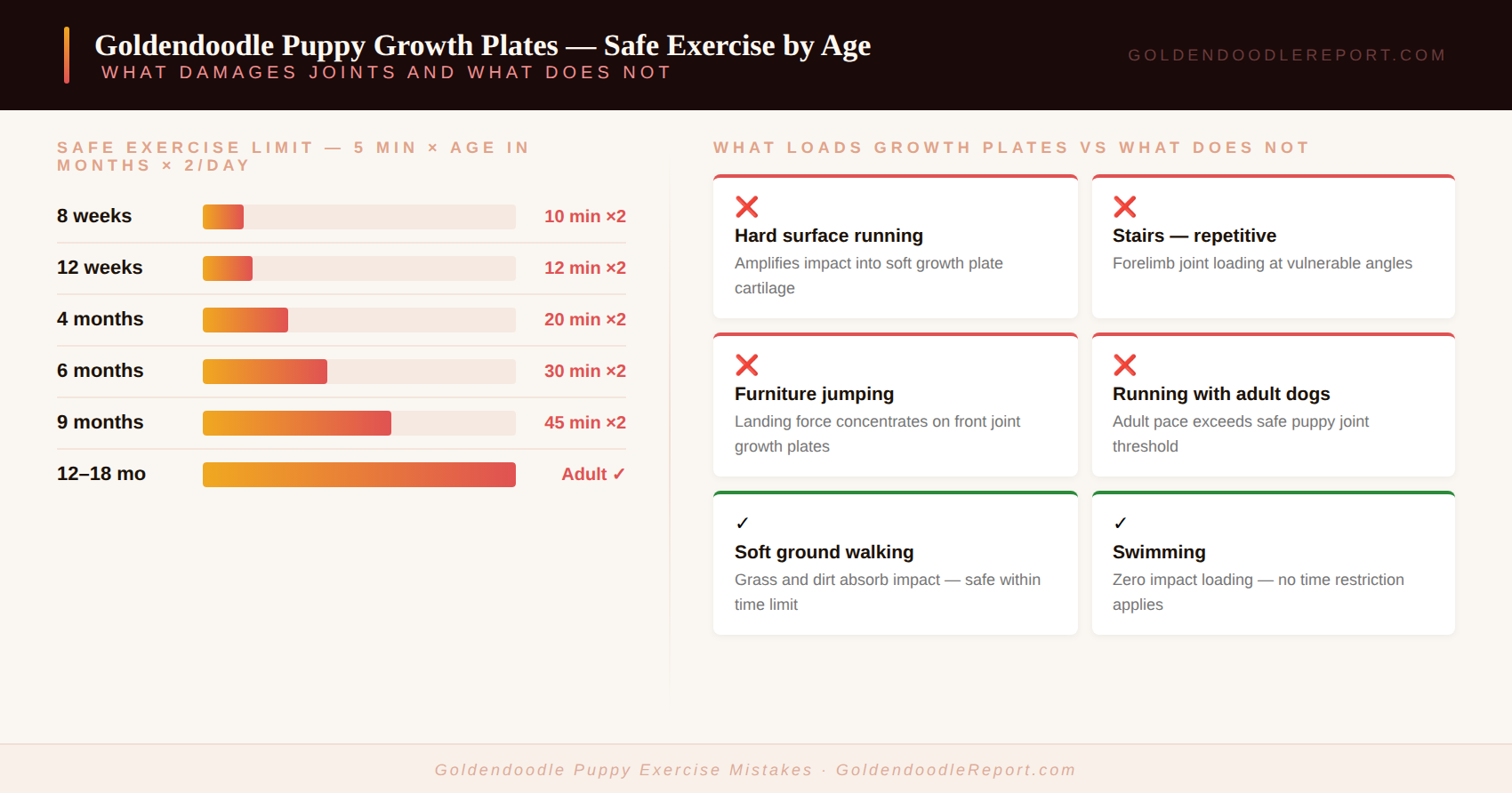
The guideline used by most veterinarians and responsible breeders is simple: 5 minutes of structured exercise per month of age, twice per day. This means:
| Age | Max Structured Exercise | Per Day Total | Notes |
|---|---|---|---|
| 8 weeks | 10 min × 2 | 20 min | On-lead walking on soft ground only |
| 12 weeks | 12 min × 2 | 24 min | First outdoor walks begin post-vaccination |
| 4 months | 20 min × 2 | 40 min | Still no running, jumping, or hard surfaces |
| 6 months | 30 min × 2 | 60 min | Graduated introduction to varied terrain |
| 9 months | 45 min × 2 | 90 min | Growth plates closing — confirm with vet before increasing |
| 12–18 months | Full adult exercise | Unrestricted | Only after vet confirms growth plates closed |
Two important clarifications on this guideline:
Free play in a garden on soft ground does not count. The guideline applies to structured exercise — on-lead walking, deliberate running, fetch games on hard surfaces. A puppy pottering around a garden at their own pace, stopping to sniff and explore, is self-regulating and is not loading their joints with the repeated impact of structured exercise.
Swimming is the major safe exception. Swimming places no impact load on growth plates. A puppy who can swim safely under supervision can do so without the same time restrictions. The caveat is safe water entry and exit — jumping in and out of a pool or dock counts as jumping and should be avoided.
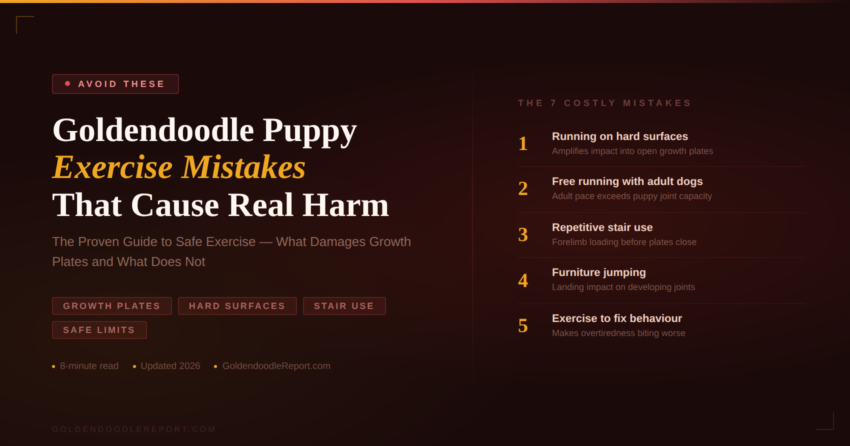
The 7 Most Costly Goldendoodle Puppy Exercise Mistakes
Mistake 1 — Running on hard surfaces
Pavement, concrete, tarmac, and other hard surfaces amplify the impact force of every footstrike. In an adult dog with closed growth plates, this force is absorbed by fully mineralised bone. In a puppy, it travels directly into the soft cartilage of the growth plate. Even a brief daily run on pavement repeated over weeks generates cumulative loading that significantly exceeds what a puppy’s developing skeleton is designed to handle.
The fix is simple: exercise on soft ground — grass, dirt paths, soft woodland trails — where the surface absorbs the impact rather than amplifying it. Reserve hard surface walking for short toilet trips and necessary urban outings rather than exercise sessions.
Mistake 2 — Allowing free running with adult dogs
This is the most common source of over-exercise in Goldendoodle puppies. Adult dogs set a pace based on their own fitness and joint capacity — not the puppy’s. A puppy running with a fit adult Labrador or Border Collie will push well past their safe exercise threshold trying to keep up, often without showing visible distress until they crash into exhausted sleep afterwards. The cumulative loading on a puppy attempting adult exercise distances is significant.
Puppies should socialise with adult dogs in environments where the pace is controlled — not dog parks or open fields where extended running is the likely outcome. Supervised calm play on soft ground is appropriate; free-running with significantly larger or fitter dogs is not.
Mistake 3 — Repetitive stair use
Stairs require a puppy to repeatedly load their forelimb joints at angles they are not yet structurally equipped for. A single stair trip is low risk. Multiple stair trips daily from 8 weeks onward — which is what happens in most homes without deliberate management — accumulates into significant loading over the weeks before growth plates close.
The correct approach for most homes is to carry the puppy on stairs until 12 weeks, then introduce supervised occasional stair use, and allow free stair use only after 16 weeks with continued caution until growth plates close. See When Can a Goldendoodle Puppy Climb Stairs? for the full protocol.
Mistake 4 — Jumping on and off furniture
The landing impact from a puppy jumping off a sofa or bed is disproportionate to how harmless it appears. The puppy’s front legs absorb the majority of landing force, concentrating it precisely in the forelimb growth plates. A puppy who jumps off the sofa 15 times per day has performed 15 repetitions of high-impact loading on immature joint structures.
The fix is to block furniture access with a playpen or use a ramp or pet steps that allow the puppy to descend gradually rather than jumping. This is worth the inconvenience — joint problems from repetitive furniture jumping are well-documented in medium and large breed puppies.
Mistake 5 — Using exercise to fix behaviour or manage energy
The instinct when a Goldendoodle puppy is hyperactive, biting, or seemingly impossible to settle is to take them for a longer walk or a run to “tire them out.” This is one of the most counterproductive responses available, for two reasons.
First, as covered in the puppy routine guides, hyperactivity and hard biting in a Goldendoodle puppy are almost always signs of overtiredness — not under-exercise. More physical stimulation makes the cortisol problem driving the behaviour significantly worse. Second, using exercise as a behaviour management tool trains the puppy that frantic behaviour produces outdoor activity — creating a reinforcement loop that sustains the frantic behaviour.
The correct response to puppy hyperactivity is a crate rest period, not more exercise.
Mistake 6 — Following adult exercise advice or breed exercise information
Exercise guides for adult Goldendoodles appropriately recommend significant daily exercise — adult Goldendoodles are active dogs who genuinely need it. Owners reading that adult Goldendoodles need 60–90 minutes of exercise per day sometimes apply this to their puppy. An 8-week puppy needs 20 minutes maximum. An 8-month puppy needs 40 minutes maximum. The adult exercise requirement does not apply until the growth plates close.
Mistake 7 — Starting formal agility, flyball, or jumping sports too early
Agility and jumping sports place extreme repetitive loading on joints that are not ready for it. No responsible agility trainer will compete a dog under 18 months — many wait until 24 months specifically because of growth plate vulnerability. Foundation work — attention, focus, simple movement patterns on flat ground — can begin early. Any exercise involving jumping, weaving at speed, or impact loading should not begin until a vet confirms growth plate closure.
Signs You May Be Over-Exercising Your Goldendoodle Puppy
Because growth plate damage accumulates without immediate pain response, the signs of over-exercise in a Goldendoodle puppy are often subtle and frequently attributed to other causes. Know what to look for:
⚠️ Signs That Warrant Reducing Exercise Immediately and Contacting Your Vet
- Stiffness on waking or after rest — particularly in the front legs or hips — in a puppy under 12 months
- Reluctance to jump up or go up stairs that were previously managed without hesitation
- A subtle change in gait — one leg lands or pushes off slightly differently from the others
- The puppy lags behind on walks rather than pulling forward — this is the opposite of their normal behaviour
- Swelling around a joint, even mild, following exercise
- Licking or chewing at a specific joint area repeatedly
- Visible lameness — limping — even if it resolves quickly after rest
Any lameness in a puppy under 12 months should be assessed by a vet before exercise continues. Do not take a “wait and see” approach — growth plate injuries assessed early have significantly better outcomes than those identified late.
What to Do Instead — Mental Stimulation as the Real Solution to Puppy Energy
The practical problem with the safe exercise guideline is that 15–20 minutes of walking does not come close to settling a 3-month Goldendoodle puppy for the rest of the day. This is where owners struggle most — the puppy’s energy needs to go somewhere.
The answer is mental stimulation. Mental exercise tires a puppy significantly more efficiently than physical exercise and carries no joint risk. The following activities all provide genuine mental fatigue without impact loading:
Short training sessions — 3–5 minutes of active reward-based training is more mentally taxing for a puppy than a 30-minute walk. The puppy must focus, process information, and perform — all of which drive genuine neurological fatigue. Three sessions across the day provides more effective settling than an extended walk ever will.
Sniff games — hide small treats around the garden or a room and let the puppy search for them. Scent work activates significant neurological processing and produces genuine tiredness. A 10-minute sniff game in the garden has been observed in multiple trainer-run studies to produce more lasting calm than a 20-minute on-lead walk.
Puzzle feeders and food toys — feeding meals through a Kong, a licki mat, or a puzzle feeder turns every meal into a cognitive exercise session. This is particularly effective at high-energy times of day — immediately after a nap when the puppy would otherwise redirect their energy into biting or destructive behaviour.
Supervised free play in the garden — soft-ground, self-directed, unsustained. The puppy controls the pace, stops when they choose, and loads their joints at the level they are comfortable with rather than being driven by a human or adult dog pace.
The combination of the correct physical exercise allowance plus active mental stimulation resolves the energy management problem that leads most owners to over-exercise in the first place. See Best Toys for Goldendoodle Puppies for specific mental stimulation tool recommendations.
What Exercise Is Safe for a Goldendoodle Puppy
To be clear alongside the mistakes: the guideline is not no exercise. It is the right exercise at the right duration on the right surfaces.
Safe: short on-lead walks on soft ground. Grass, dirt, woodland paths. Within the age-appropriate time limit. The puppy walks at a comfortable pace, sniffs, explores, and stops when they want to. This is the primary structured exercise for puppies under 6 months.
Safe: supervised swimming. Non-impact, full-body muscle engagement, genuinely tiring. Ensure safe entry and exit — no jumping. Water temperature appropriate for a young puppy. Supervision at all times. See Do Goldendoodles Like Water? for guidance on introducing water safely.
Safe: self-directed garden play on grass. Not structured exercise. The puppy sets the pace and duration. Does not count toward the daily exercise limit.
Safe: puppy classes. The structured interaction, training, and play in a supervised environment with age-matched puppies provides social development and manageable physical activity within appropriate limits. See Goldendoodle Puppy Socialisation Checklist for how to use puppy classes within the socialisation window.
For authoritative guidance on developmental orthopaedic disease and exercise in large breed puppies, the American College of Veterinary Surgeons provides detailed reference information. See the ACVS guidance on osteochondrosis in dogs.
Why These Goldendoodle Puppy Exercise Mistakes Cause Lasting Harm — The Developmental Reasoning
💡 Information Gain — Why the Damage Happens Before the Symptoms Appear
Understanding the mechanism makes the guideline easier to follow — it is not arbitrary caution, it is physics applied to developing biology.
- Growth plate cartilage has no pain receptors of the type that signal acute injury: Unlike bone, which produces immediate pain when fractured, growth plate cartilage can deform under repeated load without triggering a pain response the puppy can communicate. This is why a puppy runs enthusiastically for 45 minutes on pavement and shows no distress — the loading is happening without the feedback mechanism that would normally slow them down
- Repetitive loading below the acute injury threshold still causes microtrauma: The damage does not require a single dramatic event. Thousands of footstrikes at just below the injury threshold accumulate into structural deformation of the growth plate over weeks — the same mechanism that causes stress fractures in human runners who increase mileage too quickly
- Joint damage from growth plate injuries presents after closure: The deformed bone produced by a damaged growth plate only becomes visible when the plate closes and the final bone shape is set. This is why symptoms often appear at 6–18 months — the damage from 3–6 months of age presents when growth completes
- Larger dogs are at higher risk: Standard Goldendoodles carry more bodyweight over developing joints than Minis. The same exercise routine that produces minimal loading in a Mini may exceed safe thresholds for a Standard simply due to the mass-force relationship. The guideline applies to both but the risk is proportionally higher in larger dogs
Your Action Plan — Correcting Goldendoodle Puppy Exercise Mistakes
- Calculate your puppy’s current safe limit: Multiply the puppy’s age in months by 5. That is the maximum structured exercise in minutes, twice per day. Write it down and apply it from today.
- Assess your current exercise routine against the mistake list: Are you running on hard surfaces? Allowing free running with adult dogs? Permitting daily stair use or furniture jumping? Identify which mistakes apply and address each one specifically.
- Block furniture access: Use a playpen or baby gate to prevent unsupervised furniture jumping. Install a ramp or steps if the puppy sleeps on an elevated surface. This one change removes a significant daily source of repetitive impact loading.
- Replace excess exercise with mental stimulation: If you have been exercising beyond the safe limit, fill the gap with training sessions, sniff games, and puzzle feeders — not by simply stopping all activity. The puppy’s energy needs to go somewhere productive.
- Switch to soft ground: If your current walking route uses pavements or hard surfaces, identify a grass or dirt path alternative. Even if it is less convenient, the joint protection value is significant at this stage.
- Contact your vet if you have seen any of the warning signs: Stiffness, lameness, reluctance to use a limb, or changes in gait in a puppy under 12 months warrant veterinary assessment before exercise continues. Do not wait for the symptoms to worsen.
⏱ What to Expect When You Correct These Mistakes
- Days 1–3: The puppy may seem frustrated or more demanding when exercise is reduced. This is temporary — substitute mental stimulation immediately to fill the energy gap
- Week 1–2: Training sessions and sniff games begin producing genuine tiredness. The puppy settles better between exercise periods as mental fatigue replaces physical over-stimulation
- Months 3–6: As the safe exercise limit increases with age, the restriction feels less significant. The puppy is growing, the joints are developing, and the guideline naturally becomes more permissive
- 12–18 months: Once a vet confirms growth plates are closed — which can be assessed via X-ray — full adult exercise can begin without restriction. The months of caution before this point produce a structurally sound adult dog
✅ Your Next Step
Calculate your puppy’s safe exercise limit using the formula above and check your current routine against it today — not next week. The joint damage from goldendoodle puppy exercise mistakes accumulates silently and presents months after the cause. The best time to correct it is before symptoms appear. For the full age-by-age safe exercise guide see Goldendoodle Exercise Needs by Age.
✅ Signs Your Exercise Approach Is Correct
- The puppy wakes from rest and moves freely without stiffness or hesitation in any limb
- Gait is even and symmetrical — no favouring of any leg during or after exercise
- The puppy shows enthusiasm for walks rather than reluctance or lagging behind
- Energy is manageable through the combination of appropriate physical exercise and mental stimulation — not through extended physical exercise alone
- No joint swelling, licking, or chewing at any limb following exercise sessions
🩺 When to Contact Your Vet
- Any lameness — even intermittent or mild — in a puppy under 12 months
- Morning stiffness that takes more than a few minutes to resolve
- Reluctance to use stairs, jump, or bear weight on a specific limb
- Swelling around any joint following exercise
- A change in gait that persists for more than 24 hours
Growth plate injuries identified early are significantly more treatable than those caught late. Do not wait for obvious lameness before seeking assessment. See Goldendoodle Puppy First Vet Visit for guidance on what to raise at your next appointment.
🔑 Key Takeaways
- The most damaging goldendoodle puppy exercise mistakes — running on hard surfaces, free running with adult dogs, repetitive stair use, and furniture jumping — cause growth plate damage that accumulates silently before presenting as joint problems months later
- The safe exercise guideline of 5 minutes per month of age twice daily is a ceiling, not a minimum — it applies to structured exercise on hard or varied surfaces, not to self-directed garden play on soft ground
- Mental stimulation — training sessions, sniff games, puzzle feeders — tires a puppy more efficiently than physical exercise and carries zero joint risk. It is the practical solution to the energy management problem that drives most over-exercise
- Growth plate damage has no reliable pain signal during the exercise that causes it — the puppy runs enthusiastically while the damage accumulates. Symptoms appear weeks to months later when growth is complete
- Standard Goldendoodles are at higher risk than Minis due to greater bodyweight loading the same developing joint structures. The guideline applies to both but caution is proportionally more important for larger dogs
📚 Continue Learning
- Goldendoodle Exercise Needs by Age — the full safe exercise guide from puppy to senior
- When Can a Goldendoodle Puppy Climb Stairs? — the stair protocol in full
- Goldendoodle Puppy Growth Stages — physical development milestones including growth plate closure
- Best Toys for Goldendoodle Puppies — mental stimulation tools for every stage
- 👉 Goldendoodle Puppy Routine by 16 Weeks — coming soon
- When Do Goldendoodle Puppies Calm Down? — the energy timeline from puppy to adult
↑ Back to: The Real Goldendoodle Puppy Guide — From Pickup Day to the End of Year One | Goldendoodle Puppy Guide — All Articles
Frequently Asked Questions
What are the most common goldendoodle puppy exercise mistakes?
The seven most costly goldendoodle puppy exercise mistakes are: running on hard surfaces, allowing free running with adult dogs, repetitive stair use, furniture jumping, using exercise to manage behaviour or energy, following adult exercise recommendations, and starting jumping sports before growth plate closure. All seven cause growth plate loading that may not produce visible symptoms until months after the damage has accumulated.
How much exercise does a Goldendoodle puppy actually need?
The safe guideline is 5 minutes of structured exercise per month of age, twice per day. A 3-month-old puppy needs 15 minutes twice daily — 30 minutes total. A 6-month-old needs 30 minutes twice daily. This applies to on-lead walking and structured exercise, not to self-directed garden play on soft ground. Mental stimulation — training sessions, sniff games, puzzle feeders — fills the remaining energy management need without joint risk.
Can running on pavement damage a Goldendoodle puppy’s joints?
Yes. Hard surfaces amplify the impact force of every footstrike, directing it into the soft cartilage of open growth plates. A puppy running on pavement shows no distress during the exercise — growth plate cartilage lacks the pain receptors that signal acute injury — but the cumulative loading from weeks of hard surface running can produce structural deformation that presents as joint disease months later. Exercise on soft ground — grass, dirt, woodland paths — significantly reduces this risk.
My Goldendoodle puppy is limping after exercise — what should I do?
Stop exercise immediately and contact your vet. Any lameness in a puppy under 12 months warrants veterinary assessment before exercise resumes. Growth plate injuries identified and managed early have significantly better outcomes than those caught late. Do not wait to see if the limping resolves on its own — this is a situation where the correct response is to seek professional assessment promptly.
Is swimming safe for a Goldendoodle puppy?
Swimming is one of the safest exercises for a Goldendoodle puppy because it provides full-body muscle engagement with no impact loading on growth plates. The guideline restrictions on structured exercise do not apply to supervised swimming. The main caveats are safe water entry and exit — no jumping into or out of water — appropriate water temperature, and constant supervision. For guidance on introducing a Goldendoodle to water see Do Goldendoodles Like Water?
When can a Goldendoodle puppy start normal adult exercise?
Full adult exercise can begin once a vet confirms growth plates are closed — typically between 12 and 18 months depending on the dog’s size. Standard Goldendoodles are generally on the longer end of this range. Some vets will confirm closure via X-ray before advising on removing exercise restrictions. Until closure is confirmed, the 5-minutes-per-month guideline remains the appropriate ceiling. See Goldendoodle Exercise Needs by Age for the full timeline.
Disclaimer: The information in this article is provided for general educational purposes only. King James Adjei is a researcher and enthusiast, not a veterinarian or certified behaviourist. For health concerns, symptoms, or behaviour issues that may indicate a medical or welfare problem, always consult a qualified veterinarian or certified professional.