Affiliate Disclosure: Some links in this guide are affiliate links. If you purchase through them, we may earn a small commission at no extra cost to you. Read our full affiliate disclaimer here.
By King James Adjei — Researcher and Goldendoodle enthusiast, founder of GoldendoodleReport.com. Every guide on this site is carefully researched and written to give owners reliable, clearly organised information — updated regularly and honest about uncertainty. → About this site
📖 10-minute read | Last updated April 2026 | Reviewed for accuracy
The goldendoodle puppy first grooming experience sets a template that follows them for life. A puppy who has a calm, positive first appointment becomes a dog who tolerates or even enjoys grooming. A puppy who has a frightening or overwhelming first experience builds a negative association that takes months — sometimes years — of patient work to undo.
The difference between the two outcomes is almost entirely determined by what happens before the first appointment, not during it. This guide gives you the exact preparation protocol and tells you precisely what the first appointment should and should not include.
👤 Who This Guide Is For
- Your Goldendoodle puppy is between 8 and 16 weeks and you want to know when and how to approach the first grooming appointment
- You want a home preparation protocol to run before the first appointment so the puppy arrives calm and familiar with the process
- You want to know exactly what the first appointment should include — and what it should not
- Your puppy has already had a difficult first groom and you want to know how to rebuild a positive association
⚡ Quick Summary
The goldendoodle puppy first grooming appointment should happen at 12–16 weeks, after the vaccination course is confirmed complete, and should be an introduction groom only — not a full haircut. Home desensitisation preparation should begin at 8 weeks and run for 4 weeks before the appointment. The goal of the first appointment is a calm, positive experience. Length and thoroughness are irrelevant at this stage. A good first groom that does very little is worth more than a comprehensive groom that frightens the puppy.
✅ Quick Answer
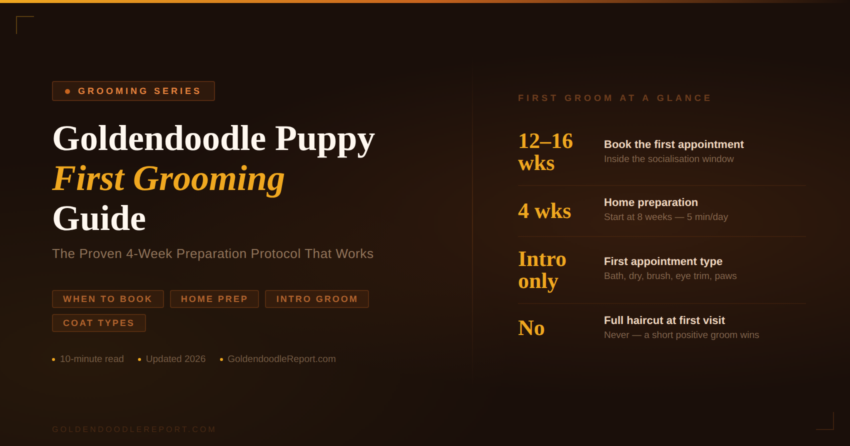
Book the goldendoodle puppy first grooming appointment at 12–16 weeks, once vaccinations are confirmed complete. Begin home handling and desensitisation at 8 weeks — touching paws, ears, mouth, running a comb through the coat for 5 minutes daily. Tell the groomer it is the first appointment and request an introduction groom only. The first visit should include a bath, blow-dry, brush-out, and a trim around the eyes and paws only — no full haircut.
For the full first-year overview see The Real Goldendoodle Puppy Guide — From Pickup Day to the End of Year One.
🔍 Quick Diagnosis — Where Are You Right Now?
- Puppy is 8–12 weeks and has not yet been to the groomer: Perfect timing — begin the home preparation protocol now so you have 4 weeks before the first appointment
- Puppy is 12–16 weeks and vaccinations are just confirmed complete: Book the intro groom now. Use this guide to brief the groomer correctly before the appointment
- Puppy is already showing coat matting at the base of the ears or legs: Do not wait — book the appointment urgently and address the matting with your groomer. Mats left too long become impossible to brush out and require shaving
- Puppy had a difficult first groom and is now fearful of grooming tools: Start the desensitisation protocol from Step 1 regardless of age. Recovery is possible — it takes longer after a negative experience but the protocol is the same
- Groomer suggested waiting until 6 months for the first groom: This is outdated advice for Goldendoodles. Their coats mat earlier than single-coated breeds and their fear associations form in the window that closes at 16 weeks. 12–16 weeks is the correct timing
📖 Real Scenario
A Goldendoodle puppy arrives home at 8 weeks. The owner is told by their breeder to wait until 6 months for the first groom because “the puppy needs to be fully vaccinated first.” The owner waits. At 6 months, the puppy goes to the groomer for the first time. The groomer places them on a table, turns on clippers, and begins a full groom. The puppy, who has never been on a grooming table, never heard clippers, and never had anyone work systematically on their coat, panics.
The groomer finishes but notes the dog was difficult. At the next appointment, the dog is worse. By the third appointment, the owner is warned the groomer may need to stop. What went wrong: the critical window for building a calm grooming association — the first 16 weeks — passed unused. A 4-week home preparation protocol started at 8 weeks and a single introduction appointment at 12–16 weeks would have prevented the entire chain of events.
When to Book the Goldendoodle Puppy First Grooming Appointment
The correct timing for the goldendoodle puppy first grooming appointment is 12–16 weeks — once the vaccination course is confirmed complete by your vet. This timing sits inside the socialisation window, which closes at approximately 16 weeks. Booking inside this window means the puppy’s brain is still in the developmental phase where positive associations with new experiences form most easily and most durably.
The common advice to wait until 6 months is appropriate for some single-coated breeds but not for Goldendoodles. Two things make earlier timing essential for this breed specifically. First, the Goldendoodle coat — particularly wavy and curly types — begins matting as early as 10–14 weeks when the puppy coat starts transitioning. Mats left until 6 months are often impossible to brush out and require full shaving, which is far more stressful than a gentle introduction groom at 12 weeks.
Second, the fear association window closes at 16 weeks. A puppy who has their first grooming experience inside this window builds a positive template. One who has it at 6 months — well into the adolescent phase — is significantly harder to settle on a grooming table.
On vaccination timing: most puppies complete their vaccination course at 10–14 weeks. Confirm with your vet before booking. Some groomers will see puppies after the second vaccination even before the full course is complete — ask your groomer about their policy and your vet about the specific risk level in your area. See Goldendoodle Puppy Vaccination Timeline for the full schedule.
Coat Type and Why It Affects Grooming Timing
Goldendoodles come in three main coat types — straight, wavy, and curly — and the coat type significantly affects both when matting becomes a risk and how quickly the puppy needs professional grooming intervention.
Straight coats are the lowest-maintenance of the three. They shed more than wavy or curly coats and are less prone to matting. Daily brushing is still required during the coat transition at 12–18 weeks, but the matting risk is lower and the timeline for the first professional groom has more flexibility.
Wavy coats are the most common Goldendoodle coat type. They are moderate-shedding and begin matting during the puppy-to-adult coat transition — typically from 12 weeks onward. The base of the ears, behind the legs, and around the collar are the highest-risk areas. Daily brushing with a slicker brush and comb is essential from 10 weeks. The first professional groom should happen no later than 16 weeks.
Curly coats are the highest-maintenance and the most prone to matting. They are also the coat type most owners choose Goldendoodles for because of the low-shed properties. Curly-coated puppies can begin developing mats as early as 10–12 weeks. Daily brushing is non-negotiable and the first professional groom should happen at 12–14 weeks rather than waiting to 16.
⚠️ Watch Out
The coat transition from puppy coat to adult coat typically begins between 12 and 18 weeks. During this transition, the soft puppy coat and the incoming adult coat exist simultaneously — this double-layer is when matting risk is highest. Running your fingers through the coat and feeling resistance or clumping is the first signal. Address mats immediately with a detangling spray and a metal comb — do not attempt to pull through them. If the mat is at the skin level, contact your groomer rather than attempting to remove it at home.
Home Preparation — The Proven 4-Week Protocol
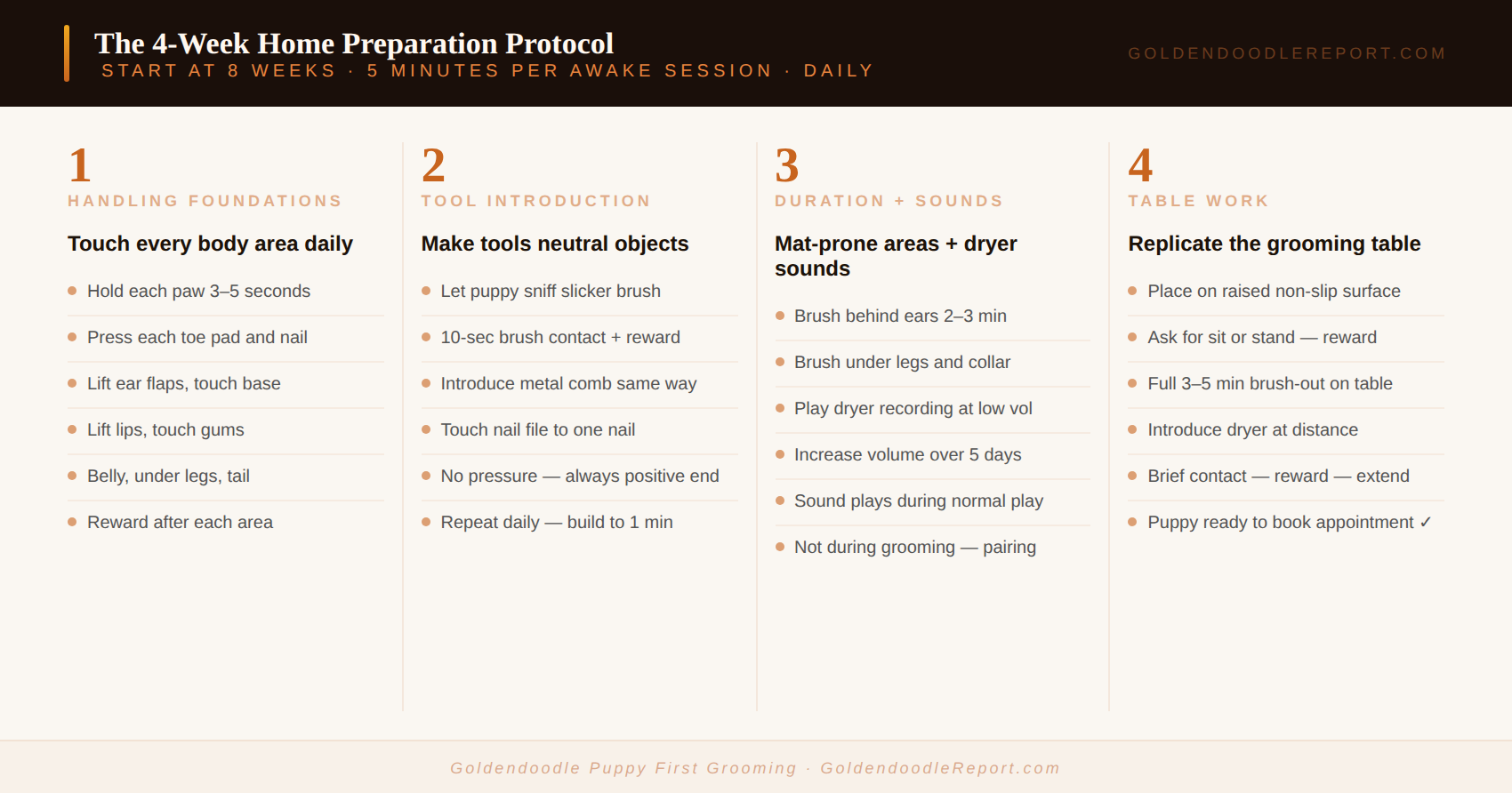
The home preparation protocol runs for 4 weeks before the first grooming appointment and has one goal: making every sensation, sound, and handling experience the puppy will encounter at the groomer familiar and positive before they encounter it in an unfamiliar environment. A puppy who has been regularly handled at home arrives at the groomer with a catalogue of neutral associations that makes calm behaviour significantly more likely.
Run each step during one of the puppy’s awake windows — never when they are tired or just woken. Keep every session under 5 minutes. End every session before the puppy loses interest. The moment the puppy disengages, end the session with a reward and return to it in the next awake window rather than pushing through.
Week 1 — Handling foundations
Touch every part of the puppy’s body daily. Paws — hold each paw for 3–5 seconds, gently press each toe pad, touch each nail. Ears — lift the ear flap, look inside, touch the base. Mouth — lift the lips, touch the gums and teeth. Tail — run your hand the full length. Under the legs and belly — firm, confident touch. Reward with a treat after each body area. The goal is that no part of the body produces a flinch or withdrawal response by the end of week 1.
Week 2 — Introducing grooming tools
Introduce the slicker brush, metal comb, and nail file with no pressure — allow the puppy to sniff each tool, touch it with their nose, investigate it freely. Then make contact. Run the brush gently through the coat for 10 seconds, reward, stop. Run the comb through the coat for 10 seconds, reward, stop. File one nail lightly, reward. The goal is that all three tools produce no negative reaction — they are simply objects that appear, touch briefly, and are followed by a reward.
Week 3 — Building duration and introducing sounds
Extend brushing sessions to 2–3 minutes on different coat areas — behind the ears, under the legs, around the collar, base of the tail. These are the areas most prone to matting and the ones most likely to cause discomfort if a mat has already formed. Play recordings of hairdryer sounds and clipper sounds at low volume during play sessions — not during grooming, just in the background during normal activity. Increase the volume gradually over several days. See Goldendoodle Puppy Socialisation Checklist for a full sound desensitisation approach.
Week 4 — Table work and full brush-out
Place the puppy on a raised, non-slip surface — a table with a rubber mat is ideal. Ask for a sit or a stand, reward, and run through a full 3–5 minute brush-out on the surface. This replicates the grooming table environment. Introduce the hairdryer at low heat and low speed at a distance — aim it at the coat briefly, reward, increase duration gradually. By the end of week 4, the puppy should accept a full brush-out on a raised surface without distress. This is the puppy who walks into the groomer’s appointment calm.
What the First Appointment Should and Should Not Include
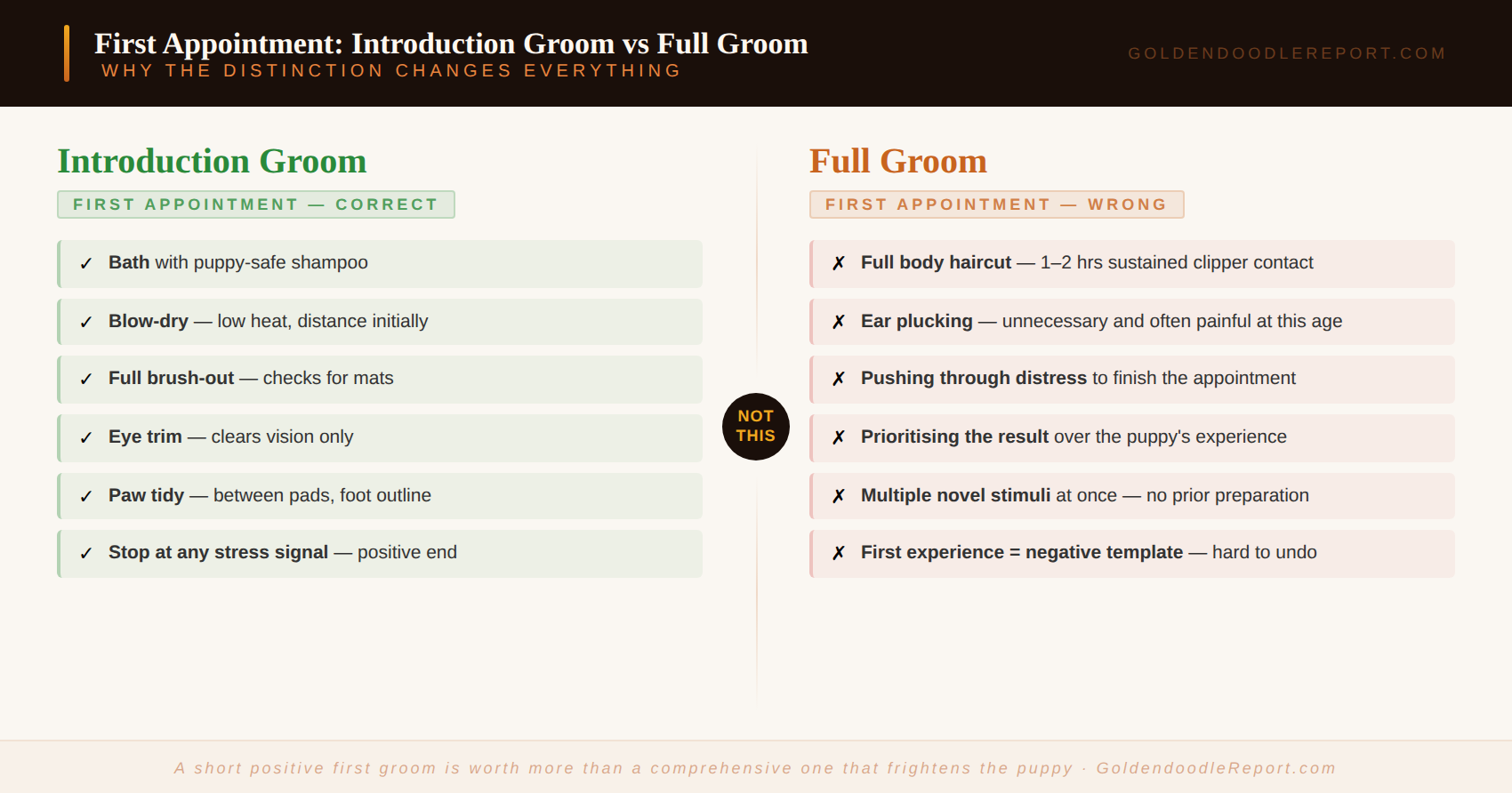
The first appointment is an introduction groom. It is not a full haircut. These are fundamentally different goals and conflating them is the most common mistake owners and groomers make with first-time Goldendoodle puppies.
The goal of the first appointment is one thing: the puppy leaves having had a positive experience and having built a neutral or positive association with the grooming environment. Length and outcome are irrelevant. A 30-minute appointment that ends calmly is worth more than a 2-hour appointment that ends with a distressed puppy.
What the first appointment should include:
- A bath with puppy-safe shampoo
- A blow-dry on low heat, ideally with the dryer held at a distance initially
- A full brush-out to remove loose coat and check for mats
- A trim around the eyes — enough to clear their vision
- A tidy around the paws — between the pads and around the foot outline
- A sanitary trim if needed
- Nail filing or clipping if the puppy tolerates it
What the first appointment should NOT include:
- A full body haircut — this takes significantly longer and involves sustained clipper or scissor contact the puppy has not built tolerance for
- Ear plucking — unnecessary at this age and often uncomfortable enough to create a lasting negative association with ear handling
- Any procedure that the puppy shows clear distress signals during — freezing, trembling, attempting to escape, excessive vocalisation
If the groomer completes the bath, dry, and brush-out and the puppy is calm — great, add the eye trim. If the puppy is calm after that, add the paw tidy. Stop the moment stress signals appear. A short positive appointment is the win. For the best shampoo choices for this first bath see Best Puppy Shampoo for Goldendoodles.
How to Brief Your Groomer
A good groomer will ask about the puppy’s history. Tell them the following before the appointment begins:
This is the puppy’s first grooming appointment. The goal is a positive experience, not a finished result. You have done 4 weeks of home preparation — handling, brushing, table work, sound introduction. The puppy is familiar with the brush and comb but has not heard clippers at full volume. You would like an introduction groom only — bath, dry, brush-out, eye trim, paw tidy. If the puppy shows distress signals at any point, please stop and end the appointment positively rather than pushing through.
A groomer who pushes back on this brief or insists on completing a full groom regardless of the puppy’s response is not the right groomer for a first-time Goldendoodle. The introduction approach is standard practice among experienced puppy groomers. If a groomer is unfamiliar with it, find one who is not.
After the First Appointment
Regardless of how the appointment went, do not create an emotional reaction at pickup. If the puppy had a calm appointment, greet them warmly but do not over-excite them with high-pitched praise — this can retroactively spike arousal and create a negative association with the transition back to the owner. Calm, warm, matter-of-fact.
If the appointment was stressful for the puppy, do not offer excessive comfort — this reinforces that the experience was something to be distressed about. Greet calmly, take them outside for a toilet trip, give a long-lasting chew, and let the puppy decompress in their safe space. Return to the home handling protocol the following day and maintain it between appointments to keep the positive associations active.
Book the second appointment within 3–4 weeks of the first. The longer the gap between appointments, the more the association needs to be rebuilt from scratch. Regular appointments — even short ones — maintain the positive template.
Grooming Tools to Start With at Home
The home preparation protocol requires three tools. You will continue using all three throughout the puppy’s life so quality matters.
A slicker brush is the primary daily tool for removing loose coat and preventing surface mats. Choose one with flexible pins and a comfortable handle — stiff-pin slicker brushes are too harsh for puppy coats and create the kind of discomfort that builds negative associations with brushing. For recommendations see Best Puppy Shampoo for Goldendoodles.
A metal comb with both wide-tooth and fine-tooth sections is essential for checking that brushing has removed tangles all the way to the skin — not just at the surface. Run the fine-tooth section through the coat after every brushing session. If it catches, there is a mat that the slicker brush did not reach.
A detangling spray reduces friction during brushing and makes the process more comfortable for the puppy. Use it lightly on areas prone to matting — behind the ears, under the legs, around the collar — before each brushing session. For toy and tool recommendations across the puppy stage see Best Toys for Goldendoodle Puppies and Best Chew Toys for Teething Goldendoodles.
For authoritative guidance on dog coat care and grooming approaches see the AKC dog grooming guide.
What Most Owners Get Wrong With the Goldendoodle Puppy First Grooming Appointment
Mistake 1 — Waiting until 6 months for the first groom
The 6-month recommendation exists for some single-coated breeds where matting is not a significant concern and where the vaccination timing argument has more weight. For Goldendoodles — whose coats begin transitioning and matting from 12 weeks, and whose critical socialisation window closes at 16 weeks — waiting until 6 months produces two preventable problems simultaneously: significant coat management issues and a first grooming experience during the adolescent phase when new positive associations are harder to build.
Mistake 2 — Booking a full groom for the first appointment
A full groom involves sustained contact with clippers or scissors across the entire body for 1–2 hours. A puppy with no previous grooming experience who encounters this at their first appointment has no preparation for the duration, the sounds, the restraint, or the sustained handling. Even a puppy who tolerates it may build a negative association that progressively worsens. An introduction groom that takes 30–45 minutes and ends positively is a far better investment.
Mistake 3 — Skipping the home preparation protocol
The 4-week home protocol is not optional preparation — it is the primary determinant of how the first appointment goes. A puppy who has been handled daily, who knows what a brush and comb feel like, who has heard hairdryer sounds during play, and who has been placed on a raised surface and brushed is a fundamentally different animal at the grooming table than a puppy who has had none of these experiences. The 5 minutes per day across 4 weeks is the most efficient investment available.
Mistake 4 — Choosing a groomer based on price rather than puppy experience
Not all groomers have experience with puppy introduction grooms. Some will agree to an introduction approach but revert to a full groom when the puppy seems to be tolerating it. Ask specific questions before booking: do you offer puppy introduction grooms? How do you handle a puppy who shows stress signals? Have you worked with Goldendoodle puppies before? A groomer who gives confident, detailed answers to these questions is worth more than one who is cheaper but inexperienced with puppies.
Why the Preparation Protocol Works — The Developmental Reasoning
💡 Information Gain — Why This Approach Produces Calm Grooming Dogs
The home preparation protocol works because of how fear associations form in the canine brain during the socialisation window.
- Familiarity neutralises threat response: The canine brain categorises unfamiliar stimuli as potential threats until evidence of safety accumulates. Handling, tool introduction, and sound exposure during the socialisation window build the evidence of safety before the threat response can become established
- The first experience template persists: The association built during the first grooming experience is neurologically prioritised — it becomes the template against which all future grooming experiences are measured. A positive first experience creates a baseline of safety. A negative first experience creates a baseline of threat that each subsequent appointment must overcome
- Table work at home reduces the novelty load at the appointment: A puppy encountering a grooming table, handling, brushing, and noise simultaneously for the first time is processing multiple novel stimuli at once — the cumulative novelty load increases stress. A puppy familiar with the table and the tools at home has already processed those stimuli — the only remaining novelty is the environment and the groomer, which is a significantly lower load
- Stopping before distress is more powerful than pushing through: Ending a session before the puppy becomes distressed builds a positive end-state association. The puppy who always ends grooming sessions while still calm learns that grooming ends well. The puppy who is pushed past their threshold learns that grooming ends in distress — the most recent emotional state is what the association is built on
Your Action Plan — Preparing for the Goldendoodle Puppy First Grooming Experience
- Today — assess coat type: Run your fingers through your puppy’s coat. Is it straight, wavy, or curly? Check the highest-risk matting areas — behind the ears, under the legs, around the collar. If you find any resistance or clumping, begin addressing it immediately with a detangling spray and wide-tooth comb before it worsens.
- This week — begin Week 1 of the home protocol: 5 minutes per awake session. Touch every body part systematically — paws, ears, mouth, tail, belly, under legs. Reward after each area. Do this daily. By day 5 the puppy should accept handling of all body areas without withdrawal.
- Week 2 — introduce the tools: Buy a slicker brush, metal comb, and detangling spray if you do not have them. Introduce each tool to the puppy as a neutral object before making contact. Begin 10-second brushing sessions with treats. No pressure. No forcing. Positive end every time.
- Week 3 — build duration and introduce sounds: Extend brushing to the high-risk matting areas. Play hairdryer recordings at low volume during play — not during grooming. Increase volume gradually over several days until the puppy is completely indifferent.
- Week 4 — table work: Place the puppy on a raised non-slip surface daily. Brush for 3–5 minutes. Introduce the hairdryer briefly. By the end of this week your puppy is ready for the appointment.
- Book the appointment: Contact groomers and ask specifically about puppy introduction grooms. Brief the groomer before the appointment using the exact points in the briefing section above. Book within the socialisation window — no later than 16 weeks.
⏱ What to Expect Week by Week
- Week 1: The puppy may flinch or pull paws away initially — this is normal. By day 3–4 most puppies begin accepting handling of all areas without withdrawal. Treats accelerate the process significantly
- Week 2: Some puppies mouth or try to bite the brush initially — redirect to a chew toy and retry. Most accept tool contact within 2–3 sessions. Keep contact brief and always follow with a reward
- Week 3: Hairdryer sound desensitisation works best when the sound is played during a naturally positive activity — eating, playing, chewing. The association builds through pairing, not through direct exposure during grooming
- Week 4: Table work is typically the easiest step if weeks 1–3 have been completed. A puppy who accepts handling and brushing on the floor will almost always accept the same on a raised surface within 1–2 sessions
- After the first appointment: Within 3–4 weeks, book the second appointment. The gap matters — regular appointments maintain the positive association
✅ Your Next Step
Start Week 1 of the home preparation protocol today — even if the appointment is 4 weeks away. Five minutes per awake session is all it takes. The puppy who arrives at their first grooming appointment having been handled daily for 4 weeks is a fundamentally different animal at the grooming table than one who has not. For the full first-year puppy guide see The Real Goldendoodle Puppy Guide.
✅ Signs the Preparation Is Working
- The puppy accepts handling of all body areas — including paws, ears, and mouth — without flinching or withdrawal after 5–7 days of daily practice
- The brush and comb can be run through the coat for 2–3 minutes without the puppy attempting to move away or mouth the tool
- Hairdryer sounds played during play produce no reaction — the puppy continues with whatever they were doing without orienting toward the sound
- The puppy can be placed on a raised surface and brushed for 3 minutes without distress
- After the first grooming appointment, the puppy exits calm — not distressed, not frantic — and settles normally within 30 minutes of returning home
🩺 When to Contact Your Vet or a Professional
- Mats at skin level that cannot be separated with fingers and detangling spray — do not attempt to cut or pull these at home. Contact your groomer urgently
- Skin irritation, redness, or sores under a mat — contact your vet before any grooming attempt on the area
- A puppy who shows extreme fear responses to all handling after a negative grooming experience — a veterinary behaviourist or certified clinical animal behaviourist can provide a structured desensitisation programme beyond what home protocols can address
- Ear odour or discharge found during routine ear handling — contact your vet before the grooming appointment
🔑 Key Takeaways
- The goldendoodle puppy first grooming appointment should happen at 12–16 weeks — inside the socialisation window — not at 6 months as some outdated advice suggests
- Begin the 4-week home preparation protocol at 8 weeks: daily handling of all body areas, tool introduction, sound desensitisation, and table work. Five minutes per awake session is all it requires
- The first appointment is an introduction groom only — bath, dry, brush-out, eye trim, paw tidy. No full haircut. A short positive appointment is worth more than a comprehensive one that frightens the puppy
- Wavy and curly Goldendoodle coats begin matting during the puppy coat transition at 12–18 weeks — daily brushing with a slicker brush and metal comb is non-negotiable from 10 weeks to prevent mats that require shaving to remove
- The first grooming experience creates a template that persists — a positive first appointment, properly prepared for, produces a dog who tolerates grooming throughout their life. A negative one creates an association that requires months of patient work to undo
📚 Continue Learning
- Goldendoodle Puppy Checklist — everything you need before and after bringing your puppy home
- Goldendoodle Puppy First Bath Guide — how to handle the first bath at home before the groomer
- Best Puppy Shampoo for Goldendoodles — the right shampoo for puppy coats
- Goldendoodle Puppy Socialisation Checklist — sound and experience desensitisation in full
- Best Chew Toys for Teething Goldendoodles — keeping the puppy occupied during grooming prep sessions
- Goldendoodle Puppy Fear Stages — why the first 16 weeks matter for every new experience
↑ Back to: The Real Goldendoodle Puppy Guide — From Pickup Day to the End of Year One | Goldendoodle Puppy Guide — All Articles
Frequently Asked Questions
When should a Goldendoodle puppy have their first grooming appointment?
The goldendoodle puppy first grooming appointment should be booked at 12–16 weeks, once the vaccination course is confirmed complete by your vet. This timing falls inside the socialisation window, which closes at approximately 16 weeks, making it the optimal period for building a positive grooming association. Waiting until 6 months — as some outdated advice suggests — misses the critical window and risks significant coat matting during the puppy coat transition.
What should happen at a Goldendoodle puppy’s first grooming appointment?
The first appointment should be an introduction groom only: a bath with puppy-safe shampoo, a blow-dry, a full brush-out, a trim around the eyes to clear vision, and a tidy around the paws. No full haircut. The goal is a positive experience, not a finished result. Brief your groomer in advance and ask them to stop if the puppy shows stress signals rather than pushing through to completion.
How do I prepare my Goldendoodle puppy for their first groom?
Begin the 4-week home preparation protocol at 8 weeks. Week 1: daily handling of all body areas — paws, ears, mouth, tail, belly. Week 2: introduce the slicker brush, metal comb, and nail file with short contact sessions and rewards. Week 3: extend brushing to mat-prone areas and play hairdryer sounds at low volume during play. Week 4: table work — brush the puppy on a raised non-slip surface for 3–5 minutes daily. Five minutes per awake session across 4 weeks is all it takes.
My Goldendoodle puppy already has mats — what do I do?
Address mats immediately rather than waiting for the scheduled appointment. Apply a detangling spray and work through the mat gently with a wide-tooth metal comb, starting from the ends of the mat and working toward the skin — never drag from the skin outward. If the mat is at skin level and cannot be loosened with fingers and spray, contact your groomer urgently. Do not attempt to cut skin-level mats at home. A mat left to worsen will eventually require full shaving of the affected area.
My puppy had a bad first groom — can I fix it?
Yes — but it takes longer after a negative experience than building the association from scratch. Start the home preparation protocol from Week 1 regardless of the puppy’s age. Keep every session under 5 minutes. End every session before the puppy shows distress. Book the next grooming appointment only when the puppy is accepting all 4 weeks of home preparation calmly. Brief the new groomer about the previous negative experience and request an introduction groom with the explicit instruction to stop at the first sign of stress. Recovery is possible with patient, consistent work.
How often should a Goldendoodle puppy be groomed?
After the first introduction groom at 12–16 weeks, book the second appointment within 3–4 weeks. From there, most Goldendoodles need professional grooming every 6–8 weeks for wavy coats and every 4–6 weeks for curly coats. Between appointments, daily brushing with a slicker brush and metal comb prevents the matting that forces groomers to shave rather than clip. A puppy who is brushed daily at home is significantly easier and less expensive to maintain at the groomer.
Disclaimer: The information in this article is provided for general educational purposes only. King James Adjei is a researcher and enthusiast, not a veterinarian or certified behaviourist. For health concerns, symptoms, or behaviour issues that may indicate a medical or welfare problem, always consult a qualified veterinarian or certified professional.