Affiliate Disclosure: Some links in this guide are affiliate links. If you purchase through them, we may earn a small commission at no extra cost to you. Read our full affiliate disclaimer here.
By King James Adjei — Researcher and Goldendoodle enthusiast, founder of GoldendoodleReport.com. Every guide on this site is carefully researched and written to give owners reliable, clearly organised information — updated regularly and honest about uncertainty. → About this site
📖 6-minute read | Last updated April 2026 | Reviewed for accuracy
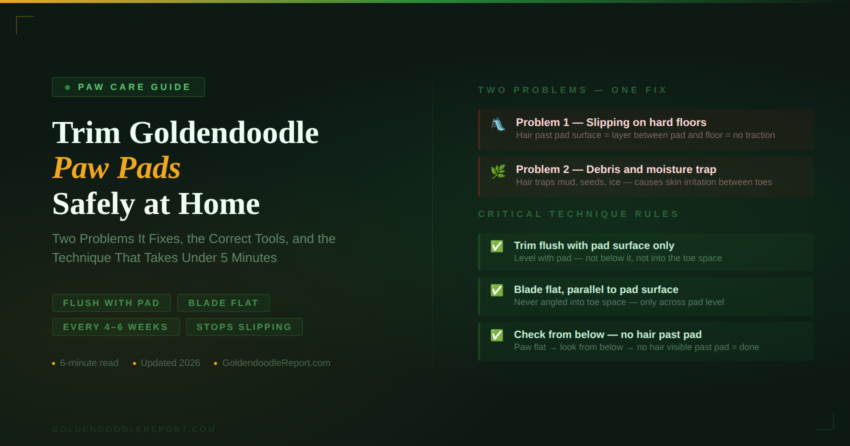
Knowing how to trim Goldendoodle paw pads is one of the most practical and highest-impact home maintenance tasks available. Hair that grows between the paw pads causes two distinct problems — it reduces traction on hard floors causing the dog to slip, and it traps moisture, debris, and ice in winter which irritates and can infect the skin between the pads. Both problems are entirely preventable with regular trimming that takes under 5 minutes. This guide covers why paw pad hair needs attention, the correct tools and technique, and how often to do it.
👤 Who This Guide Is For
- Your Goldendoodle is slipping on hard floors and you want to understand whether paw pad hair is the cause
- You want to trim the paw pads at home and need the correct technique and tools
- Your groomer has mentioned paw pad hair and you want to maintain it between appointments
- You want to prevent the debris accumulation and skin irritation that untrimmed paw pad hair causes
⚡ Quick Summary
Trim paw pad hair flush with the pad surface — level with the pad, not shorter. Use small blunt-nosed scissors or a small detail trimmer. Hold the paw firmly, spread the toes to expose the hair growing between pads, and trim flat to the pad surface. Never dig into the space between toes — only trim what protrudes at pad level. Trim every 4 to 6 weeks or whenever the dog is slipping on hard floors or shaking a paw more than usual.
✅ Quick Answer — Paw Pad Trim Step by Step
- Hold the paw firmly in one hand with the dog in a stable position
- Use your thumb to gently spread the toes apart to expose the hair between pads
- Trim the hair flush with the pad surface using small blunt scissors or detail trimmer
- Keep the blade flat against the pad surface — never pointing into the toe space
- Trim only what protrudes at pad level — do not attempt to dig into the toe space
- Repeat for each toe space and each paw
- Check from below — the paw should look neat with no hair protruding past the pad surface
For the home trimming overview see How to Trim a Goldendoodle at Home. For the complete grooming overview see Goldendoodle Grooming Guide.
Why Goldendoodle Paw Pad Trimming Is Essential Maintenance
Goldendoodles inherit the Poodle’s tendency to grow hair between the paw pads — and unlike the flat, minimal hair between a Labrador’s pads, this hair grows continuously and significantly. Left untrimmed it creates two distinct problems, and understanding both helps owners appreciate why paw pad maintenance belongs in the regular grooming routine rather than being left entirely to professional appointments.
Problem 1 — Slipping on hard floors. The paw pads are the dog’s primary contact surface with the floor. When hair grows past the pad surface it creates a layer of fur between the pad and the floor that significantly reduces traction — particularly on smooth surfaces like wood, tile, and laminate. Dogs who slip repeatedly on hard floors are at risk of muscle strains and joint stress from the constant recovery movements. The slip is also uncomfortable and causes anxiety in some dogs about moving on hard floor surfaces. Trimming the paw pad hair flush with the pad surface restores full pad-to-floor contact and eliminates the slip.
Problem 2 — Debris, moisture, and ice accumulation. Hair growing between the pads traps debris — grass, mud, gravel, plant seeds — that accumulates and irritates the sensitive skin between the toes. In winter, snow and ice pack into the hair between pads, causing pain and potential frostbite to the skin. In any season, moisture trapped between the pads by hair creates a warm, damp environment that can cause interdigital dermatitis — skin inflammation between the toes that is uncomfortable and requires veterinary treatment. Regular trimming prevents all of these by eliminating the trap.
Tools for Paw Pad Trimming
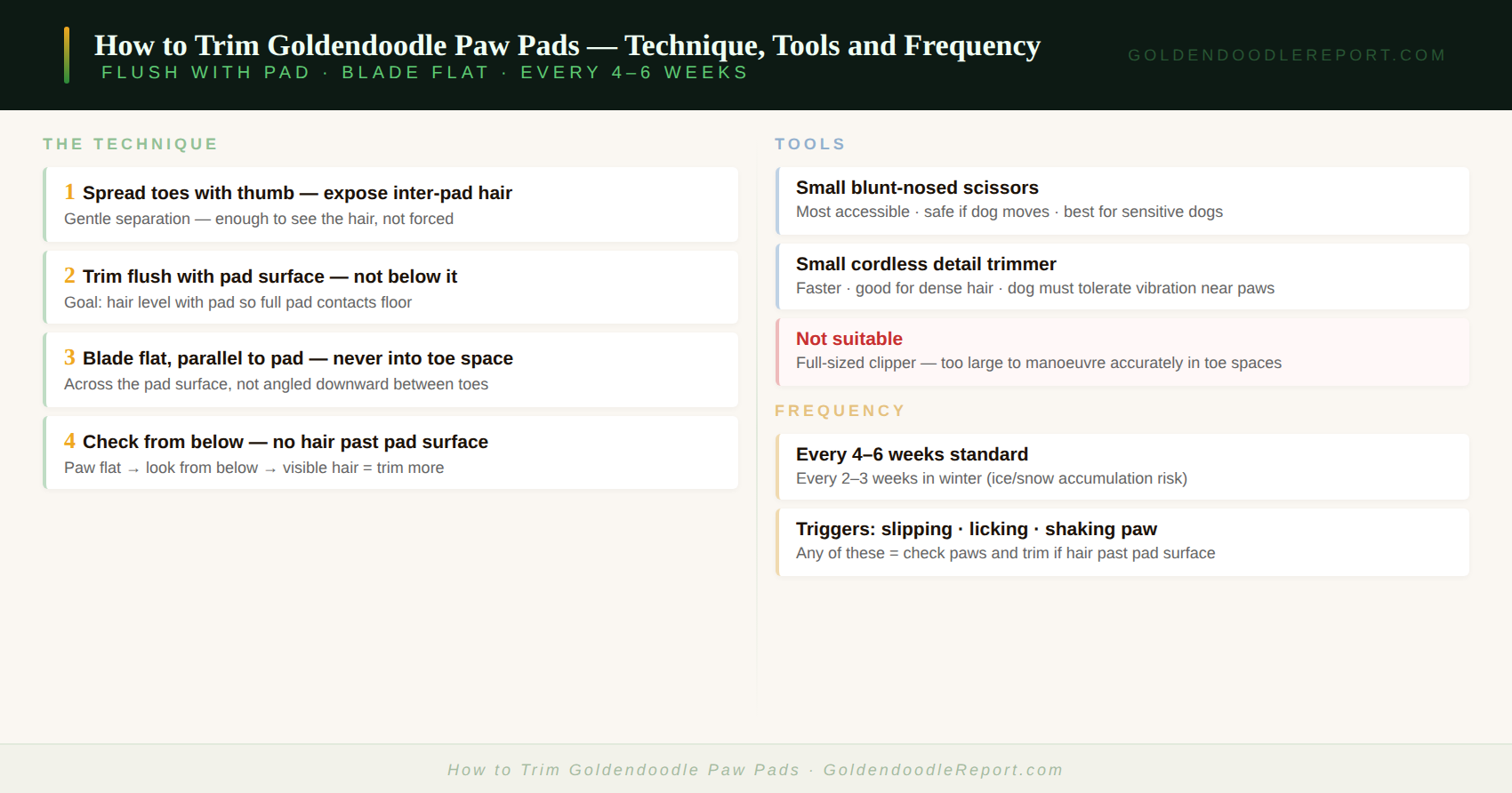
Small blunt-nosed scissors. The most accessible tool for most owners. Small scissors with blunt tips manoeuvre into the toe spaces more safely than large scissors. The blunt tip reduces the puncture risk if the dog moves, which they will. Nail scissors or small grooming scissors both work well.
Small detail trimmer or cordless mini clipper. A small battery-powered trimmer provides faster results than scissors and is particularly useful for dogs who have very dense or thick inter-pad hair. The key is choosing a trimmer small enough to manoeuvre accurately in the toe space — a full-sized clipper is too large for accurate paw pad work.
Both tools are appropriate. The choice depends on the owner’s comfort and the dog’s tolerance. Scissors give the most control and are the better choice for dogs who are less tolerant of the process. A trimmer is faster but requires the dog to be comfortable with the vibration near their paws.
How to Trim Goldendoodle Paw Pads — The Complete Technique
Positioning
The easiest position for most owners is to have the dog sitting or standing on a non-slip surface while the owner works from the side. For the front paws, gently lift the paw and hold it with the pad facing outward. For the back paws, the same approach works — hold the paw so the pad is visible and accessible. Some owners find it easier to have the dog lying on their side, which provides access to all four paws from one position if the dog is cooperative.
Exposing the inter-pad hair
Use your thumb to gently spread the toes apart. This separates the toe pads from each other and exposes the hair growing in the spaces between them. Do not force the spread — a gentle separation is sufficient to expose the hair without causing discomfort. The hair you are trimming is what protrudes upward between and beyond the pad surfaces when the paw is flat.
The correct trim level
Trim flush with the pad surface — level with the pad, not shorter. The goal is to remove the hair that protrudes past the pad surface so the pad makes full contact with the floor. Do not attempt to cut the hair below pad level or to clean out the spaces between the toes entirely — the deep inter-toe spaces are sensitive, and cutting into them causes discomfort and potential injury.
The practical test: hold the paw flat and look at it from below. If you can see hair protruding past the pad surface, it needs trimming. If the hair is level with or below the pad surface, the trim is complete.
Blade angle and direction
Whether using scissors or a trimmer, keep the blade parallel to the pad surface — flat against it, not angled into the toe space. The cutting motion is across the pad surface, not downward into the space between toes. This angle ensures only the protruding hair is removed and keeps the blade away from the sensitive inter-toe skin.
Working through each paw
Work through each toe space systematically — front paws first if the dog is more cooperative at the start of the session. Check the central pad area as well as the toe spaces — hair grows across the entire underside of the paw and can accumulate across the central pad too, though usually less densely than between the toes.
How Often to Trim Paw Pad Hair
Every 4 to 6 weeks for most Goldendoodles. The practical triggers: the dog is slipping on hard floors, the dog is shaking or licking a paw more than usual (which may indicate debris accumulation or irritation), or visible hair is protruding significantly past the pad surface.
In winter: check and trim more frequently. Ice and snow accumulation in inter-pad hair is painful and damages the skin — dogs who regularly walk on snow and ice benefit from trimming every 2 to 3 weeks through the coldest months to minimise the ice trap.
For authoritative guidance on safe home dog grooming see the AKC dog grooming guide.
⚠️ Signs the Paw Area Needs Vet Attention — Not Just Trimming
- Persistent licking or chewing at the paws beyond normal grooming — may indicate interdigital dermatitis, allergies, or foreign body
- Redness, swelling, or discharge between the toes
- The dog limping or refusing to bear weight on a paw
- A visible lump or cyst between the toes (interdigital cyst)
- Bleeding from the inter-pad area
If trimming does not resolve the slipping or paw discomfort, the cause may be something other than hair length — have the paw examined by your vet.
✅ Your Next Step
Check your Goldendoodle’s paws now — hold each paw flat and look at the pad surface from below. If hair is visibly protruding past the pad surface, it is ready to trim. The whole process takes under 5 minutes with the right tools and a cooperative dog. For the complete grooming guide see Goldendoodle Grooming Guide.
🔑 Key Takeaways
- Paw pad hair causes two problems: slipping on hard floors from reduced traction, and debris and moisture trapping that causes skin irritation and potential infection
- Trim flush with the pad surface — level with the pad, not below it. Only remove hair that protrudes past the pad
- Keep the blade parallel to the pad surface — never angled into the toe space
- Use small blunt-nosed scissors or a small detail trimmer — a full-sized clipper is too large for accurate paw pad work
- Trim every 4 to 6 weeks or when the dog is slipping — more frequently in winter when ice accumulation is a risk
- If slipping or paw discomfort persists after trimming, contact your vet — the cause may be interdigital dermatitis, cyst, or another condition
📚 Continue Learning
- Goldendoodle Grooming Guide — complete grooming authority guide
- How to Trim a Goldendoodle at Home — all safe home trimming areas
- Goldendoodle Grooming Schedule — building paw pad trimming into the routine
- → Goldendoodle Nail Trimming Guide — coming soon
↑ Back to: How to Trim a Goldendoodle at Home | Goldendoodle Grooming Guide | Goldendoodle Grooming — All Articles
Frequently Asked Questions
How to trim Goldendoodle paw pads — the correct method
Hold the paw firmly and use your thumb to gently spread the toes apart, exposing the hair between the pads. Using small blunt-nosed scissors or a detail trimmer, trim the hair flush with the pad surface — level with the pad, not shorter. Keep the blade flat against the pad surface, not angled into the toe space. Trim only what protrudes past the pad level. Check from below — if no hair protrudes past the pad surface, the trim is complete.
Why does my Goldendoodle slip on hard floors?
The most common cause of slipping in Goldendoodles on hard floors is hair growing past the pad surface. This hair creates a layer of fur between the pad and the floor that prevents the pad from making full contact with the surface. Trimming the inter-pad hair flush with the pad surface typically resolves slipping immediately. If slipping persists after trimming, the cause may be something else — consult your vet.
How often should I trim my Goldendoodle’s paw pads?
Every 4 to 6 weeks for most dogs. The practical triggers are slipping on hard floors, excessive licking or shaking of a paw, or visible hair protruding past the pad surface. In winter, trim more frequently — every 2 to 3 weeks in snowy or icy conditions — to prevent ice and snow from packing into the inter-pad hair and causing pain and skin damage.
What tools do I need to trim paw pad hair?
Small blunt-nosed scissors or a small cordless detail trimmer. A full-sized clipper is too large to manoeuvre accurately in the toe spaces. Blunt-nosed scissors are safer than pointed scissors for an area where the dog may move unexpectedly. A small detail trimmer is faster and works well for dogs comfortable with vibration near their paws.
Disclaimer: The information in this article is provided for general educational purposes only. King James Adjei is a researcher and enthusiast, not a veterinarian or certified groomer. For paw health concerns beyond normal hair maintenance, consult a qualified veterinarian.