Affiliate Disclosure: Some links in this guide are affiliate links. If you purchase through them, we may earn a small commission at no extra cost to you. Read our full affiliate disclaimer here.
By King James Adjei — Researcher and Goldendoodle enthusiast, founder of GoldendoodleReport.com. Every guide on this site is carefully researched and written to give owners reliable, clearly organised information — updated regularly and honest about uncertainty. → About this site
📖 7-minute read | Last updated April 2026 | Reviewed for accuracy
Line brushing a Goldendoodle is the single technique that separates owners who successfully prevent matting from owners who brush regularly but still develop mats. The difference is not effort or frequency — it is depth. Surface brushing makes a Goldendoodle look beautifully maintained while leaving the base layer of the coat completely untouched. Line brushing reaches the skin. This guide explains why the distinction matters, how to do it correctly, the section-by-section method, and the quality check that confirms the technique is working.
👤 Who This Guide Is For
- You brush your Goldendoodle regularly but still develop mats at professional grooming appointments
- You want to learn the correct brushing technique rather than just repeating the one that isn’t working
- Your groomer has mentioned line brushing and you want to understand what it involves
- You want to understand why the surface of the coat can look smooth while mats develop underneath
⚡ Quick Summary
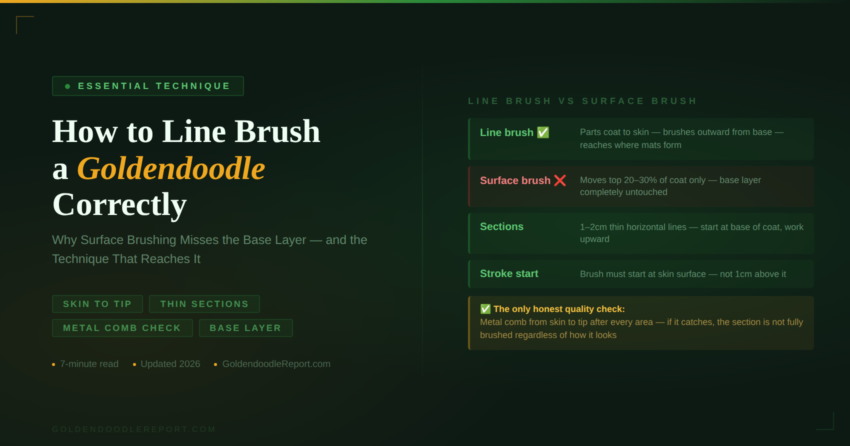
Line brushing means parting the coat to expose the skin and brushing outward from skin level in small horizontal sections, working systematically across the entire coat. Surface brushing — running the brush over the top of the coat — only moves the top 20 to 30% of the coat and misses the base layer entirely. Mat formation happens at the base. Line brushing is the only technique that addresses where mats actually form. After every line brushing session, run a metal comb through each section from skin to tip — if it catches, that section is not fully brushed regardless of how it looks.
✅ Quick Answer — Line Brushing Step by Step
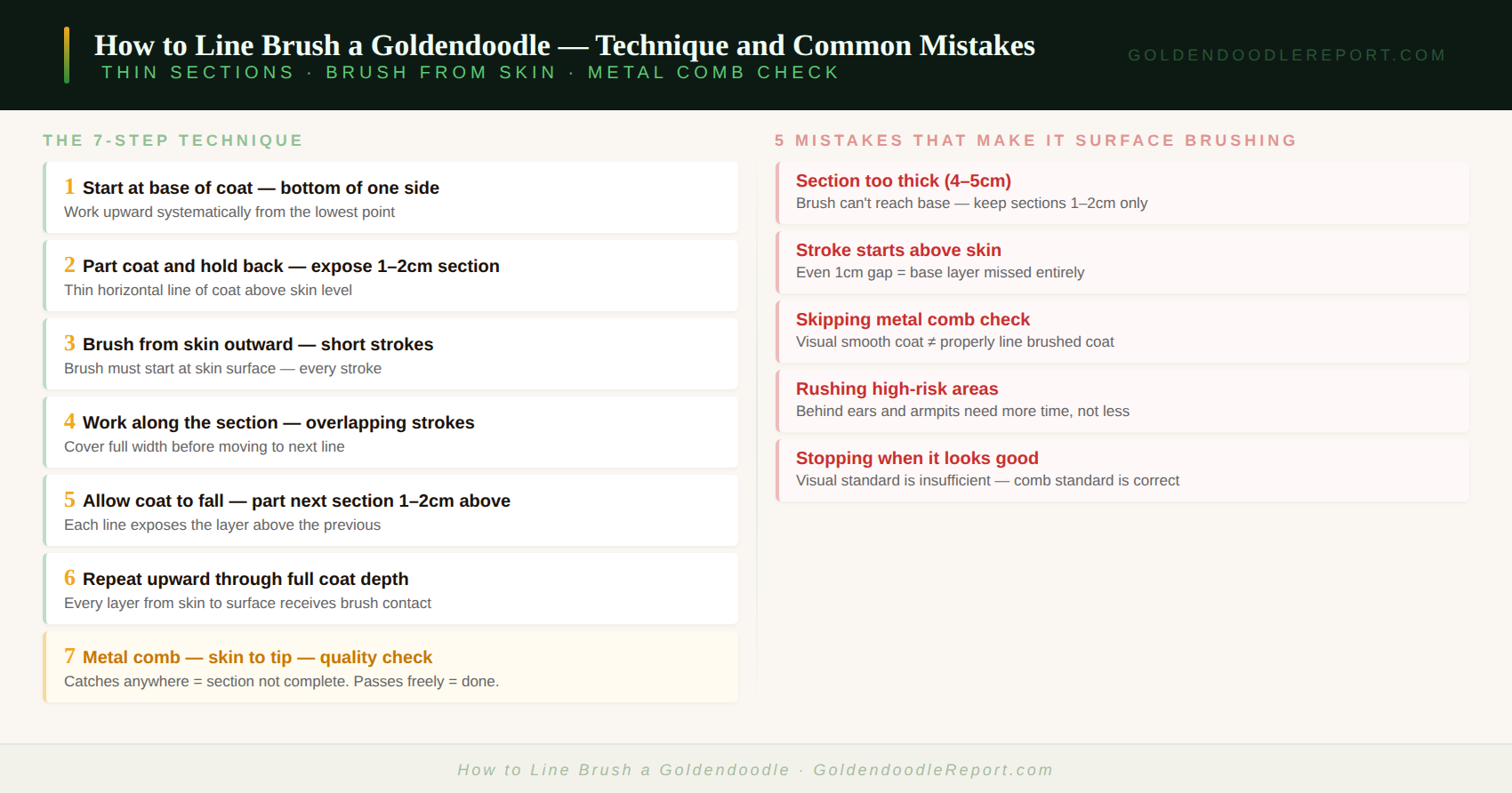
- Choose a starting point — one side of the body, one section at a time
- Use your free hand to part the coat and hold it back, exposing the skin
- Place the slicker brush at skin level and brush outward in a short stroke
- Work the section until the brush moves through freely with no resistance
- Allow the parted coat to fall back and part the next section 1 to 2cm above the first
- Repeat upward through the coat — each line builds on the one below it
- After completing each area, run a metal comb through from skin to tip — if it catches, continue brushing that section
For the complete brushing overview see How to Brush a Goldendoodle. For matting prevention see Goldendoodle Matting Prevention. For the complete grooming overview see Goldendoodle Grooming Guide.
Why Surface Brushing Fails — The Physics
A Goldendoodle coat has significant depth — particularly wavy and curly coats, which can be 3 to 4 inches deep from skin to tip at full length. When you run a brush across the top of this coat, the brush contacts and moves the top layer but the bristles never penetrate to the base. The base layer — the dense, tightly packed region of coat closest to the skin — is completely untouched.
Mat formation happens at the base layer. Loose hair accumulates at the base. Moisture that the dog picks up from rain, swimming, or morning dew collects at the base and remains trapped there when the outer layers dry. Friction from movement compresses the base layer. None of these forces are visible from the surface — and none are addressed by surface brushing. The result is a coat that looks perfectly smooth and well-maintained on the outside while developing significant matting at the base layer that only becomes apparent at the professional grooming appointment.
This is not a failure of brushing frequency. It is a failure of brushing depth. An owner who surface-brushes daily will have the same base layer matting problems as an owner who surface-brushes weekly. Line brushing, which reaches the skin with every stroke, addresses the only location where mats actually form.
How to Line Brush a Goldendoodle — The Complete Technique
The setup
Have a slicker brush, a metal comb, and optionally a detangling spray ready. The dog should be on a stable, non-slip surface — a grooming table if available, or on the floor with you kneeling alongside. Choose a calm moment.
Starting position and section size
Start at the bottom of one side — the lowest point of the coat on the body. Use your free hand to push the coat upward and hold it back, exposing a horizontal section of coat just above skin level. The section exposed should be approximately 1 to 2cm deep — a thin horizontal line of coat between the skin and the coat held above.
The brushing stroke
Place the slicker brush at the skin — in contact with the skin surface — and brush outward in a short stroke away from the body. The stroke length should be short, 3 to 5cm, moving from the skin through the full depth of the exposed section. Work along the horizontal section systematically — each stroke slightly overlapping the previous one, moving along the body until the full width of the section is brushed.
Moving up through the coat
Once the first line is complete, allow the held coat to fall back naturally. It will fall over the brushed section and you will see the parted line you have worked through. Part the next section 1 to 2cm above the first by pushing the coat upward again, exposing the next horizontal line of coat sitting on top of the section you just completed. Brush this section the same way — skin to outward.
Continue this process upward through the coat — each line revealing the layer above the one just completed — until you have worked through the full depth of the coat in that area. The systematic upward progression means every layer of the coat, from the skin up to the surface, receives brush contact.
Covering the full body
Work through the body in sections: one side of the body, then the other; the chest; the neck; the legs — including the armpit areas and the back of the thighs where mats form fastest. The five high-risk mat areas — behind the ears, under the front legs, around the collar, at the tail base, between the back legs — should receive extra attention and thoroughness within the line brushing process because these areas mat fastest. For the full list of high-risk areas see Goldendoodle Matting Prevention.
The metal comb quality check
This is the most important step — and the one most owners skip. After completing each area with the slicker brush, run a metal comb through from skin to tip. If the comb passes through freely, that area is fully brushed. If the comb catches at any point, there is a tangle or mat forming at that location that the slicker brush has missed or not fully cleared. Address whatever the comb catches before moving on.
The metal comb check is the honest test of line brushing. It does not lie about whether the coat has been reached. A coat that looks smooth but fails the metal comb check has not been line brushed effectively — it has been surface brushed until it looked right.
How Long Does Line Brushing Take
Line brushing takes significantly longer than surface brushing — particularly until the technique becomes habitual and efficient. A full body line brush on a medium Goldendoodle in good coat condition takes 20 to 45 minutes. On a coat with developing tangles, longer. This is not inefficiency — it is the time required to actually reach the base layer of the entire coat.
Many owners find it more practical to line brush in sections across multiple sessions rather than doing the full body in one sitting — one side today, the other side tomorrow, legs the day after. As long as the full coat is covered at least every other day for curly coats and every 2 to 3 days for wavy coats, this sectional approach is effective.
For authoritative guidance on dog coat care see the AKC dog grooming guide.
⚠️ Most Common Line Brushing Mistakes
- Section too thick: Parting a 4 to 5cm section means the brush cannot reach the base of the section — keep sections thin (1 to 2cm)
- Stroke starting above skin: The brush must start at the skin surface — starting 1cm above the skin misses the base layer entirely
- Skipping the metal comb check: The section looks smooth but the comb catches — this is the information that tells you whether the technique is working
- Not covering the high-risk areas: Behind the ears and under the front legs are the areas most owners rush or skip — give them more time, not less
- Stopping when the coat looks good: The visual standard is insufficient — the metal comb standard is the correct quality check
✅ Your Next Step
Try one section of line brushing right now — choose the area behind one ear, which is the highest mat risk area. Part a thin section, brush from skin outward, move to the next section above. Then run the metal comb through from skin to tip. If it catches, you have found what surface brushing was missing. For the complete grooming guide see Goldendoodle Grooming Guide.
🔑 Key Takeaways
- Surface brushing only moves the top 20 to 30% of the coat — mat formation happens at the base layer that surface brushing never reaches
- Line brushing parts the coat to expose the skin and brushes outward from skin level — this is the only technique that addresses where mats actually form
- Work in thin 1 to 2cm sections, starting at the bottom of the coat and building upward line by line
- The brush stroke must start at the skin — starting even 1cm above the skin misses the base layer
- The metal comb check after every area is the quality control — smooth-looking coat that fails the comb check has not been line brushed effectively
- Line brushing takes 20 to 45 minutes for a full coat — it can be done in sections across multiple sessions to make it more manageable
📚 Continue Learning
- Goldendoodle Grooming Guide — complete grooming authority guide
- How to Brush a Goldendoodle — complete brushing overview
- Goldendoodle Matting Prevention — why line brushing is the primary mat prevention tool
- How to Detangle a Goldendoodle Coat — when line brushing finds a tangle
- Goldendoodle Grooming Schedule — how often to line brush by coat type
- → Best Brush for Goldendoodles — coming soon
- → Best Comb for Goldendoodles — coming soon
↑ Back to: How to Brush a Goldendoodle | Goldendoodle Grooming Guide | Goldendoodle Grooming — All Articles
Frequently Asked Questions
What is line brushing a Goldendoodle?
Line brushing is a technique where the coat is parted to expose the skin and brushed outward from skin level in thin horizontal sections, working systematically upward through the coat. Each section is brushed from the base before the next section above is exposed. This ensures every layer of the coat — including the base layer where mats form — receives brush contact. It contrasts with surface brushing, where the brush runs over the top of the coat without penetrating to the base.
Why does my Goldendoodle get mats even though I brush every day?
This is almost always caused by surface brushing rather than line brushing. If the brush never reaches the base layer of the coat — the layer closest to the skin — that layer accumulates loose hair, moisture, and compression regardless of how frequently the surface is brushed. The base layer is where mats form. Switching from surface brushing to line brushing and confirming each section with a metal comb check from skin to tip typically resolves persistent matting in regularly brushed dogs.
How long does line brushing a Goldendoodle take?
20 to 45 minutes for a full coat on a medium Goldendoodle in good condition. This is significantly longer than surface brushing but addresses the base layer that surface brushing misses. Many owners find it practical to line brush in sections across multiple sessions — one area per day — rather than attempting the full coat in one sitting. As long as the full coat is covered within the correct interval for the coat type, sectional line brushing is equally effective.
How do I know if I am line brushing correctly?
The metal comb check is the only reliable quality test. After line brushing each section, run a metal comb through from skin to tip. If the comb passes through freely — no catching anywhere — the section has been line brushed effectively. If the comb catches at any point, there is a tangle or developing mat at that location that the brush has missed or not fully cleared. A coat that looks smooth but fails the metal comb check has not been line brushed to an acceptable standard.
Disclaimer: The information in this article is provided for general educational purposes only. King James Adjei is a researcher and enthusiast, not a veterinarian or certified groomer. For significant coat or matting concerns, consult a qualified professional groomer.