Affiliate Disclosure: Some links in this guide are affiliate links. If you purchase through them, we may earn a small commission at no extra cost to you. Read our full affiliate disclaimer here.
By King James Adjei — Researcher and Goldendoodle enthusiast, founder of GoldendoodleReport.com. Every guide on this site is carefully researched and written to give owners reliable, clearly organised information. → About this site
📖 8-minute read | Last updated May 2026 | Reviewed for accuracy
✅ Quick Answer
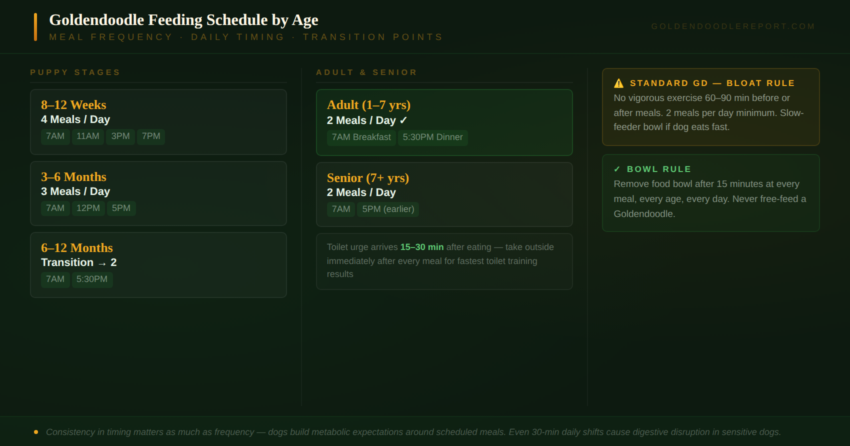
A proper Goldendoodle feeding schedule changes as your dog grows. A Goldendoodle puppy under 12 weeks needs 4 meals per day — roughly 7am, 11am, 3pm, 7pm. From 3–6 months: 3 meals per day — 7am, 12pm, 5pm. From 6 months onward: transition to 2 meals per day — 7am and 5–6pm. Adult Goldendoodles stay on 2 meals per day for life, spaced 10–12 hours apart. Consistency in daily timing matters as much as frequency — irregular feeding times disrupt digestion, complicate toilet training, and destabilise energy levels.
Most owners focus on how much to feed their Goldendoodles but underestimate how much the when matters. A puppy fed at irregular times will toilet at unpredictable times, making house training significantly harder. An adult Goldendoodle fed at inconsistent intervals develops digestive irregularity and, in Standard Goldendoodles, faces increased bloat risk. The feeding schedule is not a loose preference — it is a health and behaviour framework.
This guide gives you exact, usable daily feeding schedules for every life stage — not just the frequency, but actual suggested times — along with the transition points where the schedule changes and why getting those transitions right prevents the most common feeding-related problems owners encounter.
👤 Who This Guide Is For
- You have a new puppy coming home and want a feeding schedule ready from day one
- You are struggling with toilet training and wondering whether feeding timing could be contributing
- Your puppy is currently on 3 meals per day and you want to know exactly when and how to move to 2
- You work variable hours and want to understand how much flexibility exists in meal timing
- You are transitioning your adult dog to a senior diet and want to know if the schedule changes
📊 Quick Facts — Goldendoodle Feeding Timing
- A puppy typically needs to toilet within 15–30 minutes of eating — a predictable feeding schedule makes toilet training 2–3x faster than irregular feeding
- Gastric dilatation-volvulus (bloat) risk in Standard Goldendoodles is significantly reduced by feeding 2 meals rather than 1 large meal per day
- Dogs have a digestive cycle triggered by meal times — irregular feeding creates irregular digestion, loose stools, and bloating unrelated to diet quality
- The last meal of the day should be at least 3 hours before bedtime to allow digestion before the overnight fast
- Research on canine circadian rhythms shows dogs develop strong metabolic expectations around consistent meal times — even 30-minute shifts can cause temporary digestive upset in sensitive dogs
Why a Consistent Goldendoodle Feeding Schedule Matters
Dogs are creatures of biological rhythm. When fed at consistent times, their digestive system prepares for incoming food — gastric acid secretion, gut motility, and digestive enzyme production all ramp up in anticipation of the scheduled meal. This preparation makes digestion more efficient, nutrient absorption better, and stool quality more consistent.
When feeding is irregular, this preparation does not happen reliably. The result is a dog that is either genuinely hungry at unpredictable times, producing irregular stools, or experiencing digestive discomfort that shows up as gassiness, loose stools, or restlessness — none of which are caused by poor food quality, but by inconsistent timing.
For puppies, the link is even more direct: the post-meal toilet urge arrives within 15–30 minutes of eating. A puppy fed at 7am, 12pm, and 5pm will need to toilet at predictable windows. A puppy fed whenever the owner remembers will need to toilet unpredictably — making house training an exercise in constant vigilance rather than scheduled anticipation.
📖 Real Scenario
Two 10-week-old Goldendoodle puppies from the same litter, both being toilet trained by their respective owners. Owner A feeds at 7am, 11am, 3pm, and 7pm every day. They take the puppy outside immediately after each meal. By week 3, the puppy rarely has accidents indoors. Owner B feeds “whenever the puppy seems hungry” — sometimes 4 times, sometimes 3, at varying times. The puppy’s toileting is unpredictable. By week 6, they still have several indoor accidents daily. The only meaningful difference was the feeding schedule. The food was identical.
8–12 Weeks: 4 Meals Per Day
At 8 weeks, a Goldendoodle puppy’s stomach is small, their metabolism is very fast, and their blood sugar can drop if they go more than 4–5 hours without food. Four meals per day is not excessive — it is physiologically necessary at this age.
Suggested daily schedule — 8 to 12 weeks
| Meal | Suggested Time | Notes |
|---|---|---|
| Meal 1 | 7:00 AM | First thing after waking. Take outside immediately after |
| Meal 2 | 11:00 AM | Midmorning. Take outside immediately after |
| Meal 3 | 3:00 PM | Afternoon. Take outside immediately after |
| Meal 4 | 7:00 PM | Last meal at least 3 hrs before bedtime. Take outside after |
Key rule: Remove the food bowl after 15 minutes whether the puppy has finished or not. Free-access feeding disrupts the schedule and makes toilet prediction impossible. If the puppy consistently leaves food after 15 minutes, the portion may be too large — see our How Much to Feed a Goldendoodle guide for portion adjustment.
The puppy’s routine at this age also involves a great deal of sleep — see Goldendoodle Puppy Routine by 8 Weeks for how the feeding schedule fits into the full daily structure of sleep, play, and toilet trips.
3–6 Months: 3 Meals Per Day
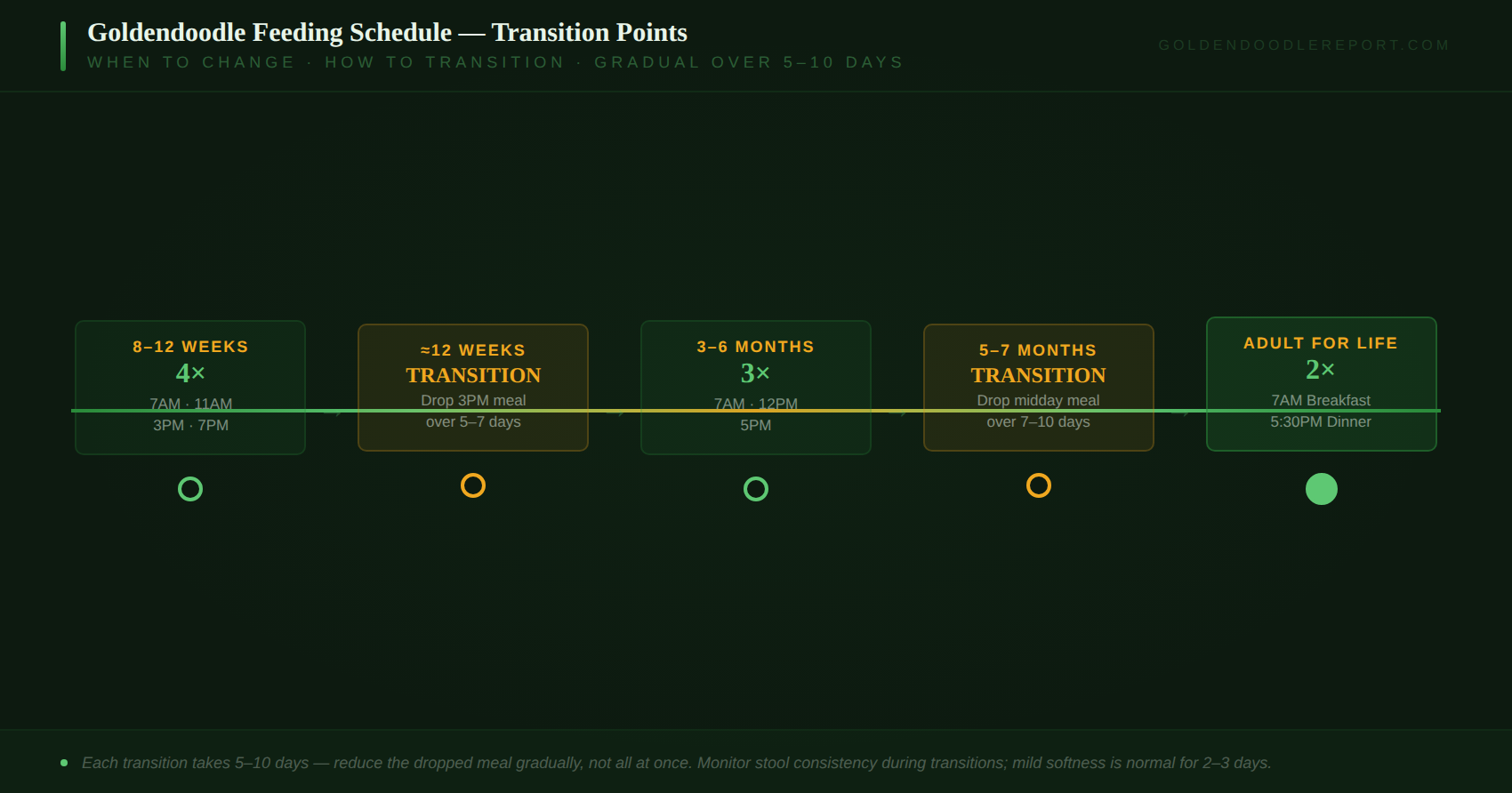
At approximately 12 weeks, most Goldendoodle puppies can comfortably handle a 5-hour gap between meals. The move from 4 to 3 meals per day is gradual — you drop the 3pm meal first by consolidating it into a slightly larger lunch and dinner, then observe for digestive changes over 3–5 days before confirming the new schedule.
Suggested daily schedule — 3 to 6 months
| Meal | Suggested Time | Notes |
|---|---|---|
| Meal 1 | 7:00 AM | Morning — first thing after waking |
| Meal 2 | 12:00 PM | Midday — 5 hrs after breakfast |
| Meal 3 | 5:00 PM | Early evening — allows full digestion before sleep |
Toilet trips should continue immediately after each meal. By this age the puppy is gaining reliability, but the post-meal toilet window is still predictable and should be used consistently to cement the habit. See Goldendoodle Puppy Routine by 10 Weeks for how the 3-meal schedule integrates with the broader daily structure.
6–12 Months: Transitioning to 2 Meals Per Day
The transition from 3 meals to 2 is the most significant schedule change in a Goldendoodle’s life. Most owners make this move between 5 and 6 months for smaller Goldendoodles and 6–7 months for Standards. The adolescent phase (6–18 months) brings a natural decrease in the intense calorie-per-pound requirement of early puppyhood, making twice-daily feeding appropriate and sustainable.
How to transition from 3 meals to 2 — step by step
Step 1 (Days 1–5): Drop the midday meal. Move the daily total into two equal meals — morning and evening. Keep morning meal at 7am and move the evening meal to 5–6pm.
Step 2 (Days 5–10): Monitor for digestive changes. Some puppies show mild loose stool for 2–3 days as the digestive cycle adjusts. This is normal. If vomiting or significant digestive distress occurs, revert to 3 meals for another 2–3 weeks before trying again.
Step 3 (Day 10+): If the puppy is tolerating 2 meals without digestive issues and body weight is stable, the transition is complete. The 2-meal schedule continues for the rest of the dog’s life.
Suggested daily schedule — 6 to 12 months
| Meal | Suggested Time | Notes |
|---|---|---|
| Meal 1 | 7:00 AM | Morning — after first toilet trip of the day |
| Meal 2 | 5:30 PM | Evening — at least 3 hrs before bedtime. 10.5 hrs after breakfast |
For the full daily routine during this age: Goldendoodle Puppy Routine by 16 Weeks.
Adult Schedule: 2 Meals Per Day
The adult schedule is the simplest — two meals per day, consistently timed, with meals spaced 10–12 hours apart. This schedule continues from around 6–12 months of age until the dog transitions to a senior protocol at 7+ years.
Suggested daily schedule — adult Goldendoodle
| Meal | Suggested Time | Notes |
|---|---|---|
| Meal 1 — Breakfast | 7:00 AM | After morning walk/toilet. Do not feed before vigorous exercise |
| Meal 2 — Dinner | 5:30–6:00 PM | Evening. At least 3 hrs before bedtime. No vigorous exercise for 60–90 min after |
⚠️ Standard Goldendoodles — exercise and meal timing. For deep-chested Standards, the rule around exercise timing is a health safety issue, not merely a comfort preference. Vigorous exercise within 60–90 minutes before or after a meal significantly increases bloat (GDV) risk. This applies in both directions — do not run or play fetch before or after meals. A short walk on a loose lead is fine. See the bloat timing section below for the complete guidance.
Senior Schedule: 7+ Years
Senior Goldendoodles continue on 2 meals per day. The timing does not change significantly — what changes is the food type and portion size, not the schedule structure. The only adjustment some owners find helpful for senior dogs is shifting the evening meal slightly earlier (5pm rather than 6pm) to allow a longer post-meal toilet opportunity before the overnight fast.
| Meal | Suggested Time | Notes |
|---|---|---|
| Meal 1 — Breakfast | 7:00 AM | After morning toilet. Senior dogs may be slower to rise — wait for them |
| Meal 2 — Dinner | 5:00 PM | Slightly earlier than adult — allows evening toilet before long overnight fast |
For portion amounts at every age: How Much to Feed a Goldendoodle. For choosing the right senior food: see our Best Senior Food for Goldendoodles guide — coming soon in this category.
How to Transition Between Schedules
The key principle in every schedule transition is gradual reduction of the dropped meal rather than sudden elimination. The digestive system needs time to recalibrate.
From 4 meals to 3 meals (around 12 weeks)
Drop the 3pm afternoon meal first. For the first 3 days, give a small snack (¼ of a normal portion) at the old 3pm slot while feeding full meals at 7am, 12pm, and 5pm. Over days 4–7, reduce the snack to nothing. Monitor stool consistency — mild softness is expected. Hard or bloody stool, or vomiting, indicates the transition is happening too fast.
From 3 meals to 2 meals (around 5–6 months)
Drop the midday meal. Divide the total daily amount equally between morning and evening. For the first week, give a small midday treat (a few kibble pieces or a training treat) at the old lunchtime to ease the transition metabolically without adding significant calories. Remove it after 5–7 days. Monitor body weight weekly for the first month — the transition to 2 meals sometimes coincides with slower growth and reduced calorie needs, which can lead to unintentional weight gain if portions are not adjusted.
The Feeding–Toilet Training Connection
The single most powerful tool in Goldendoodle toilet training is not a technique — it is a predictable feeding schedule. A puppy’s gastrocolic reflex (the urge to defecate triggered by stomach filling) typically activates within 15–30 minutes of eating. When meals happen at the same time each day, you can anticipate and prepare for this window.
The practical application: take your puppy outside within 5 minutes of finishing every meal. Do not wait to see if they need to go. Take them out, give them 5–10 minutes in the designated toilet area, and reward immediately when they go in the right place. Over 1–2 weeks of consistent scheduling, the puppy builds a strong association between eating → outdoor toilet → reward.
An owner who feeds irregularly cannot build this pattern. The post-meal window happens unpredictably, accidents happen indoors, and toilet training takes 3–4x longer than it needs to.
For the complete puppy toilet training method: see our How to Potty Train a Goldendoodle guide — coming soon in the Training category.
For how the feeding schedule integrates with the rest of the puppy’s day: Goldendoodle Puppy Routine by 8 Weeks, Goldendoodle Puppy Routine by 10 Weeks, and Goldendoodle Puppy Routine by 16 Weeks.
Bloat Risk and Meal Timing — Standard Goldendoodles
Gastric dilatation-volvulus (GDV), commonly called bloat, is a life-threatening condition in which the stomach fills with gas and twists on itself. It is a veterinary emergency. Standard Goldendoodles are among the breeds at elevated risk due to their deep chest conformation.
Meal timing and frequency are among the most evidence-supported preventive measures:
- Feed 2 meals per day, not 1. A single large daily meal dramatically increases bloat risk compared to 2 smaller meals
- No vigorous exercise 60–90 minutes before or after eating. This is the most important practical rule. A short, calm walk is acceptable — running, fetch, and rough play are not
- Use a slow-feeder bowl if your Goldendoodle eats very quickly. Rapid eating causes gas ingestion, which contributes to bloat risk
- Do not use elevated feeding bowls. Despite popular belief, research does not support elevated bowls as a bloat preventive — some studies actually show increased risk with elevation in large breeds
- Wait 30–60 minutes after vigorous exercise before feeding. Do not feed immediately post-exercise when the dog is panting and aroused
🚨 Emergency signs of bloat — go to a vet immediately if you see:
- Distended, hard, or drum-like abdomen
- Repeated retching or attempting to vomit without producing anything
- Drooling, restlessness, pacing, inability to settle
- Rapid, laboured breathing
- Sudden weakness or collapse
Bloat can become fatal within hours. Do not wait. Do not call ahead and wait for a callback. Drive to the emergency vet immediately.
How Much Flexibility Is Acceptable
Life does not always allow perfect consistency. The practical question owners ask is: how much variation in feeding times is acceptable before it causes problems?
For puppies (under 6 months): Keep variation to within 30 minutes of the scheduled time wherever possible. Puppy metabolism and toilet training are both sensitive to timing shifts. A 30-minute variation is fine. A 2-hour variation causes digestive disruption and makes accident prediction unreliable.
For adult dogs: Most adult Goldendoodles tolerate variation of up to 60–90 minutes without significant digestive effect. Consistent 60-minute shifts in the same direction (e.g. always 30 minutes later on work days) are handled well. What causes problems is unpredictable variation — one day at 5pm, the next at 8pm, the next at 3pm. The biological clock that drives digestive preparation cannot adapt to randomness.
If your schedule genuinely varies: Choose the earliest and latest realistic meal times and stick to those consistently, even on days when you could feed earlier. Consistency at a slightly suboptimal time beats perfect timing on half the days.
Common Feeding Schedule Mistakes
Mistake 1 — Free feeding (leaving food available all day)
The most damaging scheduling mistake. Free feeding makes toilet training impossible, enables obesity, and removes your ability to notice early appetite changes that signal illness. Every Goldendoodle at every life stage should be on scheduled meals with the bowl removed after 15 minutes.
Mistake 2 — Feeding immediately before vigorous exercise
Dangerous for Standard Goldendoodles (bloat risk) and uncomfortable for all sizes. Feed after walks, not before. If you walk your dog at 7am, feed at 7:30am after returning, not at 6:30am before leaving.
Mistake 3 — Moving to 2 meals too early
Owners often move to a twice-daily schedule as soon as the puppy arrives home because it is more convenient. Puppies under 12 weeks genuinely need 4 meals for blood sugar stability and metabolic support. Moving to 2 meals at 8 weeks is not harmful for all puppies, but small Minis and underweight individuals should not be pushed to fewer meals before 3 months.
Mistake 4 — Last meal too close to bedtime
Feeding the last meal less than 2 hours before bedtime means the puppy needs to toilet during the night, disrupting sleep for both dog and owner. A puppy fed at 7pm and put to bed at 10pm will almost certainly need a midnight toilet trip. Aim for the last meal of the day to be at least 3 hours before sleep time.
Mistake 5 — Irregular schedules at weekends
Many owners maintain a strict 7am/5:30pm schedule on weekdays but sleep in at weekends, shifting meals to 9am/7pm. For puppies, this weekend shift undoes much of the toilet training progress built during the week. For adult dogs, it causes predictable mid-week digestive irregularity as the system readjusts. Either maintain consistent times 7 days a week, or shift weekday times to something sustainable at weekends too.
🔑 Key Takeaways
- A predictable feeding schedule is the single most powerful tool in puppy toilet training — the post-meal toilet urge arrives within 15–30 minutes of eating every time
- Puppies need 4 meals/day until 12 weeks, 3 meals until 5–6 months, then 2 meals for life — each transition should take 5–10 days, not happen overnight
- The last meal of the day should be at least 3 hours before bedtime — this allows full digestion and reduces overnight toilet accidents
- Standard Goldendoodles: no vigorous exercise 60–90 minutes before or after meals — this is a bloat prevention rule, not a preference
- Adult dogs can tolerate up to 60–90 minutes of schedule variation without significant effect — random daily variation causes far more disruption than a consistently shifted schedule
- Free feeding should never be used at any life stage — remove the bowl after 15 minutes at every meal, every day
📚 More Goldendoodle Food & Nutrition Guides
- How Much to Feed a Goldendoodle: Amounts by Age + Weight — the portion guide to use alongside this schedule
- Best Food for Goldendoodles: What Vets Actually Recommend (2026) — coming soon
- Best Puppy Food for Goldendoodles: Large vs Standard Breed Formulas — coming soon
- Goldendoodle Food Allergies: Signs, Triggers + What to Feed Instead — coming soon
- Goldendoodle Weight Management: How to Help an Overweight Dog Safely — coming soon
Browse all guides: Goldendoodle Food & Nutrition category
🔗 Related Guides Across the Site
- Goldendoodle Puppy Routine by 8 Weeks — complete daily structure including mealtimes
- Goldendoodle Puppy Routine by 10 Weeks — the 3-meal daily structure in context
- Goldendoodle Puppy Routine by 16 Weeks — 2-meal schedule integration
- Goldendoodle Puppy Care Guide — complete first-year care overview
- Goldendoodle Puppy First Vet Visit — confirm feeding schedule with your vet at first appointment
- Why Is My Goldendoodle Always Hungry? — when the schedule is right but the dog still seems ravenous
- Goldendoodle Puppy Sleep Schedule — how feeding timing and sleep timing connect
Frequently Asked Questions
What is the best Goldendoodle feeding schedule?
How many times a day should I feed my Goldendoodle?
It depends on age. Puppies 8–12 weeks need 4 meals per day. From 3–6 months: 3 meals per day. From 6 months onward: 2 meals per day for life. Adult and senior Goldendoodles are fed twice daily — once in the morning and once in the early evening, spaced approximately 10–12 hours apart.
What time should I feed my Goldendoodle in the morning?
The exact time matters less than the consistency. Most owners feed between 6–8am. Choose a time you can maintain every day including weekends, then stick to it. A 7am breakfast is ideal for most households because it aligns with morning routines and allows a walk before feeding. If you choose 7am, maintain 7am (or within 30 minutes) every day — not 7am on weekdays and 9am on weekends.
Should I feed my Goldendoodle before or after a walk?
After, for adult dogs — particularly Standard Goldendoodles. Walking before the meal means the dog exercises on an empty stomach, which is fine. Exercising vigorously after a large meal raises bloat risk in deep-chested breeds. For puppies, a short calm walk after meals (not vigorous exercise) is appropriate and helps with toilet training.
Can I feed my Goldendoodle at night?
The last meal of the day should be at least 3 hours before bedtime to allow digestion before the overnight fast and to give the puppy (or adult dog) time to toilet before sleep. If your dog goes to bed at 10pm, the last meal should be no later than 7pm. Feeding right before bed increases overnight toilet accidents in puppies and can cause digestive discomfort in adults.
What happens if I miss a feeding time?
For adults, missing a meal by 60–90 minutes occasionally causes no harm. Feed at the next scheduled time with the normal portion — do not double the following meal to compensate. For puppies under 12 weeks, try not to let gaps extend beyond 5–6 hours as blood sugar stability is important. If you routinely cannot feed at the scheduled time, shift the schedule to one you can maintain rather than feeding inconsistently around an aspirational timetable.
My Goldendoodle wakes me up early asking for food — what should I do?
Do not feed in response to the demand. A dog that learns that waking you leads to breakfast will escalate the behaviour. Feed at your chosen time regardless of whether the dog is asking. If the dog is genuinely hungry overnight, check that portion sizes are appropriate using body condition scoring (see our How Much to Feed a Goldendoodle guide). More often the issue is the dog expecting food based on a schedule you accidentally set — if you once fed at 5:30am, the dog’s biological clock will request it at 5:30am every day thereafter.
Disclaimer: The feeding schedules in this guide are evidence-based general recommendations for educational purposes only. King James Adjei is a researcher and enthusiast, not a veterinarian or certified veterinary nutritionist. Individual dogs’ needs vary. Always consult your veterinarian regarding feeding schedules for puppies, dogs with health conditions, or dogs showing signs of digestive distress. If you observe signs of bloat in a Standard Goldendoodle — distended abdomen, unproductive retching, restlessness — seek emergency veterinary care immediately.