By King James Adjei — Researcher and Goldendoodle enthusiast, founder of GoldendoodleReport.com. Every guide on this site is carefully researched and written to give owners reliable, clearly organised information — updated regularly and honest about uncertainty. → About this site
📖 6-minute read | Last updated April 2026 | Reviewed for accuracy
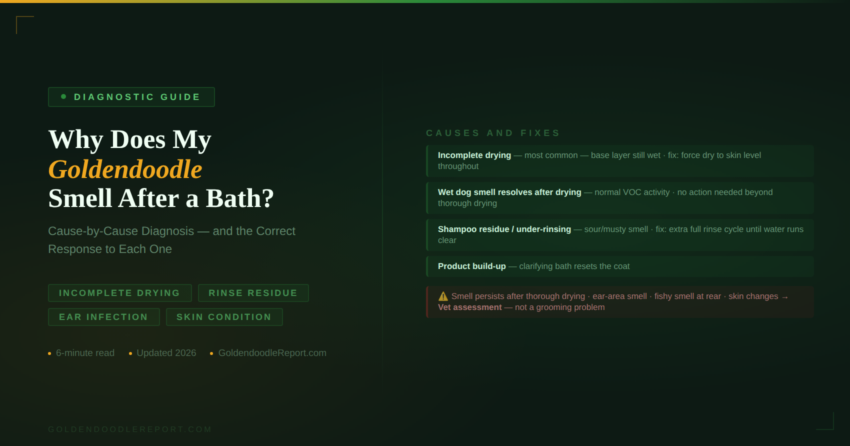
A Goldendoodle who smells after a bath is one of the most common and frustrating grooming complaints — particularly because the bath was supposed to fix the smell, not create a new one. In most cases the post-bath smell has a specific, identifiable cause that is entirely addressable. This guide covers the most common reasons a Goldendoodle smells after bathing, what each smell indicates, and the correct response to each.
⚡ The Most Common Reasons
- Incomplete drying — the most common cause of post-bath smell
- Sebaceous gland activation — the biology of “wet dog smell”
- Coat not fully rinsed — shampoo residue and product build-up
- Underlying skin condition — smell that drying does not resolve
- Ear infection — bath moisture triggering or worsening existing infection
- Anal gland issues — a distinct smell unrelated to the coat
Incomplete Drying — The Most Common Cause
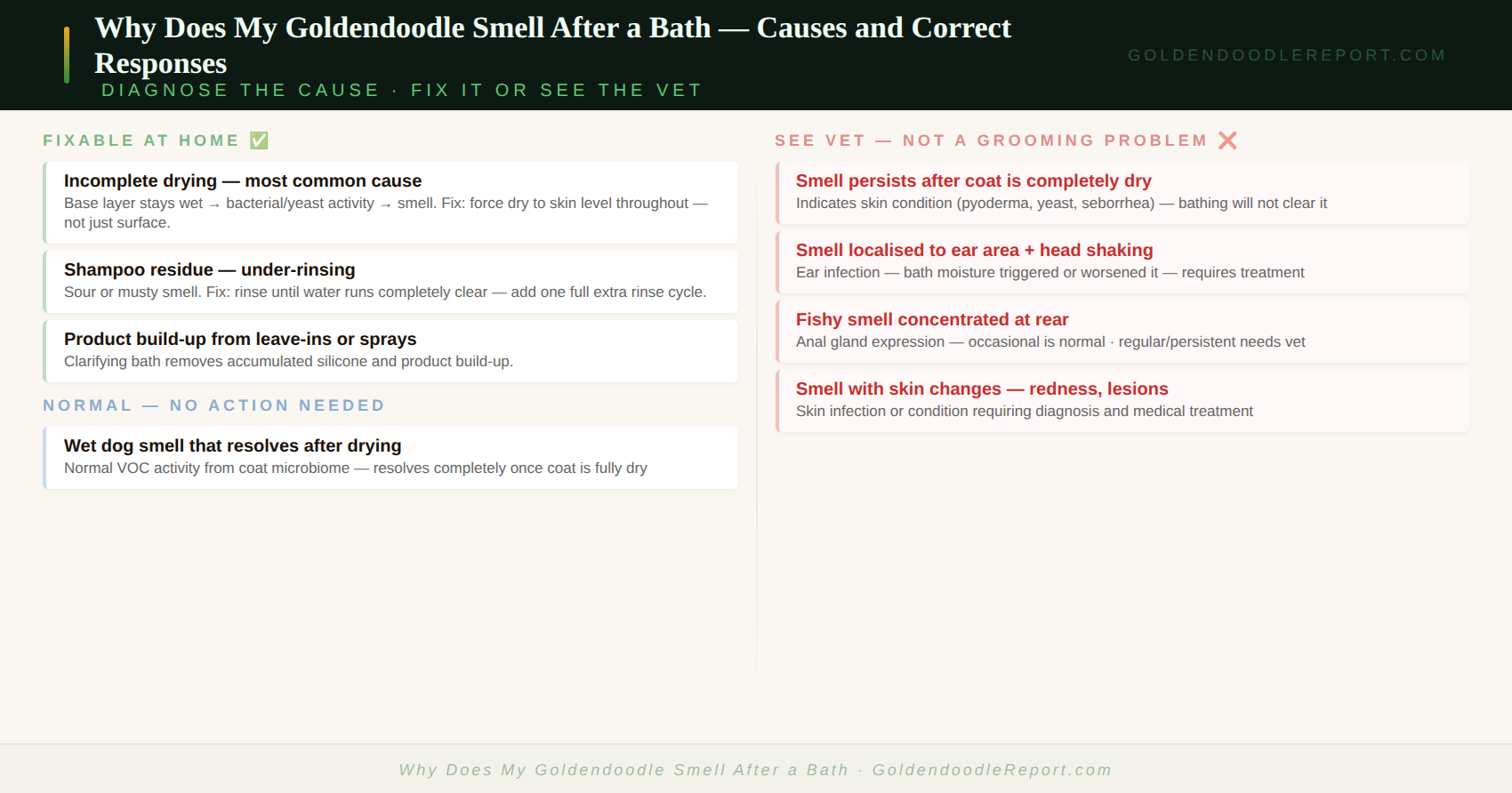
The most common reason a Goldendoodle smells after a bath is incomplete drying — specifically, the base layer of the dense coat remaining damp for hours after the surface appears dry. The Goldendoodle’s multi-layered coat retains moisture deep in the base layer long after the outer coat feels dry to the touch. This residual moisture creates the conditions for bacterial and yeast activity — and it is this activity, not the water itself, that produces the smell.
The fix is thorough force drying from skin level outward. Many owners towel dry the outer coat, see that the surface is dry, and consider the drying complete. The base layer — where the smell is generated — is still wet. A force dryer directed through each coat section from skin to tip, or a human dryer on cool setting used the same way, removes the moisture that produces the smell.
A Goldendoodle who consistently smells within a few hours of a bath is almost always an incompletely dried Goldendoodle. See How to Dry a Goldendoodle Coat for the correct technique.
The Biology of Wet Dog Smell — Why It Happens
The characteristic “wet dog” smell — distinctly different from normal dog smell — is produced by volatile organic compounds (VOCs) released by microorganisms that live naturally on the skin and coat. Bacteria and yeast that are permanently resident on a dog’s skin are normally odourless at the concentrations present on a dry coat. When the coat becomes wet, these microorganisms become temporarily more active — and their metabolic byproducts, including VOCs, are released in greater concentration as the coat dries. This is the wet dog smell.
This smell is normal and resolves as the coat dries completely. If the smell resolves within 30 to 60 minutes of thorough drying — this is wet dog smell from normal coat microbiome activity, and no action beyond thorough drying is needed. If the smell persists after the coat is fully dry — it is not wet dog smell, and a different cause should be investigated.
Shampoo Residue and Product Build-Up
Incompletely rinsed shampoo leaves residue in the coat that reacts with the skin’s natural sebum and the coat’s microbiome to produce odour — sometimes within hours of the bath. This smell is often described as sour or musty rather than the typical wet dog smell.
The rinse phase of bathing should take at least as long as the shampoo phase — often longer for a dense Goldendoodle coat. The correct rinse is complete when the water running off the coat runs completely clear and the coat feels clean and slightly “squeaky” rather than slippery. Many owners under-rinse because the coat feels superficially clean — the deep layers of the coat still hold shampoo residue. Add a full extra rinse cycle to the bathing routine and check whether the post-bath smell resolves.
Silicone or heavy product build-up from leave-in conditioners or detangler sprays can produce a similar smell over time. A clarifying bath with a mild clarifying shampoo removes accumulated product build-up and resets the coat.
Underlying Skin Conditions
A smell that persists after thorough drying and is not explained by shampoo residue may indicate an underlying skin condition. The bath itself does not cause the condition — it makes it temporarily more apparent by activating the microorganisms involved.
Bacterial skin infection (pyoderma): Produces a musty or unpleasant smell from areas of affected skin. Often accompanied by redness, hot spots, hair loss, or crusty lesions. Requires veterinary diagnosis and appropriate antibiotic treatment — bathing will not resolve it.
Yeast skin infection (Malassezia): Produces a distinctive sweet, corn chip, or musty odour. Yeast overgrowth on the skin is particularly common in Goldendoodles with skin folds, between the toes, and in the ear canal. Requires antifungal treatment — more frequent bathing with regular shampoo may temporarily reduce the smell but will not clear the infection.
Seborrhea: A skin condition that produces either excessive oiliness or excessive dryness of the skin, both of which affect smell. A persistently oily, waxy, or strongly smelling coat despite regular bathing warrants veterinary assessment.
Ear Infections — The Smell That Comes From the Ear
Goldendoodles are prone to ear infections — and a bath that introduces water into the ear canal can trigger or worsen an existing infection. If the post-bath smell is concentrated around the head and ear area rather than the coat generally, an ear infection is the most likely explanation.
Signs of an ear infection beyond smell: the dog shakes its head or scratches its ear after the bath, there is dark or coloured discharge visible in the ear, or the ear area is red or warm. An ear infection requires veterinary treatment — it is not a grooming problem. See Goldendoodle Ear Infections and Grooming. Post-bath ear cleaning with a drying veterinary ear cleaner after every bath significantly reduces this risk. See Goldendoodle Ear Cleaning Guide.
Anal Gland Issues — A Distinct Smell
Anal glands (scent glands on either side of the anus) occasionally express during bathing — the warm water and relaxation of bathing can trigger natural expression. The smell is distinctive — strong, fishy, and very different from typical dog or wet dog smell. If the smell during or after bathing is concentrated at the rear and has a fishy quality, anal gland expression is the cause.
Occasional natural expression during bathing is normal. Regular, excessive, or incomplete expression causing persistent smell or discomfort warrants a veterinary assessment — full anal gland expression by a vet or groomer may be needed, or an underlying issue affecting the glands may require treatment.
For authoritative guidance on dog skin and coat health see the AVMA pet care resources.
⚠️ When Post-Bath Smell Needs Veterinary Assessment
- Smell persists after the coat is completely and thoroughly dried
- Smell is localised to the ear area and accompanied by head shaking or scratching
- Smell is fishy or strongly concentrated at the rear
- Smell is accompanied by skin changes — redness, hair loss, hot spots, or lesions
- The smell has a distinctly different character from normal dog smell and has changed recently
✅ Your Next Step
Start with the most common cause: ensure the coat is fully dried to the base layer — not just the surface — using a force dryer or a dryer on cool setting directed through each section from skin outward. If the smell resolves after thorough drying, incomplete drying was the cause. If it persists, work through the other causes above and consult your veterinarian if the smell indicates a health issue rather than a grooming one. For the complete grooming guide see Goldendoodle Grooming Guide.
🔑 Key Takeaways
- Incomplete drying is the most common cause — the base layer retains moisture long after the surface appears dry, producing bacterial and yeast activity that generates smell
- Wet dog smell that resolves after thorough drying is normal — smell that persists after complete drying indicates a different cause
- Incompletely rinsed shampoo produces a sour or musty post-bath smell — add a full extra rinse cycle and check whether the smell resolves
- Persistent smell localised to the ear area indicates a possible ear infection — requires veterinary assessment, not more bathing
- A fishy smell concentrated at the rear indicates anal gland expression — occasional is normal, regular or persistent warrants veterinary assessment
- Smell accompanied by skin changes (redness, lesions, hair loss) indicates a skin condition requiring veterinary diagnosis and treatment
📚 Continue Learning
- Goldendoodle Grooming Guide — complete grooming authority guide
- How to Dry a Goldendoodle Coat — the correct drying technique to prevent smell
- How to Bathe a Goldendoodle — correct rinsing technique
- Goldendoodle Ear Infections and Grooming — when smell comes from the ear
- Goldendoodle Ear Cleaning Guide — post-bath ear cleaning protocol
- Best Shampoo for Goldendoodles — the right shampoo reduces residue risk
↑ Back to: Goldendoodle Grooming Guide | Goldendoodle Grooming — All Articles
Frequently Asked Questions
Why does my Goldendoodle smell worse after a bath?
The most common reason is incomplete drying — the surface coat appears dry but the dense base layer retains moisture for hours, generating bacterial and yeast activity that produces smell. Use a force dryer or a dryer on cool setting to dry each section from skin outward, not just the surface. If the smell resolves after truly thorough drying, incomplete drying was the cause. If it persists, check for shampoo residue (under-rinsing), ear infection smell localised to the head, or a skin condition that requires veterinary assessment.
What is the wet dog smell and is it normal?
Wet dog smell is produced by volatile organic compounds released by normal bacteria and yeast resident on the skin and coat — these microorganisms become temporarily more active when wet and release odour compounds during drying. It is entirely normal and resolves completely once the coat is thoroughly dried. A smell that resolves after drying is wet dog smell. A smell that persists after the coat is fully dry is a different issue requiring further investigation.
Why does my Goldendoodle smell after a bath even when I dry them?
If the smell persists after drying, the most likely causes are: the coat is not being dried to the base layer (only the surface is dry), shampoo is not being fully rinsed out, an ear infection is producing smell concentrated near the head, a skin condition (bacterial, yeast, or seborrhea) is producing smell that bathing temporarily intensifies, or anal glands expressed during the bath. Work through these causes systematically — start with extending drying time to ensure the base layer is fully dry, then add an extra thorough rinse cycle, then investigate the ear and skin causes if the smell persists.
Does a Goldendoodle smell more than other dogs?
Not inherently — but the dense coat retains moisture longer than short coats, making incomplete drying more consequential. A Goldendoodle who is thoroughly dried after every bath has no more smell than most other breeds. The perception that Goldendoodles are particularly smelly typically comes from the combination of an active outdoor lifestyle, dense coat that traps odour and moisture, and the incomplete drying that many owners unknowingly practice.
Disclaimer: The information in this article is provided for general educational purposes only. King James Adjei is a researcher and enthusiast, not a veterinarian. For persistent unusual smells, skin changes, or ear symptoms, always consult a veterinarian — these may indicate health conditions that require professional diagnosis and treatment.