Affiliate Disclosure: Some links in this guide are affiliate links. If you purchase through them, we may earn a small commission at no extra cost to you. Read our full affiliate disclaimer here.
By King James Adjei — Researcher and Goldendoodle enthusiast, founder of GoldendoodleReport.com. Every guide on this site is carefully researched and written to give owners reliable, clearly organised information. → About this site
🩺 Medical content notice: Feeding amounts in this guide are evidence-based general guidelines. Your Goldendoodle’s specific needs depend on activity level, health status, spay/neuter status, and the exact food you use. Always verify portion sizes with your veterinarian and follow the feeding guidelines on your chosen food’s packaging.
📖 8-minute read | Last updated May 2026 | Reviewed for accuracy
✅ Quick Answer
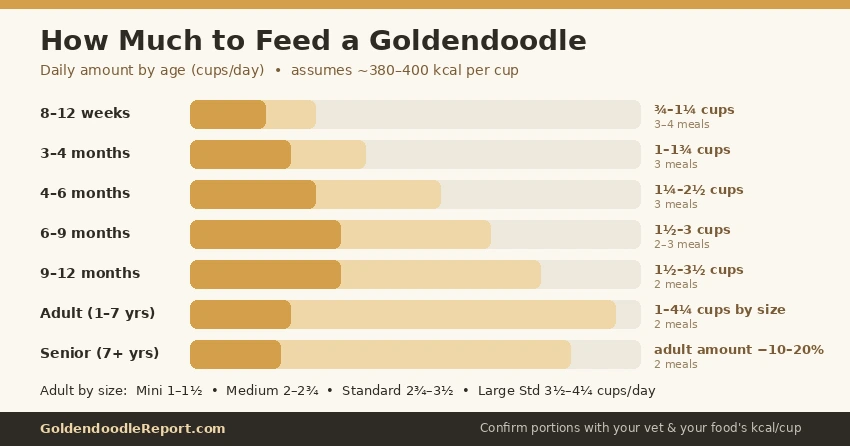
A Goldendoodle puppy (8–12 weeks) typically needs ¾–1¼ cups of puppy food per day, split across 3–4 meals. An adult Goldendoodle (1–7 years) needs 2–4 cups per day depending on size and activity, split across 2 meals. A senior Goldendoodle (7+ years) needs approximately 10–20% less than their adult amount. These are starting points — adjust based on body condition, not just weight. The exact amount depends on the calorie density of your specific food, which varies significantly between brands.
Overfeeding is the most common nutrition mistake Goldendoodle owners make. Because Goldendoodles are enthusiastic eaters and rarely self-regulate, an owner who free-feeds or follows overly generous portion guidelines ends up with a dog that is carrying excess weight — which over time contributes to joint strain, reduced lifespan, and higher vet costs.
Underfeeding is less common but happens most often with puppies, whose energy demands during rapid growth are significantly higher than most owners realise. A Goldendoodle puppy that is not getting enough calories in the first 6 months shows it through slow growth, low energy, poor coat development, and an inability to gain weight appropriately.
This guide gives you the numbers — by age, by weight, and by life stage — alongside the body condition scoring method that tells you whether those numbers are right for your specific dog.
👤 Who This Guide Is For
- You just brought home a Goldendoodle puppy and want to know exactly how much to feed them from day one
- You have an adult Goldendoodle and are unsure whether you are overfeeding or underfeeding
- Your dog is gaining or losing weight and you want to understand how to adjust portions correctly
- You are switching foods and need to recalculate amounts for the new brand
📊 Quick Facts — Goldendoodle Feeding
- An estimated 56% of US dogs are overweight or obese — Goldendoodles are particularly at risk because they rarely refuse food
- The calorie content of dry dog foods ranges from approximately 300 to 500+ kcal per cup — a difference of up to 65% between brands at the same volume
- Puppies need approximately twice the calories per pound of body weight compared to adult dogs during peak growth phases
- Spayed and neutered Goldendoodles typically require 20–30% fewer calories than intact dogs of the same size and activity level
- Free-feeding (leaving food available all day) is strongly associated with obesity in Goldendoodles — scheduled meals are recommended at every life stage
Why Feeding Amounts Vary So Much
The most confusing thing about Goldendoodle feeding guides — including this one — is that the numbers are always a range, never a single precise figure. That is not vagueness. It reflects three genuine variables that mean no single number applies to every Goldendoodle.
Variable 1 — Size difference across the breed
A Mini Goldendoodle at 15 lbs and a Standard Goldendoodle at 65 lbs are both “Goldendoodles.” Their calorie needs differ by a factor of 3–4x. Feeding guides that give one figure for “goldendoodles” without specifying size are not useful.
Variable 2 — Calorie density of different foods
Dry kibble ranges from approximately 300 to 500+ kcal per cup. That means 2 cups of one food can contain the same calories as 3 cups of another. Always find the kcal/cup figure on your specific food’s packaging or website before calculating portions — never assume cups are equivalent across brands.
Variable 3 — Individual metabolic rate
Two Goldendoodles of identical size, age, and activity level can have meaningfully different metabolic rates. Spayed/neutered dogs burn fewer calories. Dogs with hypothyroidism burn fewer still. A highly active dog needs significantly more than a dog who walks once per day. The amounts in this guide are starting points — body condition scoring (covered below) tells you whether those starting points need adjusting for your specific dog.
📖 Real Scenario
Two owners of 35 lb Goldendoodles both search “how much to feed a goldendoodle” and find the same guide. The first owner has been feeding 2 cups per day of a high-calorie performance kibble (490 kcal/cup) — that is 980 kcal/day for a moderate-energy adult who needs approximately 820 kcal/day. The dog gains weight slowly. The second owner feeds 2 cups of a standard adult kibble (340 kcal/cup) — that is 680 kcal/day, which is below maintenance for an active dog. Neither owner realises the issue because they are both feeding “2 cups.” The lesson: always look at kcal/cup, not just cup volume.
Puppy Feeding Amounts (8 Weeks – 12 Months)
Goldendoodle puppies have higher calorie requirements per pound of body weight than adult dogs because they are supporting rapid bone growth, muscle development, organ maturation, and immune system development simultaneously. Underfeeding during this window has lasting consequences — it is much more damaging than mild overfeeding.
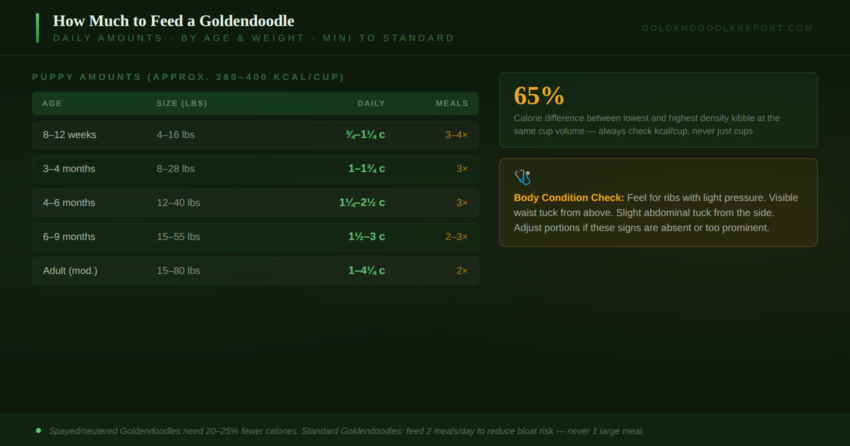
The table below uses an assumed calorie density of approximately 380–400 kcal per cup — close to the average for quality puppy kibble. If your food is higher or lower than this, adjust accordingly by checking the packaging.
| Age | Weight Range | Daily Amount | Meals Per Day |
|---|---|---|---|
| 8–12 weeks | 4–8 lbs (mini) / 8–16 lbs (standard) | ¾–1¼ cups | 3–4 meals |
| 3–4 months | 8–14 lbs (mini) / 15–28 lbs (standard) | 1–1¾ cups | 3 meals |
| 4–6 months | 12–20 lbs (mini) / 25–40 lbs (standard) | 1¼–2½ cups | 3 meals |
| 6–9 months | 15–25 lbs (mini) / 35–55 lbs (standard) | 1½–3 cups | 2–3 meals |
| 9–12 months | 18–30 lbs (mini) / 40–65 lbs (standard) | 1½–3½ cups | 2 meals |
Important note on puppy food type: Standard Goldendoodles should be fed a large breed puppy formula during the growth phase. Large breed formulas have controlled calcium and phosphorus ratios that prevent excessively rapid bone growth — too much calcium during growth has been linked to developmental bone problems in large dogs. Mini Goldendoodles can use a regular puppy formula. Ask your vet to confirm which category your dog’s adult size falls into.
⚠️ Transition your puppy to adult food gradually. Most Goldendoodles transition from puppy to adult food between 12 and 18 months — Mini Goldendoodles closer to 12 months, Standards closer to 18 months. Switching abruptly causes digestive upset. Transition over 7–10 days, mixing increasing proportions of adult food with decreasing puppy food.
For the full puppy feeding schedule including meal timing and transitioning to 2 meals per day, see our Goldendoodle Feeding Schedule guide in this category.
For guidance on what your puppy needs specifically at each developmental stage: Goldendoodle Puppy Care Guide and Goldendoodle Puppy First Vet Visit — confirming feeding plans with your vet at the first visit is strongly recommended.
Adult Feeding Amounts (1–7 Years)
Once a Goldendoodle has reached their adult size and is no longer actively growing, calorie needs stabilise and are primarily driven by body weight and daily activity level. The shift from puppy to adult food and adult portions is one of the most important transitions to get right — many dogs begin gaining excess weight at this stage simply because their owner continues puppy portion sizes after switching to adult food.
By adult body weight (assuming ~380 kcal/cup kibble, moderately active dog)
| Adult Weight | Size Category | Daily Amount | Per Meal (2x/day) |
|---|---|---|---|
| 15–20 lbs | Mini Goldendoodle | 1–1½ cups | ½–¾ cup |
| 20–30 lbs | Mini / Medium | 1½–2 cups | ¾–1 cup |
| 30–45 lbs | Medium Goldendoodle | 2–2¾ cups | 1–1⅓ cups |
| 45–60 lbs | Standard Goldendoodle | 2¾–3½ cups | 1⅓–1¾ cups |
| 60–80 lbs | Large Standard | 3½–4¼ cups | 1¾–2 cups |
Activity level adjustments
The amounts above assume a moderately active dog — daily walks, some play, not sedentary but not working or competing. Adjust as follows:
- Low activity (mostly indoor, short walks): reduce by 10–15%
- Moderate activity (30–60 min daily exercise): use the table amounts as-is
- High activity (agility, hiking, 60+ min vigorous daily exercise): increase by 15–25%
- Spayed or neutered: reduce base amount by 20–25% regardless of activity
For full guidance on choosing the right food alongside the amounts: see our Best Food for Goldendoodles guide in this category.
Senior Feeding Amounts (7+ Years)
Goldendoodles are generally considered senior from around 7 years of age for Standards and 9–10 years for Minis (smaller dogs tend to live longer and age more slowly). Senior dogs typically need fewer calories than they did as adults — activity decreases, metabolism slows, and muscle mass begins to decline.
Starting point: Reduce the adult amount by 10–20% as a starting point when transitioning to senior feeding. Use body condition scoring (below) to fine-tune from there.
What changes in senior nutrition: Senior dogs often benefit from food with slightly higher protein levels (to maintain muscle mass), added joint-supporting ingredients (glucosamine and chondroitin), and lower overall calorie density. Fibre content that supports digestive health also becomes more important. See our Best Senior Food for Goldendoodles guide — coming soon in this category.
⚠️ Do not reduce senior portions too aggressively. A common mistake is cutting food significantly in senior dogs because they are less active. However, maintaining muscle mass in older dogs requires adequate protein intake. If your senior Goldendoodle is at a healthy weight, the priority is maintaining body condition — not reducing for the sake of reducing. The vet’s annual body condition assessment is the best guide here.
How Many Times Per Day to Feed
Meal frequency matters almost as much as portion size — both for digestive health and for managing bloat risk in Standard Goldendoodles.
| Life Stage | Recommended Meals/Day | Why |
|---|---|---|
| 8–12 weeks | 4 meals/day | Tiny stomach, high energy need, prevents low blood sugar |
| 3–6 months | 3 meals/day | Stomach growing, still high calorie demand per pound |
| 6–12 months | 2–3 meals/day | Transitioning toward adult schedule |
| Adult (1–7 yrs) | 2 meals/day | Reduces bloat risk, supports stable energy, aids weight management |
| Senior (7+ yrs) | 2 meals/day | Digestive support, portion control, maintains routine |
Bloat risk and meal timing — Standard Goldendoodles
Standard Goldendoodles (deep-chested breeds) carry a risk of gastric dilatation-volvulus (GDV or bloat) — a life-threatening condition where the stomach twists after a large meal, particularly when followed by vigorous exercise. To reduce this risk: feed 2 meals rather than 1 large daily meal, never allow vigorous exercise for 60–90 minutes before or after feeding, and use a slow-feeder bowl if your dog eats quickly. If you ever see your Standard Goldendoodle with a distended abdomen, restlessness, and unsuccessful retching — go to an emergency vet immediately. Do not wait.
👉 For the complete puppy feeding schedule with daily timing: see our Goldendoodle Feeding Schedule — coming soon in this category.
Body Condition Scoring — The Real Measure
Numbers in a table cannot tell you whether your individual Goldendoodle is getting the right amount to eat. Body condition scoring can. It is the method vets use and the method you should use at home between vet visits — it takes 30 seconds and is far more accurate than any feeding table.
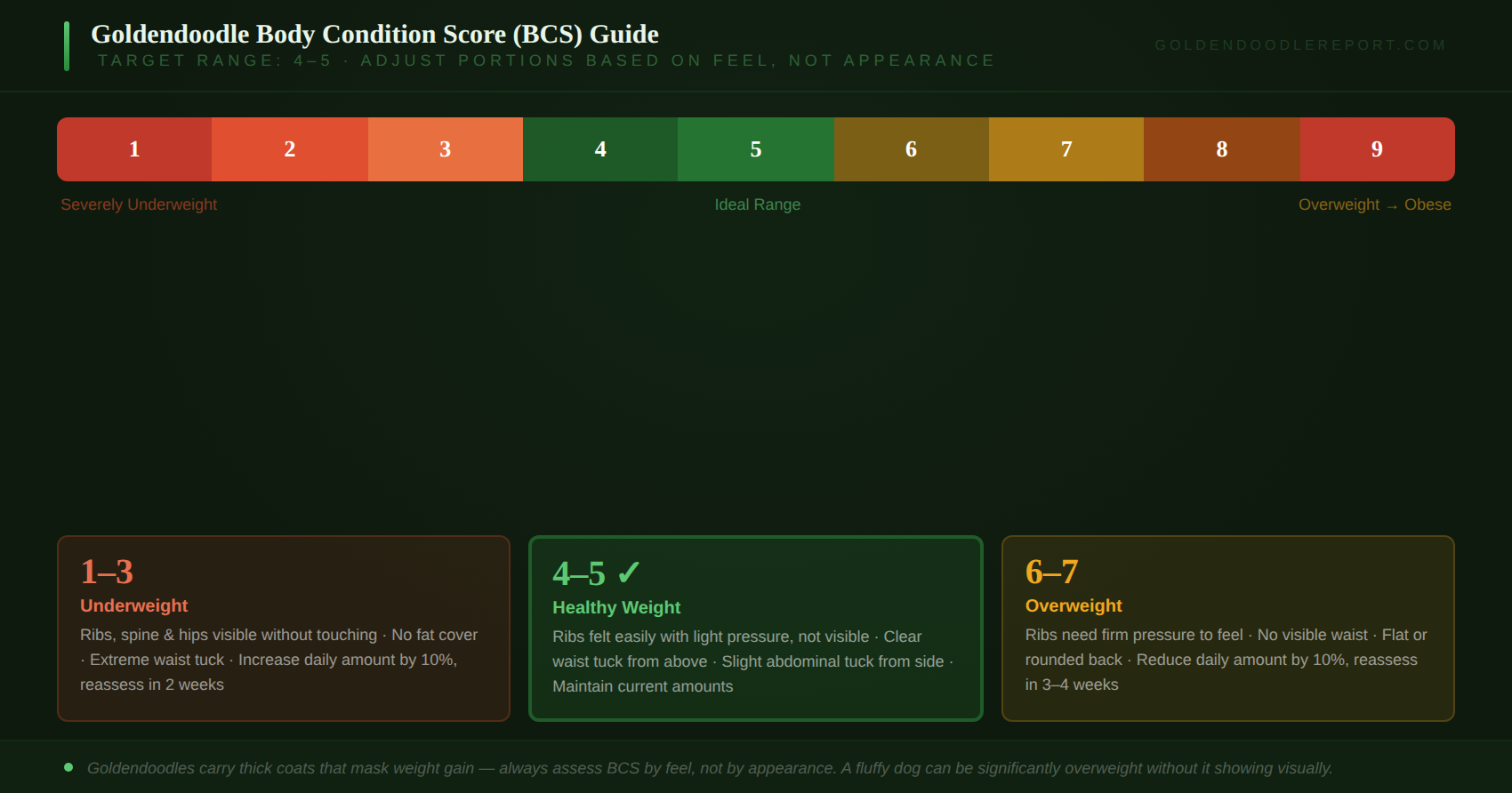
The standard scale runs from 1 (severely underweight) to 9 (severely obese). Target range for a healthy Goldendoodle is 4–5.
How to assess your Goldendoodle’s body condition
Step 1 — Feel the ribs: Place both hands on your dog’s ribcage with light pressure. You should be able to feel individual ribs with minimal pressure but not see them prominently from a distance. If you cannot feel ribs without pressing firmly, the dog is overweight. If ribs are clearly visible or palpable without any pressure, the dog is underweight.
Step 2 — Check the waist: Looking at your dog from above, there should be a visible inward tuck behind the ribcage — a waist. If the back appears straight or widens behind the ribs, the dog is likely overweight.
Step 3 — Check the abdomen: Looking from the side, the abdomen should tuck upward slightly behind the ribcage. A saggy, pendulous belly indicates overweight. An extremely tucked belly indicates underweight.
✅ Healthy body condition — what you should find:
- Ribs palpable with light pressure but not visually prominent
- Visible waist tuck when viewed from above
- Slight abdominal tuck visible from the side
- Muscle definition visible around shoulders and haunches
- No excess fat deposits over the spine or tail base
Goldendoodles carry more coat than many breeds, which can mask weight gain. Always assess body condition by feel, not appearance. A fluffy Goldendoodle can be significantly overweight without it being obvious visually.
Signs You Are Overfeeding Your Goldendoodle
- Cannot feel ribs without pressing firmly — the most reliable early indicator of overweight
- No visible waist from above — the dog’s back appears rectangular or wider behind the ribs
- Low exercise tolerance — tires quickly on walks, reluctant to play for extended periods
- Weight gain confirmed at vet visits — even 1–2 lbs over ideal weight matters in smaller Goldendoodles
- Soft, flabby feel to the abdomen — excess fat accumulates around the belly first
- Difficulty grooming themselves — overweight dogs have reduced flexibility and may develop matting in areas they can no longer reach
The most important link to grooming: Overweight Goldendoodles develop coat matting faster because they cannot reach certain areas to self-groom and they move less, preventing natural coat maintenance. See our Goldendoodle Matting Prevention guide for the connection between weight and coat health.
Signs You Are Underfeeding Your Goldendoodle
- Ribs visually prominent or easily felt without any pressure
- Spine and hip bones prominently visible
- Dull, dry coat and excessive shedding — nutritional deficiency shows quickly in coat quality
- Low energy and lethargy — particularly noticeable in puppies who should be active and playful
- Constantly searching for food — sniffing, counter-surfing, eating grass, eating inedible objects
- Poor growth rate in puppies — falling behind the expected weight curve for their age
Coat quality is one of the earliest external indicators of nutritional status. A Goldendoodle that is getting adequate calories and protein should have a soft, glossy coat. For more on coat health and nutrition: Goldendoodle Coat Types Explained.
How to Adjust Portions Correctly
If body condition scoring shows your dog is overweight or underweight, adjust portions in small increments — not dramatic cuts or increases.
Adjusting for overweight
Reduce the daily amount by approximately 10% and reassess body condition after 3–4 weeks. If there is no change, reduce by a further 10%. Do not reduce by more than 20% of total daily intake without veterinary guidance — significant calorie restriction can cause other problems including nutritional deficiency and muscle loss.
Adjusting for underweight
Increase daily amount by 10% and reassess after 2–3 weeks. If a puppy is consistently underweight despite appropriate portions, consult your vet — intestinal parasites and other conditions can cause poor weight gain even on adequate feeding. See our Goldendoodle Puppy Deworming Guide for parasite-related weight issues.
When switching foods
Do not assume the same cup measurement applies when switching food brands. Check the kcal/cup on the new food and recalculate the daily portion before starting the transition. Transition over 7–10 days mixing old and new food to avoid digestive upset.
For full guidance on choosing between food types including dry, wet, fresh, and raw: see our Best Food for Goldendoodles guide — coming soon in this category.
Special Situations
Goldendoodle with food allergies or sensitive stomach
Goldendoodles with food allergies or sensitivities may require a limited ingredient or hydrolysed protein diet. The amounts remain similar but the food type changes significantly. Common Goldendoodle allergens include chicken protein, beef protein, and wheat. For dogs on prescription or specialty diets, follow your vet’s specific portion guidance rather than standard guidelines. See our Goldendoodle Food Allergies guide and Goldendoodle Sensitive Stomach Food guide — both coming soon in this category.
Signs that diet may be affecting your dog’s skin and coat are also covered in our Goldendoodle Spring Allergies guide and the Why Is My Goldendoodle Shedding So Much? article — nutrition is a frequently missed cause of excessive shedding.
Pregnant or nursing Goldendoodles
Pregnant Goldendoodles in the final 3–4 weeks of pregnancy need a gradual increase in food — typically transitioning to a high-quality puppy food and increasing amounts by 25–50%. Nursing dogs have dramatically increased calorie needs — up to 2–4x normal maintenance. This is not a situation to manage without veterinary guidance.
Post-surgery or recovery feeding
Dogs in recovery from surgery or illness often have reduced appetite and altered metabolic needs. Follow your vet’s specific guidance. Do not attempt to maintain normal portions in a dog that is unwell — calorie needs change significantly during illness and recovery.
🔑 Key Takeaways
- Always calculate portions using your food’s kcal/cup figure — cup volume is meaningless without this, as calorie density varies by up to 65% between foods
- Puppies need 3–4 meals per day until 3–6 months, then 3 meals, then 2 — meal frequency matters for blood sugar stability and bloat risk management
- Spayed and neutered Goldendoodles need approximately 20–25% fewer calories than intact dogs — this adjustment is missed by most owners and causes weight gain
- Body condition scoring — feeling for ribs, checking waist tuck, checking abdominal tuck — is more accurate than any feeding table and takes 30 seconds
- Standard Goldendoodles carry a bloat risk: 2 meals per day (not 1), no vigorous exercise 60–90 minutes before or after eating, and slow-feeder bowls if needed
- Coat quality is an early indicator of nutritional status — dull, dry coat or excessive shedding often signals nutritional insufficiency, not just grooming needs
📚 More Goldendoodle Food & Nutrition Guides
- Goldendoodle Feeding Schedule: Meal Timing by Age — coming soon
- Best Food for Goldendoodles: What Vets Actually Recommend (2026) — coming soon
- Best Puppy Food for Goldendoodles: Large vs Standard Breed Formulas — coming soon
- Goldendoodle Food Allergies: Signs, Triggers + What to Feed Instead — coming soon
- Goldendoodle Sensitive Stomach: 5 Foods That Actually Help — coming soon
- Goldendoodle Weight Management: How to Help an Overweight Dog Safely — coming soon
Browse all guides: Goldendoodle Food & Nutrition category
🔗 Related Guides Across the Site
- Goldendoodle Puppy Care Guide — includes feeding in the context of the full first year
- Goldendoodle Puppy First Vet Visit — confirming your feeding plan at the first appointment
- Goldendoodle Puppy Deworming Guide — parasites as a cause of poor weight gain
- Why Is My Goldendoodle Shedding So Much? — nutrition’s role in excessive shedding
- Goldendoodle Spring Allergies — food allergies vs environmental triggers
- Why Is My Goldendoodle Always Hungry? — causes beyond just underfeeding
- Goldendoodle Matting Prevention — weight and coat health connection
Frequently Asked Questions
How many cups of food should I feed my Goldendoodle per day?
It depends on size, age, activity, and the calorie density of your specific food. As a starting point: a Mini Goldendoodle (15–25 lbs) needs approximately 1–1¾ cups per day; a Medium (30–45 lbs) needs 2–2¾ cups; a Standard (45–65 lbs) needs 2¾–3½ cups. These assume a food at approximately 380 kcal/cup. Check the kcal/cup on your actual food and adjust accordingly. Always use body condition scoring to confirm the amount is right for your individual dog.
Can I free-feed my Goldendoodle (leave food out all day)?
Free-feeding is strongly not recommended for Goldendoodles. The breed has a poor self-regulation mechanism around food — most Goldendoodles will eat whatever is available, regardless of whether they need it. Free-feeding is one of the most consistent predictors of obesity in the breed. Scheduled meals (2 per day for adults) allow accurate portion control, make it easier to notice when a dog’s appetite changes (which can signal illness), and support toilet training and routine in younger dogs.
How do I know if I’m feeding my Goldendoodle enough?
Use body condition scoring — the most reliable method. You should be able to feel your dog’s ribs with light pressure but not see them prominently. There should be a visible waist tuck from above and a slight abdominal tuck from the side. A dog that is consistently ravenous, losing weight, or showing dull coat condition despite regular grooming may be underfed. A dog that is gaining weight or where ribs cannot be felt without firm pressure is likely being overfed.
Do Goldendoodles need different food as puppies vs adults?
Yes — puppy food and adult food have meaningfully different nutritional profiles. Puppy food is higher in protein, fat, calcium, phosphorus, and overall calories to support rapid growth. Standard Goldendoodles specifically need a large breed puppy formula, which has controlled calcium and phosphorus ratios to prevent developmental bone problems caused by too-rapid growth. Switching to adult food before the dog has finished growing (too early) or continuing puppy food past growth completion (too late) both have negative nutritional consequences.
Should I feed my Goldendoodle once or twice a day?
Twice per day is the standard recommendation for adult Goldendoodles. Feeding once per day increases bloat risk in Standard Goldendoodles and can cause blood sugar fluctuations. Puppies need more frequent meals — 4 times daily until 3 months, 3 times daily until 6 months, then transitioning to twice daily. Twice-daily feeding also makes weight management easier since you can adjust individual meal sizes.
My Goldendoodle always seems hungry — am I underfeeding them?
Not necessarily. Goldendoodles are enthusiastic eaters who frequently appear hungry even when well-fed — it is a breed characteristic. If your dog is at a healthy body condition score (you can feel ribs, visible waist tuck, appropriate energy levels), they are not underfed regardless of how hungry they seem. If body condition score indicates underweight, then portions need adjustment. For more on the “always hungry” behaviour specifically: Why Is My Goldendoodle Always Hungry?
Disclaimer: The feeding amounts in this guide are evidence-based general guidelines for educational purposes only. King James Adjei is a researcher and enthusiast, not a veterinarian or certified veterinary nutritionist. Individual dogs’ needs vary based on health status, activity, and specific food used. Always consult your veterinarian for feeding guidance specific to your dog, particularly for puppies, pregnant or nursing dogs, dogs with health conditions, or dogs with confirmed food allergies.