By King James Adjei — Researcher and Goldendoodle enthusiast, founder of GoldendoodleReport.com. Every guide on this site is carefully researched and written to give owners reliable, clearly organised information — updated regularly and honest about uncertainty. → About this site
📖 5-minute read | Last updated April 2026 | Reviewed for accuracy
The quality of a Goldendoodle’s grooming appointment depends significantly on the information the owner provides before the groomer begins. A groomer working without context makes assumptions — about coat condition, about style preference, about the dog’s behaviour, about health considerations that affect how the dog should be handled. Owners who communicate clearly and specifically before every appointment get consistently better results than those who say “just do the usual” and hope for the best. This guide covers exactly what to tell your groomer — and how to say it.
👤 Who This Guide Is For
- You have a grooming appointment coming up and want to communicate your preferences clearly
- You have had disappointing grooming results and want to understand what information would have changed the outcome
- You are using a new groomer for the first time and want to give them the best possible start
- You want a practical checklist of what to cover before every appointment
⚡ Quick Summary — What to Tell Your Groomer
- The specific haircut style and length you want — with reference photos
- Your dog’s known mat-prone areas — where the coat tangles fastest
- Any mat or coat condition issues present at this appointment
- The dog’s behaviour during specific grooming tasks — what it accepts and what it resists
- Any health conditions, skin sensitivities, or injuries that affect how the dog should be handled
- Whether anything has changed since the last appointment — new medications, recent illness, behaviour changes
For choosing the right groomer see How to Choose a Groomer for a Goldendoodle. For the complete grooming guide see Goldendoodle Grooming Guide.
Tell Them Exactly What You Want — Style and Length
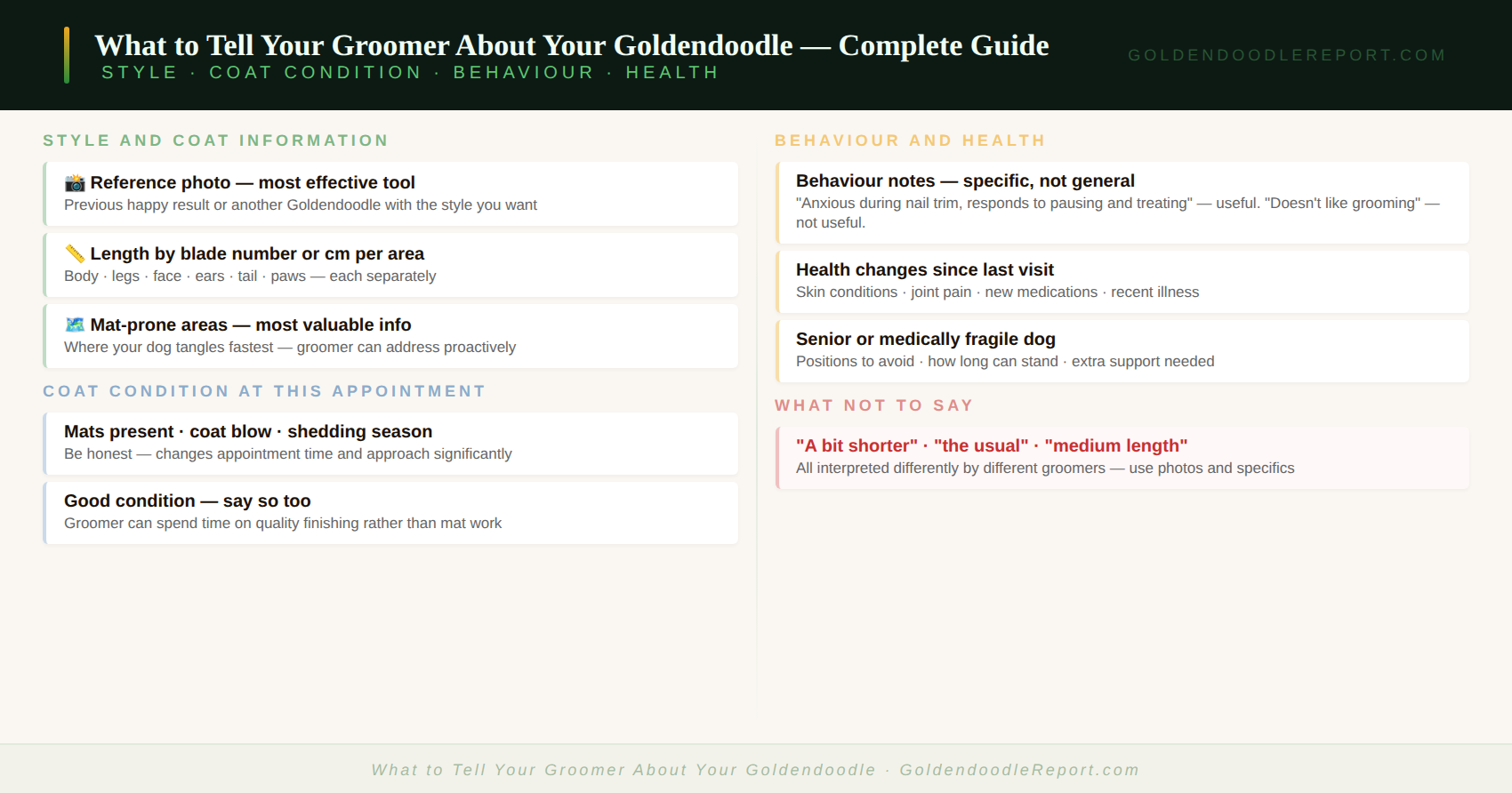
The most common source of grooming disappointment is vague style communication. “A bit shorter,” “neater around the face,” and “the usual” are not actionable instructions — they depend entirely on what the groomer assumes you mean, which may not match what you have in mind.
Bring a reference photo. The most effective communication tool for grooming style is a photo of the result you want. A photo of your dog from a previous appointment you were happy with, or a photo of another Goldendoodle whose coat you like, removes ambiguity entirely. Show the photo and say specifically what you want the same and what you want different.
State the length in blade numbers or centimetres, not adjectives. “A number 5 blade on the body” or “about 3 centimetres on the legs” is specific and unambiguous. “Medium length” means different things to different groomers. If you don’t know the blade numbers, ask your groomer to show you what each produces — most are happy to explain and then agree on a specific option.
Cover every area separately. Goldendoodles typically have different length preferences for the body, legs, face, ears, tail, and paws. Tell the groomer specifically what you want for each — do not assume they will interpret “shorter overall” as meaning the same thing for the face as for the body. See Goldendoodle Haircut Styles for the main style options.
Tell Them Your Dog’s Mat-Prone Areas
Every Goldendoodle has specific areas where the coat mats faster than others — typically behind the ears, under the front legs (armpits), around the collar, behind the back legs, and the tail base. Many owners are not aware that their individual dog has a predictable pattern to where mats form first.
If you know where your dog mats — tell the groomer specifically. A groomer who knows that this particular dog mats behind the ears faster than anywhere else will check and address those areas proactively, before a mat that could have been detangled becomes one that requires clipping out. This is the single most useful piece of dog-specific information you can provide.
If you don’t yet know your dog’s specific mat-prone areas — ask your groomer after the appointment where they found the most matting. Over 2 to 3 appointments you will build a clear picture of the individual dog’s pattern, which you can then communicate back.
Tell Them the Coat Condition at This Appointment
Be honest about how the coat arrives. If you know there are mats in specific areas — say so before the groomer begins. This serves two purposes: it lets the groomer plan the appointment time appropriately, and it allows a conversation about how the mats will be addressed before the dog is on the table.
If the coat is in good condition — say that too. A groomer who knows the coat has been well maintained can spend appointment time on quality finishing work rather than spending the first 30 minutes on mat removal.
If the dog is in coat blow — tell the groomer. This changes the entire approach to the appointment — the groomer needs to account for the mixed coat texture, the additional brushing required, and the mat risk during the transition. A groomer who does not know the dog is in coat blow may not allocate sufficient time or may interpret the coat condition incorrectly. See Goldendoodle Coat Blowing Guide.
Tell Them How the Dog Behaves During Specific Tasks
A dog who is generally calm but becomes anxious during nail trimming, or who accepts everything except the face area, or who needs to be supported during ear cleaning — all of these are things a good groomer needs to know before they begin rather than discovering mid-appointment.
Be specific, not general. “He doesn’t like being groomed” tells the groomer very little. “He’s fine for most of the appointment but gets anxious when the clippers approach his face — he responds well to pausing and treating” tells the groomer exactly what to anticipate and what to try.
Mention any changes since the last visit. A dog who was calm at the last appointment but has recently become anxious about nail trimming — perhaps because of an accidentally cut quick — needs this communicated. The groomer cannot know what has changed between appointments unless the owner tells them.
Tell Them About Health Conditions and Skin Issues
Any health condition that affects the grooming session should be communicated before the appointment begins — not discovered on the table.
Skin conditions: if the dog has a hot spot, rash, or area of irritated skin, tell the groomer specifically where it is and what it is. A groomer who does not know about a hot spot and applies shampoo or mechanical pressure to it causes pain and can worsen the condition.
Joint or mobility issues: older Goldendoodles with arthritis or hip dysplasia have positions that cause discomfort — the groomer needs to know which positions to avoid and how long the dog can comfortably stand on the table.
Recent illness or medication: some medications affect coat condition, skin sensitivity, or behaviour. If the dog has been unwell or started new medication since the last appointment, mention it — the groomer can adjust their approach accordingly.
For authoritative guidance on professional dog grooming see the AKC dog grooming guide.
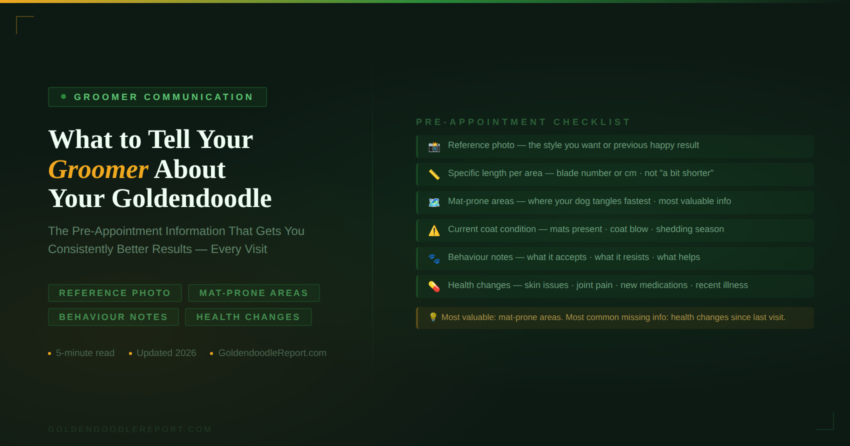
✅ Pre-Appointment Checklist
- 📸 Reference photo of the style you want (or your dog from a previous happy appointment)
- 📏 Specific length for each area — body, legs, face, ears, tail, paws
- 🗺️ Your dog’s mat-prone areas — where the coat tangles fastest
- ⚠️ Any mats or coat condition issues at this appointment
- 🐾 Behaviour notes — what the dog accepts, what it resists, what helps
- 💊 Any health changes, skin conditions, or new medications since last visit
- 📅 Whether the dog is in coat blow or seasonal shedding period
🔑 Key Takeaways
- A reference photo is the most effective communication tool for grooming style — it removes all ambiguity about what you want
- State length in blade numbers or centimetres — never adjectives like “a bit shorter”
- Tell the groomer your dog’s mat-prone areas — this is the most valuable dog-specific information you can provide
- Be honest about coat condition — mats present, coat blow in progress, or recent shedding increase all change how the appointment should be approached
- Behaviour notes should be specific — “anxious during nail trim, responds to pausing and treating” is useful; “doesn’t like grooming” is not
- Any health condition, skin issue, or recent illness that affects handling should be communicated before the appointment begins
📚 Continue Learning
- Goldendoodle Grooming Guide — complete grooming authority guide
- How to Choose a Groomer for a Goldendoodle — selecting the right groomer
- Goldendoodle Haircut Styles — style options to discuss with your groomer
- Goldendoodle Coat Blowing Guide — what to tell the groomer during coat blow
- Goldendoodle Grooming Mistakes to Avoid — common mistakes that produce poor outcomes
- Mobile Groomer vs Salon Groomer for Goldendoodles — the format decision
↑ Back to: Goldendoodle Grooming Guide | Goldendoodle Grooming — All Articles
Frequently Asked Questions
What should I tell my groomer about my Goldendoodle?
Before every appointment: the specific haircut style and length you want (with a reference photo if possible), your dog’s mat-prone areas, the current coat condition, behaviour notes for specific grooming tasks, and any health conditions or changes since the last visit. For first appointments with a new groomer: add a brief history of past grooming experiences, any previous incidents (quick cut during nail trim, bad reaction to a specific product), and what the dog responds well to during grooming.
How do I describe the haircut I want for my Goldendoodle?
The most effective approach is a reference photo — either of your dog from a previous appointment you were happy with, or a photo of another Goldendoodle with the style you want. Supplement the photo with specific length instructions for each area (body, legs, face, ears, tail) stated in blade numbers or centimetres. Avoid adjectives like “medium” or “neat” — these are interpreted differently by different groomers and produce inconsistent results.
What if my groomer has already started and I realise something is wrong?
Speak up as soon as you notice — do not wait until the end of the appointment. A groomer who is told mid-appointment that the length is shorter than wanted can adjust for the remaining sections. A groomer told only at the end cannot reverse the work already done. Good groomers appreciate mid-appointment feedback and expect it — they are not working with a fixed plan that cannot adapt.
Should I stay for my Goldendoodle’s grooming appointment?
Most professional groomers prefer owners to drop off and return — the dog typically settles more easily without the owner present, as the owner’s presence can trigger the dog’s attention-seeking behaviour that makes grooming harder. However, if your dog has severe anxiety or medical needs that require your presence, communicate this clearly when booking — do not simply arrive and expect to stay without prior arrangement.
Disclaimer: The information in this article is provided for general educational purposes only. King James Adjei is a researcher and enthusiast, not a veterinarian or certified groomer. For dogs with significant behavioural or medical concerns, consult your veterinarian before the grooming appointment.