Affiliate Disclosure: Some links in this guide are affiliate links. If you purchase through them, we may earn a small commission at no extra cost to you. Read our full affiliate disclaimer here.
By King James Adjei — Researcher and Goldendoodle enthusiast, founder of GoldendoodleReport.com. Every guide on this site is carefully researched and written to give owners reliable, clearly organised information — updated regularly and honest about uncertainty. → About this site
📖 9-minute read | Last updated April 2026 | Reviewed for accuracy
The goldendoodle puppy routine by 16 weeks is the final major schedule update of the early puppy stage — and the one that surprises owners most. Just when the routine feels like it has finally stabilised, two things happen simultaneously: the socialisation window closes, and the first signs of adolescence begin. The puppy who was reliably sitting on command last week suddenly seems to have forgotten everything they learned.
The nap schedule that worked at 12 weeks is now producing resistance. Understanding why both of these things happen — and what to do about them — is what makes the 16-week transition manageable rather than demoralising.
👤 Who This Guide Is For
- Your Goldendoodle puppy is approaching or has just reached 16 weeks and the 12-week schedule has started slipping
- Your puppy is ignoring commands they previously knew reliably and you want to understand whether this is normal
- You want to know what changes at 16 weeks and whether you still need the same nap structure
- You are aware the socialisation window closes around now and want to know what that means practically going forward
⚡ Quick Summary
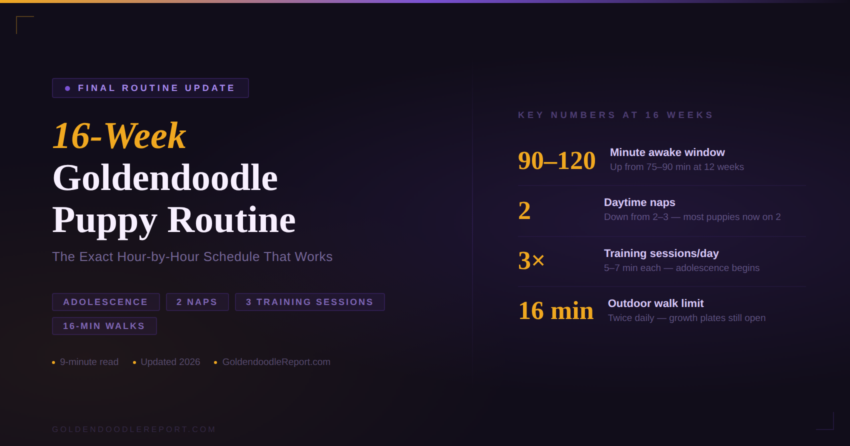
At 16 weeks, awake windows extend to 90–120 minutes, most puppies drop to 2 daytime naps, training sessions can extend to 5–7 minutes, and the daily walk increases to 16 minutes twice per day. Adolescence begins in earnest, producing apparent command regression that is developmental — not a training failure. The socialisation window closes but deliberate positive exposure should continue throughout puppyhood.
✅ Quick Answer
A goldendoodle puppy routine by 16 weeks follows the same feed-toilet-play-train-toilet-nap structure but with longer awake windows of 90–120 minutes, 2 daytime naps rather than 3, daily walks of 16 minutes twice per day, and training sessions of 5–7 minutes. Expect apparent regression in trained behaviours — this is adolescence beginning, not a permanent setback. Consistency during this phase is more important than at any previous stage.
For the complete first-year overview see The Real Goldendoodle Puppy Guide — From Pickup Day to the End of Year One.
🔍 Quick Diagnosis — What Is Your Puppy Telling You?
- Puppy is ignoring commands they knew reliably two weeks ago: Adolescence is beginning — neurological reorganisation temporarily reduces responsiveness. Continue training consistently; this is not permanent regression
- Puppy is fighting the third nap completely: The drop to 2 naps has arrived — extend the first two naps to 2 hours and remove the third. Watch for overtiredness signs to confirm
- Puppy seems more easily distracted outdoors than before: Normal adolescent behaviour — the world is becoming more interesting and competing with your commands. Shorter training sessions in higher-distraction environments build focus gradually
- Biting has reduced but chewing everything in sight continues: Teething is still active at 16 weeks — adult teeth continue pushing through until 6 months. Maintain frozen chew toy rotation
- Puppy is staying awake past 90 minutes without obvious overtiredness: The awake window has extended — the routine needs adjusting rather than forcing a nap at the old timing
📖 Real Scenario
It is week 16. The puppy has been sitting reliably on the first command for three weeks. Today they looked straight at the owner, heard the command clearly, and walked away to sniff the corner. The owner repeats the command. The puppy ignores it again. Frustrated, the owner assumes the training has failed and that they need to start over from scratch. What is actually happening: the adolescent brain is reorganising, impulse control circuits are temporarily less reliable, and the puppy is not being defiant —
they are experiencing a neurological transition that affects every dog regardless of how well they have been trained. The correct response is not to abandon the training or to punish the non-compliance. It is to go back to shorter, higher-reward sessions, reduce distraction, and hold the routine steady for the next 4–6 weeks while the brain catches up.
What Changes at 16 Weeks — and Why the 12-Week Routine No Longer Fits
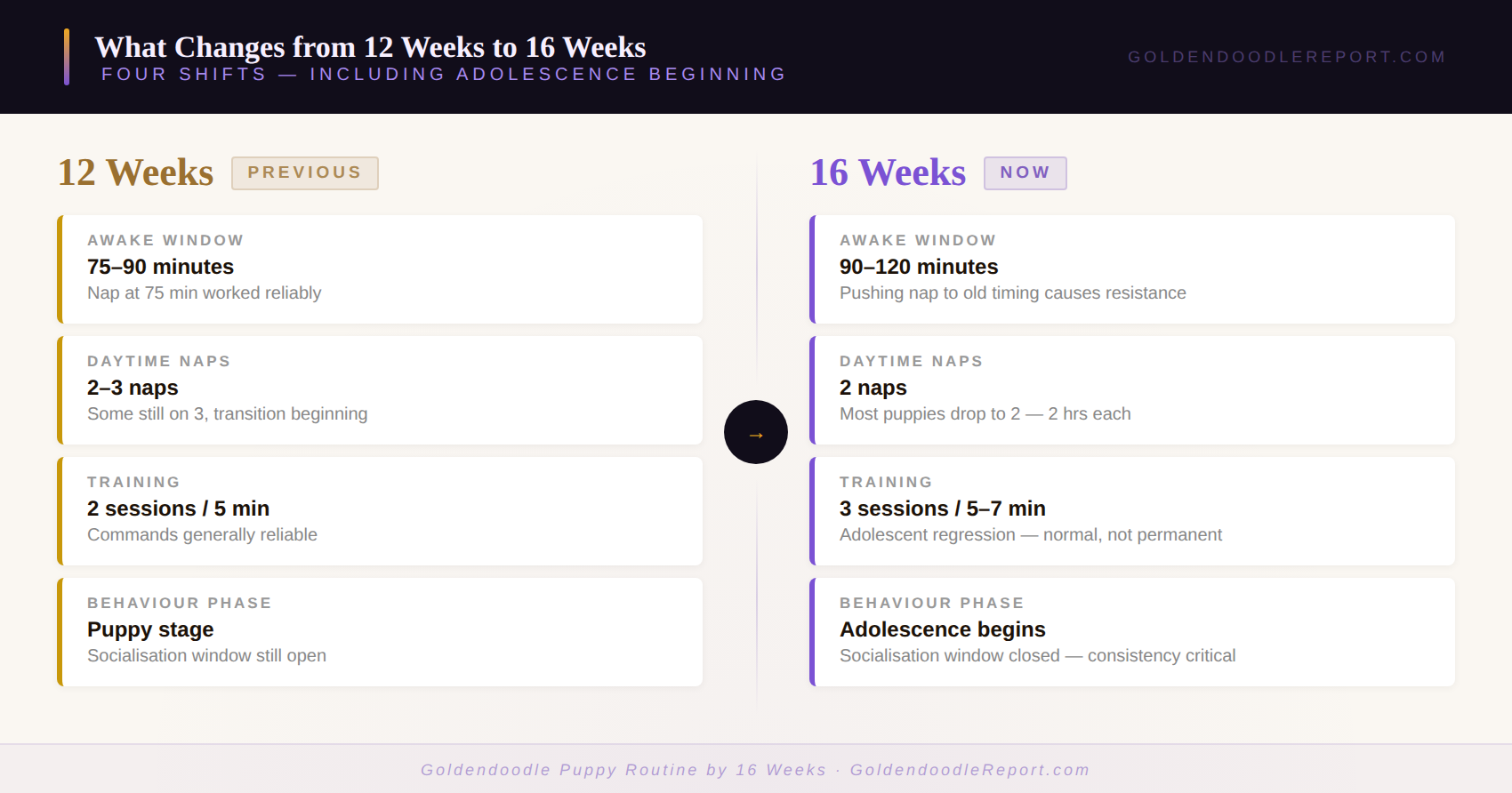
Between 12 and 16 weeks, the daily routine shifts in four ways that all connect to the same underlying cause — the puppy’s brain is entering a new developmental phase.
First, the awake window extends further to 90–120 minutes. The nervous system is maturing and the puppy can sustain alertness for significantly longer before the cortisol threshold is reached. Using 75–90 minute awake windows from the 12-week schedule will produce increasing nap resistance as the puppy is simply not tired at the old timing.
Second, most puppies drop from 3 naps to 2 at this stage. The total daily sleep reduces slightly to 14–16 hours, and 2 longer naps of approximately 2 hours each replace the 3 shorter naps. Some puppies made this transition earlier at 12 weeks — for those still on 3 naps at 16 weeks, this is the point where the drop typically happens.
Third, the outdoor walk extends to 16 minutes twice per day — 2 minutes per month of age at 4 months. Growth plates remain open and the exercise guideline still applies, but the slightly longer walk begins to serve as a meaningful physical and mental outlet for a puppy whose energy and curiosity are both increasing.
Fourth, and most significantly, adolescence begins. The neurological reorganisation that drives adolescent behaviour in dogs typically starts between 14 and 18 weeks and runs through 6–18 months depending on size. Goldendoodles are not immune. At 16 weeks the first signs appear — selective hearing, reduced responsiveness to familiar commands, increased interest in environmental distractions over the owner. This is developmental, not behavioural failure.
The Complete Goldendoodle Puppy Routine by 16 Weeks
The schedule below reflects a puppy who has transitioned to 2 daytime naps. If your puppy is still on 3 naps at 16 weeks, continue the 12-week schedule until the transition happens naturally — do not force it. The intervals between blocks matter more than the clock times.
| Time | Block | Duration | Notes |
|---|---|---|---|
| 6:30 AM | Wake + Toilet | 5 min | Immediate toilet trip — do not delay |
| 6:35 AM | Meal 1 | 10 min | Remove bowl after 10 minutes regardless |
| 6:45 AM | Outdoor Walk 1 | 16 min | Morning walk — prime socialisation and sniff time |
| 7:05 AM | Play + Toilet | 40 min | Calm indoor play. Toilet mid-play. Chew toy available |
| 7:45 AM | Training Session 1 | 5–7 min | Sit, down, wait, leave it. High-reward. End on success |
| 8:00 AM | Toilet + Nap 1 | 2 hrs | Crate nap. Puppy awake ~90 min. Door closed |
| 10:00 AM | Wake + Toilet | 5 min | Immediate toilet trip on waking |
| 10:05 AM | Play + Socialisation | 45 min | New experiences, varied surfaces, calm handling |
| 10:50 AM | Meal 2 | 10 min | Ask for sit before bowl goes down — impulse control practice |
| 11:05 AM | Play + Training Session 2 | 50 min | 5–7 min training mid-session. Toilet mid-play |
| 12:00 PM | Toilet + Nap 2 | 2 hrs | Longest nap. ~115 min awake. Crate door closed |
| 2:00 PM | Wake + Toilet | 5 min | Immediate toilet trip |
| 2:05 PM | Meal 3 | 10 min | Sit before bowl. Final meal of day |
| 2:15 PM | Outdoor Walk 2 + Handling | 16 min | Afternoon walk. Practice loose-lead walking |
| 2:35 PM | Play + Chew Time | 60 min | Independent play. Frozen chew toy. Toilet mid-session |
| 3:40 PM | Short Rest | 45–60 min | Quiet crate rest. Not a full nap. Door closed |
| 4:40 PM | Wake + Toilet | 5 min | Toilet trip |
| 4:45 PM | Training Session 3 | 5–7 min | Third daily session. Vary commands and environment |
| 4:55 PM | Calm Play | 50 min | Wind-down begins. No rough games. Chew toy available |
| 5:50 PM | Toilet + Pre-Evening Rest | 45–60 min | Essential — prevents overtiredness during family time |
| 6:50 PM | Wake + Toilet | 5 min | Toilet trip |
| 6:55 PM | Family Time / Calm Play | 90 min | Low stimulus. Chew toy. Calm interaction. No rough play |
| 8:25 PM | Toilet + Short Rest | 35 min | Crate rest before final session |
| 9:00 PM | Last Play + Toilet | 25 min | Final calm play and last toilet trip before bed |
| 9:30 PM | Bedtime Crate | All night | Many 16-week puppies sleep through. Overnight trip no longer guaranteed |
Colour key: 🟡 Nap/Rest | 🟢 Training | 🔵 Night sleep
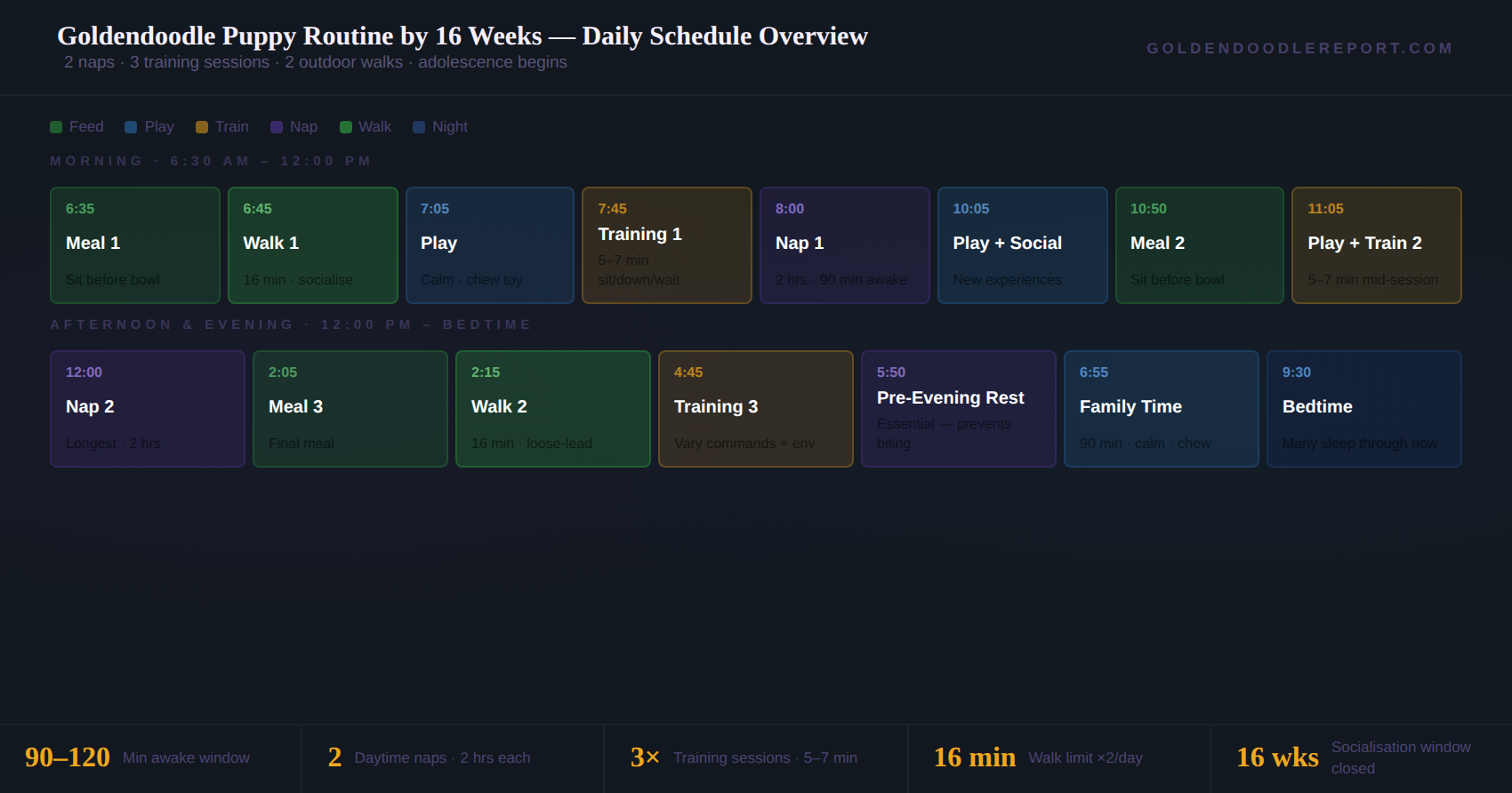
Many 16-week puppies begin sleeping through the night without an overnight toilet trip. If your puppy wakes and signals, respond — but if they sleep through, do not wake them for a trip that is no longer needed.
Feeding at 16 Weeks
Meals remain at 3 per day at 16 weeks. The most effective feeding change at this stage is using mealtimes as built-in training moments — asking for a sit before the bowl goes down takes 3 seconds per meal and reinforces impulse control three times a day without requiring an extra training session. During adolescence, when the puppy’s responsiveness to commands is temporarily reduced, this mealtime routine maintains the training habit even on days when formal sessions produce frustration.
Appetite is typically robust at 16 weeks. If your puppy suddenly reduces food intake without other symptoms, check whether teething discomfort is still affecting them — adult teeth continue pushing through until approximately 6 months. For guidance on nutrition by life stage, see the puppy feeding fundamentals guide at the American Kennel Club.
Sleep and Nap Windows at 16 Weeks
Total daily sleep at 16 weeks is typically 14–16 hours — noticeably less than the 16–20 hours at 8 weeks. The most significant routine change is the drop from 3 naps to 2. Where the 12-week schedule used three naps of 1.5–2 hours each, the 16-week schedule uses two naps of approximately 2 hours each plus a shorter afternoon rest period.
How to know the drop to 2 naps has arrived
Three consistent signals indicate the puppy is ready for the 2-nap transition: the third nap is resisted for 3 or more consecutive days, the puppy compensates by sleeping longer in the first two naps, and the puppy reaches evening without showing the overtiredness signs that previously appeared by 5pm. If only one or two of these apply, maintain 3 naps and reassess in a week.
The pre-evening rest remains essential
Despite the reduced nap count, the pre-evening rest block stays in the schedule at 16 weeks. A puppy who has been active since the afternoon nap will be overtired by 7pm even with a longer awake window. The pre-evening rest is the single most effective prevention for the frantic biting that owners experience during family evening time. For full sleep guidance see Goldendoodle Puppy Sleep Schedule and How Much Sleep Does a Goldendoodle Puppy Need?
Adolescence Begins — What It Means for the Goldendoodle Puppy Routine by 16 Weeks
The adolescent phase in Goldendoodles typically begins between 14 and 18 weeks. At 16 weeks the first signs are usually visible: selective responsiveness to commands, increased interest in environmental distractions, and what looks to owners like deliberate defiance. It is not defiance. It is neurological.
During adolescence the canine brain undergoes significant reorganisation — the prefrontal cortex, which governs impulse control and decision-making, is still developing and temporarily less reliable. The puppy who sat reliably on the first command last week is not ignoring you because they have forgotten or because they are being wilful. They are experiencing the same developmental process that makes adolescence challenging across species.
What this means for the daily routine
The routine structure itself does not change during adolescence — the schedule above holds. What changes is how training sessions are approached within the routine. During adolescent regression, shorter sessions with higher reward rates produce better results than longer sessions with lower rates. If the puppy is ignoring a command they previously knew, reduce distraction, shorten the session to 3 minutes, increase the reward value, and end on a success rather than repeating the failing command until frustration on both sides builds.
Consistency of the routine during adolescence is more important than at any previous stage. A predictable schedule — same wake time, same meal times, same walk times, same training windows — provides the structure the adolescent brain needs even when it is least able to regulate itself. Owners who abandon the routine during the difficult adolescent weeks typically find the phase lasts longer and produces more entrenched problem behaviours than those who hold the structure steady. For full guidance on what to expect see When Do Goldendoodle Puppies Calm Down? and Goldendoodle Puppy Fear Stages.
After the Socialisation Window Closes
The socialisation window closes at approximately 16 weeks. This does not mean socialisation stops — it means the neurological ease with which new positive associations form is significantly reduced from this point. New experiences after 16 weeks can still build confidence, but they require more repetitions and more careful management than the same experiences would have required at 10 weeks.
What the window closing practically means for the daily routine:
Continue deliberate positive exposure on every walk. The outdoor walks are still the most valuable socialisation tool available — traffic, unfamiliar people, different environments, other animals at a safe distance. A puppy who encountered these experiences consistently between 8 and 16 weeks will generalise calmly to new versions of them. One who did not will need significantly more gradual, patient work to build the same associations.
If there are specific experiences your puppy has not yet had positive exposure to — children, cyclists, busy roads, other dogs — introduce them now through careful, controlled, positive-only sessions. The window is not a hard off-switch. Experiences after 16 weeks still matter. They just require more investment. See Goldendoodle Puppy Socialisation Checklist for a full exposure list.
Play and Training at 16 Weeks
Training sessions extend to a maximum of 5–7 minutes at 16 weeks. Three sessions per day is the target — morning, midday, and late afternoon — placed in the middle of each awake window where focus peaks. The schedule above includes all three.
Commands to consolidate at 16 weeks: sit, down, wait, leave it, loose-lead walking, and the beginning of recall in low-distraction environments. Do not move to off-lead recall in public spaces — the adolescent brain makes this unreliable. Build the foundation in the garden and low-distraction areas before adding public-space complexity.
Loose-lead walking practice on the daily walks is the highest-value training activity at this age — it combines physical exercise, mental focus, and impulse control in the real environment where they matter most. See Goldendoodle Exercise Needs by Age and When Can a Goldendoodle Puppy Climb Stairs?
⚠️ Watch Out
Adolescence produces a second fear period in many puppies between 6 and 14 months. At 16 weeks you are approaching the end of the first fear period window — any experiences that produce a genuine fear response now should be handled with the same care as at 8–11 weeks. Back off, allow recovery, re-expose positively at lower intensity. Do not push through fear responses at any age.
What Most Owners Get Wrong at 16 Weeks
Mistake 1 — Interpreting adolescent regression as training failure
A puppy who ignores commands at 16 weeks that they reliably performed at 12 weeks is not regressing or defying. They are entering adolescence. The correct response is not to restart training from scratch, punish non-compliance, or abandon the training programme. It is to reduce session length, increase reward density, reduce distraction level, and hold the routine steady for the 4–6 weeks it takes for the adolescent brain to stabilise. Owners who understand this navigate the phase significantly more calmly than those who do not.
Mistake 2 — Removing the routine because the puppy seems more mature
A 16-week puppy looks and behaves more like a dog than at 8 weeks. This creates the impression that the structured routine is no longer needed. It is more needed now than ever. The adolescent brain regulates itself poorly without external structure — the predictable schedule is not a constraint on the puppy’s development, it is the scaffolding that supports it. Owners who relax the routine during adolescence typically find the phase lasts longer and produces more entrenched habits.
Mistake 3 — Assuming the socialisation window closing means socialisation is done
The window closing means positive association formation is harder, not that it stops. Every walk from 16 weeks onward is still a socialisation opportunity. A puppy who emerges from the critical window with good foundational exposure generalises calmly to new experiences. One who did not needs patient, gradual work — which starts now, not later.
Mistake 4 — Increasing exercise to manage adolescent energy
Growth plates remain open at 16 weeks. The exercise guideline of 16 minutes twice per day still applies. Adolescent energy is not a signal that the puppy needs more physical exercise — it is a signal that they need more mental stimulation, consistent training, and routine structure. A 16-minute walk with active training practice and deliberate socialisation exposure serves the adolescent puppy far better than a 45-minute off-lead run that strains developing joints.
Why the Goldendoodle Puppy Routine by 16 Weeks Works — The Developmental Reasoning
💡 Information Gain — Why This Timing Works at 16 Weeks
Every interval in the goldendoodle puppy routine by 16 weeks is placed where it is for a specific developmental reason.
- Three training sessions per day: Adolescent brains benefit from shorter, more frequent training exposure rather than fewer longer sessions. Three 5–7 minute sessions produce more reliable retention than one 15-minute session and are less likely to end in frustration
- Morning walk placed first in the day: Post-meal exercise on an active stomach carries risk in some puppies. The 10-minute post-meal buffer before the afternoon walk reduces this. The morning walk is placed before the first training session so the puppy’s arousal level from outdoor stimulation settles before focused learning begins
- Mealtime sit request: Asking for a sit before every meal builds impulse control daily without additional training time. During adolescent regression, this mealtime ritual often remains more reliable than formal training sessions because the motivation (food) is higher and the context is consistent
- Pre-evening rest retained despite 2-nap schedule: Moving to 2 naps does not mean the puppy needs less total rest — it means the rest is distributed differently. Without the pre-evening rest, an adolescent puppy awake since 2pm will be significantly overtired by 7pm, producing the frantic biting and inability to settle that makes family evening time unpleasant
- Overnight trip no longer set as alarm: Many 16-week puppies sleep through. Setting an alarm that wakes a puppy who was sleeping through trains a new waking pattern. Allow the puppy to signal if they need to go — and if they do not signal, let them sleep
Your Action Plan — Implementing the Goldendoodle Puppy Routine by 16 Weeks
- Adjust awake windows immediately: Push each nap attempt 15–20 minutes later than the 12-week timing. Watch for the puppy staying awake past 90 minutes without overtiredness signs — this confirms the window has extended.
- Test the 2-nap transition: If the third nap is being resisted consistently, remove it for 3 days and observe. If the puppy compensates with longer first and second naps and reaches evening without excessive overtiredness — the transition has happened. If overtiredness signs return, restore the third nap for another week.
- Add the third training session: The schedule now has 3 daily training sessions. Use different commands in each to build breadth. If adolescent regression is affecting responsiveness, reduce session length to 3 minutes and increase reward frequency rather than abandoning the sessions entirely.
- Introduce mealtime impulse control: From today, ask for a sit before placing every food bowl. Do not feed until the puppy sits. This takes 5–10 seconds per meal and builds one of the most valuable habits of the adolescent phase.
- Reassess the overnight alarm: If your puppy has been sleeping through for 3 or more consecutive nights, stop setting the alarm. Let them signal if needed. If they wake and cannot settle within a few minutes, take them out — but do not assume the trip is still needed.
- Hold the routine during adolescent regression: When the puppy ignores commands, the correct response is consistency — not abandonment of the structure. Mark the 4–6 week adolescent window on the calendar. Maintain the schedule through it. The puppy who emerges from adolescence with a steady routine behind them is significantly easier to live with than one whose routine collapsed during the phase.
⏱ What to Expect Over the Next 4–6 Weeks
- Weeks 16–18: Adolescent regression peaks — selective hearing, distraction-driven behaviour, apparent command forgetting. Hold the routine. Do not increase punishment or decrease training frequency
- Weeks 18–20: Most puppies begin showing improved responsiveness as the first adolescent wave settles. Training reliability returns gradually — reinforce every success heavily during this recovery window
- Months 4–6: Teething completes, the routine stabilises significantly, and the first extended calm periods begin appearing. The 16-week schedule needs only minor adjustments until the next major shift at 6 months
- Friction point: Adolescent regression is the most common reason owners believe their dog is “untrainable” or “stubborn.” Understanding it is developmental — not permanent, not a reflection of training quality — is the single most important mindset shift of the 16-week period
✅ Your Next Step
Now that you have the complete goldendoodle puppy routine by 16 weeks, the most important companion guide is When Do Goldendoodle Puppies Calm Down? — it explains the full adolescent timeline so you know exactly what to expect over the coming months. The 16-week routine is the last major schedule update of the early puppy phase. From here the schedule evolves gradually rather than shifting sharply every two weeks.
✅ Signs the 16-Week Routine Is Working
- Puppy settles into the 2-nap structure within 3–5 days of the transition — longer naps compensate naturally for the removed third nap
- Mealtime sit request is reliable even when formal training sessions are producing adolescent resistance — the mealtime habit holds because motivation is consistent
- Evening family time is noticeably calmer when the pre-evening rest is maintained — the quality of the 90-minute family window is directly tied to whether the rest happened
- Adolescent regression is accepted as developmental rather than personal — owner frustration is lower and sessions end more positively
- Overnight sleeping through begins appearing consistently — the puppy is maturing and the routine has built the foundation for reliable night sleep
🩺 When to Contact Your Vet
- Retained baby teeth — adult teeth fully through alongside baby teeth that have not fallen out by 5–6 months
- Limping or reluctance to walk after exercise — stop walks and contact your vet before resuming
- Complete appetite loss for more than 48 hours not explained by teething
- Aggression — genuine aggression at 16 weeks is rare but requires professional assessment, not continued home training
- Any signs of pain, distress, or significant behaviour change not consistent with normal adolescent development
See Goldendoodle Puppy First Vet Visit for what to cover at your 4-month check-up.
🔑 Key Takeaways
- The goldendoodle puppy routine by 16 weeks uses awake windows of 90–120 minutes, 2 daytime naps, and 3 training sessions per day — the biggest structural change from 12 weeks is the nap reduction and the third training session
- Adolescence begins at approximately 16 weeks — apparent command regression is neurological and developmental, not a training failure. Consistency during this phase matters more than at any previous stage
- The socialisation window closes at 16 weeks but deliberate positive exposure continues — every walk remains a socialisation opportunity, with more repetitions needed to build associations than before the window closed
- Mealtime impulse control — asking for a sit before every bowl — is the highest-value daily training habit during adolescence because motivation is consistent even when formal session responsiveness is reduced
- The pre-evening rest remains non-negotiable despite the 2-nap schedule — without it, adolescent overtiredness produces the frantic biting and inability to settle that makes evening family time unpleasant
📚 Continue Learning
- 👉 Goldendoodle Puppy Routine by 12 Weeks
- Goldendoodle Puppy Routine by 10 Weeks — the full routine series from the start
- When Do Goldendoodle Puppies Calm Down? — the full adolescent timeline explained
- Goldendoodle Puppy Biting Phase Guide — managing biting through adolescence
- Goldendoodle Puppy Fear Stages — the second fear period explained
- Goldendoodle Puppy Growth Stages — physical development through adolescence
↑ Back to: The Real Goldendoodle Puppy Guide — From Pickup Day to the End of Year One | Goldendoodle Puppy Guide — All Articles
Frequently Asked Questions
What should a goldendoodle puppy routine by 16 weeks look like?
A goldendoodle puppy routine by 16 weeks uses awake windows of 90–120 minutes, 2 daytime naps of approximately 2 hours each, 3 training sessions of 5–7 minutes placed mid-awake-window, and outdoor walks of 16 minutes twice per day. The pre-evening rest remains in the schedule. Mealtime sit requests build impulse control three times daily. Expect adolescent regression in trained behaviours — this is normal and temporary.
How many naps does a 16-week Goldendoodle need?
Most 16-week Goldendoodles transition to 2 daytime naps of approximately 2 hours each. The signal for the transition is the third nap being consistently resisted for 3 or more days while the first two naps lengthen to compensate. If the puppy is still showing overtiredness signs — hard biting, inability to settle — at the end of awake windows, maintain 3 naps until the signals change.
Why is my 16-week Goldendoodle ignoring commands they used to know?
Adolescence typically begins between 14 and 18 weeks. The developing brain undergoes neurological reorganisation during this phase, temporarily reducing the reliability of impulse control and command responsiveness. This is developmental, not a training failure. The correct response is shorter sessions with higher reward rates and consistent routine maintenance — not punishment, not abandoning training, and not restarting from scratch. Reliability returns within 4–6 weeks as the first adolescent wave passes.
Is the socialisation window really closed at 16 weeks?
The critical socialisation window — during which positive associations form most easily — closes at approximately 16 weeks. Socialisation does not stop. Every walk from 16 weeks onward remains a valuable exposure opportunity. New experiences after the window require more repetitions and more careful management than before, but they still build confidence. A puppy who received good socialisation between 8 and 16 weeks will generalise calmly to new experiences throughout their life.
Can I increase my 16-week Goldendoodle’s exercise now?
Not yet. Growth plates remain open at 16 weeks and the exercise guideline of 16 minutes twice per day still applies. Adolescent energy is best managed through mental stimulation — training sessions, sniff games, puzzle feeders — rather than extended physical exercise. The walk guideline increases by 2 minutes per additional month of age. At 5 months (20 weeks) the limit increases to 20 minutes twice per day.
When will my Goldendoodle puppy calm down?
Mini Goldendoodles often show the first significant calming around 10–12 months. Standard Goldendoodles typically do not settle fully until 15–18 months, with some continuing into 24 months. The adolescent phase — characterised by selective hearing, high energy, and regression in trained behaviours — commonly runs from 16 weeks to 12–18 months. It is not permanent. See When Do Goldendoodle Puppies Calm Down? for the full timeline.
Disclaimer: The information in this article is provided for general educational purposes only. King James Adjei is a researcher and enthusiast, not a veterinarian or certified behaviourist. For health concerns, symptoms, or behaviour issues that may indicate a medical or welfare problem, always consult a qualified veterinarian or certified professional.