Affiliate Disclosure: Some links in this guide are affiliate links. If you purchase through them, we may earn a small commission at no extra cost to you. Read our full affiliate disclaimer here.
By King James Adjei — Researcher and Goldendoodle enthusiast, founder of GoldendoodleReport.com. Every guide on this site is carefully researched and written to give owners reliable, clearly organised information — updated regularly and honest about uncertainty. → About this site
📖 8-minute read | Last updated April 2026 | Reviewed for accuracy
Understanding goldendoodle coat types is not just an academic exercise — it determines every practical grooming decision you make. How often to brush, how often to bathe, how often to book professional grooming, which haircut styles work best, what tools to buy, and how much to budget annually all depend on which of the three primary coat types your dog has. This guide identifies each coat type clearly, explains how to tell which one your dog has, covers the genetics that determine it, and explains what each type means for your specific grooming routine.
👤 Who This Guide Is For
- You are not sure which coat type your Goldendoodle has and want to identify it correctly
- Your puppy’s coat has changed significantly at 12–18 weeks and you want to understand why
- You want to understand how coat type affects your grooming routine and what changes are needed
- You are choosing between Goldendoodle generations and want to understand how generation affects coat type likelihood
⚡ Quick Summary
Goldendoodle coat types fall into three categories: straight, wavy, and curly. Wavy is the most common. Curly is the highest maintenance. Straight is the lowest maintenance and the least common in intentional Goldendoodle breeding. Coat type is determined by genetics — specifically the MC5R and KRT71 genes inherited from the Poodle and Golden Retriever parents. The puppy coat is not the adult coat — the transition at 12–18 weeks is the highest mat-risk period of a Goldendoodle’s life and the point at which the true adult coat type becomes clear.
✅ Quick Answer — Goldendoodle Coat Type Identification
- Straight coat: Flat, smooth, lies close to the body — sheds more than other types
- Wavy coat: Loose S-shaped waves, fluffy appearance — the classic Goldendoodle look
- Curly coat: Tight curls similar to a Poodle — low shedding, highest mat risk
- Not sure? Look at the muzzle — the curlier the fur around the muzzle, the curlier the adult coat will be
For the complete grooming overview see Goldendoodle Grooming Guide. For how coat type affects grooming frequency specifically see How Often to Groom a Goldendoodle.
The Three Goldendoodle Coat Types Explained
Straight coat
The straight coat lies flat against the body with no wave or curl pattern. It is the coat type that most closely resembles the Golden Retriever parent and the least common type in intentional Goldendoodle breeding — where the goal is typically a low-shedding, wavy or curly coat.
Appearance: Flat, smooth, and close-lying. The coat may have a slight wave near the tail or behind the ears but is predominantly straight across the body. Less fluffy than wavy or curly types.
Shedding: The highest-shedding Goldendoodle coat type. Significantly more shedding than wavy or curly coats because the straight coat does not trap loose hair the way the other types do.
Mat risk: Lowest mat risk of the three types. The straight coat releases loose hair rather than accumulating it, which means the conditions for mat formation are less severe.
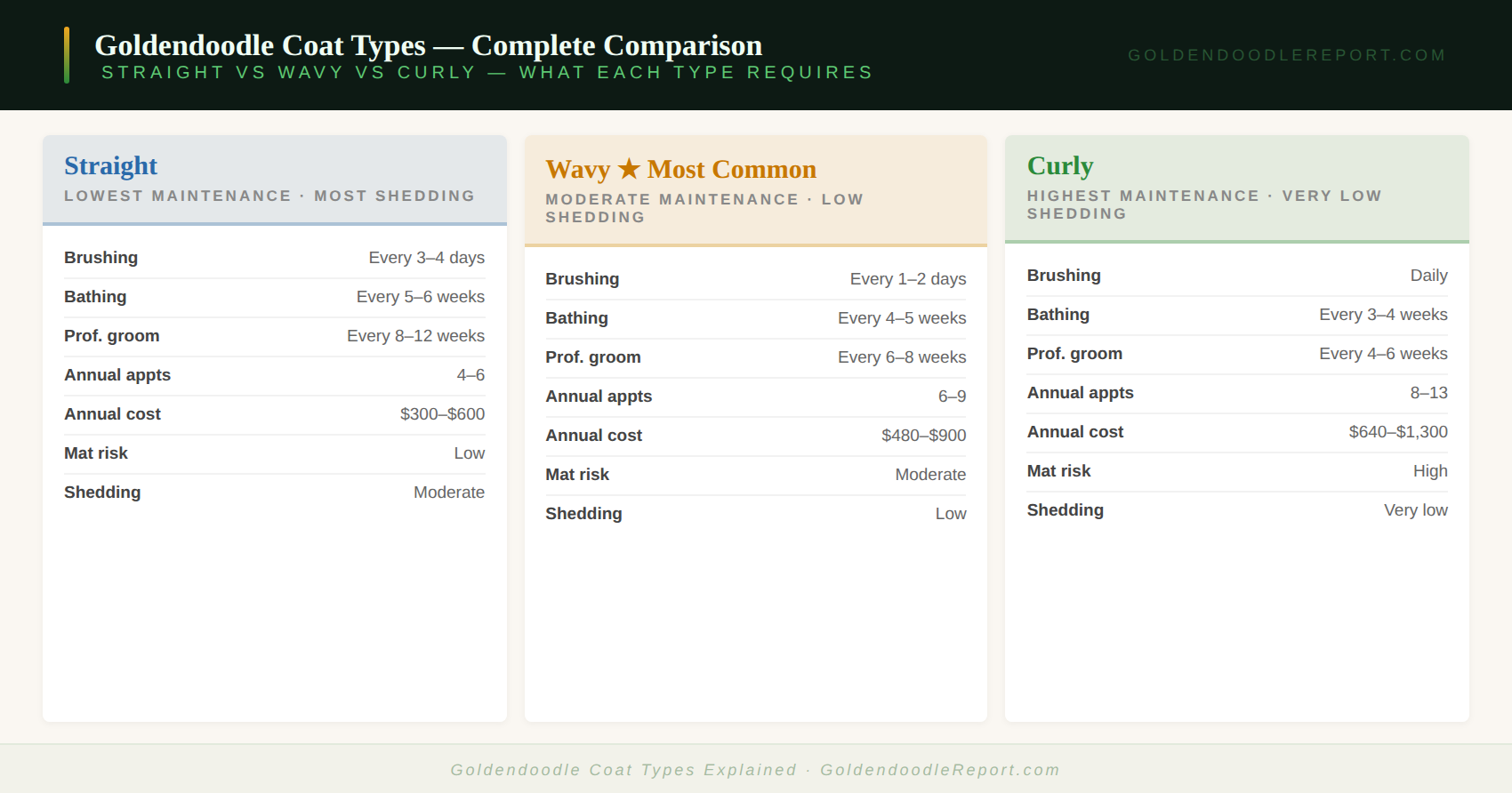
Maintenance: Brushing every 3–4 days. Professional grooming every 8–12 weeks. The most forgiving coat type for owners with less time for daily grooming.
Wavy coat
The wavy coat is the most common Goldendoodle coat type. It falls between straight and curly — loose, flowing S-shaped waves that give the breed its characteristic soft, fluffy appearance. This is the coat type that most people picture when they think of a Goldendoodle.
Appearance: Loose S-shaped waves across the body. The coat is fuller and fluffier than straight but less tightly curled than a Poodle-type coat. The waves may be more pronounced in some areas — around the head, on the legs, and on the tail.
Shedding: Moderate shedding. The wave pattern traps some loose hair — significantly less shedding than straight coats but more than curly coats. Often described as low-shedding, which is accurate compared to most breeds but not compared to curly-coated Goldendoodles.
Mat risk: Moderate. The wave pattern creates more mat risk than straight coats — particularly at the high-friction areas: behind the ears, under the front legs, around the collar. Daily or every-other-day brushing keeps the wavy coat well-managed.
Maintenance: Brushing every 1–2 days. Professional grooming every 6–8 weeks. The most popular coat type for owners who want the Goldendoodle aesthetic with manageable maintenance requirements.
Curly coat
The curly coat is the highest-maintenance Goldendoodle coat type and the one most associated with the low-shedding properties that make the breed popular among owners with allergy concerns. The tight curl pattern — inherited predominantly from the Poodle parent — traps loose hair rather than releasing it, which produces the low-shed quality but creates the most significant mat risk.
Appearance: Tight, springy curls across the entire body, similar to a Poodle coat. The curl diameter varies — some curly Goldendoodles have loose ringlets, others have very tight, dense curls. The coat appears fuller and denser than wavy types.
Shedding: Lowest shedding of the three types. The tight curls trap loose hair so effectively that very little ends up on furniture or clothing — the reason many owners specifically seek this coat type. The trade-off is that the trapped loose hair accumulates in the coat and must be brushed out regularly or it becomes the mat formation material.
Mat risk: Highest mat risk. A curly coat left without brushing for two to three days will develop tangles at the high-risk areas. Left for a week, those tangles become mats. Left for longer, those mats compress to skin level and require professional dematting or shaving.
Maintenance: Daily brushing — non-negotiable. Professional grooming every 4–6 weeks. The highest maintenance of the three types, requiring the most consistent daily care and the most frequent professional appointments.
How to Identify Your Goldendoodle’s Coat Type
Identifying a Goldendoodle’s adult coat type from a puppy is an inexact science — the puppy coat is not the adult coat, and it changes significantly during the transition at 12–18 weeks. However, several indicators give a reliable guide to the likely adult coat type before the transition completes.
The muzzle method — most reliable indicator
Look at the fur around the muzzle and face. The curliness of the muzzle fur is the most reliable predictor of adult coat type available before the transition completes. A puppy with a straight, flat muzzle coat will almost certainly develop a straight adult coat. A puppy with wavy or curly fur around the muzzle — even if the body coat is relatively straight — will develop a wavy or curly adult coat. This indicator works because the muzzle fur is developmentally ahead of the body coat and shows the curl gene expression earlier.
Body coat texture
Feel the body coat by pushing your fingers against the coat growth direction. A straight coat feels flat and smooth against the fingers. A wavy coat has a slight give and wave texture. A curly coat resists and springs back when pushed against the grain. This test becomes more reliable as the puppy ages and the adult coat develops.
Loose hair presence
The amount of loose hair in the coat and on your clothing after handling the puppy gives a rough indication. A puppy leaving significant loose hair on your clothing is likely developing a straight or wavy coat. A puppy leaving almost no loose hair on your clothing is likely developing a curly coat.
The Genetics Behind Goldendoodle Coat Types
Goldendoodle coat type is determined primarily by two genes: the MC5R gene (which controls coat furnishings — the longer facial hair that gives doodles their characteristic look) and the KRT71 gene (which controls curl pattern). The combination of these genes inherited from the Poodle and Golden Retriever parents determines the coat type.
Poodles carry two copies of the curl gene variant. Golden Retrievers carry none. A first-generation Goldendoodle (F1 — 50% Poodle, 50% Golden Retriever) inherits one copy of the curl gene from the Poodle parent, producing the wavy coat that is most common in F1 litters. An F1B Goldendoodle (75% Poodle, 25% Golden Retriever) is more likely to inherit two copies of the curl gene, producing the tighter curly coat that is more common in F1B litters.
This is why coat type varies predictably with generation:
| Generation | Poodle % | Most Likely Coat | Shedding |
|---|---|---|---|
| F1 | 50% | Wavy | Low to moderate |
| F1B | 75% | Wavy to curly | Very low |
| F2 | 50% | Variable — all three types possible | Variable |
| F2B | 62.5% | Wavy to curly | Low |
| Multigen | Variable | Depends on parent testing | Low to very low |
The Puppy Coat Transition — The Most Important Period
The puppy-to-adult coat transition is the most significant coat change a Goldendoodle experiences and the period of highest mat risk in a dog’s life. Understanding it prevents the matting problems that catch many owners off guard.
Most Goldendoodle puppies are born with a soft, relatively flat or lightly wavy puppy coat that feels nothing like the adult coat will. This puppy coat begins to be replaced by the adult coat at approximately 12–18 weeks, with the transition typically completing between 6 and 12 months of age. During the transition, both coats coexist — the soft puppy coat and the incoming adult coat — creating a double-layer that mats faster than either coat type would alone.
⚠️ Why the Coat Transition Is the Highest Mat-Risk Period
- The soft puppy coat and denser adult coat exist simultaneously — creating a double layer that tangles more readily than either alone
- The transition often starts at the same areas that are permanently high-risk — behind the ears and under the legs — making these areas even more prone to matting during this period
- Many owners are caught off guard because the puppy coat was manageable and the sudden increase in mat formation seems unexpected
- Mats that form during the transition and are not addressed quickly can become severe enough to require professional dematting or shaving within weeks
- Daily brushing during the transition period is non-negotiable regardless of coat type
What Your Coat Type Means for Your Grooming Routine
| Grooming Task | Straight | Wavy | Curly |
|---|---|---|---|
| Brushing | Every 3–4 days | Every 1–2 days | Daily |
| Bathing | Every 5–6 weeks | Every 4–5 weeks | Every 3–4 weeks |
| Professional groom | Every 8–12 weeks | Every 6–8 weeks | Every 4–6 weeks |
| Annual appointments | 4–6 | 6–9 | 8–13 |
| Annual grooming cost | $300–$600 | $480–$900 | $640–$1,300 |
| Shedding level | Moderate | Low | Very low |
| Mat risk | Low | Moderate | High |
For authoritative guidance on dog coat genetics and breed characteristics see Goldendoodle Association breed information.
✅ Your Next Step
Identify your Goldendoodle’s coat type using the muzzle method and the texture test. Then check your current brushing and grooming frequency against the table above. If your intervals are longer than recommended for your coat type, that is where most of your grooming problems originate. For the complete grooming guide see Goldendoodle Grooming Guide.
🔑 Key Takeaways
- The three goldendoodle coat types are straight, wavy, and curly — wavy is most common, curly is highest maintenance, straight is lowest maintenance
- The muzzle is the most reliable early indicator of adult coat type — the curlier the muzzle fur, the curlier the adult coat
- Coat type is determined by genetics and correlates predictably with generation — F1B dogs are more likely to have curly coats than F1 dogs
- The puppy coat is not the adult coat — the transition at 12–18 weeks is the highest mat-risk period of a Goldendoodle’s life. Daily brushing during this period is non-negotiable regardless of coat type
- Every grooming decision — brushing frequency, bathing frequency, professional grooming intervals, annual cost — depends on coat type. Knowing your coat type is the foundation of an effective grooming routine
📚 Continue Learning
- Goldendoodle Grooming Guide — the complete grooming authority guide
- How Often to Groom a Goldendoodle — professional grooming frequency by coat type
- Goldendoodle Grooming Schedule — complete task calendar by coat type
- How to Brush a Goldendoodle — the line brushing technique for all coat types
- 👉 Goldendoodle Matting Prevention — coming soon
- 👉 How to Detangle a Goldendoodle Coat — coming soon
- 👉 Best Brush for Goldendoodles — coming soon
- 👉 Goldendoodle Haircut Styles — coming soon
↑ Back to: Goldendoodle Grooming Guide | Goldendoodle Grooming — All Articles
Frequently Asked Questions
What are the different goldendoodle coat types?
There are three primary goldendoodle coat types: straight, wavy, and curly. Straight coats lie flat against the body, shed the most, and require the least maintenance. Wavy coats have loose S-shaped waves and are the most common type — moderate shedding and moderate maintenance. Curly coats have tight Poodle-like curls, shed the least, and require the most maintenance including daily brushing and professional grooming every 4–6 weeks.
How do I know what coat type my Goldendoodle has?
The most reliable indicator in young puppies is the fur around the muzzle — the curlier the muzzle fur, the curlier the adult coat will be. For adult dogs, the coat type is usually obvious: straight coats lie flat and smooth, wavy coats have visible S-shaped waves, curly coats have tight springy curls. If still unsure, ask your groomer — an experienced Goldendoodle groomer can identify coat type accurately on first sight and will tell you what the coat requires.
Why has my Goldendoodle’s coat changed at 3–4 months?
The soft puppy coat begins transitioning to the adult coat at approximately 12–18 weeks. During this transition both coats coexist simultaneously — the outgoing puppy coat and the incoming adult coat — creating a dense double layer that mats more easily than either coat alone. This is completely normal and expected. The transition typically completes between 6 and 12 months of age. Daily brushing during this period is non-negotiable regardless of what coat type the dog had as a puppy, because the transition period carries the highest mat risk of the dog’s life.
Which Goldendoodle coat type is the best for allergy sufferers?
Curly coats shed the least and are the coat type most often recommended for allergy sufferers. The tight curl pattern traps loose hair in the coat rather than releasing it into the environment. However, no dog is truly hypoallergenic — the allergic reaction in most people is triggered by the protein in dog saliva and skin cells (dander), not the hair itself. A curly-coated Goldendoodle produces less airborne hair than a straight-coated one but still produces dander. If allergies are a significant concern, spending time with a specific dog before committing is the most reliable test.
Does Goldendoodle coat type change as they age?
The most significant coat change happens during the puppy-to-adult transition at 12–18 weeks when the soft puppy coat is replaced by the adult coat. After this transition completes — typically by 6–12 months — the adult coat type is generally stable. Minor changes in texture and density can occur with age, particularly in senior dogs whose coats may become softer or thinner. Some owners also notice coat changes following spaying or neutering. If a significant coat change occurs in an adult dog outside of known hormonal changes, it is worth mentioning to a vet as certain medical conditions can affect coat quality.
Disclaimer: The information in this article is provided for general educational purposes only. King James Adjei is a researcher and enthusiast, not a veterinarian or certified groomer. For health concerns or coat-specific questions about your dog’s individual condition, consult a qualified veterinarian or professional groomer.