Affiliate Disclosure: Some links in this guide are affiliate links. If you purchase through them, we may earn a small commission at no extra cost to you. Read our full affiliate disclaimer here.
By King James Adjei — Researcher and Goldendoodle enthusiast, founder of GoldendoodleReport.com. Every guide on this site is carefully researched and written to give owners reliable, clearly organised information — updated regularly and honest about uncertainty. → About this site
📖 8-minute read | Last updated April 2026 | Reviewed for accuracy
Goldendoodle matting prevention is not complicated — but it requires understanding why mats form before the prevention habits make sense. Most owners who struggle with matting are doing some things right and one or two things wrong, and the wrong things are usually the same across every case: brushing the surface of the coat instead of through it, bathing a coat with existing tangles, and leaving the coat damp after bathing or outdoor activity. Fix those three things consistently and matting becomes rare rather than routine. This guide explains the mechanics of how mats form, identifies the specific locations where they form fastest, and gives you the complete prevention protocol that keeps a Goldendoodle coat mat-free between grooming appointments.
👤 Who This Guide Is For
- Your Goldendoodle keeps developing mats despite regular brushing and you want to understand what is going wrong
- You are a new owner and want to set up the right prevention habits before matting becomes a problem
- Your groomer has mentioned matting at recent appointments and you want to address it before it gets worse
- You want to understand why mats form in specific locations and how to target your prevention efforts
⚡ Quick Summary
Goldendoodle matting prevention requires five consistent habits: line brushing from skin to tip (not surface brushing), metal comb checking after every brush session, brushing before bathing never after, drying the coat completely after every bath and outdoor activity, and checking the five high-risk mat areas at every session. No product prevents matting — detangling spray reduces friction and makes brushing more effective, but consistent technique is the only prevention that works.
✅ Quick Answer — The Goldendoodle Matting Prevention Protocol
- Line brush from skin to tip in sections — not surface brushing
- Check with metal comb after every session — if it catches, address it immediately
- Always brush before bathing — never after
- Blow-dry completely after every bath — never air-dry
- Check and dry the coat after rain, swimming, or any wet outdoor activity
- Pay specific attention to the five high-risk areas at every brushing session
- Book professional grooming at the correct interval for the coat type — do not stretch it
For the complete grooming overview see Goldendoodle Grooming Guide. For the correct brushing technique see How to Brush a Goldendoodle.
Goldendoodle Matting Prevention Starts Here — Understanding Why Mats Form
A mat is a tightly compressed tangle of coat fibres that has reached the point where the individual hairs can no longer be separated from each other. Understanding how mats form — the specific mechanical process — makes the prevention habits intuitive rather than arbitrary.
Mat formation begins with loose hair. As a Goldendoodle sheds naturally, loose hair remains in the coat rather than falling away — particularly in wavy and curly coats where the wave and curl pattern traps it. This loose hair accumulates among the live coat fibres. When the accumulated loose hair and live fibres are compressed by movement, moisture, or friction against surfaces, they interlock. Once interlocked, normal coat movement and more friction tightens the interlocked fibres further. Over days or weeks, this compresses into what becomes visible as a mat.
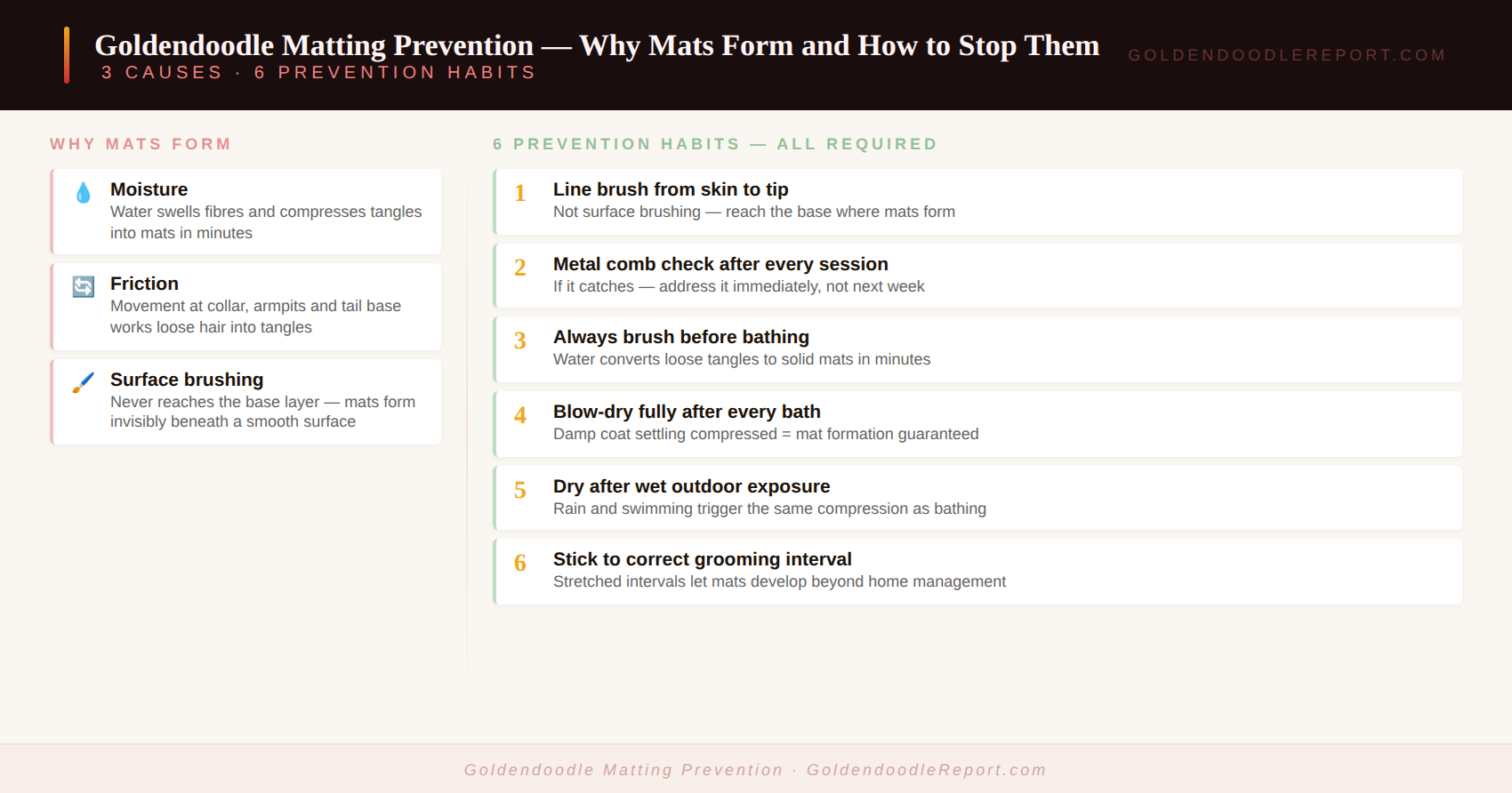
Three conditions accelerate this process dramatically:
Moisture. Water causes coat fibres to swell, which forces them closer together and creates more surface-to-surface contact between fibres. This is why a Goldendoodle who swims or gets rained on and is not dried immediately develops mats significantly faster than one who stays dry. It is also why bathing a coat with existing tangles converts them into mats — the water does the compression work in minutes that would take days of normal wear.
Friction. Areas where the coat is repeatedly rubbed against itself or against a surface — collar contact, leg-to-body contact, skin folds — accumulate tangles faster than static areas because the friction continuously works loose hairs into the live coat fibres.
Incomplete brushing. Surface brushing removes loose hair from the top layer of the coat but leaves the dense base layer untouched. Loose hair accumulating at the base — where the slicker brush never reaches — forms mats invisibly while the coat surface looks smooth and well-maintained.
The Five High-Risk Mat Areas in Goldendoodles
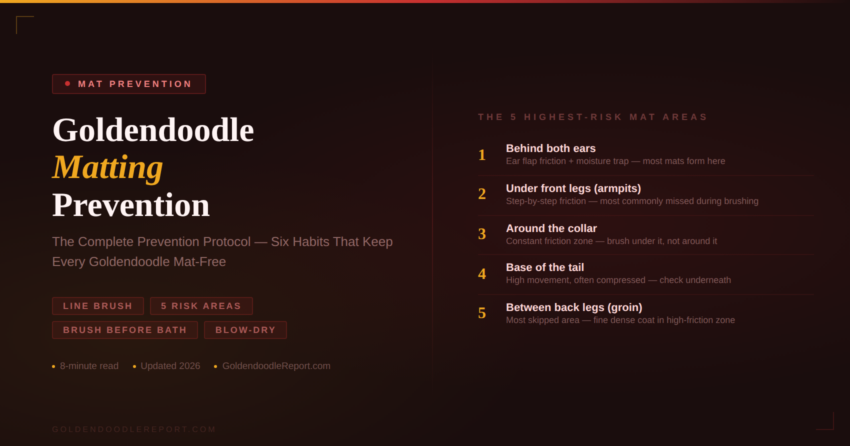
Mat formation is not random. Five specific areas on a Goldendoodle body develop mats faster than anywhere else — because all three acceleration conditions (moisture, friction, incomplete brushing) are present simultaneously in these locations.
1. Behind the ears. The ear flap movement creates constant friction against the coat behind the ear. The floppy ear traps moisture beneath it. The dense, fine coat in this area is difficult to brush thoroughly. The result: the highest-risk mat location on most Goldendoodles. Many owners have never pushed the ear flap aside and examined the coat directly behind the ear — where severe mats can form while the visible ear area looks fine.
2. Under the front legs (armpits). Every step the dog takes creates friction between the front leg and the body at this junction. The coat here is dense and fine. The area is sheltered from airflow and holds moisture longer than exposed areas. And it is the area most commonly missed during brushing — many owners brush the leg and the body but skip the junction between them entirely.
3. Around the collar. The collar creates a zone of constant friction running around the entire neck. Every movement of the dog’s head works the coat under and around the collar. Owners often brush around the collar rather than under it — which means the zone of maximum friction is the zone that receives the least brushing attention.
4. At the base of the tail. The tail base is a high-movement, often-compressed area where the coat sits against the hindquarters constantly. Many owners miss this area or brush it briefly. The mat typically forms underneath the tail base where it is least visible.
5. Between the back legs (groin area). Fine, dense coat in a high-friction, high-moisture area. The groin area is the most commonly skipped area during brushing — it requires the dog to stand cooperatively while the owner works in an awkward position. Neglecting it consistently produces significant matting that is often only discovered at the grooming appointment.
The Complete Goldendoodle Matting Prevention Protocol — All Six Habits
Daily habit 1 — Line brush from skin to tip
Surface brushing — running the slicker brush across the top of the coat — removes visible loose hair but leaves the dense base coat completely untouched. Line brushing — parting the coat to expose the skin and brushing outward from the skin in short sections — reaches the base layer where mat formation begins. After line brushing each section, run the metal comb through from skin to tip. If the comb catches anywhere, there is a tangle developing that needs attention now rather than next week. See How to Brush a Goldendoodle for the complete technique.
Daily habit 2 — Prioritise the five high-risk areas
Every brushing session should give extra attention to the five high-risk areas. Begin the session by checking these areas first — while you are fresh and the dog is cooperative — rather than leaving them for last when both tend to be tiring. Push the ear flaps aside and brush directly behind both ears. Lift each front leg and brush the armpit junction. Remove the collar or brush carefully underneath it. Check under the tail base. Work through the groin area. These five areas done thoroughly prevent the vast majority of matting problems.
Daily habit 3 — Dry the coat after wet exposure
Any time the coat gets wet — rain, swimming, morning dew from grass — check and dry the high-risk areas before the dog settles and the coat compresses while damp. A quick towel-press and targeted blow-dry of the five high-risk areas takes less than ten minutes and prevents the mat formation that happens when damp coat is left compressed for hours. See How to Dry a Goldendoodle Coat for the correct drying technique.
Pre-bath habit — Always brush before bathing
This is the most important single habit in matting prevention. A loose tangle that takes 30 seconds to brush out before a bath becomes a solid mat after the bath — the water compresses the fibres in minutes. Before every bath, complete a full line brush-out and metal comb-check. Only when the comb passes freely through every section of the coat should the bath begin. See How to Bathe a Goldendoodle for the full pre-bath protocol.
Post-bath habit — Blow-dry completely
A Goldendoodle that air-dries after a bath is setting up its next round of mats. The damp coat settles compressed in the high-risk areas and dries in that position. Blow-dry fully after every bath — starting with the high-risk areas — until the hand-press test on the skin reveals no cool damp patches anywhere. See How to Dry a Goldendoodle Coat for the complete drying order and technique.
Scheduling habit — Do not stretch grooming intervals
Professional grooming at the correct interval for the coat type is part of the matting prevention system. A curly coat left for 8 weeks when it needs 5 will arrive at the appointment with mats that could have been prevented. Stick to the correct interval and book the next appointment at checkout rather than reactively when the coat looks like it needs attention. For correct intervals by coat type see How Often to Groom a Goldendoodle.
Goldendoodle Matting Prevention Products — What Helps and What Cannot
Detangling spray reduces friction between coat fibres during brushing, makes brushing more comfortable for the dog, and makes it easier to work through tangles before they develop into mats. Applied lightly to the coat before every brushing session — particularly at the five high-risk areas — it makes the entire brushing process more effective and faster.
What detangling spray cannot do is prevent mat formation on its own. A coat that is surface brushed with excellent detangling spray still develops mats at the base layer. A coat that is left damp after swimming develops mats whether or not it was sprayed with detangler beforehand. The spray is a brushing aid — it improves the effectiveness of correct technique. It does not replace correct technique. See 👉 Best Detangler Spray for Goldendoodles — coming soon for product recommendations.
Conditioner applied after bathing and rinsed out makes the coat softer and more manageable — which reduces friction and makes subsequent brushing more effective. Like detangling spray, it supports the prevention protocol without replacing it. See 👉 Best Conditioner for Goldendoodles — coming soon.
For authoritative guidance on dog coat care see the AKC dog grooming guide.
⚠️ When Prevention Has Not Worked — What to Do Now
If mats have already formed, the response depends on the stage:
- Early-stage tangle (comb catches but moves through): Apply detangling spray directly, work through from tip to skin with the wide-tooth comb in small increments — never pull through from the skin outward
- Developing mat (comb cannot pass but coat is still soft): Apply detangling spray generously, use fingers to gently separate the outer layers of the mat, then work through with the wide-tooth comb from tip to skin. Patience is required — this can take 10–20 minutes per mat
- Established mat (compressed, felt-like at skin level): Do not attempt to brush or comb through. Contact your groomer. Forcing through an established skin-level mat causes pain and skin damage. See 👉 How to Remove Mats Safely — coming soon
✅ Your Next Step
Check the five high-risk areas on your Goldendoodle right now — push the ear flap aside and feel behind both ears, check under both front legs, check around and under the collar, check under the tail base, and check the groin area. If the metal comb catches anywhere, that is an early-stage mat forming. Address it today before it develops further. For the complete grooming guide see Goldendoodle Grooming Guide.
🔑 Key Takeaways
- Mats form because of three conditions: loose hair accumulation, moisture, and friction. Understanding this makes the prevention habits intuitive — each one targets one of these conditions
- The five highest-risk mat areas are: behind the ears, under the front legs, around the collar, at the base of the tail, and between the back legs. These areas receive the most friction and moisture while being the most commonly missed during brushing
- Surface brushing does not prevent matting. Line brushing — from skin to tip in sections — is the only technique that reaches the base layer where mats form
- Bathing a coat with existing tangles converts them into mats — the water does in minutes what days of wear would do slowly. Always brush before bathing
- Damp coat left compressed while the dog rests mats faster than anything else. Dry after every bath and after any wet outdoor exposure
- No product prevents matting on its own — detangling spray and conditioner support correct technique but cannot replace it
📚 Continue Learning
- Goldendoodle Grooming Guide — the complete grooming authority guide
- How to Brush a Goldendoodle — the line brushing technique that prevents mats
- How to Bathe a Goldendoodle — why brushing before bathing is non-negotiable
- How to Dry a Goldendoodle Coat — preventing post-bath mat formation
- How Often to Groom a Goldendoodle — correct intervals that prevent mat build-up
- Goldendoodle Coat Types Explained — how coat type affects mat risk
- 👉 How to Remove Mats Safely — coming soon
- 👉 How to Detangle a Goldendoodle Coat — coming soon
- 👉 Should You Shave a Matted Goldendoodle? — coming soon
- 👉 Best Detangler Spray for Goldendoodles — coming soon
↑ Back to: Goldendoodle Grooming Guide | Goldendoodle Grooming — All Articles
Frequently Asked Questions
What is the most effective goldendoodle matting prevention routine?
Goldendoodle matting prevention requires five consistent habits: line brush from skin to tip at every session (not surface brushing), check with a metal comb after brushing, always brush before bathing, blow-dry completely after every bath, and dry the coat after any wet outdoor exposure. Focus extra attention on the five highest-risk areas at every session — behind the ears, under the front legs, around the collar, at the tail base, and between the back legs. These habits together prevent virtually all mat formation in consistently maintained Goldendoodles.
Why does my Goldendoodle keep getting mats even though I brush regularly?
The most common cause is surface brushing — the slicker brush runs through the top layer of the coat and makes it look smooth without reaching the dense base layer where mats actually form. Switch to line brushing — parting the coat to expose the skin and brushing outward in short sections — and use the metal comb as a quality check after each section. If the comb passes freely through every section from skin to tip, the coat has been properly brushed. If it catches, there is a mat forming that surface brushing is missing entirely.
Where do Goldendoodles mat the most?
Goldendoodles mat most frequently in five specific locations: behind the ears, under the front legs (armpits), around the collar, at the base of the tail, and between the back legs. These areas share three characteristics — they experience the most friction from movement, they trap moisture longer than other areas, and they are the areas most commonly skipped or brushed only superficially during home grooming sessions. Giving these areas deliberate extra attention at every session prevents the vast majority of matting problems.
Does detangling spray prevent matting in Goldendoodles?
Detangling spray reduces friction between coat fibres and makes brushing more effective — it is a valuable aid to the prevention protocol. It cannot prevent matting on its own. A coat that is not line brushed regularly, that is bathed without being brushed first, or that is left damp after outdoor activity will mat regardless of how much detangling spray is applied. Think of it as a tool that makes correct technique more effective — not a substitute for correct technique.
How often should I brush my Goldendoodle to prevent matting?
Curly coats need daily line brushing to prevent matting. Wavy coats need brushing every 1–2 days. Straight coats need brushing every 3–4 days. During the puppy coat transition at 12–18 weeks, daily brushing is required for all coat types regardless — the double layer of puppy and adult coat mats faster than either alone. These frequencies assume thorough line brushing that reaches the skin. Daily surface brushing is significantly less effective than every-other-day line brushing.
Disclaimer: The information in this article is provided for general educational purposes only. King James Adjei is a researcher and enthusiast, not a veterinarian or certified groomer. For health concerns or grooming questions specific to your dog’s condition, consult a qualified veterinarian or professional groomer.