Affiliate Disclosure: Some links in this guide are affiliate links. If you purchase through them, we may earn a small commission at no extra cost to you. Read our full affiliate disclaimer here.
By King James Adjei — Researcher and Goldendoodle enthusiast, founder of GoldendoodleReport.com. Every guide on this site is carefully researched and written to give owners reliable, clearly organised information — updated regularly and honest about uncertainty. → About this site
📖 8-minute read | Last updated April 2026 | Reviewed for accuracy
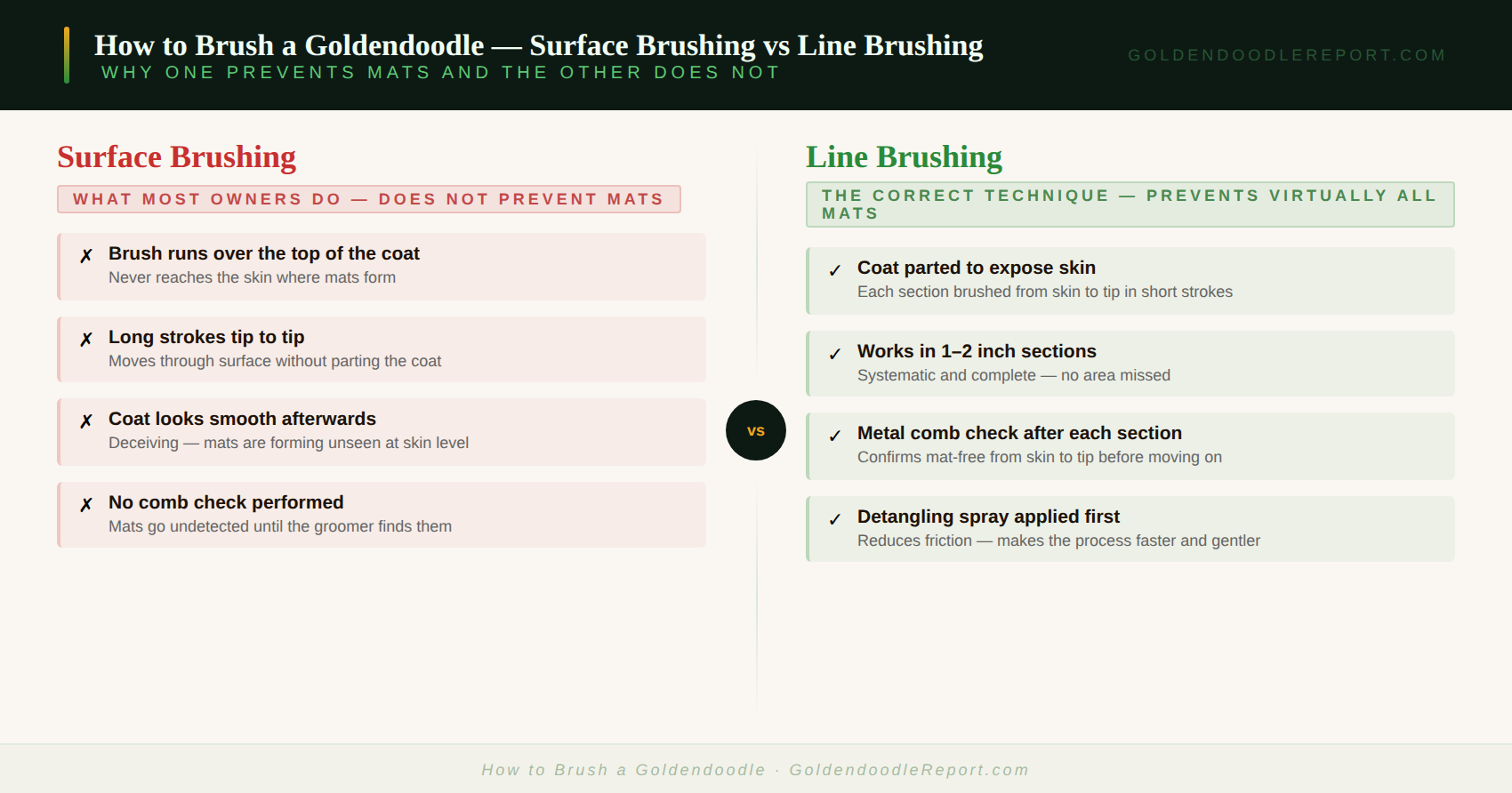
Most Goldendoodle owners want to know how to brush a Goldendoodle without creating mats — and most are surprised to discover the technique they are using is the problem. The reason is almost always the same: they are brushing the surface of the coat rather than brushing through it. Surface brushing removes loose hair from the top layer and makes the coat look smooth — but it leaves the dense undercoat completely untouched, which is exactly where mats form.
Learning how to brush a Goldendoodle correctly means learning line brushing — and knowing how to brush a Goldendoodle — the technique that works from skin to tip in sections, reaching the mat formation zone that surface brushing never touches. This guide covers the correct technique step by step, the tools required, the sections to work through, and what to do when you find a tangle.
👤 Who This Guide Is For
- You brush your Goldendoodle regularly but still find mats at the groomer
- You want to learn the correct brushing technique from scratch before picking up bad habits
- Your current brushing sessions feel like they are not working and you want to understand why
- You want to know exactly which tools are needed and how to use each one correctly
⚡ Quick Summary
How to brush a Goldendoodle correctly: use a slicker brush working in sections from skin to tip — not surface to surface. After brushing each section, run a metal comb through from skin to tip to confirm it is mat-free all the way to the base. Apply detangling spray lightly to the coat before starting. Work systematically through the coat in sections — legs first, then body, then neck, then head. The entire process takes 5–15 minutes depending on coat type and length. Done correctly and consistently, it prevents virtually all mat formation.
✅ Quick Answer — How to Brush a Goldendoodle Step by Step
- Apply detangling spray lightly to the coat
- Part the coat with your free hand to expose the skin
- Brush outward from the skin in short strokes — not top to bottom
- Work in sections — complete each section before moving on
- After each section, run the metal comb through from skin to tip
- If the comb catches — work the tangle with detangling spray before continuing
- Work through legs, body, neck, and head in order
For the complete grooming overview see Goldendoodle Grooming Guide. For brushing frequency by coat type see How Often to Groom a Goldendoodle.
🔍 Quick Diagnosis — Why Your Brushing Is Not Working
- You brush regularly but still get mats: You are surface brushing — the brush is not reaching the skin. Switch to line brushing and use the metal comb as a quality check after each section
- Brushing takes too long and the dog gets impatient: You are working through the whole coat in one pass rather than in sections. Systematic section-by-section brushing is faster and more thorough than random full-coat strokes
- The brush keeps catching and pulling: You are brushing a dry coat without detangling spray, or you are pulling through tangles rather than working them out. Apply spray first, and work tangles from tip to skin — never from skin to tip
- Your dog hates being brushed: The brush is too stiff for the coat, the sessions are too long, or brushing was not introduced positively during puppyhood. Start with shorter sessions and use treats throughout
📖 Real Scenario
An owner brushes their wavy-coated Goldendoodle every day for five minutes. The coat always looks smooth afterwards. At the six-week grooming appointment, the groomer finds significant matting behind both ears and under the front legs. The owner is confused — they brush every day. What went wrong: the daily brushing was surface brushing. The slicker brush ran through the top layer of the coat and the coat looked and felt smooth because the loose surface hair was removed. But the dense layer closest to the skin — where mat-forming tangles develop — was never touched. A five-minute line brushing session three times per week would have prevented every mat that five minutes of daily surface brushing missed.
Tools You Need to Brush a Goldendoodle Correctly
Three tools are required. No others are necessary for standard brushing — additional tools become relevant only when dealing with mats.
Slicker brush
The slicker brush is the primary brushing tool. It has fine, short wire pins set in a flexible rubber base that penetrate the Goldendoodle coat without scratching the skin. The key specification for Goldendoodles is flexible pins — stiff-pin slicker brushes are too harsh for the dense, often curly coat and create the kind of skin-level discomfort that makes dogs resistant to brushing. The pin density should be high enough to catch loose hair efficiently without the brush being so stiff that it drags.
Do not use a bristle brush, a paddle brush, or a pin brush as a primary tool. None of these penetrate a Goldendoodle coat effectively enough to reach the skin. The slicker brush is the right tool for this specific coat type. See 👉 Best Brush for Goldendoodles — coming soon for specific product recommendations.
Metal comb
The metal comb is the quality control tool — not a brushing tool. It is used after the slicker brush to confirm that brushing has reached all the way to the skin. A metal comb with both wide-tooth and fine-tooth sections is ideal — the wide-tooth section for the body coat and the fine-tooth section for the face, ears, and legs where the coat is denser and more prone to matting.
The test is simple: after brushing a section with the slicker brush, run the metal comb through that same section from skin to tip. If the comb passes freely through the entire section without catching anywhere, that section is mat-free. If it catches — even slightly — there is a tangle the brush did not reach. Work it out with detangling spray before moving on. See 👉 Best Comb for Goldendoodles — coming soon.
Detangling spray
Detangling spray reduces friction between coat fibres, making brushing more comfortable for the dog and significantly more effective for the owner. Apply it lightly across the coat before starting each session — a light mist is sufficient, not saturation. Focus on the high-risk areas: behind the ears, under the front legs, around the collar. Do not brush a completely dry coat — the friction causes the brush to drag, pulls at the skin, and converts loose tangles into tighter ones. See 👉 Best Detangler Spray for Goldendoodles — coming soon.
How to Brush a Goldendoodle — The Exact Line Brushing Technique
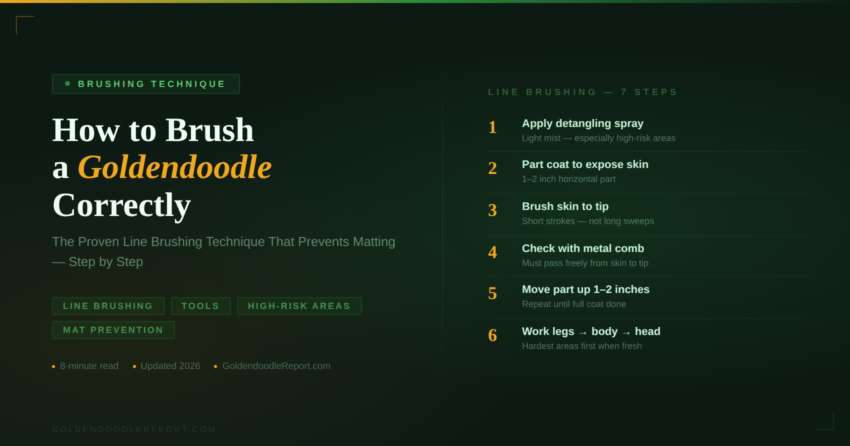
Line brushing is the technique used by professional groomers to work through a Goldendoodle coat systematically and completely. It is called line brushing because you work in lines — parting the coat horizontally and brushing each exposed layer from skin to tip before moving the part upward to expose the next layer.
Step 1 — Apply detangling spray
Mist the coat lightly with detangling spray before starting. You do not need to saturate the coat — a light, even mist across the sections you are about to brush is sufficient. For curly coats, pay particular attention to the four high-risk areas: behind the ears, under the front legs, around the collar, and at the base of the tail. These are where mats form fastest and where the detangling spray is most important.
Step 2 — Choose your starting section
Start with the legs — specifically the rear legs, then front legs. The legs contain the densest coat on most Goldendoodles and the most mat-prone areas. Getting the hardest part done first, when both you and the dog are fresh, produces better results than leaving it until the end of the session when both are tiring.
Step 3 — Part the coat to expose the skin
Use your free hand to part the coat horizontally, pulling the top layer up and out of the way to expose the skin. The part should be roughly 1–2 inches wide. This is the starting line for the brushing stroke — you are going to brush the hair hanging below this part from the skin outward.
Step 4 — Brush from skin to tip
Place the slicker brush at the skin level — actually touching the skin at the base of the hair — and brush outward in short, smooth strokes following the direction of coat growth. The stroke goes from the skin to the tip of the hair, not from tip to skin. The length of each stroke is the length of the hair section being brushed — typically 2–4 inches for a standard length coat.
Do not drag the brush from one end of the body to the other in long sweeping strokes. Long strokes move through the surface of the coat without parting it. Short strokes from skin to tip within a small section are what produce a properly brushed coat.
Step 5 — Check with the metal comb
After brushing each section, run the metal comb through the same section from skin to tip. This is the quality check that confirms the brush reached the skin. If the comb passes freely — move the part upward by 1–2 inches and repeat. If the comb catches — do not force it. Work the caught area with detangling spray and the wide-tooth end of the comb, working from the tip of the tangle toward the skin in small increments. Once the comb passes freely, move on.
Step 6 — Work up the body systematically
After completing the legs, move to the body. Start at the lowest point — the belly — and work upward toward the back, moving the part up 1–2 inches at a time. Then move to the neck and chest. Then the head and face, which requires a lighter touch and the fine-tooth end of the comb. The tail is done last — hold it at the base rather than pulling, and brush from the base outward.
Step 7 — Final full-coat comb-through
Once every section has been brushed and individually comb-checked, do a final full-coat run with the metal comb from skin to tip across the entire coat. This final pass catches anything missed during the section-by-section work and confirms the coat is completely mat-free before you finish.
How to Brush a Goldendoodle — High-Risk Areas That Need Extra Attention
Five areas on a Goldendoodle develop mats faster than the rest of the coat and require extra attention at every brushing session regardless of how well the rest of the coat is maintained.
Behind the ears. The combination of ear flap movement, moisture, and dense coat behind the ear creates the conditions for rapid mat formation. Check this area first at every session and spend extra time here. Many groomers find the worst mats in this area even on dogs whose owners brush consistently.
Under the front legs (armpits). The friction from the front leg movement against the body continuously works the coat in this area into tangles. It is one of the areas most commonly missed by owners because it requires lifting the leg to access properly.
Around the collar. The constant friction of the collar against the coat creates a mat formation zone that runs around the entire neck. Either remove the collar before brushing or brush carefully around and under the collar area.
At the base of the tail. The area where the tail meets the body — particularly underneath — mats quickly and is easily missed.
Between the back legs (groin area). Dense, fine coat in a high-friction area. Many owners skip this area entirely during brushing because it requires the dog to stand in a specific position. Neglecting it consistently results in significant matting.
⚠️ When You Find a Tangle
Finding a tangle during brushing is normal — it is why you are brushing. The correct response depends on the stage of the tangle:
- Loose tangle (comb catches but moves through with light resistance): Apply detangling spray directly to the area, work the wide-tooth comb through from the tip toward the skin in small increments — never from skin to tip through a tangle. Once the comb moves freely, brush the section and confirm with the comb
- Early mat (comb cannot pass through but coat is still soft and separable with fingers): Apply detangling spray, use fingers to gently separate the mat from the outside in, then work through with the wide-tooth comb from tip to skin. This takes patience but is preferable to pulling through with the brush
- Established mat (compressed, felt-like, sitting at skin level): Do not attempt to brush or comb through it. Contact your groomer. Attempting to force through an established mat causes pain and skin damage. See 👉 How to Remove Mats Safely — coming soon
How to Brush a Goldendoodle — Frequency and Best Timing
Brushing frequency depends on coat type: curly coats need daily brushing, wavy coats every 1–2 days, straight coats every 3–4 days. These frequencies assume thorough line brushing — not surface brushing. A 5-minute line brushing session three times per week is significantly more effective than a 10-minute surface brushing session every day.
The best time to brush is when the dog is calm and settled — not immediately after exercise or play when arousal levels are high. Many owners anchor brushing to an existing calm daily habit: after the evening walk, during a relaxed evening television period, before bed. A predictable time that the dog comes to associate with calm handling produces better cooperation than ad-hoc sessions that feel unpredictable.
Always brush before bathing — never after. A wet coat tightens existing tangles into mats. Brush thoroughly, confirm with the comb, then bathe. See 👉 How to Bathe a Goldendoodle — coming soon for the full bathing protocol.
For authoritative guidance on dog coat care and brushing technique see the AKC dog grooming guide.
✅ Your Next Step
The next time you brush your Goldendoodle, apply the line brushing technique from this guide rather than your current approach. Part the coat, brush from skin to tip in sections, and run the metal comb through each section as you go. If the comb passes freely through every section by the end of the session, the coat is properly brushed for the first time. For the complete grooming guide see Goldendoodle Grooming Guide.
🔑 Key Takeaways
- Surface brushing — running the brush across the top of the coat — does not prevent matting. Line brushing — working from skin to tip in sections — is the technique that reaches the mat formation zone
- The metal comb is the quality control tool, not a brushing tool. Run it through each section after brushing to confirm the coat is mat-free all the way to the skin
- Always apply detangling spray before brushing — never brush a completely dry coat. It reduces friction, makes the process more comfortable, and is significantly more effective
- The five highest-risk mat areas require extra attention at every session: behind the ears, under the front legs, around the collar, at the base of the tail, and between the back legs
- Always brush before bathing, never after — wet hair tightens tangles into mats
- When you find a tangle, work from the tip toward the skin — never force through from the skin outward
📚 Continue Learning
- Goldendoodle Grooming Guide — the complete grooming authority guide
- Goldendoodle Grooming Schedule — how brushing fits into the full grooming calendar
- 👉 How to Line Brush a Goldendoodle — coming soon
- 👉 Goldendoodle Matting Prevention — coming soon
- 👉 How to Remove Mats Safely — coming soon
- 👉 How to Detangle a Goldendoodle Coat — coming soon
- 👉 Best Brush for Goldendoodles — coming soon
- 👉 Best Comb for Goldendoodles — coming soon
- 👉 Best Detangler Spray for Goldendoodles — coming soon
↑ Back to: Goldendoodle Grooming Guide | Goldendoodle Grooming — All Articles
Frequently Asked Questions
How do you brush a Goldendoodle without hurting them?
Use a slicker brush with flexible pins rather than stiff wire, apply detangling spray before every session to reduce friction, and work in small sections from skin to tip rather than long top-to-bottom strokes. When you encounter a tangle, work through it from the tip toward the skin in small increments — never pull through from the skin outward. Keep sessions short enough that the dog stays comfortable — 5–10 minutes for most coat types — and use treats throughout to reinforce the brushing experience positively.
What is the most effective way to brush a Goldendoodle?
The correct technique is line brushing — parting the coat horizontally to expose the skin, then brushing from the skin outward in short strokes following the coat growth direction. Work in sections across the entire coat, checking each section with a metal comb after brushing to confirm it is mat-free to the skin. Apply detangling spray before starting. Work through legs first, then body, neck, and head. Finish with a final full-coat metal comb-through to confirm every section is completely clear.
How often should you brush a Goldendoodle?
Curly coats need daily line brushing. Wavy coats need brushing every 1–2 days. Straight coats need brushing every 3–4 days. These frequencies apply to thorough line brushing — not surface brushing. A properly executed line brushing session three times per week is significantly more effective at preventing mats than daily surface brushing that never reaches the skin.
Why does my Goldendoodle still get mats even though I brush regularly?
The most common cause is surface brushing — the brush runs through the top layer of the coat and makes it look smooth without ever reaching the skin layer where mats form. Switch to the line brushing technique described in this guide and use the metal comb as a quality check after each section. If the comb passes freely through every section from skin to tip by the end of the session, you are brushing correctly. If it catches anywhere, there are mats forming that your current technique is not addressing.
Should I brush my Goldendoodle wet or dry?
Always brush dry, before bathing — never wet or after bathing. Wet hair is more elastic and tangles compress more tightly when wet, converting loose tangles into solid mats. Apply detangling spray to a dry coat before brushing to reduce friction — the coat should be lightly misted, not wet. After bathing, blow-dry the coat with a brush rather than brushing a wet coat, which has the same mat-compressing effect as brushing after a bath.
Disclaimer: The information in this article is provided for general educational purposes only. King James Adjei is a researcher and enthusiast, not a veterinarian or certified groomer. For coat-specific concerns or grooming questions about your dog’s individual condition, consult a qualified professional groomer or veterinarian.