Affiliate Disclosure: Some links in this guide are affiliate links. If you purchase through them, we may earn a small commission at no extra cost to you. Read our full affiliate disclaimer here.
By King James Adjei — Researcher and Goldendoodle enthusiast, founder of GoldendoodleReport.com. Every guide on this site is carefully researched and written to give owners reliable, clearly organised information — updated regularly and honest about uncertainty. → About this site
📖 8-minute read | Last updated April 2026 | Reviewed for accuracy
Most Goldendoodle grooming problems trace back to a small number of consistent mistakes — and most of those mistakes are made by owners who are genuinely trying to do things right. The issues are not laziness or neglect. They are misunderstandings about technique, timing, and what the Goldendoodle coat actually requires. This guide covers the ten most consequential grooming mistakes, explains why each one causes the specific problems it causes, and gives the exact correction so the mistake does not keep producing the same outcome.
👤 Who This Guide Is For
- You groom your Goldendoodle regularly but still get mats, expensive grooming bills, or a dog who resists grooming
- Your groomer keeps finding mats despite your consistent brushing effort
- You want to understand which grooming habits are creating problems before those problems become expensive
- You are a new owner who wants to build the right habits from the start
⚡ Quick Summary
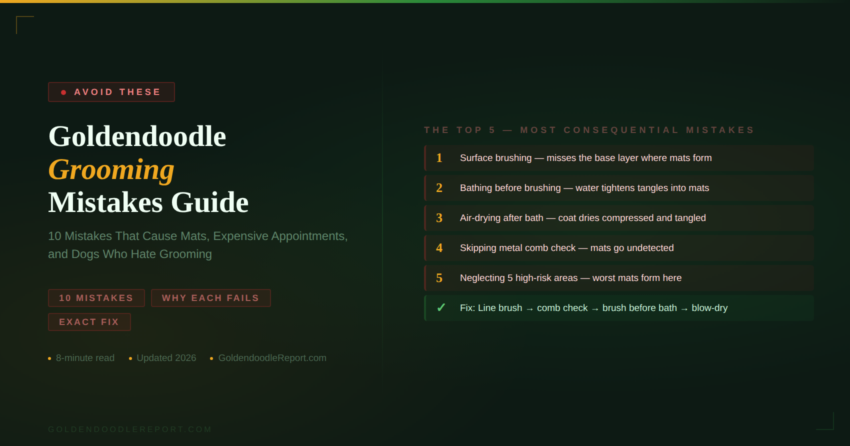
The ten most consequential Goldendoodle grooming mistakes are: surface brushing instead of line brushing, bathing before brushing, not drying the coat after bathing, skipping the metal comb quality check, neglecting the five high-risk mat areas, stretching professional grooming intervals, not drying after outdoor water exposure, using the wrong brush, letting the coat grow too long between appointments, and not introducing grooming positively during puppyhood. Most owners make at least three of these consistently — identifying and correcting the ones that apply to your routine produces an immediate improvement in coat condition and grooming appointment outcomes.
For the complete grooming overview see Goldendoodle Grooming Guide. For the correct brushing technique see How to Line Brush a Goldendoodle.
The Ten Goldendoodle Grooming Mistakes to Avoid
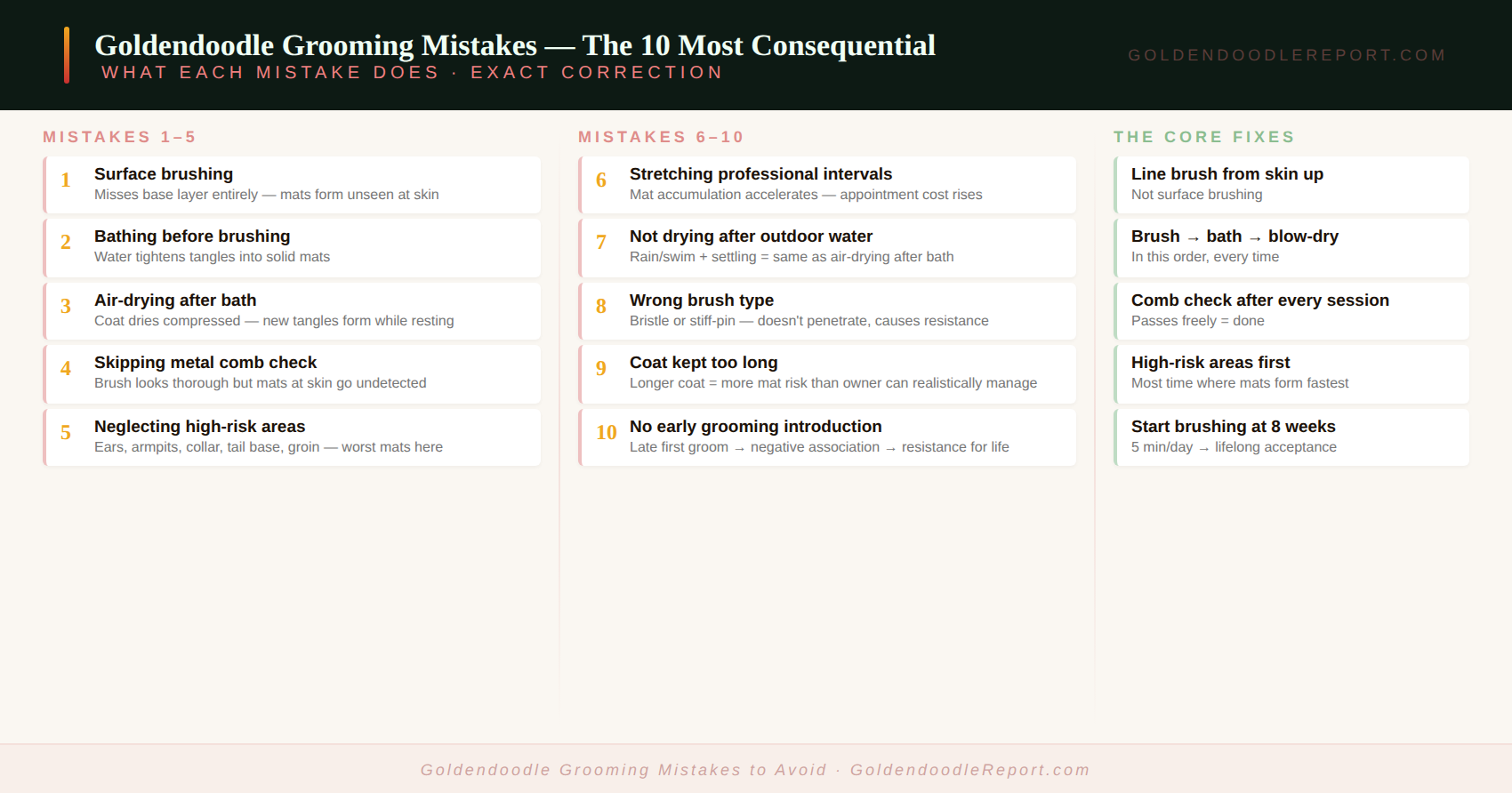
Mistake 1 — Surface brushing instead of line brushing
What it looks like: Running the brush across the top of the coat in long strokes from neck to tail. The coat looks smooth afterward. The dog tolerates it easily.
Why it causes problems: The brush never reaches the skin. Goldendoodle coats can be 3 to 4 inches deep at full length. Surface brushing moves the top 20 to 30% of the coat and leaves the dense base layer — where mats actually form — completely untouched. The smooth surface appearance is misleading. A coat that passes visual inspection after surface brushing can be significantly matted at skin level.
The correction: Line brushing — parting the coat horizontally to expose the skin and brushing outward from the skin in thin sections, working upward through the coat systematically. After every area, run a metal comb from skin to tip to confirm it is mat-free. See How to Line Brush a Goldendoodle.
Mistake 2 — Bathing before brushing
What it looks like: Giving the dog a bath when they are dirty, then brushing the coat once it dries.
Why it causes problems: Water tightens loose tangles into solid mats. A coat that has developing tangles — which most Goldendoodle coats do between brushing sessions — goes into the bath as loose tangles and comes out as compressed mats that may require professional dematting or shaving to remove.
The correction: Always brush thoroughly and confirm with the metal comb before bathing. The coat that enters the bath should be fully tangle-free. After bathing, blow-dry with a brush rather than air-drying. See How to Bathe a Goldendoodle.
Mistake 3 — Leaving the coat damp after bathing
What it looks like: Towel-drying the coat after a bath and allowing it to air-dry the rest of the way, often while the dog lies down or rests.
Why it causes problems: A damp coat dries in whatever compressed position it settles. If the dog lies on their side, the coat on that side dries compressed and tangled. A coat left to air-dry after bathing almost always develops significant new tangles — particularly in the high-risk areas — that were not present before the bath.
The correction: Blow-dry the coat completely after every bath using a dog dryer or a human hair dryer on a low heat setting, with a brush to keep the coat moving and drying in the correct position. Full coat drying takes 15 to 30 minutes depending on coat density. See How to Dry a Goldendoodle Coat.
Mistake 4 — Skipping the metal comb quality check
What it looks like: Brushing the coat with a slicker brush, confirming it looks smooth, and finishing the session.
Why it causes problems: The slicker brush is a brushing tool, not a quality check tool. It removes loose hair and works through accessible tangles, but it does not reliably detect developing mats at skin level. The metal comb does. A comb run from skin to tip that passes freely confirms the coat is mat-free. A comb that catches anywhere reveals what the brush missed.
The correction: Run a metal comb through each section from skin to tip after brushing. If it passes freely — the section is complete. If it catches anywhere — work through that area before finishing. The comb check is the honest test of whether the brushing session was effective. See How to Brush a Goldendoodle.
Mistake 5 — Neglecting the five high-risk mat areas
What it looks like: Brushing the body coat thoroughly but rushing through or skipping the areas that are harder to access.
Why it causes problems: The five highest-risk mat areas — behind the ears, under the front legs, around the collar, at the base of the tail, and between the back legs — mat faster than any other area because of friction, moisture, and compressed coat. These are precisely the areas most owners skip because they require the dog to hold an awkward position or because they feel like secondary areas. They are not secondary. They are where most groomers find the worst mats on otherwise well-maintained dogs.
The correction: Treat these five areas as the priority at every brushing session — not the afterthought. Spend more time on them, not less. See Goldendoodle Matting Prevention for the complete high-risk area protocol.
Mistake 6 — Stretching professional grooming intervals
What it looks like: Extending the time between professional appointments from the recommended 6 to 8 weeks to 10, 12, or more weeks — either to save money or because the coat still looks acceptable.
Why it causes problems: Mat accumulation is not linear — it accelerates as the coat grows longer. A dog whose last appointment was 12 weeks ago does not have 50% more matting than one who went at 8 weeks. They typically have significantly more, because longer coat creates more mat risk and more mat risk compounds. Extended intervals also result in higher grooming costs — dematting fees on top of the standard appointment — which typically exceed the savings from the extended interval.
The correction: Book the next professional appointment before leaving the current one. Treat grooming appointments as fixed maintenance costs rather than optional events. See How Often to Groom a Goldendoodle.
Mistake 7 — Not drying after outdoor water exposure
What it looks like: Letting the dog come in from rain, wet grass, or swimming and settle on their bed or sofa to dry naturally.
Why it causes problems: The same mechanism as air-drying after a bath — the coat dries compressed in whatever position the dog settles. In addition, outdoor water exposure often includes mud and debris that works into the base layer as the coat dries. A dog who swims several times per week and is never dried properly will develop significant matting regardless of how consistently they are brushed, because the wet compression repeatedly creates new tangles faster than brushing can address them.
The correction: Towel-dry the high-risk areas immediately after any outdoor water exposure. For swimming or heavy rain, follow with detangling spray and a brush-through of the highest-risk areas before the dog rests.
Mistake 8 — Using the wrong brush
What it looks like: Using a bristle brush, paddle brush, or stiff-pin slicker brush as the primary brushing tool.
Why it causes problems: Bristle and paddle brushes do not penetrate a Goldendoodle coat deeply enough to be effective — they are surface tools. Stiff-pin slicker brushes cause discomfort at the skin level and make dogs resistant to brushing. Neither type reaches the base layer where mats form.
The correction: Use a slicker brush with flexible pins — the flexible pin design penetrates the coat without scratching the skin, making the process both effective and comfortable. See → Best Brush for Goldendoodles — coming soon.
Mistake 9 — Keeping the coat too long between professional appointments
What it looks like: Choosing the longest possible coat length at grooming appointments because the long coat looks better, then struggling to maintain it between appointments.
Why it causes problems: Coat length and mat risk are directly proportional. A 3-inch coat has significantly more matting potential than a 1.5-inch coat — more coat depth means more base layer density, more moisture retention, and more friction in high-risk areas. Many owners choose long coats for aesthetic reasons and then find the maintenance requirement exceeds what they can realistically sustain.
The correction: Choose the shortest coat length that you find acceptable — not the longest length you theoretically could maintain. A well-maintained shorter coat looks significantly better than a poorly maintained longer coat. Discuss coat length realistically with your groomer based on your actual brushing routine.
Mistake 10 — Not introducing grooming positively during puppyhood
What it looks like: Waiting until the puppy is older and the coat is longer before starting regular brushing and grooming. First professional grooming appointment happens at 4 to 6 months during a full groom.
Why it causes problems: A dog who first experiences grooming as an adult, during a lengthy and potentially uncomfortable appointment, forms a negative association with the process that persists for years. Resistance to brushing, anxiety at the grooming salon, and prolonged appointments because of the dog’s behaviour all trace back to insufficient early positive exposure.
The correction: Begin daily handling of paws, ears, and mouth from 8 weeks. Introduce the brush with treats from the first week. First professional appointment at 12 to 16 weeks — short introduction groom only. The investment of 5 minutes per day during the first 4 months produces a dog who accepts grooming calmly for life. See Goldendoodle Puppy First Grooming Guide.
For authoritative guidance on dog grooming see the AKC dog grooming guide.
✅ Your Next Step
Read through the ten mistakes above and identify which ones apply to your current routine. Most owners recognise at least two or three immediately. Start with whichever is causing the most immediate problem — if your groomer keeps finding mats, start with Mistake 1 and Mistake 4. If bathing produces new tangles, start with Mistake 2 and Mistake 3. Correcting one mistake at a time produces a visible improvement within one grooming cycle. For the complete grooming guide see Goldendoodle Grooming Guide.
🔑 Key Takeaways
- Surface brushing is the most common and most consequential mistake — it misses the base layer where mats form while creating a false impression of a well-brushed coat
- Always brush before bathing, never after — water converts loose tangles into solid mats
- Air-drying after bathing allows the coat to dry in a compressed, tangled position — blow-dry with a brush after every bath
- The metal comb check after every brushing session is the only reliable confirmation that the coat is mat-free — visual inspection is not sufficient
- The five high-risk areas — behind the ears, under the front legs, collar, tail base, between back legs — need more attention than the body coat, not less
- Grooming introduced positively from 8 weeks produces a dog who accepts it calmly for life — late introduction produces resistance that persists for years
📚 Continue Learning
- Goldendoodle Grooming Guide — complete grooming authority guide
- How to Line Brush a Goldendoodle — the correct technique (Mistake 1 fix)
- How to Brush a Goldendoodle — complete brushing guide including comb check
- How to Bathe a Goldendoodle — brush first, bathe second (Mistake 2 fix)
- How to Dry a Goldendoodle Coat — blow-dry protocol (Mistake 3 fix)
- Goldendoodle Matting Prevention — high-risk area protocol (Mistake 5 fix)
- How Often to Groom a Goldendoodle — correct professional intervals (Mistake 6 fix)
- Goldendoodle Grooming Schedule — building all corrections into one consistent routine
- Goldendoodle Puppy First Grooming Guide — early introduction (Mistake 10 fix)
↑ Back to: Goldendoodle Grooming Guide | Goldendoodle Grooming — All Articles
Frequently Asked Questions
What is the most common Goldendoodle grooming mistake?
Surface brushing — running the brush across the top of the coat without reaching the skin — is by far the most common and most consequential mistake. It produces a coat that looks well-maintained but has developing mats at the base layer that only become apparent at the professional grooming appointment. Switching to line brushing and adding a metal comb quality check after each session corrects this mistake completely.
Why does my Goldendoodle get matted even though I brush every day?
Almost certainly because of surface brushing rather than line brushing, or because the five high-risk areas are being skipped or rushed. Daily surface brushing does not prevent matting — daily line brushing with a metal comb quality check does. Check whether the comb passes freely from skin to tip through every section after your next brushing session. If it catches anywhere, you have found what daily brushing has been missing.
Should I brush my Goldendoodle before or after a bath?
Always before — never after. Bathing a coat with existing tangles converts those tangles into solid mats. The coat that enters the bath must be fully tangle-free, confirmed with a metal comb pass. After the bath, blow-dry the coat completely with a brush — do not allow it to air-dry, as the coat will dry in whatever compressed position the dog settles and develop new tangles in the process.
How do I stop my Goldendoodle from hating grooming?
For puppies — start at 8 weeks with short positive sessions, treats, and gentle handling of all body parts including paws, ears, and mouth. Make the first professional appointment a short introduction groom at 12 to 16 weeks, not a full groom. For adult dogs who already resist — shorten sessions significantly, use high-value treats throughout, and stop before the dog becomes anxious rather than pushing through. Consistent positive short sessions over weeks produce more progress than infrequent long uncomfortable ones.
Disclaimer: The information in this article is provided for general educational purposes only. King James Adjei is a researcher and enthusiast, not a veterinarian or certified groomer. For significant coat or matting concerns, consult a qualified professional groomer.