Affiliate Disclosure: Some links in this guide are affiliate links. If you purchase through them, we may earn a small commission at no extra cost to you. Read our full affiliate disclaimer here.
By King James Adjei — Researcher and Goldendoodle enthusiast, founder of GoldendoodleReport.com. Every guide on this site is carefully researched and written to give owners reliable, clearly organised information — updated regularly and honest about uncertainty. → About this site
📖 7-minute read | Last updated April 2026 | Reviewed for accuracy
Goldendoodle coat blowing is one of the least understood and most poorly managed events in the breed’s grooming lifecycle. Many owners experience it without knowing what is happening — the puppy coat suddenly starts shedding in clumps, mats appear overnight despite daily brushing, and the dog’s appearance changes dramatically over a period of weeks. Understanding what coat blowing is, when it happens, and why it creates the highest mat risk of the dog’s entire life gives owners the information they need to manage the transition instead of being overwhelmed by it.
👤 Who This Guide Is For
- Your Goldendoodle puppy is between 6 and 14 months old and you have noticed increased shedding, matting, or coat texture change
- Your groomer has mentioned the puppy coat transition and you want to understand what it involves
- You want to know how to manage the coat during the transition to prevent significant matting
- You want to understand when the transition is complete and what the adult coat will look like
⚡ Quick Summary
Goldendoodle coat blowing — the transition from soft puppy coat to adult coat — typically occurs between 6 and 14 months of age and lasts 8 to 16 weeks. During this period, the loose puppy coat becomes tangled with the incoming adult coat at skin level, creating the worst mat conditions the dog will ever experience. Daily line brushing is non-negotiable during coat blow — not every other day, not when it looks needed — daily. Professional grooming at closer intervals than normal is also required. Owners who do not adjust their grooming routine during coat blow almost universally experience a shave-down.
✅ Quick Answer — Coat Blow Protocol
- Brushing: Daily line brushing without exception — this is the highest mat risk period of the dog’s life
- Metal comb check: After every brushing session — the coat can develop mats between daily sessions during peak transition
- Professional grooming: Every 4 to 6 weeks during transition — shorter interval than the adult coat requires
- Detangling spray: More generous application than normal — the mixed coat texture tangles faster
- Coat length: Ask the groomer to keep the coat shorter during transition — shorter coat = significantly lower mat risk
- Duration: 8 to 16 weeks — daily protocol must be maintained throughout, not relaxed once it seems to improve
For the complete brushing technique see How to Line Brush a Goldendoodle. For mat prevention see Goldendoodle Matting Prevention. For the complete grooming overview see Goldendoodle Grooming Guide.
What Is Goldendoodle Coat Blowing?
Coat blowing is the term for the transition period during which a Goldendoodle sheds its soft, fine puppy coat and grows in its adult coat. Every Goldendoodle goes through this transition — it is a normal biological process, not a health problem. However, the specific characteristics of the Goldendoodle coat make this transition significantly more difficult to manage than in most other breeds.
The reason is the simultaneous presence of two coat types. During the transition, the puppy coat does not shed cleanly and completely before the adult coat grows in — the two coats coexist for weeks. The fine, soft puppy coat loosens from the follicle but remains tangled in the incoming adult coat rather than shedding out. This loose dead coat sitting within the growing adult coat creates the worst mat formation conditions of the dog’s life — more mat risk than any other single event or period in the dog’s adult grooming cycle.
The transition is complete when the puppy coat has fully shed and only adult coat remains. This is confirmed by a change in coat texture — the adult coat is typically denser, coarser, and in curly-coated dogs, curlier than the puppy coat. The adult coat is also the coat that determines the long-term maintenance requirements the owner will manage for the rest of the dog’s life.
When Coat Blowing Happens — Timeline
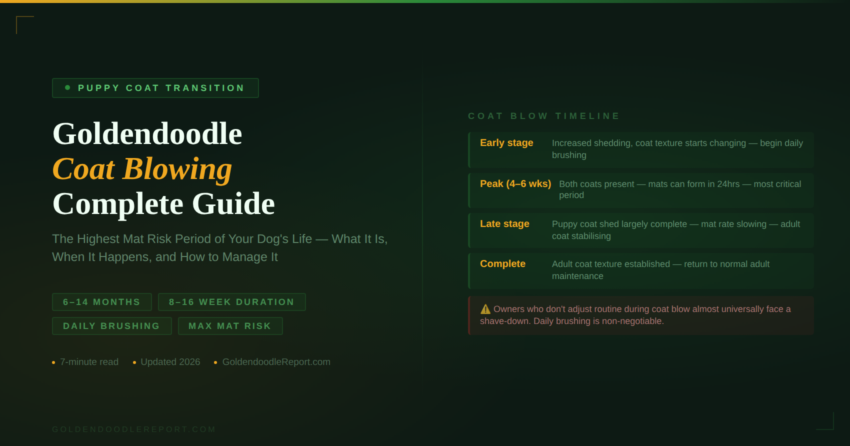
The transition typically begins between 6 and 10 months of age in most Goldendoodles. Some begin as early as 5 months; a small number do not begin until 12 to 14 months. The transition itself lasts 8 to 16 weeks — with the most intensive mat-formation period occurring in the middle 4 to 6 weeks when both coats are most densely present simultaneously.
The early signs: increased shedding — loose puppy coat visible on furniture, clothing, and in the brush during grooming. The coat texture begins to change — some areas may feel slightly rougher or denser than others. Mats begin forming faster than the previous brushing routine can address.
The peak period: loose puppy coat is fully embedded in the growing adult coat. Mat formation is at its fastest. Daily brushing sessions that previously took 10 to 15 minutes now take 20 to 30 minutes to complete properly. The metal comb catches in every session regardless of how thorough the previous day’s brushing was.
The late stage: the puppy coat shed is largely complete. Mat formation begins to slow. The coat texture stabilises into the adult coat pattern. Brushing returns to normal duration. This is the point at which the adult coat’s long-term maintenance requirements become clear.
Why Coat Blow Creates Maximum Mat Risk
Understanding the mechanics of why coat blow creates maximum mat risk explains why the daily protocol cannot be negotiated during this period.
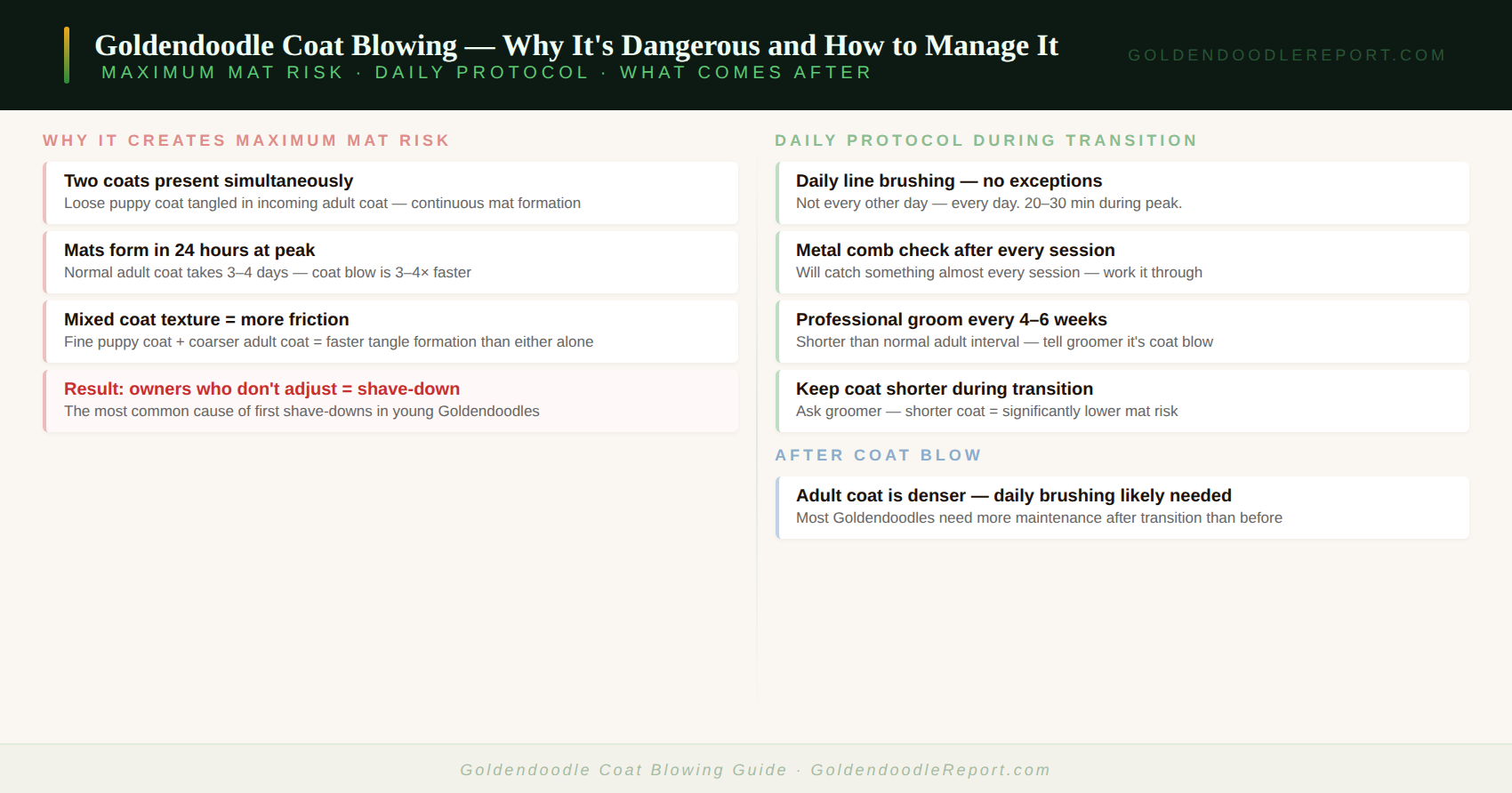
In a normal adult coat, mat formation requires days of unbrushed accumulation at the base layer. During coat blow, the loose puppy coat fibres act as a continuous mat-formation accelerant — they are everywhere in the base layer, loosened from the follicle, and tangling with the incoming adult coat continuously. A base layer that takes 3 to 4 days to develop a mat in normal adult coat can develop a significant mat in 24 hours during peak coat blow.
Additionally, the mixed coat texture — fine puppy coat mixed with coarser adult coat — creates more friction between fibres than either coat type alone. More friction equals faster tangle formation. Combined with the increased coat depth as the adult coat grows in, the result is a coat that demands significantly more grooming attention than either the puppy coat before transition or the adult coat after it.
The Daily Coat Blow Protocol
Daily line brushing — non-negotiable
During coat blow, line brushing must happen every single day without exception. Not every other day — every day. The 24-hour mat formation rate during peak coat blow means that skipping a single day can result in mats that require 45 minutes of careful work to resolve. Skipping two consecutive days during peak transition almost always results in mats that require professional dematting.
The brushing session during coat blow takes longer than normal — expect 20 to 30 minutes for a thorough line brush during peak transition. Use generous detangling spray throughout and reapply during the session. Focus extra time on the five high-risk areas — behind the ears, under the front legs, around the collar, at the tail base, and between the back legs — as these accumulate loose puppy coat most densely. See How to Line Brush a Goldendoodle for the complete technique.
Metal comb check — daily
Run the metal comb from skin to tip through every section after every brushing session. During coat blow, this check will catch something almost every session regardless of how thorough the brushing was. This is normal — the loose puppy coat generates tangles faster than the brush can clear them. Work through whatever the comb catches before finishing the session. See How to Brush a Goldendoodle.
Professional grooming every 4 to 6 weeks during transition
The normal adult coat professional grooming interval — 6 to 8 weeks for wavy coats, 4 to 6 for curly — should be shortened during coat blow. Book professional appointments every 4 to 6 weeks during the transition regardless of coat type. The professional appointment provides deep coat work, removes accumulated loose puppy coat that home brushing has not fully cleared, and gives the groomer the opportunity to assess how the transition is progressing and whether any mat accumulation needs professional attention.
Tell the groomer your dog is in coat blow at the appointment. Ask them to keep the coat shorter than usual during transition — shorter coat during a coat blow significantly reduces mat risk and makes home maintenance more manageable.
Increase detangling spray use
The mixed coat texture during coat blow requires more detangling spray than normal. Apply generously before every brushing session and reapply during the session when resistance increases. The spray reduces the friction between the mixed coat textures and makes brushing both faster and more effective. See → Best Detangler Spray for Goldendoodles — coming soon.
After the Coat Blow — What to Expect
Once the transition is complete, the adult coat’s characteristics become clear. For most Goldendoodles, the adult coat is denser and requires more maintenance than the puppy coat — curly adult coats in particular are significantly denser than the puppy coat that preceded them. Owners who managed the puppy coat with every-other-day brushing typically need to increase to daily brushing for the adult coat.
The good news: the coat blow transition, once complete, does not repeat at the same intensity. Adult Goldendoodles do have seasonal shedding periods — particularly in spring — but none approaches the intensity of the puppy coat transition. Once through the coat blow, owners who have established the daily brushing habit during transition find the adult coat maintenance manageable.
For authoritative guidance on dog coat development see the AKC dog grooming guide.
⚠️ Warning Signs During Coat Blow
- Mats appearing daily despite brushing — increase session thoroughness and frequency; if mats cannot be worked through, contact groomer immediately
- Brushing sessions taking significantly longer than 30 minutes — coat may have accumulated mats that require professional dematting
- Dog becoming increasingly resistant to brushing — sessions may be too long or too painful; break into shorter sessions with more treats, or contact groomer
- Skin visible in patches — normal during heavy shedding phase, but check for redness or irritation that may need veterinary attention
✅ Your Next Step
If your Goldendoodle is between 6 and 14 months old and you have noticed increased shedding or faster matting, your dog is likely in coat blow. Switch to daily line brushing immediately — not next week, today. Book a professional grooming appointment within the next 4 weeks and tell the groomer the dog is in coat transition. The owners who navigate coat blow successfully are the ones who increase their grooming effort at the start of transition rather than responding to problems as they develop. For the complete grooming guide see Goldendoodle Grooming Guide.
🔑 Key Takeaways
- Coat blowing is the transition from puppy coat to adult coat — it happens between 6 and 14 months and lasts 8 to 16 weeks
- The loose puppy coat tangled in the incoming adult coat creates the highest mat risk of the dog’s entire life — mats can form in 24 hours during peak transition
- Daily line brushing without exception is non-negotiable during coat blow — skipping even one day during peak transition risks significant mat accumulation
- Professional grooming every 4 to 6 weeks during transition — shorter than the normal adult interval — and ask the groomer to keep the coat shorter than usual
- The coat blow transition, once complete, does not repeat at the same intensity — the daily brushing habit built during transition makes adult coat maintenance sustainable
- Tell your groomer the dog is in coat blow at every appointment during the transition — this changes how they approach the session
📚 Continue Learning
- Goldendoodle Grooming Guide — complete grooming authority guide
- How to Line Brush a Goldendoodle — the technique required during coat blow
- How to Brush a Goldendoodle — complete brushing guide including comb check
- Goldendoodle Matting Prevention — mat prevention protocol including high-risk areas
- Goldendoodle Coat Types Explained — how the adult coat differs from the puppy coat
- How to Detangle a Goldendoodle Coat — when coat blow produces tangles mid-session
- Should You Shave a Matted Goldendoodle? — if coat blow reaches the point of significant matting
- Goldendoodle Grooming Schedule — adjusting the schedule during coat transition
↑ Back to: Goldendoodle Grooming Guide | Goldendoodle Grooming — All Articles
Frequently Asked Questions
What is coat blowing in Goldendoodles?
Coat blowing is the transition period during which a Goldendoodle sheds its soft puppy coat and grows in its denser adult coat. It typically occurs between 6 and 14 months of age and lasts 8 to 16 weeks. During this period, the loosening puppy coat becomes tangled with the incoming adult coat at skin level, creating the worst mat conditions the dog will ever experience. The transition is complete when the puppy coat has fully shed and the adult coat texture — typically denser and coarser — is established.
How do I manage my Goldendoodle’s coat during the transition?
Daily line brushing without exception, metal comb check after every session, professional grooming every 4 to 6 weeks during the transition, generous detangling spray use, and asking the groomer to keep the coat shorter than usual during transition. The key difference from normal adult coat maintenance is daily rather than every-other-day brushing — the 24-hour mat formation rate during peak coat blow makes anything less than daily brushing insufficient.
How long does Goldendoodle coat blowing last?
8 to 16 weeks from the beginning of noticeable puppy coat shedding to the establishment of the stable adult coat. The most intensive period — when both coats are most densely present and mat formation is fastest — typically lasts 4 to 6 weeks in the middle of the transition. The transition is complete when the coat texture stabilises and mat formation returns to the normal adult rate.
Will my Goldendoodle’s coat change after the puppy coat transition?
Yes — significantly in most cases. The adult coat is typically denser, coarser, and in curly-coated dogs, curlier than the puppy coat. Owners who found the puppy coat manageable with every-other-day brushing typically need to increase to daily brushing for the adult coat. The adult coat’s specific texture and density also determines the long-term professional grooming frequency the dog will require for the rest of its life.
Disclaimer: The information in this article is provided for general educational purposes only. King James Adjei is a researcher and enthusiast, not a veterinarian or certified groomer. For concerns about skin condition, excessive shedding beyond normal coat blow, or significant matting during transition, consult a qualified professional groomer or veterinarian.